Latest arrangements of vaccination programme

     Under the COVID-19 Vaccination Programme officially launched on February 26, members of the public in the five priority groups, starting from today (March 1), can make online booking for receiving the Sinovac vaccine at the eight Community Vaccination Centres (CVCs) and the 18 general out-patient clinics of the Hospital Authority (HA) for the period until March 28. (List of the eight CVCs at Annex 1)
 
     A Government spokesman said that the Department of Health today started distributing the first batch of the Sinovac vaccines to private doctors and clinics participating in the programme under the Vaccination Subsidy Scheme. It is expected that these doctors and clinics can start providing the vaccination service to members of the public beginning from tomorrow (March 2). The list of participating private doctors and clinics that have made vaccine orders has been uploaded to the designated website of the programme (www.covidvaccine.gov.hk).
 
     Members of the public can choose and make an appointment for vaccination direct with a private doctor or clinic under the programme, without going through the Government online booking system. When going for vaccination, one need to bring the identity document and proof for priority group.
 
     For the Comirnaty vaccine, people in the priority groups can make reservations through the online booking system starting from March 3 for vaccination at the seven CVCs operated by the HA for the period from March 10 to 30. (List of the seven CVCs at Annex 2)
 
     Information about the vaccination venues including CVCs, general out-patient clinics of the HA, private doctors and clinics participating in the programme are available at the Interactive Map Dashboard of COVID-19 (https://chp-dashboard.geodata.gov.hk/covid-19/zh.html) and the GeoInfo Map (https://www.map.gov.hk/gm). These information will be timely updated.  

     "Vaccination will protect ourselves and others and reduce the chance of outbreak of the epidemic in the community. We call on people in the five priority groups to get vaccinated as soon as possible so that Hong Kong's economy and people's lives can return to normal as soon as possible," the spokesman said.


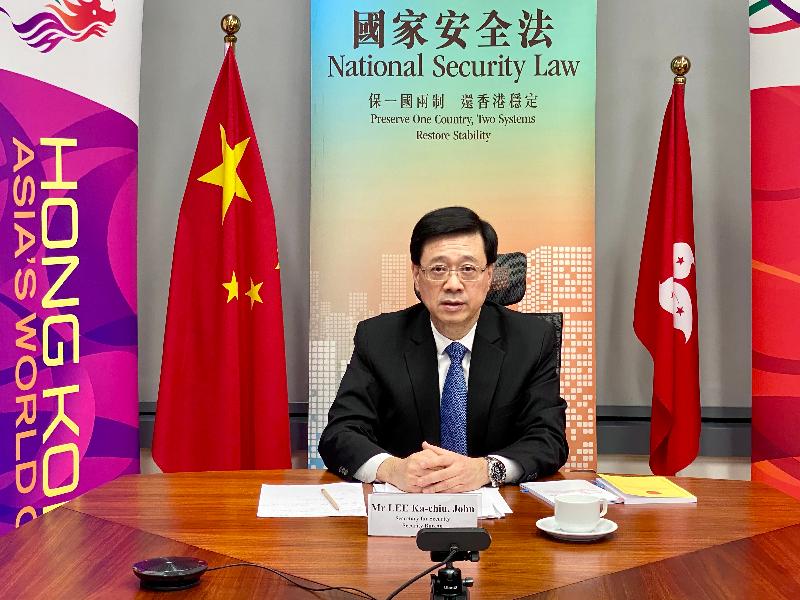
Speech by S for S on Hong Kong National Security Law at side event webinar at 46th session of UN Human Rights Council (English only) (with photo)

     Following is the speech by the Secretary for Security, Mr John Lee, on the Hong Kong National Security Law at a side event webinar at the 46th session of the United Nations Human Rights Council today (March 1):
 
     Thank you, Minister Jiang (Minister, Permanent Mission of the People's Republic of China to the United Nations Office at Geneva and Other International Organizations in Switzerland, Mr Jiang Duan), for the very kind introduction.
 
     Good morning ladies and gentlemen. I would like to take this opportunity to share with you the latest account of Hong Kong.
 
     Before I do that, I would like to take you back to the time before June 2019, i.e., the time before Hong Kong was wrecked by violence. For those of you who have visited Hong Kong before then, you have witnessed in person that Hong Kong is a beautiful city, representing efficiency, safety, opportunities and vibrancy. Yet, all these were shattered by the violence and disturbances which lasted for about a year since June 2019. The mobsters and rioters ruined the city and pushed it into an abyss. They smashed shops, restaurants, railways and public facilities. They devastated the city by petrol bombs. Over 5 000 petrol bombs were thrown and more than 10 000 extra seized. They cruelly set a man ablaze with inflammable liquid. They killed a 70-year-old man by hurling a brick at him. They seriously attacked innocent people who held different opinions. Some were even tied up and humiliated. Police officers were targeted, stabbed by knives, poured with corrosive liquid, wounded by arrows, you name it. Six genuine firearms were seized together with over 1 000 rounds of genuine ammunition. Heavy explosives with remote control devices were also found, similar to those used in terrorist attacks in other places. Mobsters brazenly displayed flags advocating "Hong Kong independence". They preached what they called "mutual destruction", to jump off the cliff with Hong Kong. Some shameless individuals even incited fallacies such as "to break the law to achieve justice". The Legislative Council building was stormed and seriously devastated. Foreign intervention was rampant with money, supplies, and other forms of support provided to the mobsters.
 
     What kind of people would destroy their hometown for "mutual destruction"? Which countries would tolerate such violence on their homeland? What have outside forces been doing here? 
 
     One unfortunate fact is that Hong Kong itself has failed to close a loophole in its system which left its door open to national security threats. Despite having reunified with our mother country for over 23 years, Hong Kong has failed to carry out its obligation under the Basic Law Article 23 to legislate to protect national security. This has created a vacuum. Certain external forces have exploited this vacuum to further their political gains at the expense of our national security and Hong Kong's interests. Some Hong Kong people colluded with these external forces and disgracefully called for sanctions against Hong Kong to crush the city's own interests. A foreign organisation admitted at the hearing of a congressional committee of its country that funds were deployed to assist Hong Kong rioters in evading investigation. 
 
     The CPG (Central People's Government) had no choice but to close this vacuum by enacting the Hong Kong National Security Law to stop the destruction and chaos of Hong Kong. The effect of the law is obvious and direct. Violence has dropped significantly. Advocacy of "Hong Kong independence" subsided. People arrested for offences in public order incidents have dropped by 50 per cent in five months. Stability and order have been restored. People have returned to their normal life. Business has resumed normal. Economy begins to recover. The financial market as the indicator for economic outlook is the first to pick up. Stock market capitalisation has reached an all-time high, up by 40 per cent. Daily turnover has increased even more, up by 130 per cent compared to a year ago. The city is steadily proceeding on the path of recovery and potential growth, notwithstanding the downward pressure from COVID-19.
 
     The Hong Kong National Security Law stipulates only four types of offences of secession, subversion, terrorist activities and collusion to endanger national security to tackle the actual scenarios of national security threats that rocked Hong Kong in the period of disturbances and devastation. The four offences are in no comparison to the wide-ranging and prolific national security laws that exist in many countries. I must point out that the very first Article of the law states up front that its very purpose is to ensure the resolute, full and faithful implementation of the "One Country, Two Systems" policy. The Law has six chapters. Chapter I talks about the General Principles of the law. It has six articles. Three of these six are on protection of rights and freedoms. These include that rights and freedom shall be respected and protected as currently enjoyed by citizens under the Basic Law, the International Covenant on Civil and Political Rights, and the International Covenant on Economic, Social and Cultural Rights. It stresses on the rule of law including presumption of innocence, right to defend, and no double jeopardy. In other words, half of Chapter I, the first and foremost chapter, focuses on and emphasises protection of rights and freedoms. This signifies how the law gives due regard to such protection. These are the fundamental principles a judge will take into consideration in any trial.
 
     Another point I want to make very clear here is that the National Security Law makes no change to the Basic Law. The Basic Law confers Hong Kong's independent judiciary, free from any interference. It gives immunity to judicial officers in the performance of their judicial functions. It confers the power of final adjudication in the Court of Final Appeal. Therefore, contrary to misguided perception, Hong Kong residents enjoy not just the same rights and freedoms that they have always been enjoying as enshrined in the Basic Law but also extra protection from national security threats which have rocked Hong Kong in the earlier long period of violence, chaos and harm to persons.
 
     In Hong Kong, no person is above the law regardless of status, wealth, political power or background. The National Security Law is applied fairly. Enforcement actions and trials are based on facts and evidence. Judgments are made public with elaborate reasoning on decisions. 
 
     In fact, Hong Kong people have been enjoying more freedoms and rights now than before its reunification with China. At that time, the Governors were appointed by the British Government. Now the Chief Executive has to go through an election by a broadly representative Election Committee in accordance with the Basic Law. The Basic Law provides constitutional guarantee for fundamental rights and freedoms, and provides that the Legislative Council shall be constituted by election. Such constitutional protection did not exist before the reunification.
 
     Now that stability and order have been restored, Hong Kong will proceed to prosper again as one of the world's international megacities. In addition, the National Five-Year Plan has laid down strong support for enhancing Hong Kong as an international financial, shipping and trade centre; developing its innovation and technology industry; and establishing it as an international legal and dispute resolution services centre in the Asia-Pacific region. Hong Kong is one of the 11 cities that form the Guangdong-Hong Kong-Macao Greater Bay Area (GBA). The GBA has one of the highest industrial strengths in the region, a combined population of over 70 million and a rich ecosystem of start-ups. It houses a majority of China's most innovative technology companies. The GBA will be one of the key centres of growth in China. Hong Kong, as a highly open and international city, complements the strengths of the other 10 cities of the GBA. Markets, businesses, opportunities and potentials will be beyond limits. 
 
     Under the "One Country, Two systems", the CPG's supports for Hong Kong are all-rounded and wide-ranging. For example, in assisting Hong Kong to fight COVID-19, a big nucleic acid test support team was swiftly deployed from the Mainland to do testing for around 1.8 million residents in a matter of two weeks. And with the support of the CPG, Hong Kong quickly constructed a temporary hospital and a community treatment facility with altogether 1 800 beds, in which the Mainland bore the full cost. And despite the shortage of vaccines worldwide, with the support of the CPG and the country's health authorities, vaccines have promptly and smoothly arrived in Hong Kong about 10 days ago, helping Hong Kong kick-start the vaccination programme.
 
     The "One Country, Two Systems" makes all these things possible and fast happening. With order restored by the Hong Kong National Security Law, and the "One Country, Two Systems" fully ensured, increasing opportunities at all fronts will happen and grow in Hong Kong, especially those from the Mainland. I welcome you all to join us and fully capture them.
 
     Thank you.
Photo  


InvestHK encourages Australian companies to leverage Hong Kong’s business advantages in the Guangdong-Hong Kong-Macao Greater Bay Area (with photos)

     Invest Hong Kong (InvestHK) hosted a hybrid symposium entitled "Hong Kong: Your Greater Bay Area Partner in Expanding Your Global Business" in Sydney today (March 1), attracting over 400 participants from Hong Kong and Australia.
      
     The symposium focused on the attractiveness of the Guangdong-Hong Kong-Macao Greater Bay Area (GBA) as well as the strategic role of Hong Kong in the overall development of the GBA. It brought together the Director of the Australian Chamber Business Leaders Council, Mr Paul Nicolaou, and other speakers renowned in their respective fields to share insights. 
      
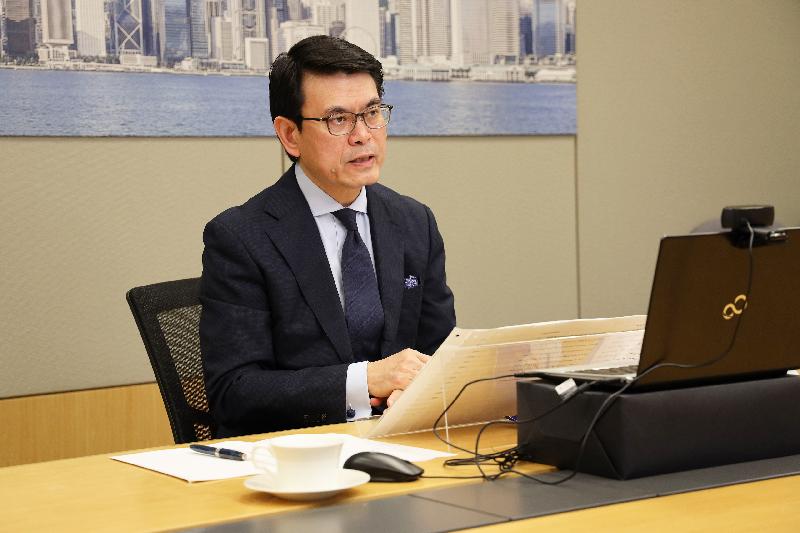
     The Secretary for Commerce and Economic Development, Mr Edward Yau, talked in his online keynote speech about the huge potential of the GBA and encouraged Australian enterprises to seize the abundant opportunities. He said that, as quoted in studies, while the GBA constitutes only 1 per cent of land in the entirety of China and has 5 per cent of the country's population, it produces 12 per cent of the nation's GDP, and exports 37 per cent of national trade.
      
     "Connectivity through extensive efficient railway systems plus world-class airports and container ports and telecom networks within the GBA provides a solid foundation for it to thrive as a major economic engine of the country. While the 11 cities pursue a common goal of building the GBA into the best bay area in the world, they play different functions as a holistic cluster. Green and sustainable development will be another driver of the GBA in attracting international businesses. By various estimates, the GBA's GDP will grow to top US$4.7 trillion by 2030, presenting growth potential that Australian companies should not be missing," Mr Yau said.
      
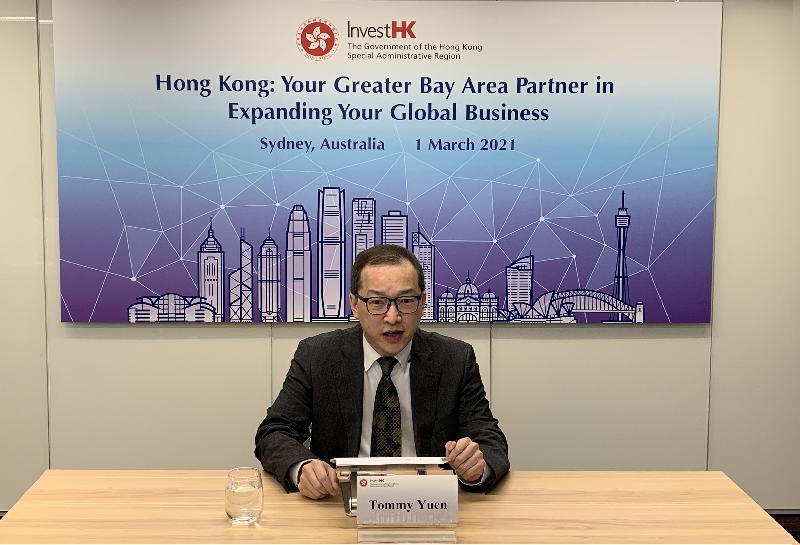
     Another keynote speaker, the Commissioner for the Development of the Guangdong-Hong Kong-Macao Greater Bay Area, Mr Tommy Yuen, said via video, "Hong Kong, under 'one country, two systems' and armed with the GBA development plan is ideally placed to contribute to and benefit from both. Hong Kong will focus on better integration into the country's domestic market, taking the GBA development as an entry point, and will proactively strengthen our role as a facilitator to link up the domestic circulation and the international circulation. Playing the dual role well will bring continuous impetus to Hong Kong’s economy. Businesses that operate in Hong Kong will hence be able to take full advantage of not just what Hong Kong has to offer but what the GBA market can offer."
      
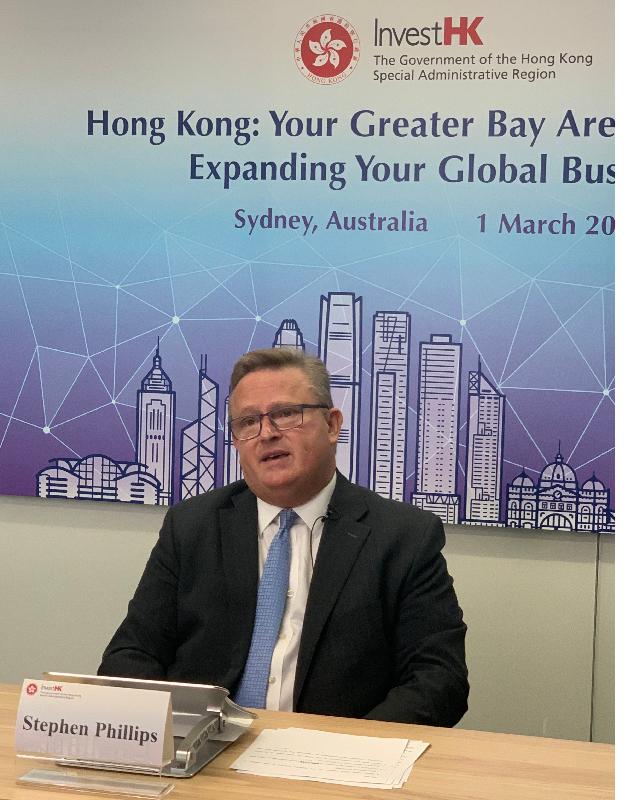
     The Director of the Hong Kong Economic and Trade Office in Sydney, Ms Winnie Chan, and the Director-General of Investment Promotion at InvestHK, Mr Stephen Phillips, delivered welcoming remarks. Mr Phillips, speaking via video, revealed the vast business potential and the composite advantages of Hong Kong in the emerging market of the GBA. "The GBA in my opinion is the most exciting economic development plan in this planet. It is home to 72 million consumers and many of the country's most innovative companies, and backed by the leading international financial centre status of Hong Kongas well as all other dynamic economic clusters. The intra-regional trade and investment flows, especially between the GBA and ASEAN, present many new opportunities ahead," he said.
      
     Other speakers at the symposium included the Managing Director and Group CEO of the University of Wollongong Global Enterprises, Ms Marisa Mastroianni, who discussed her experience on how to leverage Hong Kong to extend the university's global network of higher education institutions. The CEO and Founder of AirTrunk, Mr Robin Khuda; Partner in Tax of KPMG Hong Kong and Head of Alternative Investments of KPMG China Mr Darren Bowdern; the National President of Australia China Business Council, Mr David Olsson; and the Director of Philanthropy and Government Relations of the Fred Hollows Foundation, Mr Michael Allen, also talked about the unparalleled opportunities in Hong Kong during the panel discussion moderated by the Chairman, Global Engagement of the Business Council of Australia, Mr Warwick Smith.
      
About InvestHK
      
     InvestHK is the department of the Hong Kong Special Administrative Region Government responsible for attracting foreign direct investment and supporting overseas and Mainland businesses to set up or expand in Hong Kong. It provides free advice and customised services for overseas and Mainland companies. For more information, please visit www.investhk.gov.hk.
      
     For photos of the symposium, please visit: www.flickr.com/photos/investhk/albums/72157718478324988.

Photo  Photo  Photo  


Financial Leaders Forum convenes 15th meeting

     The Financial Leaders Forum, chaired by the Financial Secretary, Mr Paul Chan, held its 15th meeting today (March 1).
 
     At the meeting, Members were briefed by the Insurance Authority (IA) on the vision and strategies to promote the competitiveness and sustainability of the insurance sector in Hong Kong. Members appreciated the efforts of the Government and the IA in catapulting Hong Kong into becoming a global risk management centre, and were pleased to note that multiple policy initiatives had been taken to strengthen the development of Hong Kong's insurance market, deepen financial inclusiveness and support the Guangdong-Hong Kong-Macao Greater Bay Area development as well as infrastructure projects related to the Belt and Road Initiative.
 
     Members were updated by the Financial Services and the Treasury Bureau and financial regulators on the latest progress in promoting green and sustainable finance in Hong Kong, including the strategic plan and near-term action points by the Green and Sustainable Finance Cross-Agency Steering Group co-chaired by the Hong Kong Monetary Authority and the Securities and Futures Commission (SFC), as well as the enormous opportunities presented by the Guangdong-Hong Kong-Macao Greater Bay Area development and the Belt and Road Initiative. Members noted the new initiatives announced by the Government in the 2021-22 Budget to further enrich the green finance ecosystem in Hong Kong, including the plan to expand the scale of the Government Green Bond Programme and issue retail green bonds, and the launch in mid-2021 of a new Green and Sustainable Finance Grant Scheme. Members welcomed the Government and financial regulators to continue their efforts to consolidate Hong Kong's position as the green and sustainable finance hub in the region. 
 
     Members were also briefed by the SFC and the Hong Kong Exchanges and Clearing Limited (HKEX) on the latest developments of special purpose acquisition companies (SPACs) in the global financial market. The SFC and HKEX were asked to explore suitable listing regimes to enhance the competitiveness of Hong Kong as an international financial centre, while safeguarding the interests of the investing public.


Appeal for information on missing man in Tsuen Wan (with photo)

     Police today (March 1) appealed to the public for information on a man who went missing in Tsuen Wan.
 
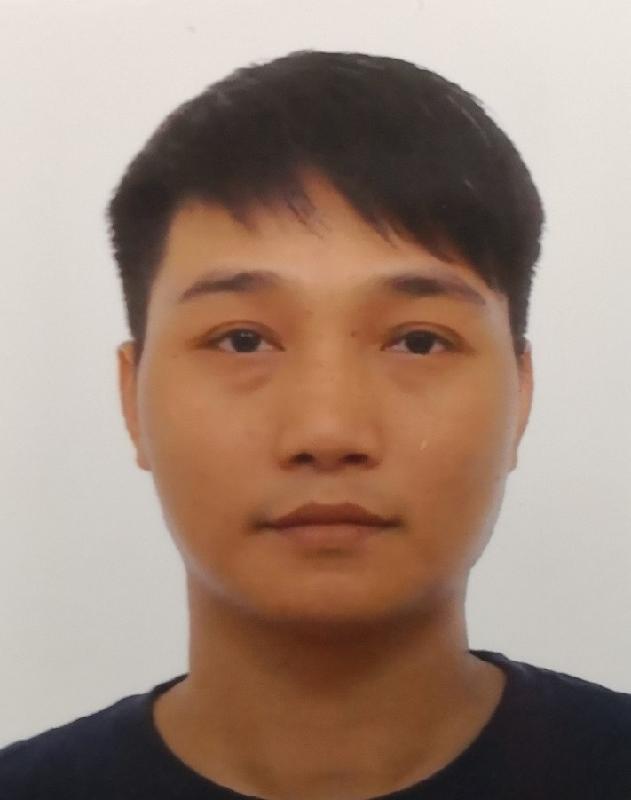
     Wan Yin-keung, aged 35, went missing after he left his residence in Lei Muk Shue Estate on February 23 afternoon. His family made a report to Police on February 27.
       
     He is about 1.7 metres tall, 70 kilograms in weight and of medium build. He has a round face with yellow complexion and short black hair. He was last seen wearing a black sweater, black trousers and blue and white sports shoes.
 
     Anyone who knows the whereabouts of the missing man or may have seen him is urged to contact the Regional Missing Person Unit of New Territories South on 3661 1173 or 6099 3830, or email to rmpu-nts-2@police.gov.hk, or contact any police station.

Photo