Public hospitals daily update on COVID-19 cases

The following is issued on behalf of the Hospital Authority:

     As at 9am today (March 8), seven COVID-19 confirmed patients were discharged from hospital in the last 24 hours. So far, a total of 10 636 patients with confirmed or probable infection have been discharged.
 
     At present, there are 655 negative pressure rooms in public hospitals with 1 196 negative pressure beds activated. A total of 221 confirmed patients are currently hospitalised in 23 public hospitals, a community treatment facility and the North Lantau Hospital Hong Kong Infection Control Centre, among which 13 patients are in critical condition, 15 are in serious condition and the remaining 193 patients are in stable condition.
 
     The Hospital Authority will maintain close contact with the Centre for Health Protection to monitor the latest developments and to inform the public and healthcare workers on the latest information in a timely manner.
 
     Details of the above-mentioned patients are as follows:
 

Patient condition Case numbers
Discharged 10863, 10939, 10944, 10978, 11029, 11044, 11077
Critical 1989, 3496, 6125, 6607, 6794, 8018, 8078, 9612, 9907, 10358, 10367, 10851, 10904
Serious 6386, 7076, 7468, 8221, 9055, 9135, 9550, 9793, 10083, 10585, 10865, 10942, 10953, 10984, 11055


Hong Kong Customs seizes suspected illicit cigarettes worth about $7.6 million (with photo)

     Hong Kong Customs today (March 8) seized about 2.8 million suspected illicit cigarettes with an estimated market value of about $7.6 million and duty potential of about $5.3 million at the Kwai Chung Customhouse Cargo Examination Compound.

     Through risk assessment, Customs officers selected for inspection a seaborne transshipment container arriving from Indonesia and destined for Australia via Hong Kong. Upon inspection, Customs officers found the batch of suspected illicit cigarettes inside the container.

     An investigation is ongoing.

     Customs will continue its intelligence analysis and risk assessment for interception at source to combat illicit cigarette activities.

     Smuggling is a serious offence. Under the Import and Export Ordinance, any person found guilty of importing or exporting unmanifested cargo is liable to a maximum fine of $2 million and imprisonment for seven years.

     Members of the public may report any suspected illicit cigarette activities to Customs' 24-hour hotline 2545 6182 or its dedicated crime-reporting email account (crimereport@customs.gov.hk).

Photo  


Announcement of results of Strategic Public Policy Research Funding Scheme 2020-21

     The Policy Innovation and Co-ordination Office (PICO) announced today (March 8) the results of the 2020-21 Strategic Public Policy Research (SPPR) Funding Scheme.

     On the advice of the Assessment Panel, PICO has supported three projects with total funding of about $9.2 million in the 2020-21 SPPR Funding Scheme. A total of 45 applications had been received.
 
     The SPPR Funding Scheme aims to support longer-term public policy research on strategic themes, build up research capacity and facilitate collaboration among institutions/think tanks on the strategic themes. The strategic themes for 2020-21 include (1) Development of the Guangdong-Hong Kong-Macao Greater Bay Area; (2) Belt and Road Initiative; (3) Big Data/Smart City; (4) Innovation and Technology/Artificial Intelligence/Re-Industrialisation; (5) Alternative Procurement Models for Major Infrastructure Projects; (6) Developing Green Finance in Hong Kong; (7) City Branding Strategy for Hong Kong; (8) Consolidating Hong Kong's Position as an International Logistics Hub; (9) Transitional Housing; (10) Children, Youth and Family Development; (11) Ageing Population; (12) Healthcare System Innovation; and (13) Manpower Supply and Development.

     Applications to the SPPR Funding Scheme are invited once a year, normally in the second quarter of a year. Applications are assessed by an independent assessment panel, chaired by and comprising experienced academics. The assessment panel will also take into account comments of outside reviewers who are academics and experts during the assessment process. Each application is considered on its merits and the strategic relevance to public policy development of Hong Kong. A declaration of interests system is in place to ensure that the assessments are fair and impartial.

     Details of the funded projects have been uploaded to PICO's website (www.pico.gov.hk/en/PRFS).


Transcript of remarks by SFH at media session (with video)

     Following is the transcript of remarks by the Secretary for Food and Health, Professor Sophia Chan, on the COVID-19 Vaccination Programme at a media session this afternoon (March 8):

Reporter: Can I ask your professional opinion, how do you view the rate of the four suspected serious adverse events among some 93 000 doses of CoronaVac administered compared to the rate among other countries that were also administered the Sinovac vaccine, such as Brazil, or other countries in Europe or in Asia as well? Thank you.

Secretary for Food and Health: Thank you for your question. First of all, we review some of the data from other countries which have administered Sinovac as well as BioNTech vaccines to understand more about the adverse events reported. However, the adverse event reported is only the first step. The most important is for our Expert Committee (Expert Committee on Clinical Events Assessment Following COVID-19 Immunisation) to review and also to assess and analyse the causality, the causality assessment, that is whether the adverse event is directly related to vaccination. So until and unless we have established this relationship, the current rate is probably not comparable at this stage. But of course we will continue to review the situation and also review not only the vaccination data, but also the data, for example, of having these adverse events which happen every day in the Hospital Authority's Accident and Emergency Department. We will also review all these different rates. The Department of Health and the Hospital Authority are looking at these statistics. Once we have more information, they will report.

(Please also refer to the Chinese portion of the transcript.)


Hong Kong Customs special operation combats online sale of counterfeit goods (with photos)

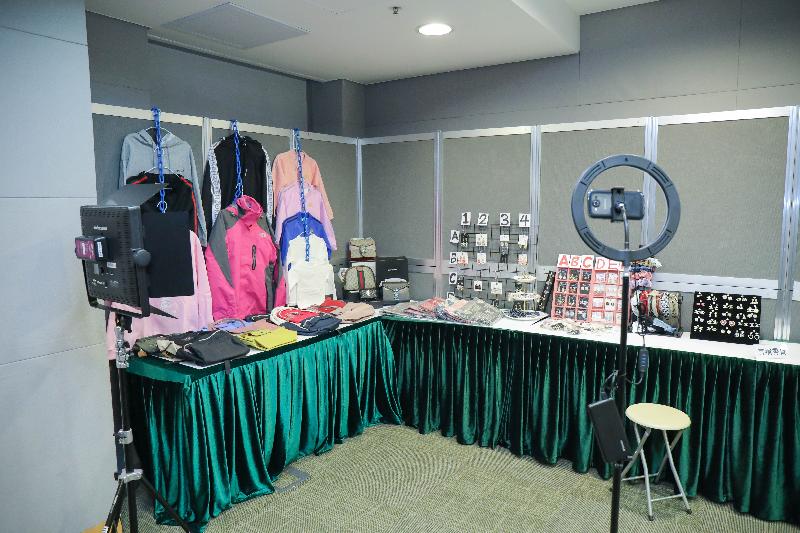
     Hong Kong Customs mounted a special operation codenamed "ThunderNet" between November last year and February this year to combat the online sale of counterfeit goods, targeting those counterfeiting activities on online platforms in the name of shopping agents and by means of live webcasts. During the four-month operation, Customs detected a total of 13 cases and seized about 2 700 items of suspected counterfeit goods with an estimated market value of over $1.8 million. Twenty-two persons were arrested.

     Customs has conducted enforcement operations in view of the increasing popularity of online shopping during the epidemic. Investigations revealed there are two major types of modi operandi among cases of selling counterfeit goods online.

     For the first type, online sellers solicit business in the name of a shopping agent and claim that they have a connection with the suppliers or a team of shopping agents in places such as Europe and the United States. Counterfeit goods are packaged as "goods purchased by agents" and are put on sale with discounted prices at dedicated pages and accounts on online platforms to attract customers. Another type involves the sale of counterfeit goods through live webcasts on social media, commonly referred to as "live streaming e-commerce". This mode of operation is becoming more popular and culprits have also taken the opportunity to sell counterfeit goods in an interactive mode.

     Online sellers generally would use different kinds of excuses to avoid face-to-face transactions and request buyers to deposit money into designated bank accounts. The delivery mode would also be confined to express courier services so that buyers would not have the opportunity to check the authenticity of goods in person.

     Through a big data analytics system, Customs officers traced and analysed suspicious dedicated pages and accounts by means of targeted investigations and deployments. During the "ThunderNet" operation, Customs officers posed as customers and conducted test-purchases online with the assistance of trademark owners. Eight and five cases involving the first and second types of modi operandi were detected respectively after multiple enforcement actions were taken. A total of 17 dedicated pages and accounts suspected of selling counterfeit goods on online platforms were raided while 17 residential premises and three shops were searched, resulting in seizures of the batch of suspected counterfeit goods, including handbags, clothes, shoes, accessories and household goods.

     During the operation, six men and 16 women, aged between 20 and 69, were arrested. Investigations of the cases are ongoing and all arrested persons have been released on bail pending further investigations.

     The Head of Intellectual Property Investigation Bureau of Customs, Mr Tse Kwok-keung, appealed to consumers at a press conference today (March 8) to purchase goods at reputable shops and websites. To lower the risk of purchasing counterfeit goods through online shopping, consumers should pay attention to the seller's history and whether only a single payment method is offered. They should also beware of the refund policies and any other protective mechanisms as well as to compare the prices of goods carefully. Consumers are advised to check with the trademark owners or authorised agents if the authenticity of a product is in doubt.
      
     Customs also reminds online sellers not to sell counterfeit goods and to be cautious in merchandising since selling counterfeit goods is a serious crime.
      
     Under the Trade Descriptions Ordinance, any person who sells or possesses for sale any goods with a forged trademark commits an offence. The maximum penalty upon conviction is a fine of $500,000 and imprisonment for five years.

     Members of the public may report any suspected infringement activities to Customs' 24-hour hotline 2545 6182 or its dedicated crime reporting email account (crimereport@customs.gov.hk).
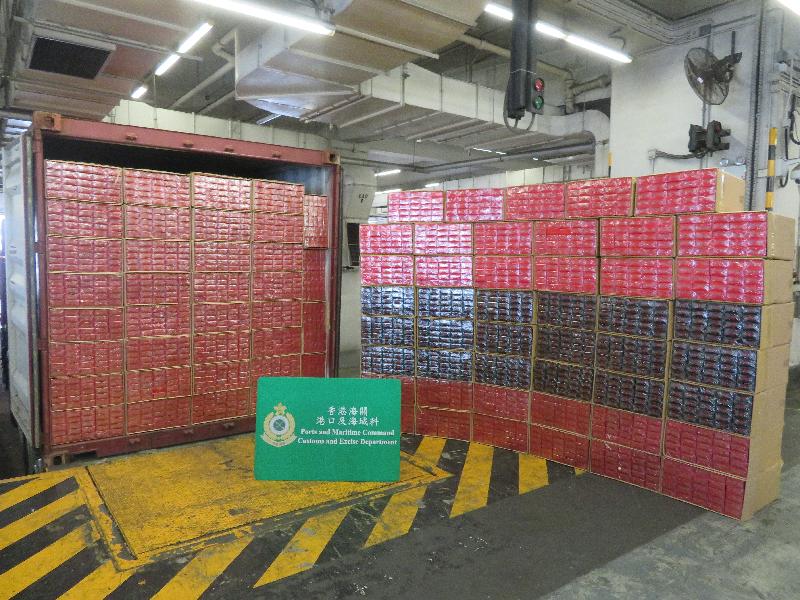
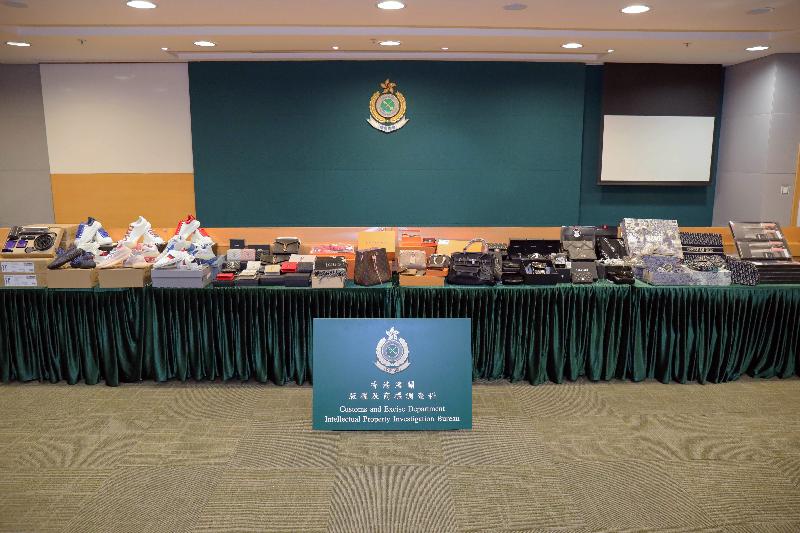
Photo  Photo