Opening remarks by S for IT at Information Security Summit 2021 (English only) (with photo)

     Following are the opening remarks by the Secretary for Innovation and Technology, Mr Alfred Sit, at the Information Security Summit 2021 today (March 9):
      
Willy (Chairman of the Hong Kong Productivity Council (HKPC), Mr Willy Lin), Victor (Government Chief Information Officer, Mr Victor Lam), Mohamed (Executive Director of the HKPC, Mr Mohamed Butt), Mr Johnstone (Chairman of the Information Security Summit 2021 Organising Committee, Mr Dale Johnstone), distinguished guests, ladies and gentlemen,
      
     Good morning. I am very glad to join you here today at the Information Security Summit 2021. Thanks to technology advancement, both virtual and physical participation in this year's summit has widened our engagement with stakeholders both locally and from places outside Hong Kong. I would like to express my gratitude to the HKPC for organising this summit, which gives us a valuable opportunity to connect with information experts from around the world, as well as to share experiences and insights.
      
     Innovation and technology (I&T) has been playing a prominent role in driving economic growth, and in improving people's quality of life. It is particularly evident in the midst of the COVID-19 epidemic that I&T helps us fight the epidemic more effectively. The HKSAR Government has rolled out a number of electronic systems to help support the fight against COVID-19 along the way, from supporting compulsory quarantine, contact tracing to testing and vaccination.
      
     For business, a new normal has emerged, many organisations have swiftly adopted digital technologies to continue business operation and some of them even have expanded their businesses. New technologies, such as 5G, IoT, AI and machine learning, are increasingly deployed. Nevertheless, one must not lose sight of the cyber risks that come along. It is all the more important for all of us to stay vigilant and to continuously improve the defence and response capability of the whole society.
      
     The Government attaches great importance to cyber security and is tackling the challenges with a multi-pronged strategy. Let me serve you some of the important aspects of our strategy.
      
     First, support to the community. To enable the building of a secured and reliable cyber environment for the community, the Office of the Government Chief Information Officer (OGCIO), led by Victor, works closely with the Hong Kong Computer Emergency Response Team (HKCERT), run by the HKPC, to provide appropriate support. Such support activities include the dissemination of updated information on cyber security incidents and security advisories to the business sector and the general public, and organising seminars and competitions to raise public awareness of cyber security.
      
     In addition, the Government provides financial support to the business sector to strengthen their information security level. Our Technology Voucher Programme subsidises local non-listed companies, including small and medium enterprises, to strengthen their businesses operation and increase their competitiveness. Companies can make good use of subsidies to acquire such solutions or services that help strengthen the defence against cyber attacks and improve operational recovery.
      
     Collaboration among stakeholders is also essential and the Government is determined to cultivate a co-operative culture in the society to combat cyber security threats. On this, OGCIO has been spearheading the cross-sector Partnership Programme for Cyber Security Information Sharing since 2018. With HKCERT as a key contributor, the Partnership Programme helps to enhance Hong Kong's overall defence capability and resilience against cyber attacks. Currently, about 370 public and private organisations have joined the Programme, covering a wide range of sectors including finance and insurance, public utilities, transport, healthcare, telecommunications, I&T, information security and tertiary education institutions. At present, some 120 banks have also joined the platform.
      
     The second aspect is talent. Human capital is one of the key success factors in enhancing cyber security. We have been encouraging our local tertiary institutions to introduce more information security courses in different disciplines in order to nurture more cyber security talent. In the area of professional training, we work with professional bodies to promote accreditation of IT professionals in the field. With the concerted efforts of all stakeholders, we are happy to see the promising growth in the number of personnel engaging in information security and related duties in Hong Kong, from 4 200 in 2019 to an estimated 5 500 in 2020, representing an over 30 per cent increase.
      
     Apart from nurturing local talent, we also strive to attract talent from around the globe. We have enhanced the Technology Talent Admission Scheme, and expanded its coverage to all companies in Hong Kong conducting R&D activities in designated technology areas, including cyber security. The expanded scope and streamlined procedures benefit more enterprises and expedite the admission of cyber security experts from different parts of the world.
      
     Last but not least, international co-operation. Both OGCIO and HKCERT actively participate in computer emergency incident response organisations, and closely connect with the cyber security organisations in the Mainland and the Asia-Pacific region. It enables us to acquire cyber security intelligence swiftly and prevent cyber attacks in a more timely manner.
      
     I am sure you will all agree that cyber security is one of the most important areas in this Internet-driven era. The Government will continue to work closely with all relevant stakeholders to build a secure and reliable cyber environment for Hong Kong. I look forward to the fruitful exchanges between the security experts here today and the summit participants on updated topics in cyber security management. May I wish you all a fruitful, enjoyable and inspiring summit. Thank you very much.
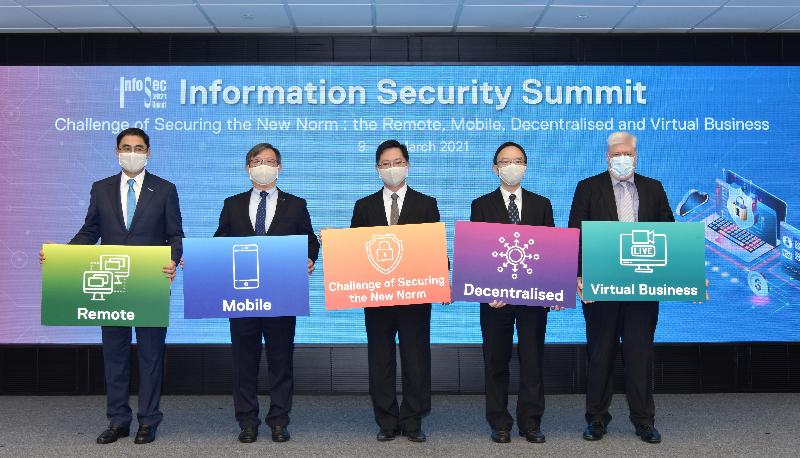
Photo  


10th round of compulsory testing for staff members of RCHEs, RCHDs and nursing homes to commence shortly

     The Government today (March 9) announced that the 10th round of compulsory testing for staff members of residential care homes for the elderly (RCHEs), residential care homes for persons with disabilities (RCHDs) and nursing homes will commence shortly.
 
     In accordance with section 10(1) of the Prevention and Control of Disease (Compulsory Testing for Certain Persons) Regulation (Cap. 599J) (the Regulation), the Secretary for Food and Health issued a compulsory testing notice yesterday (March 8), requiring persons who are employed by and will be on duty at RCHEs, RCHDs, nursing homes and day service units attached to the premises of residential care homes during the period from March 23 to April 1, 2021, or who will provide services to residents or users through hire-of-service contracts with residential care homes and the aforementioned units during that period (including full-time, part-time and relief staff), to undergo polymerase chain reaction-based nucleic acid tests for COVID-19 during the period from March 13 to 22, 2021, according to the requirements and procedure set out in the notice (the Specified Test).
 
     The staff of the aforementioned institutions may choose the following means to undergo the Specified Test:
   
(1) To undergo the Specified Test in any of the Community Testing Centres (see the list at www.communitytest.gov.hk/en), Temporary Testing Centres (if any) (see the list at www.swd.gov.hk/en/index/site_pubsvc/page_supportser/sub_ttc), or mobile specimen collection stations (if any) (see the list at www.coronavirus.gov.hk/eng/early-testing.html) in accordance with the instructions given by the staff at the centre/station;
   
(2) To undergo the Specified Test as arranged by institution operators at a laboratory listed on the "COVID-19 Thematic Website" (see the list at www.coronavirus.gov.hk/pdf/List_of_recognised_laboratories_RTPCR.pdf) and as instructed by the staff of the laboratory;
   
(3) To obtain a specimen bottle from one of the 121 post offices, 47 general out-patient clinics of the Hospital Authority or vending machines set up at 20 MTR stations, collect a deep throat saliva sample in the specimen bottle as per the guidelines provided together with the specimen bottle, and return the specimen bottle with the sample (see the specimen bottles distribution and specimen collection locations and times at www.coronavirus.gov.hk/eng/early-testing.html);
   
(4) To undergo the Specified Test at general out-patient clinics of the Hospital Authority as instructed by a medical professional of the Hospital Authority; or
   
(5) To self-arrange testing provided by a laboratory listed on the "COVID-19 Thematic Website" at their own expense (see the list at www.coronavirus.gov.hk/pdf/List_of_recognised_laboratories_RTPCR.pdf).
   
     Any person who fails to comply with the testing notice commits an offence and may be subject to a fixed penalty of $5,000. He or she would also be issued with a compulsory testing order requiring him or her to undergo testing within a specified time frame. Failure to comply with the order is an offence and the offender would be liable to a fine at level 4 ($25,000) and imprisonment for six months.
 
     A spokesman for the Social Welfare Department (SWD) said that the SWD and the Department of Health would issue letters to institutions to inform them of the relevant arrangements and requirements. The spokesman reminded that staff of the said institutions who would undergo testing at community testing centres should make advance booking via the community testing centre booking system (www.communitytest.gov.hk) for the free testing service. In addition, institution operators should remind their staff members to properly keep the SMS notifications of their test results or their test result reports.
 
     Institution operators are required to keep records of their staff having received the Specified Test and the results within the time frame specified by the Government. Institution operators also have to co-operate with Checking Officers (Compulsory Testing) of the SWD who are enforcing the Regulation at residential care homes.


Key statistics on service demand of A&E Departments and occupancy rates in public hospitals

The following is issued on behalf of the Hospital Authority:

     During the winter surge, the Hospital Authority is closely monitoring the service demand of Accident and Emergency Departments and the occupancy rates in public hospitals. Key service statistics are being issued daily for public information. Details are in the appended table.


Government enforces “restriction-testing declaration” and compulsory testing notice in respect of specified “restricted area” in Tsim Sha Tsui

     The Government yesterday (March 8) exercised the power under the Prevention and Control of Disease (Compulsory Testing for Certain Persons) Regulation (Cap. 599J) to make a "restriction-testing declaration" effective from 8.30pm yesterday, under which people (hereafter referred to as "persons subject to compulsory testing") within the specified "restricted area" in Tsim Sha Tsui (i.e. Tsim Sha Tsui Mansion, 83-97 Nathan Road / 36-50 Lock Road, Tsim Sha Tsui) are required to stay in their premises and undergo compulsory testing. Persons subject to compulsory testing are required to stay in their premises until all such persons identified in the area have undergone testing and the test results are mostly ascertained. In addition, the Government had issued a compulsory testing notice yesterday to any person who had been present at the building for more than two hours from February 23 to March 8, 2021, to undergo compulsory testing on or before March 10 even if they were not present in the "restricted area" at the time when the declaration took effect. The Government finished the compulsory testing exercise at around 7am today (March 9) and is now carrying out enforcement actions in the "restricted area" to verify that all people in the "restricted area" have undergone compulsory testing. The Government will further announce the revocation time of the declaration.

     Starting from around 7am today, persons in the "restricted area" in Tsim Sha Tsui who have undergone testing and are able to present SMS notifications with negative test results or wear wristbands as proof of having undergone testing may leave the "restricted area" through the designated exit after providing personal information to a prescribed officer.

     The Government set up temporary specimen collection stations in the "restricted area" yesterday and requested persons subject to compulsory testing to collect combined nasal and throat swab samples at the stations to undergo a COVID-19 virus test before 2am today. As at 2am today, around 500 residents had undergone testing. No confirmed cases were found.

     Moreover, the Government also assigned staff to visit around 520 households (including more than 30 guesthouses with around 180 rooms), around 260 households/rooms (including around 100 rooms in guesthouses) did not answer the door. Those include some households with confirmed case or undergoing quarantine. Some units are possibly vacant as well. The Government does not have detailed information in this respect and will take measures to follow up.

     The Government also understands that some residents already underwent testing at the mobile specimen collection stations set up in the district or by other means. Therefore, persons in the "restricted area" who have undergone testing from March 6 to 8, 2021, and are able to provide the SMS notification through mobile phone or related certification containing the test results, are not required to take the test again.

     The Government reiterates that enforcement actions will be taken seriously. Any person who fails to present an SMS notification with a negative test result or wear a wristband as proof of having undergone testing breaches the compulsory testing notice and may be liable to a fine of $5,000. The person will also be issued with a compulsory testing order, requiring him/her to undergo testing within a specified time frame. Failure to comply with the compulsory testing order or the "restriction-testing declaration" is an offence and the offender may be liable to a fine of level 4 ($25,000) and imprisonment for six months.


Statistics for COVID-19 Vaccination Programme

     â€‹Under the COVID-19 Vaccination Programme which started on February 26, as of 8pm today (March 8), a total of about 9 900 persons received their first dose of the Sinovac vaccine in the past 24 hours, including about 6 100 persons receiving vaccination at eight Community Vaccination Centres, and about 3 100 persons at private doctors and clinics participating in the programme.
      
     The overall percentage of people who booked and received the Sinovac vaccine at the eight community vaccination centres is about 72 per cent today.
 
     So far a cumulative total of about 103 800 persons have received the first dose of vaccination (Annex 1), including about 101 700 persons receiving the Sinovac vaccine and about 2 100 persons receiving the Comirnaty vaccine.
 
     For the past 24 hours ended at 0000 hours today, there were eight cases of ambulance transfer to hospital. Among them, five cases did not require hospital admission, two cases were discharged, and one case was admitted for observation (Annex 2).