Quarterly business receipts indices for service industries for fourth quarter of 2020 and whole year of 2020

     Business receipts in value terms of many major service industries showed decreases of different magnitudes in the fourth quarter of 2020 when compared with the fourth quarter of 2019, according to the provisional figures of business receipts indices released today (March 9) by the Census and Statistics Department (C&SD).
 
     Comparing the fourth quarter of 2020 with the fourth quarter of 2019, larger decreases were recorded in business receipts of the accommodation services (-33.3%), administrative and support services (-26.0%), food services (-25.1%), banking (-12.2%), retail (-9.0%) and transportation (-6.5%) industries.
 
     On the other hand, double-digit increases were recorded in business receipts of the courier (+36.2%), real estate (+27.4%), warehousing and storage (+27.0%), financing (except banking) (+17.6%) and insurance (+10.1%) industries during the same period.
 
     Analysed by service domain, business receipts of the tourism, convention and exhibition services domain decreased by 85.7% year-on-year during the same period, whereas those of the computer and information technology services domain increased by 1.7% year-on-year.
 
     On a seasonally adjusted quarter-to-quarter comparison, business receipts in value terms of most major service industries recorded increases of different magnitudes in the fourth quarter of 2020 when compared with the third quarter of 2020. In particular, double-digit increases were recorded in business receipts of the transportation (+17.4%), real estate (+16.9%) and food services (+13.3%) industries. On the other hand, the banking industry registered a decrease of 6.8% in business receipts during the same period.
 
     Comparing the fourth quarter of 2020 with the third quarter of 2020 and on a seasonally adjusted basis, business receipts of the tourism, convention and exhibition services domain increased by 10.2%, while those of the computer and information technology services domain also increased by 3.0%.
 
     For 2020 as a whole, many major service industries recorded year-on-year decreases in business receipts. Double-digit decreases were recorded in business receipts of the accommodation services (-59.2%), food services (-29.4%), administrative and support services (-25.4%), retail (-24.3%) and transportation (-19.6%) industries. On the other hand, double-digit increases were recorded in business receipts of the courier (+28.4%), financing (except banking) (+12.2%) and warehousing and storage (+11.5%) industries.
 
     Analysed by service domain, business receipts of the tourism, convention and exhibition services domain decreased by 87.1%, while those of the computer and information technology services domain also decreased by 3.4% during the same period.
 
Commentary
 
     A Government spokesman said that the service industries showed a mixed performance in the fourth quarter of 2020, with some industries improving further while others still facing notable pressures amid the threat of the epidemic.
 
     Specifically, on a year-on-year comparison, business receipts of import/export trade turned to an increase, while those of warehousing and storage, courier, financing (except banking), insurance, and real estate continued to record notable growth. However, business receipts of other service industries continued to decline by varying degrees, and the declines for industries related to consumption and tourism remained visible.
 
     The spokesman further pointed out that the business environment, particularly for the consumer-facing service industries, is likely to remain challenging in the near term as the epidemic is yet to be fully contained and inbound tourism remains frozen. With the launch of the COVID-19 Vaccination Programme, the threat of the epidemic would be mitigated, providing the necessary conditions for a more solid and broad-based revival of economic activities in the second half of 2021. The Government will continue to monitor the developments closely.
 
Further information
 
     Table 1 presents the business receipts indices and their corresponding year-on-year rates of change in respect of selected service industries and service domains for the recent five quarters and the whole year of 2020, while Table 2 shows the corresponding quarter-to-quarter rates of change in the business receipts indices for the recent five quarters based on the seasonally adjusted series.
 
     The revised figures of business receipts indices for the fourth quarter and the whole year of 2020 will be released at the website of the C&SD (www.censtatd.gov.hk/hkstat/sub/sp70.jsp?subjectID=7&tableID=093&ID=0&productType=8) and relevant publications of the C&SD starting from April 20, 2021.
 
     Data for compiling the business receipts indices are mainly based on the Quarterly Survey of Service Industries conducted by the C&SD, supplemented by relevant data provided by the Hong Kong Monetary Authority and the Hong Kong Tourism Board.
 
     A service domain differs from a service industry in that it comprises those economic activities which straddle different industries but are somehow related to a common theme. It may include all activities carried out by all establishments in a service industry that is closely related to the domain. For a service industry that is less closely related, however, only a portion of the establishments in the industry or even only part of the economic activities of the establishments is related to the domain. Taking the tourism, convention and exhibition services domain as an example, it includes all services of hotels and travel agents, and some (those involving visitors as customers) but not all of the services of restaurants, retailers and transport operators.
 
     The classification of service industries follows the Hong Kong Standard Industrial Classification Version 2.0, which is used in various economic surveys for classifying economic units into different industry classes.
 
     More detailed statistics are given in the report "Quarterly Business Receipts Indices for Service Industries, Fourth Quarter 2020". Users can download this publication at the website of the C&SD (www.censtatd.gov.hk/hkstat/sub/sp70.jsp?productCode=B1080006).
 
     Members of the public who have enquiries about the business receipts indices may contact the Business Services Statistics Section of the C&SD (Tel: 3903 7267 or email: business-receipts@censtatd.gov.hk).


Special traffic and transport arrangements in Chai Wan for Ching Ming Festival

     â€‹The Transport Department (TD) today (March 9) reminded the public that special traffic and transport arrangements will be implemented in Chai Wan for those visiting cemeteries during the Ching Ming Festival. In view of COVID-19, the TD appealed to members of the public to arrange grave-sweeping activities over a wider period before and after the Ching Ming Festival (April 4) to avoid overcrowding.

     The special traffic and transport arrangements will include:
 
A. Traffic control/road closures

March 14 (Sunday) and 27 (Saturday) and April 10 (Saturday), 17 (Saturday), 24 (Saturday) and 25 (Sunday)
——————————————————–
     During the implementation of Level I traffic control by the Police, vehicles will continue to be allowed to use the section of Cape Collinson Road east of Lin Shing Road (i.e. the left-turning movement from Lin Shing Road to Cape Collinson Road leading to the vicinity of the Chinese Permanent Cemetery). Should traffic conditions worsen, the Police may consider escalating the road closures to Level II.
 
March 21 (Sunday) and 28 (Sunday) and April 2 (Friday, public holiday), 6 (Tuesday, public holiday), 11 (Sunday) and 18 (Sunday) and May 1 (Saturday, public holiday)
——————————————–
     In connection with the implementation of Level II road closures by the Police, Lin Shing Road and Cape Collinson Road will be closed to all vehicular traffic from 7am to 6pm (except for franchised buses; green minibus (GMB) routes 16A, 16M, 16X and 18M; hearses; funeral vehicles; and vehicles with permits).
 
April 3 (Saturday, public holiday), 4 (Ching Ming Festival) and 5 (Monday, public holiday)
——————————————————-
     In connection with the implementation of Level III road closures by the Police, Lin Shing Road and Cape Collinson Road will be closed to all vehicular traffic from 7am to 6pm (except for franchised buses; GMB routes 16A, 16M and 16X; hearses; funeral vehicles; and vehicles with permits).
 
B. Public transport services
 
     Special bus services will be operated on the following dates and bus services will be strengthened depending on the passenger demand and traffic conditions to avoid crowding and reduce queuing time.
 

Route Date Operating time
New World First Bus (NWFB) Route 388 (Circular)
– between Chai Wan Station Bus Terminus and Chai Wan Cemeteries
March 14 and 21, April 17 and 18 and May 1 9am to 2pm
March 27 and 28 and April 10 and 11 9am to 4pm
April 2 and 6 8am to 5pm
April 3, 4 (Ching Ming Festival) and 5 7am to 6pm
NWFB Route 389 (Circular)
– between Shau Kei Wan Bus Terminus and Chai Wan Cemeteries
March 28 and April 11 9am to 4pm
April 2 and 6 8am to 5pm
April 3, 4 (Ching Ming Festival) and 5 7am to 6pm
April 18 9am to 2pm
NWFB Route 9C
– from Shau Kei Wan Bus Terminus to Chai Wan Cemeteries
April 2, 3, 4 (Ching Ming Festival), 5 and 6 9am and 1pm

 
     Depending on the actual traffic conditions in the areas, implementation of and adjustments to the extent of road closures, traffic control measures and public transport diversions will be made by the Police whenever necessary.
 
     Members of the public are advised to be alert to the latest traffic news on radio and television. They may also visit the TD's website (www.td.gov.hk), use the mobile application "HKeMobility" or call 1823 for the latest traffic and transport information.


LegCo Public Accounts Committee to hold public hearing tomorrow

The following is issued on behalf of the Legislative Council Secretariat:
 
     The Legislative Council (LegCo) Public Accounts Committee (PAC) will hold a public hearing on "Efforts of the Home Affairs Department in facilitating building management" (Chapter 4) of the Director of Audit's Report No.75 tomorrow (March 10) at 2.30pm in Conference Room 1 of the LegCo Complex. 
 
     Four witnesses have been invited to appear before the above hearing to respond to points raised in the Report and answer questions asked by the PAC members.
 
     The programme for the public hearing is as follows:
 
Date: March 10 (Wednesday)
Time: 2.30pm
Venue: Conference Room 1
 
Subject: Efforts of the Home Affairs Department in facilitating building management (Chapter 4 of the Director of Audit's Report No.75)
 
Witnesses:
 
Secretary for Home Affairs
Mr Caspar Tsui
 
Director of Home Affairs
Miss Janice Tse
 
Deputy Director of Home Affairs (2)
Miss Vega Wong
 
Assistant Director (5),
Home Affairs Department
Mr Alfred Lee
 
     The PAC is chaired by Mr Abraham Shek, and its Deputy Chairman is Mr Paul Tse. Other members include Mr Steven Ho, Mr Shiu Ka-fai, Ms Yung Hoi-yan, Mr Lau Kwok-fan and Mr Tony Tse.


Effective Exchange Rate Index

     The effective exchange rate index for the Hong Kong dollar on Tuesday, March 9, 2021 is 101.9 (up 0.3 against yesterday's index).


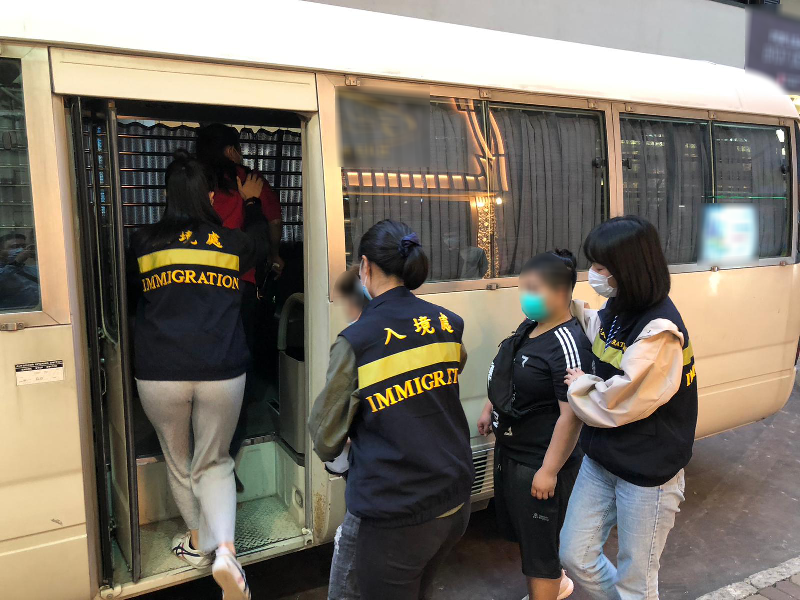
Sixteen persons arrested during anti-illegal worker operations (with photo)

     The Immigration Department (ImmD) mounted a territory-wide anti-illegal worker operation codenamed "Twilight" yesterday (March 8). A total of 10 suspected illegal workers, two suspected employers, three overstayers and a suspected aider and abettor were arrested.
 
     During the "Twilight" operation, ImmD Task Force officers raided 14 target locations including a company, a logistics company, a premises under renovation, a public cargo working area, residential buildings and restaurants. The suspected illegal workers comprised a man and nine women, aged 29 to 49. Among them, four women were holders of recognisance forms, which prohibit them from taking any employment. In addition, a woman was suspected of using and being in possession of a forged Hong Kong identity card. Meanwhile, two women, aged 50 and 55, were suspected of employing the illegal workers. Furthermore, three male overstayers, aged 28 to 31, and a man, aged 35, suspected of aiding and abetting a person who overstayed in Hong Kong were also arrested.

     "Any person who contravenes a condition of stay in force in respect of him shall be guilty of an offence. Also, visitors are not allowed to take employment in Hong Kong, whether paid or unpaid, without the permission of the Director of Immigration. Offenders are liable to prosecution and upon conviction face a maximum fine of $50,000 and up to two years' imprisonment. Aiders and abettors are also liable to prosecution and penalties," an ImmD spokesman said.
 
     The spokesman warned that, as stipulated in section 38AA of the Immigration Ordinance, illegal immigrants or people who are the subject of a removal order or a deportation order are prohibited from taking any employment, whether paid or unpaid, or establishing or joining in any business. Offenders are liable upon conviction to a maximum fine of $50,000 and up to three years' imprisonment. The Court of Appeal has issued a guideline ruling that a sentence of 15 months' imprisonment should be applied in such cases. It is an offence to use or possess a forged Hong Kong identity card or a Hong Kong identity card related to another person. Offenders are liable to prosecution and a maximum penalty of a $100,000 fine and up to 10 years' imprisonment.
 
     The spokesman reiterated that it is a serious offence to employ people who are not lawfully employable. The maximum penalty is imprisonment for three years and a fine of $350,000. The High Court has laid down sentencing guidelines that the employer of an illegal worker should be given an immediate custodial sentence. According to the court sentencing, employers must take all practicable steps to determine whether a person is lawfully employable prior to employment. Apart from inspecting a prospective employee's identity card, the employer has the explicit duty to make enquiries regarding the person and ensure that the answers would not cast any reasonable doubt concerning the lawful employability of the person. The court will not accept failure to do so as a defence in proceedings. It is also an offence if an employer fails to inspect the job seeker's valid travel document if the job seeker does not have a Hong Kong permanent identity card. The maximum penalty for failing to inspect such a document is imprisonment for one year and a fine of $150,000.
 
     Under the existing mechanism, the ImmD will, as a standard procedure, conduct initial screening of vulnerable persons, including illegal workers, illegal immigrants, sex workers and foreign domestic helpers, who are arrested during any operation with a view to ascertaining whether they are trafficking in persons (TIP) victims. When any TIP indicator is revealed in the initial screening, the officers will conduct a full debriefing and identification by using a standardised checklist to ascertain the presence of TIP elements, such as threats and coercion in the recruitment phase and the nature of exploitation. Identified TIP victims will be provided with various forms of support and assistance, including urgent intervention, medical services, counselling, shelter, temporary accommodation and other supporting services. The ImmD calls on TIP victims to report crimes to the relevant departments.

Photo