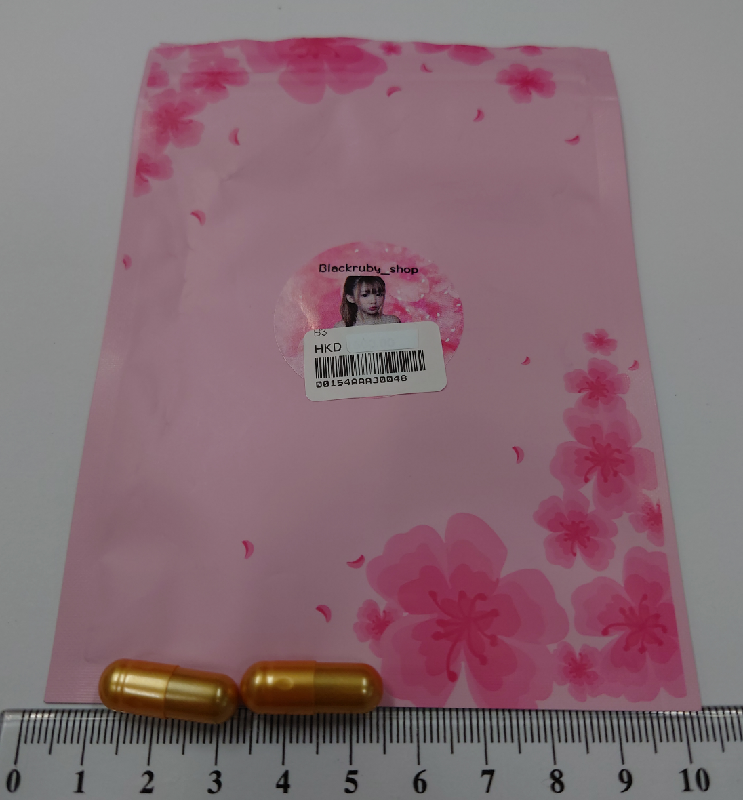
Public urged not to buy or consume slimming product with undeclared banned ingredient (with photo)

     The Department of Health (DH) today (March 9) appealed to members of the public not to buy or consume a slimming product named "Blackruby_shop" as it was found to contain an undeclared and banned Western drug ingredient that might be dangerous to health.

     Upon intelligence, a local seller was found offering for sale the above slimming product via a social media platform. Samples of the product were obtained for analysis and the Government Laboratory's results confirm that the samples contained sibutramine, a Part 1 poison under the Pharmacy and Poisons Ordinance (Cap. 138) (the Ordinance). The DH's investigation is continuing.

     Sibutramine was once used as an appetite suppressant. Since November 2010, products containing sibutramine have been banned in Hong Kong because of an increased cardiovascular risk.

     According to the Ordinance, all pharmaceutical products must be registered with the Pharmacy and Poisons Board of Hong Kong before they can be legally sold in the market. Illegal sale or possession of unregistered pharmaceutical products or Part 1 poisons are criminal offences. The maximum penalty for each offence is a fine of $100,000 and two years' imprisonment.

     The DH spokesman strongly urged members of the public not to buy products of unknown or doubtful composition, or to consume products from unknown sources. Members of the public who have purchased the above products should stop consuming them immediately. They should consult healthcare professionals for advice if feeling unwell after consumption.

     The spokesman added that weight control should be achieved through a balanced diet and appropriate exercise. The public should consult healthcare professionals before using any medication for weight control. They may visit the website of the Drug Office of the DH for "Health message on overweight problem and slimming products" and "Information on slimming products with undeclared Western drug ingredients" for more information.

     The public may submit the product to the Drug Office of the DH at Room 1801, Wu Chung House, 213 Queen's Road East, Wan Chai, during office hours for disposal.

Photo  


Public hospitals daily update on COVID-19 cases

The following is issued on behalf of the Hospital Authority:

     As at 9am today (March 9), 25 COVID-19 confirmed patients were discharged from hospital in the last 24 hours. Including a patient (case number: 10885) discharged earlier on March 7, a total of 10 662 patients with confirmed or probable infection have been discharged so far.
 
     At present, there are 655 negative pressure rooms in public hospitals with 1 196 negative pressure beds activated. A total of 205 confirmed patients are currently hospitalised in 22 public hospitals, a community treatment facility and the North Lantau Hospital Hong Kong Infection Control Centre, among which 14 patients are in critical condition, 12 are in serious condition and the remaining 179 patients are in stable condition.
 
     The Hospital Authority will maintain close contact with the Centre for Health Protection to monitor the latest developments and to inform the public and healthcare workers on the latest information in a timely manner.
 
     Details of the above-mentioned patients are as follows:
 

Patient condition Case numbers
Discharged 9550, 10538, 10729, 10884, 10885, 10898, 10905, 10916, 10921, 10927, 10940, 10945, 10947, 10949, 10963, 10967, 10968, 10977, 10988, 10995, 11016, 11019, 11027, 11035, 11059, 11091
Critical 1989, 3496, 6125, 6607, 6794, 8018, 8078, 9612, 9907, 10358, 10367, 10851, 10904 , 10984
Serious 6386, 7468, 8221, 9055, 9135, 9793, 10083, 10585, 10865, 10942, 10953, 11055


Phishing email related to Taiwan Cooperative Bank, Ltd.

The following is issued on behalf of the Hong Kong Monetary Authority:
 
     The Hong Kong Monetary Authority (HKMA) wishes to alert members of the public to a press release issued by Taiwan Cooperative Bank, Ltd. on phishing email, which has been reported to the HKMA. Hyperlink to the press release is available on the HKMA website for ease of reference by members of the public.
 
     Anyone who has provided his or her personal information to the email concerned or has conducted any financial transactions through the email should contact the bank concerned using the contact information provided in the press release, and report to the Police or contact the Cyber Security and Technology Crime Bureau of the Hong Kong Police Force at 2860 5012.


CHP investigates 21 additional confirmed cases of COVID-19

     The Centre for Health Protection (CHP) of the Department of Health (DH) announced that as of 0.00am, March 9, the CHP was investigating 21 additional confirmed cases of coronavirus disease 2019 (COVID-19), taking the number of cases to 11 121 in Hong Kong so far (comprising 11 120 confirmed cases and one probable case).
 
     Among the newly reported cases announced, 13 are imported cases.
 
     A total of 215 cases have been recorded in the past 14 days (February 23 to March 8), including 174 local cases of which 59 are from unknown sources.
 
     The CHP's epidemiological investigations and relevant contact tracing on the confirmed cases are ongoing. For case details and contact tracing information, please see the Annex or the list of buildings with confirmed cases of COVID-19 in the past 14 days and the latest local situation of COVID-19 available on the website "COVID-19 Thematic Website" (www.coronavirus.gov.hk).
 
     Meanwhile, the CHP reminded those who had visited specified venues under the Prevention and Control of Disease (Compulsory Testing for Certain Persons) Regulation (Cap. 599J) to receive COVID-19 nucleic acid testing according to the compulsory testing notice. The public are also urged to seek medical attention early if symptoms develop.
 
     The CHP called on members of the public to avoid going out, having social contact and dining out. They should put on a surgical mask and maintain stringent hand hygiene when they need to go out. The CHP strongly urged the elderly to stay home as far as possible and avoid going out. They should consider asking their family and friends to help with everyday tasks such as shopping for basic necessities.
 
     The spokesman said, "Given that the situation of COVID-19 infection remains severe and that there is a continuous increase in the number of cases reported around the world, members of the public are strongly urged to avoid all non-essential travel outside Hong Kong.
 
     "The CHP also strongly urges the public to maintain at all times strict personal and environmental hygiene, which is key to personal protection against infection and prevention of the spread of the disease in the community. On a personal level, members of the public should wear a surgical mask when having respiratory symptoms, taking public transport or staying in crowded places. They should also perform hand hygiene frequently, especially before touching the mouth, nose or eyes.
 
     "As for household environmental hygiene, members of the public are advised to maintain drainage pipes properly, regularly pour water into drain outlets (U-traps) and cover all floor drain outlets when they are not in use. After using the toilet, they should put the toilet lid down before flushing to avoid spreading germs."
 
     Moreover, the Government has launched the website "COVID-19 Thematic Website" (www.coronavirus.gov.hk) for announcing the latest updates on various news on COVID-19 infection and health advice to help the public understand the latest updates. Members of the public may also gain access to information via the COVID-19 WhatsApp Helpline launched by the Office of the Government Chief Information Officer. Simply by saving 9617 1823 in their phone contacts or clicking the link wa.me/85296171823?text=hi, they will be able to obtain information on COVID-19 as well as the "StayHomeSafe" mobile app and wristband via WhatsApp.
 
     To prevent pneumonia and respiratory tract infections, members of the public should always maintain good personal and environmental hygiene. They are advised to:
 
• Wear a surgical mask when taking public transport or staying in crowded places. It is important to wear a mask properly, including performing hand hygiene before wearing and after removing a mask;
• Perform hand hygiene frequently, especially before touching the mouth, nose or eyes, after touching public installations such as handrails or doorknobs, or when hands are contaminated by respiratory secretions after coughing or sneezing;
• Maintain drainage pipes properly and regularly (about once a week) pour about half a litre of water into each drain outlet (U-trap) to ensure environmental hygiene;
• Cover all floor drain outlets when they are not in use;
• After using the toilet, put the toilet lid down before flushing to avoid spreading germs;
• Wash hands with liquid soap and water, and rub for at least 20 seconds. Then rinse with water and dry with a disposable paper towel. If hand washing facilities are not available, or when hands are not visibly soiled, performing hand hygiene with 70 to 80 per cent alcohol-based handrub is an effective alternative;
• Cover your mouth and nose with tissue paper when sneezing or coughing. Dispose of soiled tissues into a lidded rubbish bin, then wash hands thoroughly; and
• When having respiratory symptoms, wear a surgical mask, refrain from work or attending class at school, avoid going to crowded places and seek medical advice promptly.


Fourth-term Commission on Poverty convenes third meeting

     The Chief Secretary for Administration, Mr Matthew Cheung Kin-chung, chaired the third meeting of the fourth-term Commission on Poverty (CoP) held online this afternoon (March 9).

     Members noted the implementation progress of various assistance programmes and the financial position of the Community Care Fund (CCF), and endorsed the following two proposals:

1. Further refinement to the means test mechanism of the CCF Medical Assistance Programmes

     Following the announcement in the 2020 Policy Address to further refine the means test mechanism of the CCF Medical Assistance Programmes, the CoP endorsed several refinements to the mechanism, with details as follows:

i.   The calculation of annual disposable financial resources (ADFR) for recurrent applications is modified, with the drug expenses paid by the patient for the last treatment course included as allowable deduction of the patient’s household disposable income, and to include only 80 per cent of the patient's household disposable income (inclusive of monthly allowable deductions) in the calculation of households' ADFR;

ii.  New allowable deduction items are added for all drug subsidy applications, including school fees on tertiary education for full-time students aged 25 or below and maintenance payments. The calculation of income for all drug subsidy applications is also adjusted to exclude double pay, year-end payment, bonus and gratuity, as well as monthly payout amount of reverse mortgage/policy reverse mortgage, in the calculation of income; and

iii. The validity period of the financial assessment of the first application is extended from 12 months to 18 months on the condition that the patient contribution is not more than $2,000. Patients will make the same amount of contribution upon annual renewal of application without the need for financial assessment. If patients consider that there is a need for financial reassessment owing to the change in financial condition of their households, they could make such a request anytime during the application period. In addition, the Hospital Authority will waive the requirement to submit financial documents if the patient has been referred a second application within one to two months after the first application.

The refinements above will commence in the second quarter of this year.

2. Additional funding for the One-off Living Subsidy for Low-income Households Not Living in Public Housing and Not Receiving Comprehensive Social Security Assistance (CSSA) programme

     The CoP endorsed earlier a provision of $2,565.91 million under the CCF to introduce two rounds of the One-off Living Subsidy for Low-income Households Not Living in Public Housing and Not Receiving CSSA programme in 2020 and 2021. Owing to the impact brought by social unrest and the COVID-19 epidemic, Hong Kong's economy has been deteriorating and the unemployment and underemployment rates remain high. The number of applications for the first-round subsidy is projected to exceed the estimated number of applications by about 20 per cent (i.e. around 127 000 beneficiary households in total). On this basis, the CCF Secretariat estimated that the number of applications received under the second-round subsidy will increase by 40 per cent compared to the first-round subsidy (i.e. around 177 800 beneficiary households in total). To cater for the projected additional beneficiary households, the CoP endorsed the additional provision of $571.83 million, including an additional funding of $34.46 million for administrative fees. The total estimated expenditure for the two rounds of subsidy is about $3,137.74 million.

     Members were also briefed on the proposed measures to further assist the financial needy individuals and families. These measures include the reduction of the working hour requirements of the Working Family Allowance (WFA) Scheme and the relaxation of the asset limits of the Short-term Food Assistance Services Project (STFASP), both of which were on a time-limited basis.

     Having regard to the challenges brought by the COVID-19 epidemic, the Government recommended reducing, on a one-year time-limited basis, the minimum WFA working hour requirement for non-single-parent households substantially in the following manner:
 

Types of allowances Existing requirement of total monthly working hours (Hours) Recommended requirement of total monthly working hours (Hours)
Basic Allowance 144 to less than 168 72 to less than 132
Medium Allowance 168 to less than 192 132 to less than 192
Higher Allowance 192 or more Unchanged at 192 or more

In the case of a four-person household with two children, if their aggregated monthly working hours fall between 72 and 131, they may receive up to $3,800 WFA per month under the proposal.

     In addition, newly unemployed and underemployed individuals and families may be ineligible for the STFASP if their assets exceed the asset limit. In this regard, the Government proposed that the asset limits of the STFASP should be relaxed and pitched to those of the WFA Scheme on a one-year basis. For illustration, the asset limit of an individual is proposed to be relaxed from $99,000 to $266,000, and that of a four-person household from $264,000 to $548,000.

     The estimated financial implications of the two proposals are around $1,384 million. The Government will submit the two proposals to the Legislative Council Finance Committee (FC) for approval of their financial implications as soon as possible. Subject to the FC's approval, these measures may be implemented in June this year at the earliest.

     At the meeting, members agreed that the Government should relax the eligibility criteria of existing support measures amid the worsening economy and employment situation, so as to provide timely assistance to financial needy individuals and families. Members also shared their views and suggestions on providing further assistance to financial needy individuals and families at the meeting.