Statement by ExCo Non-official Members in response to approval by Standing Committee of National People’s Congress of amended Annex I and Annex II to Basic Law

The following is issued on behalf of the Executive Council Secretariat:
 
     The Non-official Members of the Executive Council (ExCo) today (March 30) issued the following statement:
 
     The ExCo Non-official Members strongly support and warmly welcome the approval by the Standing Committee of the National People's Congress of the amended Annex I to the Basic Law on Method for the Selection of the Chief Executive of the Hong Kong Special Administrative Region and Annex II to the Basic Law on Method for the Formation of the Legislative Council of the Hong Kong Special Administrative Region and its Voting Procedures. The ExCo Non-official Members believe that the amendments will plug the loopholes in Hong Kong's electoral system, address the chaos seen in the past few years and thereby get Hong Kong back on the right track of the principle of "One Country, Two Systems".

     The ExCo Non-official Members hope that with the improved electoral system, society will be able to move away from the excessive politicisation and the internal rift that have plagued Hong Kong in recent years and focus again on developing the economy and improving the livelihood of our citizens, which will be conducive to the long-term prosperity and stability of the city.

      The ExCo Non-official Members will render their full support to and co-operate with the Hong Kong Special Administrative Region Government in enacting the relevant local legislation to ensure that the improvements to the electoral system can be put into effect as soon as possible.


Expert Committee on Clinical Events Assessment Following COVID-19 Immunisation assesses serious adverse events relating to COVID-19 vaccination

     The Expert Committee on Clinical Events Assessment Following COVID-19 Immunisation (Expert Committee) convened a meeting today (March 30) to assess serious adverse events relating to COVID-19 vaccination.
 
     The Department of Health (DH) has been closely monitoring possible adverse events following COVID-19 immunization. Based on the guidelines of the World Health Organization (WHO), the DH enhanced the existing surveillance system and carried out active surveillance. Under the surveillance system, the DH monitors Adverse Events Following Immunization (AEFIs) and encourages and receives from healthcare providers and pharmaceutical industry AEFI reports of COVID-19 immunization. The DH also partners with the University of Hong Kong (HKU) to conduct an active surveillance programme for Adverse Events of Special Interest (AESI) under the COVID-19 Vaccines Adverse Events Response and Evaluation Programme (CARE Programme).
 
     According to reporting criteria of AEFIs endorsed by the Expert Committee, when there are obvious medical causes for certain clinical events including death cases, the healthcare professionals may consider the event not fulfilling the reporting criteria of AEFIs. On the other hand, under the CARE Programme, the DH and the Hospital Authority (HA) have set up mechanism to refer death cases not fulfilling reporting criteria of AEFIs to HKU for surveillance and analysis. The HKU would provide regular reports to the Expert Committee; if unusual pattern is detected, the DH will be notified and the information will be referred to the Expert Committee for assessment as soon as possible. In addition, according to the risk communication plan endorsed by the Expert Committee, figures and summary of clinical events received will be released and updated through the designated website. When suspected adverse event involving death case within 14 days of vaccination is received, it will be announced via press release as soon as possible.
 
     Up to March 28, the DH had received a total of 13 death case reports with history of COVID-19 immunization from the HA. These cases involved 9 males and 4 females between 55 and 80 years old. Existing information indicates that most of these cases died of cardiovascular diseases. The Expert Committee conducted causality assessment of individual cases based on the algorithm of the WHO and all available information, including the medical conditions and history of the patient with relevant clinical data, vaccine information and preliminary autopsy findings. The Expert Committee has already concluded two of these reports that there was no causal relationship between the deceased's outcome and COVID-19 vaccination. The medical history and preliminary autopsy findings of other cases showed that the outcomes of the deceased persons were not directly associated with COVID-19 vaccination. Their assessment will be concluded when necessary information is available.
 
     The Expert Committee assessed six of the above 13 cases in today's meeting. The first case, announced on March 6, involved a 55-year-old lady who passed away on the same day. The full autopsy report indicated that the patient died of acute myocardial infarction due to aortic dissection, other investigation results did not reveal any possible immunological reactions due to vaccine. Based on the WHO algorithm, the Expert Committee considered that the causality of the deceased's outcome with COVID-19 vaccination was inconsistent (i.e. no causal relationship). Four other cases involved four gentlemen, aged 59 to 66 years old. Their preliminary autopsy findings were coronary artery disease, ruptured myocardial infarction and coronary thrombosis, coronary and hypertensive heart disease, as well as coronary artery disease with acute ischaemia. Together with the remaining case who died of acute myocardial infarction, the Expert Committee considered that the outcomes of the deceased persons were not directly associated with COVID-19 vaccination.
 
     According to the local mortality data, in the same period (i.e. February 26 to March 28) of 2019, among people aged 55 or above, there were 362 deaths (i.e. 14.2 per 100 000 population) and 602 deaths (23.7 per 100 000 population) due to ischaemic heart diseases and heart disease respectively. The Expert Committee reviewed these data and considered there is no unusual pattern identified so far. The Expert Committee will continue to closely monitor the situation and collect more data for further assessment.


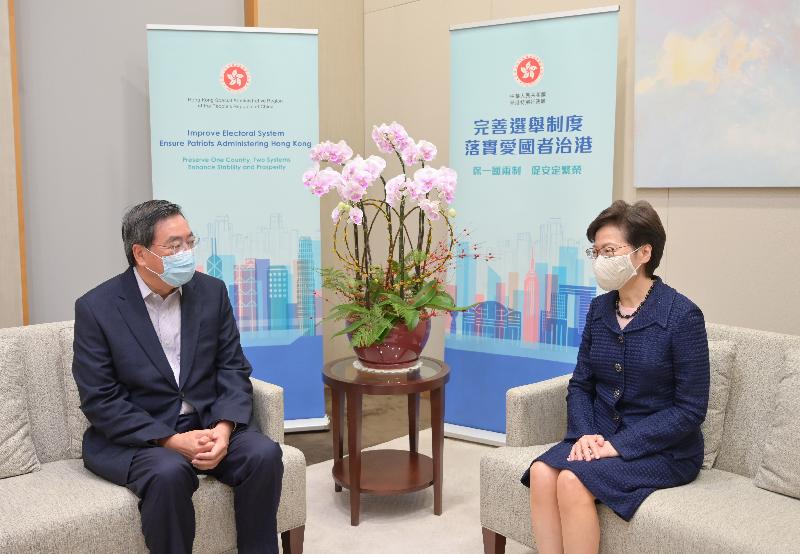
CE discusses with LegCo President follow-up work relating to improving electoral system (with photo)

     The Chief Executive, Mrs Carrie Lam, today (March 30) met with the President of the Legislative Council (LegCo), Mr Andrew Leung, to discuss with him local legislation and other follow-up work in relation to improving the electoral system.
 
     Mrs Lam told Mr Leung that the Hong Kong Special Administrative Region (HKSAR) Government fully welcomes and supports the approval by the Standing Committee of the National People's Congress of the amended Annex I to the Basic Law on Method for the Selection of the Chief Executive of the Hong Kong Special Administrative Region and Annex II to the Basic Law on Method for the Formation of the Legislative Council of the Hong Kong Special Administrative Region and its Voting Procedures to improve the electoral system of the HKSAR. She said that the HKSAR Government will press ahead at full steam with the exercise of amending the relevant local electoral laws, with the introduction of the bill into LegCo in mid-April as the target. She is grateful to LegCo for accepting her earlier suggestion for LegCo to form a subcommittee under the House Committee to first deliberate on the main contents of the Decision of the National People's Congress and the amended Annex I and Annex II to the Basic Law, so that upon the introduction of the bill by the HKSAR Government, the subcommittee would immediately be transformed into a Bills Committee to scrutinise the bill.
 
     She pointed out that taking into account the time needed for local legislation and preparatory work for the relevant election, the seventh-term LegCo election is expected to take place in December 2021. She told the LegCo President that the Government still has about 16 legislative proposals covering a wide range of economic and social matters that would require the scrutiny of LegCo in the coming few months and expressed the hope that the sixth-term LegCo can continue operation until the start of the electoral process of the seventh-term LegCo.

Photo  


FS strongly supports approval by NPCSC of amended Annex I and Annex II to Basic Law

     In response to the approval by the Standing Committee of the National People's Congress (NPCSC) today (March 30) of the amended Annex I to the Basic Law on Method for the Selection of the Chief Executive of the Hong Kong Special Administrative Region (HKSAR) and Annex II to the Basic Law on Method for the Formation of the Legislative Council of the Hong Kong Special Administrative Region and its Voting Procedures, the Financial Secretary, Mr Paul Chan, issued the following statement:
      
     The NPCSC has approved the amended Annex I and Annex II to the Basic Law to improve the electoral system of the HKSAR for the full implementation of the Decision of the National People's Congress on improving the electoral system of the HKSAR. By revising the method of formation and scale of the Election Committee and the Legislative Council, the principle of "patriots administering Hong Kong" can be fully implemented to plug the loopholes of the existing electoral system and an electoral system that fits the actual situation and development needs of Hong Kong and has wider participation can also be established. I fully support the approval.
      
     Through improving the electoral system of the HKSAR, the principle of "patriots administering Hong Kong" can be fully implemented with institutional safeguards and Hong Kong's political development can be back on track. The executive authorities and the legislature can restore better interaction with the overall interests of Hong Kong as the core consideration, which can play a pivotal role in maintaining Hong Kong's long-term prosperity and stability.
      
     An improved electoral system will strengthen the executive-led political system and enhance the governance capability of the HKSAR Government, thereby enabling the community as a whole to focus on progressively resolving Hong Kong's deep-seated issues to allow sustained social and economic stability and prosperity.

     An improved electoral system and the national security law implemented last year are important, essential and urgent for the successful implementation of "one country, two systems", "Hong Kong people administering Hong Kong" and a high degree of autonomy. Under the leadership of the Chief Executive, the HKSAR Government will spare no effort in explaining the amendments to the community and in pressing ahead with the work on amending relevant ordinances to strive for early and full implementation of the new electoral system.


S for S and heads of six disciplined services departments welcome and support approval by NPCSC of amended Annex I and Annex II to Basic Law

     The Secretary for Security, Mr John Lee, together with the heads of six disciplined services departments, namely the Commissioner of Police, Mr Tang Ping-keung; the Commissioner of Customs and Excise, Mr Hermes Tang; the Director of Immigration, Mr Au Ka-wang; the Commissioner of Correctional Services, Mr Woo Ying-ming; the Director of Fire Services, Mr Joseph Leung; and the Controller of the Government Flying Service, Captain Wu Wai-hung, welcomes and fully supports the amended Annex I "Method for the Selection of the Chief Executive of the Hong Kong Special Administrative Region" and Annex II "Method for the Formation of the Legislative Council of the Hong Kong Special Administrative Region and Its Voting Procedures" to the Basic Law of the Hong Kong Special Administrative Region (HKSAR) of the People's Republic of China today (March 30) approved by the Standing Committee of the National People's Congress (NPCSC), which ensure "patriots administering Hong Kong" and improve the electoral system of the HKSAR.

     Mr Lee said that he will lead the disciplinary forces to continue to resolutely safeguard national sovereignty, security and development interests, and ensure the prosperity and stability of Hong Kong. The heads of six disciplined services departments said that they will stand in solidarity and attend to their duties steadfastly to safeguard national security as well as maintain the law and order, stability and security of the Hong Kong community.

     The amendments further enhance the broad representation of Hong Kong's electoral system and improve the quality of democracy. The amendments approved by the NPCSC are sensible, reasonable, constitutional and legal, plugging the loopholes of Hong Kong's current electoral system. They are the keys to solving the current problems in Hong Kong and also an important principle for the development of Hong Kong's democracy. The amendments implement the broad requirements of "patriots administering Hong Kong" in accordance with the actual situation in Hong Kong.

     Mr Lee said, "It is a well-intended decision by the Central Authorities to improve Hong Kong's electoral system following the enactment of the Law of the People's Republic of China on Safeguarding National Security in the HKSAR (the National Security Law). The amendments specify clearly the regulations of the electoral system and provide a solid and powerful constitutional guarantee, enhancing the governance of the HKSAR Government, fostering the cohesion and unity of society and addressing the deep-seated problems. Hong Kong will be able to vigorously develop on a solid basis in the future."

     The Hong Kong National Security Law safeguards national security while improving the electoral system ensures political stability and safety, and only in doing so can Hong Kong society enjoy comprehensive safeguarding of security. The Security Bureau and the six disciplinary forces fully support the amendments by the NPCSC, and will stand united and spare no effort in safeguarding national security to ensure Hong Kong's prosperity and long-term stability and order.