Hong Kong Customs combats unfair trade practices at hair salon

     Hong Kong Customs today (April 13) arrested a proprietor and a stylist of a hair salon suspected of having applied a false trade description to hairdressing service, in contravention of the Trade Descriptions Ordinance (TDO).

     Customs earlier received information alleging that a hair salon in Tsuen Wan district had made a false claim in relation to the price of its hairdressing service. The hair salon had charged a customer a price that was double the price stated on the price list after providing the hairdressing service.

     After investigation, Customs officers today arrested a 64-year-old female proprietor and a 51-year-old male stylist of the salon.

     Investigation is ongoing and the arrested persons have been released on bail pending further investigation.

     Customs reminds traders to comply with the requirements of the TDO. Consumers should procure services at reputable traders and be clear about the price before making a transactional decision.

     Under the TDO, any trader who applies a false trade description to a service supplied to a consumer commits an offence. The maximum penalty upon conviction is a fine of $500,000 and imprisonment for five years.

     Members of the public may report any suspected violations of the TDO to Customs' 24-hour hotline 2545 6182 or its dedicated crime-reporting email account (crimereport@customs.gov.hk).


Hong Kong Customs and Police seize suspected illegally imported strategic commodities in joint operation (with photos)

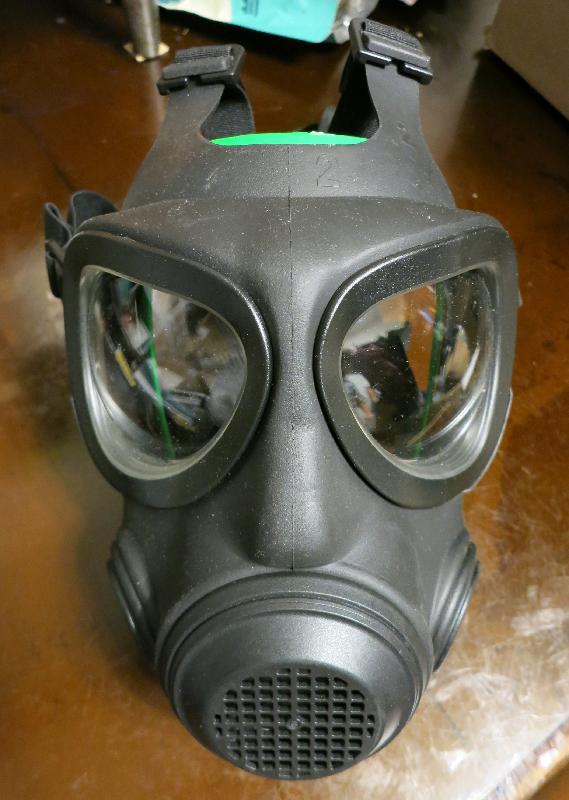
     â€‹Hong Kong Customs and the Police conducted a joint operation yesterday (April 12) and today (April 13) in Mong Kok and Ma On Shan to combat the illegal import of strategic commodities. A batch of strategic commodities suspected to be imported without a valid licence was seized, including 133 gas masks, 175 filter canisters and four helmets. Eight persons were arrested.

     Law enforcement agencies earlier received information alleging the sale of suspected illegally imported strategic commodities at some shops in Mong Kok district. After investigation, Customs and the Police conducted a joint enforcement operation during the above-mentioned period and first seized a batch of strategic commodities suspected to be imported without a valid licence at two shops in Mong Kok, including 29 gas masks, six filter canisters and four helmets. Seven persons suspected to be connected with the case were arrested.

     Later, law enforcement agencies arrested another person suspected to be in connection with the case at a residential unit in Ma On Shan, where 104 gas masks and 169 filter canisters were seized.

     During the operation, five men and three women, aged between 19 and 33, were arrested. They comprise three company directors, four salespersons and a person who stored the items concerned at one of the shops involved. 

     Investigation is ongoing. The arrested persons have been released on bail pending further investigation and the likelihood of further arrests is not excluded.

     Under the Import and Export Ordinance (IEO), any person who imports or exports gas masks, filter canisters or helmets belonging to the control list of strategic commodities under the Import and Export (Strategic Commodities) Regulations without a valid import or export licence commits an offence and is liable to an unlimited fine and to imprisonment for seven years on conviction.

     Members of the public may report any suspected violation of the IEO to Customs' 24-hour hotline 2545 6182 or its dedicated crime-reporting email account (crimereport@customs.gov.hk).

Photo  Photo  


Specifications under Prevention and Control of Disease (Regulation of Cross-boundary Conveyances and Travellers) Regulation to be gazetted

     In view of the severe global pandemic situation of COVID-19, and to guard against the importation of new virus variants, the Government announced today (April 13) that it will gazette the specifications under the Prevention and Control of Disease (Regulation of Cross-boundary Conveyances and Travellers) Regulation (Cap. 599H) to include Egypt as one of high-risk Group B specified places, effective from April 20, to more effectively combat the epidemic.
 
     "The global pandemic situation remains severe. During the two-week period from late March to early April, there were over 7.9 million new cases and more than 138 000 new deaths reported globally. Hong Kong cannot afford to drop its guard on entry prevention and control measures," a spokesman for the Food and Health Bureau said.
 
     Taking into account the latest public health risk assessment, and the changes and developments of the epidemic situation, the Secretary for Food and Health will publish in the Gazette updated specifications made under Cap. 599H to include Egypt under the high-risk Group B specified places. The relevant specifications will be effective from April 20 until further notice.
  
     All persons arriving at Hong Kong (either via the airport or land boundary control points) who have stayed in Group B specified places on the day of arrival in Hong Kong or during the 21 days before that day have to undergo compulsory quarantine for 21 days in designated quarantine hotels. Persons arriving at Hong Kong who have stayed in Group B specified places on the day they board for Hong Kong or during the 21 days before that day are required to present prior to boarding proof of a negative result of a nucleic acid test for COVID-19 conducted within 72 hours before the scheduled time of departure of the aircraft, and confirmation of a room reservation in a designated quarantine hotel in Hong Kong for not less than 21 nights starting on the day of the arrival of the relevant traveller in Hong Kong. Details on the grouping of specified places and their respective boarding and compulsory quarantine requirements can be found at the following webpage: www.coronavirus.gov.hk/eng/high-risk-places.html.
 
     The spokesman said, "The Government will continue to closely monitor the situation, including the developments of the epidemic both globally and locally, vaccination progress, and changes in the volume of cross-boundary passenger traffic, and will adjust the boarding and compulsory quarantine requirements for persons arriving at Hong Kong from places with different risks when necessary."


Food factory in Tuen Mun convicted again for discharging substandard wastewater

     A food factory under Vitasoy International Holdings Limited in Tuen Mun discharged substandard industrial wastewater again and violated the requirements of the wastewater discharge licence. The company was fined $12,000 by Fanling Magistrates' Courts today (April 13) for contravening the Water Pollution Control Ordinance (WPCO).

     Environmental Protection Department (EPD) enforcement officers conducted a blitz inspection at the aforementioned factory in October last year and collected wastewater samples for analysis. The results showed that the concentration of five-day biochemical oxygen demand in the wastewater exceeded the upper limit as stated in the wastewater discharge licence. The department then prosecuted the company in accordance with the WPCO. The company was fined $10,000 by the court for committing the same offence in April 2019 according to department records. The wastewater treatment system of the company had been enhanced afterwards. After detecting the discharge of substandard industrial wastewater again, the EPD met with the management of the company and reminded them to always maintain the proper operation of the wastewater treatment system and to strictly adhere to the discharge standards as stipulated in the licence.

     A spokesperson for the EPD reminded all wastewater discharge licensees that they should arrange regular cleaning and maintenance of the wastewater treatment facilities and collect wastewater samples regularly for analysis in accordance with the requirements of the licence to ensure the facilities maintain proper operation and comply with the requirements of the licence as well as preventing substandard wastewater from flowing into the sewers.

     Under the WPCO, anyone who discharges commercial or industrial wastewater into communal sewers not in compliance with the standard of the discharge licence commits an offence. First-time offenders are liable to a maximum fine of $200,000 and six months' imprisonment. For subsequent offences, offenders are liable to a maximum fine of $400,000 and six months' imprisonment.


Improving Electoral System (Consolidated Amendments) Bill 2021 gazetted today

     The Improving Electoral System (Consolidated Amendments) Bill 2021 (the Bill) was published in the Gazette today (April 13).
 
     On March 11, 2021, the National People's Congress (NPC) passed the Decision of the NPC on Improving the Electoral System of the Hong Kong Special Administrative Region (the Decision) and authorised the Standing Committee of the National People's Congress (NPCSC) to amend Annex I to the Basic Law on Method for the Selection of the Chief Executive of the Hong Kong Special Administrative Region and Annex II to the Basic Law on Method for the Formation of the Legislative Council of the Hong Kong Special Administrative Region and its Voting Procedures. The NPCSC on March 30 adopted the amended Annex I and Annex II to the Basic Law. 
 
     Pursuant to the Decision, the Hong Kong Special Administrative Region (HKSAR) Government shall, according to the Decision and the amended Annexes I and II to the Basic Law, amend the relevant local legislation and organise and regulate the relevant electoral activities in accordance with the law. According to the amended Annexes I and II to the Basic Law, the specific election or formation methods of the Chief Executive (CE), the Election Committee (EC) and the Legislative Council (LegCo), including matters such as the delineation of eligible corporate electors of the relevant Election Committee Subsectors (ECSSs) or Functional Constituencies (FCs), the delineation of Geographical Constituencies (GCs), the nomination method and the voting method, shall be prescribed by the HKSAR by means of electoral law. It is therefore incumbent upon the HKSAR Government to implement the new electoral system that accords with the actual situation in Hong Kong by way of local legislation.
 
     In addition, it is also necessary to amend the relevant electoral legislation so as to implement a host of improvement measures for public elections. 
 
     The Bill mainly comprises the following six key areas of amendments:

(1) reconstituting the EC, introduction of oath-taking requirement and related matters;
 
(2) providing for the method for selecting the CE and related matters; 

(3) updating the composition and formation of the LegCo; 

(4) updating the eligibility of becoming candidates in CE elections, ECSS elections and LegCo elections, and establishing the Candidate Eligibility Review Committee;

(5) amending the Elections (Corrupt and Illegal Conduct) Ordinance (Cap. 554) to regulate in accordance with the law acts that manipulate or sabotage elections; and 

(6) implementing a host of measures to improve the electoral arrangements, which include implementing electronic poll register, enhancing the inspection and compilation of the registers of electors, setting up a special queue for electors in need in public elections, empowering the Chief Electoral Officer to require schools and non-government organisations receiving grants from the Government to make available their premises for use as polling station(s) and/or counting station(s) in public elections, and lifting the requirement of withholding financial assistance payable until disposal of election petitions arising from LegCo and District Council elections.
 
     A Government spokesman said, "This legislative exercise seeks to implement the Decision adopted by the NPC and the Annexes I and II to the Basic Law amended by the NPCSC. This fully reflects the Government's underlying notions and principles of upholding the constitutional order established by the Constitution and the Basic Law, as well as of rule of law. We are confident that improving the electoral system can ensure that Hong Kong can stay true to the original aspiration in implementing the principle of 'one country, two systems' and get Hong Kong back on the right track. It is only by putting in place institutional safeguards to ensure 'patriots administering Hong Kong' that the principle of 'one country, two systems' can be fully and faithfully applied in the HKSAR, which is conducive to the long-term prosperity and stability of the city."
 
     The Government spokesman added that the Bill will be introduced into the LegCo for first reading and second reading tomorrow (April 14). The Government will fully complement the work of the LegCo in scrutinising the Bill to strive for its early passage so as to kick start the extensive preparatory work for the elections.