Transcript of remarks of press conference (with photos/video)

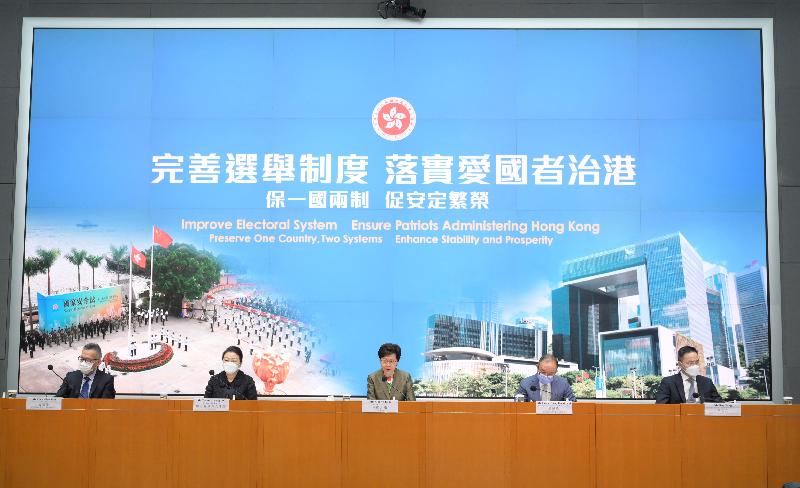
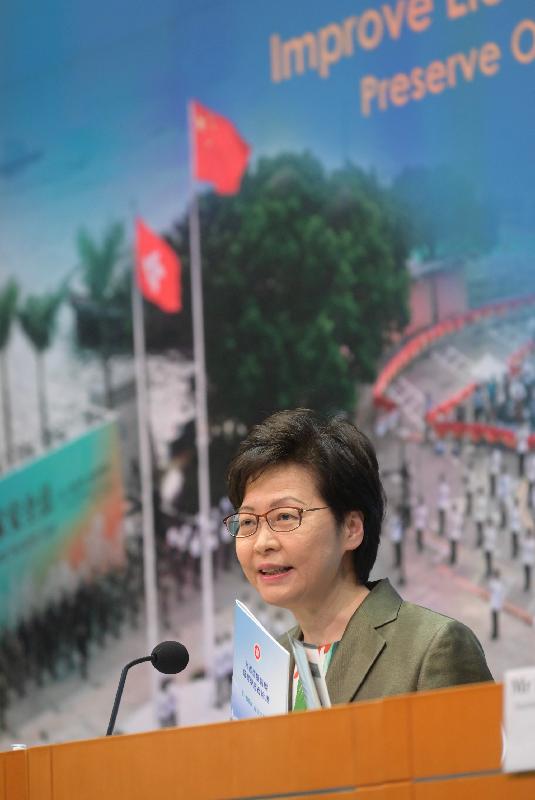
     The Chief Executive, Mrs Carrie Lam, held a press conference this afternoon (April 13) on the Improving Electoral System (Consolidated Amendments) Bill 2021. Also joining were the Secretary for Justice, Ms Teresa Cheng, SC; the Secretary for Constitutional and Mainland Affairs, Mr Erick Tsang Kwok-wai; the Permanent Secretary for Constitutional and Mainland Affairs, Mr Roy Tang; and the Acting Law Officer (Special Duties), Mr Llewellyn Mui. Following is the transcript of remarks of the press conference.
 
Reporter: Could you explain why is it a problem for people to, you know, to encourage others not to vote in an election as a form of protest? What are the penalties for people deemed to have incited others to cast blank votes? Secondly, could you tell us what is the basis for carving up the original five constituencies into 10 constituencies? And also you said you are going to appoint some new members from society to sit in the vetting committee, but even so wouldn't there still be a conflict of interest given that your cabinet members and people appointed by you will still get to choose who can run in the elections? Thank you.
 
Chief Executive: I can't remember the penalty… because there are over 400 clauses in this bill. Let us find out for you the penalty for the two new offences under this consolidated ordinance. The reason for introducing two offences in this exercise stemmed from Annex I and Annex II to the Basic Law. In fact, most of the things we are now doing in the local legislation is to fully and accurately implement Annex I and Annex II as approved by the National People's Congress Standing Committee. That is the starting position. In both Annexes, we are required to act in accordance with the law to prevent any acts that are amounting to manipulating or obstructing elections. In Hong Kong, based on the experience that we have had over the years about elections, we have identified these two aspects that we should do something in law. One is during the election period, when there are certain activities by certain people, which are intended to incite people not to cast a vote or to do something strange in the elections, then it will be an offence. As the Secretary for Justice has explained and I will draw your attention to that particular clause, I think it's Clause 366 in the consolidated bill, that there are certain defence that any person could deploy and what is an activity  is also well defined. If you do it behind closed door amongst yourself and a few friends, that perhaps would not be an offence. I would suggest that you go through that particular provision in the ordinance to understand how somebody will be committing an offence under this proposal.
 
      The reason why is because, one, we have to implement (Annex I and Annex II as approved by the) National People's Congress Standing Committee, the other is of course we all want elections to be very fair. Any manipulation to jeopardise or sabotage an election should not be permitted in a situation like Hong Kong.
 
     The second question is about the "carving out". Again, this is a decision made by the National People's Congress Standing Committee, when the number of directly elected geographical constituency Members in the Legislative Council is down to 20. And we are required to look at how we organise district-based elections in Hong Kong and try to come up with these 10 districts each to return two Members into the Legislative Council. An easy way to do it is to merge the much-smaller constituencies that made up the District Council elections and also taking into account the size of the population. Mr Roy Tang has already explained to you that we are following the established rules, that is within a range, it will not have a district which is too huge, too large and another one which is too small. That is the basis.
 
     As far as for members of the Candidate Eligibility Review Committee, you have to accept that under the current election regime, this job is already done by a public servant, actually a civil servant in the name of a Returning Officer. He or she, appointed during an election, has the sole discretion to decide whether a candidate fulfils the requirements for a candidate. If not, the candidate will be disqualified by the Returning Officer. The current proposal also stems from Annex I and Annex II. It has elevated this whole arrangement to consider the eligibility of a candidate to a committee, rather than an individual, to a group of Principal Officials who are accountable to the people of Hong Kong for their acts, who are not unknown people. The legislation will provide for a committee to be made up of a chairman and two to four members, and all of them have to be Principal Officials appointed by the Central People's Government under Basic Law Article 48(5) because this is such an important job. And hence I have decided – because this matter is being left to Hong Kong, it is not designated or specified in Annex I and Annex II – having regard to the objective of this exercise, I have decided to propose in the legislation that it will be made up of Principal Officials. But in the last two weeks, whenever we talk about this Candidate Eligibility Review Committee, there was a school of thought, just like what you have put up, that, "Okay, it's all officials, how could you convince us that you will be very fair"? So I have accepted the view put to us, and later on we will introduce a committee-stage amendment to this bill to allow for the Chief Executive to appoint a number of community leaders to become members of the Candidate Eligibility Review Committee.
 
     Being Principal Officials or being the Chief Executive, we have to face potential conflict of interest day in and day out. Every Tuesday, when I convene the ExCo (Executive Council) meetings, myself, members of the Government team and also Non-official Members of the Executive Council, all have to face possible, potential conflict of interest. We have a very robust declaration system. We will have to declare if we perceive that there will be a conflict of interest. And I may as well make this very clear just in case there are more unhelpful speculations. It is true that if there is an incumbent Chief Executive who wants to seek a re-election to serve a second term, then he or she will be put in a position as chairing the National Security Committee to form an opinion on whether, in a CE election, a candidate fulfils the qualification. That could be seen as a more direct conflict of interest because the CE will be in a position that he or she could disqualify other candidates. I will make it a rule, not in the legislation, but I will make it very clear now and I will say it very clearly in the Legislative Council through my colleagues that it is my view that any incumbent Chief Executive, if he or she is seeking another term through election, in other words he or she will contest in the coming Chief Executive election, then this incumbent Chief Executive should not get himself or herself involved in that particular discussion at the National Security Committee. But the Candidate Eligibility Review Committee has no position for the Chief Executive. The Chief Executive only appoints. If any members of the Candidate Eligibility Review Committee, for example a Principal Official who wants to contest in a CE election, then well before the nomination period starts, he or she has to resign. That conflict simply will not arise.
 
Reporter: Two questions. A follow-up question on why it is unlawful to encourage others not to vote. Some tricky scenarios here. What if voters find no favourable candidates in their own constituencies, can they simply express their view and ask their friends in the neighbourhood not to vote? And if there are only two candidates in one constituency, can a candidate simply ask voters not to support his rival? The second question regarding the vetting committee, as the national security police are given power to conduct background checks, how would you address the concerns over the absence of checks and balance of the Police? Will any intelligence collected by the national security police in the vetting process be used to accuse potential candidates of violating the national security law? Thank you.
 
Chief Executive: I'll answer the second question, and the Secretary for Constitution and Mainland Affairs could help, again, on this election matter about inciting people not to vote and so on.
 
     The world has changed, especially for Hong Kong in terms of national security. Since June 30 last year, we have a national security law, and the national security law is a piece of national legislation promulgated for implementation in Hong Kong. By definition, not only in Hong Kong, but in worldwide, national security are top confidential matters. The law provides that the designated department, the National Security Department in the Hong Kong Police Force, be given certain powers and responsibilities, and the responsibility includes conducting assessment on national security grounds. They have to fulfil their duty, and on this occasion a part of this duty is to provide input, on a fact-finding basis, to the National Security Committee, which will then form an opinion on whether a certain candidate, based on the facts presented by the Police, is qualified or not qualified to run in an election. If he or she is not qualified on national security grounds, then an opinion will be passed on to the Candidate Eligibility Review Committee for a final decision to be made by the Candidate Eligibility Review Committee. And the work of the National Security Committee and, by definition, the work of the National Security Department in the Police Force is not to be disclosed. Similarly, I don't think anybody will breach the law to try to disclose information collected by the Police for this particular purpose for other purposes, in which case I'm sure that they will be breaching the law in other aspects.
 
Permanent Secretary for Constitutional and Mainland Affairs: My first comment on second hypothetical scenario of the reporter is about whether is legal to ask your friend or other people not to support any candidate or one of the two candidates, as you have mentioned, in an election. It is actually perfectly legal to do so as long as when you are, actually in the existing legislation, when you are trying to do something to promote the election of a candidate or to prevent another candidate from being elected, what you are doing is what we called election advertisement. And you have to count your expenses, so if you are doing it for a candidate, then all the expenses you have incurred in doing the promotion for that particular candidate or against another candidate, would be counted as part of the election expenses of that candidate. That's one point.
 
     The second point is if you are doing it without the consent of the candidate you want to promote, then you are probably committing an offense. Without the permission of the candidate, and then incur expenses on his behalf, is an offence under the existing law. The first hypothetical situation which you have mentioned, whether is legal to ask your friend not to vote, or to cast an invalid vote, or to destroy a ballot paper in the polling station, the last scenario is a criminal offence. So it all depends on the factual situation of your behaviour, and whether you are doing it in some form of organised activity, is a matter of evidence for the court. Thank you.
 
(Please also refer to the Chinese portion of the transcript.)
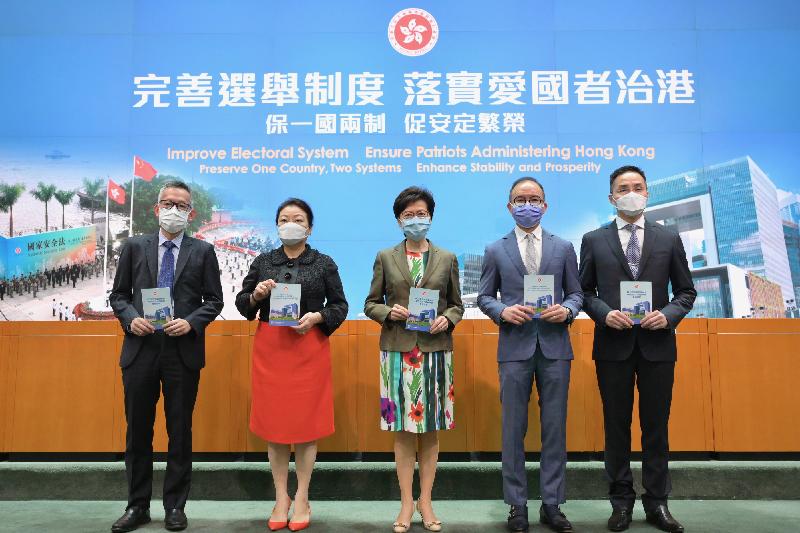
Photo  Photo  Photo  


Government gazettes compulsory testing notice

     The Government will exercise the power under the Prevention and Control of Disease (Compulsory Testing for Certain Persons) Regulation (Cap. 599J) and publish in the Gazette a compulsory testing notice, which requires any person who had been present at three specified premises during the specified period (persons subject to compulsory testing) to undergo a COVID-19 nucleic acid test.

     Currently, in all districts in Hong Kong, if one or more new confirmed cases are found in the residential buildings (including buildings for both commercial and residential uses), or there are sewage samples tested positive, or there are other factors which implied possible infection risks, the buildings will be included in the compulsory testing notice.

     For testing targeting at workplaces, if one or more confirmed cases are found in a workplace, it will be included in the compulsory testing notice.
 
     Three premises fulfilling the above criteria are included in the compulsory testing notice today (April 13).

     Details of the compulsory testing notice are as follows:

1. Any person who had been present at any specified premises listed in Part A of Annex 1 for more than two hours at any time during the period from March 31 to April 13, 2021 (including but not limited to residents, visitors and workers), have to undergo testing by April 15, 2021. If persons subject to compulsory testing have previously undergone testing between April 11 and April 13, 2021, they would be taken to have complied with the requirements set out in the compulsory testing notice.
 
2. Any person who had been present at any specified premises listed in Part B of Annex 1 for more than two hours at any time during the period from March 31 to April 13, 2021 (including but not limited to full-time, part-time and relief staff and visitors), have to undergo testing by April 15, 2021. If persons subject to compulsory testing have previously undergone testing between April 11 and April 13, 2021, they would be taken to have complied with the requirements set out in the compulsory testing notice.  

     A spokesman for the Food and Health Bureau reminds the public that in accordance with the compulsory testing notice issued earlier, all household members of close contacts are required to undergo compulsory testing. Any person who had lived with a person placed under quarantine pursuant to section 22 of the Prevention and Control of Disease Regulation (Cap. 599A) (person under quarantine) in the same residential unit on the date of commencement of quarantine or during the 14 days before that day, and who becomes aware of the quarantine of the person under quarantine when the relevant quarantine has not yet been completed, have to undergo testing within two days of he/she becoming aware of the person under quarantine has been placed under quarantine and report to the Government the result of the test by phone (at 6275 6901), fax (at 2530 5872) or email (ct@csb.gov.hk) within three days of undergoing the test.

     The Government will set up a mobile specimen collection station at Kingsford Terrace, Ngau Chi Wan tomorrow (April 14) for residents and workers subject to compulsory testing. The service period of the mobile specimen collection station at Maple Street Playground in Sham Shui Po will be extended to April 23 (Friday).
 
     The opening dates and operating hours of the mobile specimen collection stations in various districts providing free COVID-19 nucleic acid testing services for the general public are stated in Annex 2. Apart from mobile specimen collection stations, persons subject to compulsory testing can also choose to attend any of the community testing centres across the territory to receive testing free of charge. Persons with "LeaveHomeSafe" COVID-19 exposure notification or SMS notification from the Centre for Health Protection reminding them to undergo testing as soon as possible may receive free testing at community testing centres or mobile specimen collection stations (if the service scope is applicable).

     Persons subject to compulsory testing may choose to undergo testing via the following routes:

1. To visit any of the mobile specimen collection stations (see the list and target groups (if applicable) at www.coronavirus.gov.hk/eng/early-testing.html) for testing;
2. To attend any of the community testing centres (see the list at www.communitytest.gov.hk/en);
3. To obtain a deep throat saliva specimen collection pack from any of the 121 post offices, vending machines set up at 20 MTR stations or 47 designated general outpatient clinics (GOPCs) of the Hospital Authority and return the specimen to one of the designated specimen collection points (see the distribution points and times, and the specimen collection points and times, at www.coronavirus.gov.hk/eng/early-testing.html);
4. To undergo testing at any of the GOPCs of the Hospital Authority as instructed by a medical professional of the Hospital Authority;
5. To self-arrange testing provided by private laboratories which are recognised by the Department of Health (DH) and can issue SMS notifications in respect of test results (see the list at www.coronavirus.gov.hk/pdf/List_of_recognised_laboratories_RTPCR.pdf); or
6.To use a specimen bottle distributed to the relevant specified premises by the Centre for Health Protection (if applicable), and return the specimen bottle with the sample collected as per relevant guidelines.

     The spokesman cautioned that testing received at accident and emergency departments of the Hospital Authority or during hospital stays, or testing provided by private laboratories which cannot issue SMS notifications in respect of test results, does not comply with the requirements of the aforementioned compulsory testing notice.

     "If persons subject to compulsory testing have symptoms, they should seek medical attention immediately and undergo testing as instructed by a medical professional. They should not attend the mobile specimen collection stations or the community testing centres."

     Persons subject to compulsory testing must keep the SMS notification containing the result of the test for checking by a law enforcement officer when the officer requires the persons to provide information about their undergoing the specified test.

     Furthermore, persons subject to testing under the compulsory testing notices should, as far as reasonably practicable, take appropriate personal disease prevention measures including wearing a mask and maintaining hand hygiene, and, unless for the purpose of undergoing the specified test, stay at their place of residence and avoid going out until the test result is ascertained as far as possible.

     Any enquiries on compulsory testing arrangements may be addressed to the hotline at 6275 6901, which operates daily from 9am to 6pm. If persons subject to compulsory testing plan to conduct testing at any of the community testing centres, they can check the centre's appointment status in advance. The hotlines of the community testing centres are available at www.communitytest.gov.hk/en/info.

     The Government will continue to trace possibly infected persons who had been to the relevant premises, and seriously verify whether they had complied with the testing notices. Any person who fails to comply with the testing notices commits an offence and may be fined a fixed penalty of $5,000. The person would also be issued with a compulsory testing order requiring him or her to undergo testing within a specified time frame. Failure to comply with the order is an offence and the offender would be liable to a fine at level 4 ($25,000) and imprisonment for six months.

     Relevant officers of different government departments are empowered to perform certain functions under the relevant Regulations under the Prevention and Control of Disease Ordinance (Cap. 599), including requesting individuals to provide information and assistance when necessary. Any person who fails to comply with the relevant request commits an offence and would be liable to a fine at level 3 ($10,000). Collection and use of any personal data for conducting COVID-19 tests must meet the requirements under the Personal Data (Privacy) Ordinance (Cap. 486). Government departments or testing service providers which handle the relevant information may provide the data to the DH or other relevant departments for anti-epidemic purposes as necessary. The workflow does not involve the provision of any personal data to organisations or persons outside Hong Kong.

     The spokesman said, "The Government urges all individuals who are in doubt about their own health conditions, or individuals with infection risks (such as individuals who visited places with epidemic outbreaks or contacted confirmed cases), to undergo testing promptly for early identification of infected persons."


Grantham Hospital announces passing away of COVID-19 patient

The following is issued on behalf of the Hospital Authority:

     The spokesperson for the Grantham Hospital (GH) today (April 13) announced that a patient confirmed with COVID-19 passed away today.
 
     A 77-year-old male patient (case number: 1989) tested positive for COVID-19 was admitted to the Pamela Youde Nethersole Eastern Hospital on July 20, 2020 for isolation treatment. His condition deteriorated and he was then transferred to the Intensive Care Unit on July 27, 2020.
 
     After treatment, the patient's antibody test result for COVID-19 was positive and he was released from isolation order by the Department of Health on August 28, 2020. Due to his own underlying diseases, he continued to stay in the hospital and was transferred to the Tuberculosis & Chest Medical Unit of GH on March 22, 2021 for further treatment. The patient's condition continued to deteriorate and he eventually succumbed at 4.40pm today.
 
     The hospital is saddened by the passing away of the patient and would offer necessary assistance to his family members.
 
     Including the above patient, 202 COVID-19 patients have passed away in public hospitals so far.


SEN’s opening remarks at LegCo Finance Committee special meeting

     Following is the opening remarks (English translation) by the Secretary for the Environment, Mr Wong Kam-sing, at the special meeting of the Legislative Council Finance Committee this afternoon (April 13):
 
Chairman,
 
     The Financial Secretary continues to support the Environment Bureau's work towards carbon neutrality and environmental protection in the Budget this year.

     First of all, the 2020 Policy Address announced that the Hong Kong Special Administrative Region would strive to achieve carbon neutrality before 2050. To this end, the Government will update Hong Kong's Climate Action Plan in the middle of this year to set out more proactive strategies and measures to reduce carbon emissions. This year, the Budget proposes the following measures to further strengthen such efforts:
 
* earmarking an additional $1 billion to install more small-scale renewable energy systems in government buildings and infrastructure; and
 
* earmarking $150 million for a new Green Welfare NGOs programme to conduct energy audits, as well as install the more energy efficient variable-speed air-conditioners and light emitting diode (LED) lighting, at the premises of eligible welfare non-governmental organisations free of charge.

     Second, the Government will also set aside $500 million to carry out enhancement works on facilities in some country parks, such as providing recreational elements; improving facilities in country parks; and enriching visitors' experiences, enjoyment and awareness at the countryside.

     Third, to promote waste reduction and recycling, the Government announced the Waste Blueprint for Hong Kong 2035 on February 8 this year with the vision of "Waste Reduction • Resources Circulation • Zero Landfill". The Blueprint sets out a number of measures to enhance participation of the entire community on waste reduction, promote resources circulation and develop necessary waste management infrastructure, with a view to moving away from over-reliance on landfills in the long term. Measures related to waste reduction include:
 
* injecting an additional funding of $1 billion to the Recycling Fund and extending its application period to 2027;
 
* setting up more Recycling Stores and smart recycling facilities to enhance the coverage of the community recycling network;
 
* extending the outreach services of Green Outreach to all districts over the territory to strengthen on-site recycling support;
 
* continuing to implement various producer responsibility schemes (PRSs), and we are consulting the public on the PRS on plastic beverage containers and carrying out a pilot scheme on reverse vending machines to collect plastic beverage containers; and
 
* continuing to co-operate with the Bills Committee of the Legislative Council on the scrutiny work of the bill on municipal solid waste charging with a view to facilitating its early passage.

     Fourth, to promote new energy transport, last month we announced the first ever Hong Kong Roadmap on Popularisation of Electric Vehicles, which sets out the vision of "Zero Carbon Emissions • Clean Air • Smart City". The Roadmap elaborates on our long-term policy objectives and plans on promoting the use of electric vehicles (EVs), with a view to attaining zero vehicular emissions before 2050. Key measures include no new registration of fuel-propelled private cars in 2035 or earlier, expanding the EV charging network and promoting its marketisation, training EV technicians and mechanics, formulating a PRS for retired EV batteries, and more. We will also continue to take forward the relevant work including:
 
* subsidising the installation of EV charging-enabling infrastructure at more than 60 000 parking spaces in existing private residential buildings through the $2 billion EV-charging at Home Subsidy Scheme; and
 
* formulating trials for various electric public transport and commercial vehicles, such as a pilot scheme for electric public light buses, and a trial for electric ferries serving in-harbour routes which is expected to be launched in 2023.

     Fifth, we will also update A Clean Air Plan for Hong Kong in the middle of this year to set out challenges, targets and strategies to further improve the air quality of Hong Kong.

     We anticipate that the measures mentioned above could create or support thousands of job opportunities in the next few years. The Budget also allocates additional resources to support green recovery. The measures include:
 
* providing about 900 additional temporary jobs in the realm of environmental protection, involving over $100 million; and
 
* extending the rental reduction waiver for tenants of the EcoPark, country park refreshment kiosks and the Hong Kong Wetland Park for another six months.

     My colleagues and I are happy to listen to Members' views and respond to questions. Thank you, Chairman.


Government makes “restriction-testing declaration” and issues compulsory testing notice in respect of specified “restricted area” in Tsuen Wan

     The Government today (April 13) exercised the power under the Prevention and Control of Disease (Compulsory Testing for Certain Persons) Regulation (Cap. 599J) to make a "restriction-testing declaration" (declaration) effective from 8pm, under which people (hereafter referred to as "persons subject to compulsory testing") within the specified "restricted area" in Tsuen Wan (i.e. Tower 2 of Lido Garden, 41-63 Castle Peak Road Sham Tseng, Tsuen Wan; see Annex) are required to stay in their premises and undergo compulsory testing. Persons subject to compulsory testing are required to stay in their premises until all such persons identified in the area have undergone testing and the test results are mostly ascertained. The Government aims at finishing this exercise at about 7am tomorrow (April 14), in order to achieve the goal of zero cases in the district with concerted efforts.

     A Government spokesman said, "Under Cap. 599J, the Government can, according to the needs of infection control, make a 'restriction-testing declaration'. As there is a confirmed case recorded in Tower 2 of Lido Garden recently, as assessed, the risk of infection in the relevant area may be higher, the Government decided to make a 'restriction-testing declaration' for the relevant area."

     The Government will set up temporary specimen collection stations at the "restricted area" and request persons subject to compulsory testing to undergo testing before 1am tomorrow. Persons subject to compulsory testing will be arranged to undergo nucleic acid testing at specimen collection stations where dedicated staff will collect samples through combined nasal and throat swabs. Persons subject to compulsory testing must stay at their place of residence until all test results are ascertained to avoid cross-infection risk. The Government will arrange door-to-door specimen collection for people with impaired mobility and elderly persons.

     "We understand that this exercise will cause inconvenience to the public. The Government has made arrangements to carry out testing for all persons present in the 'restricted area' as soon as possible at night after most people are released from work. The aim is to strive to complete testing of all identified persons subject to compulsory testing and confirm the results, and finish the exercise at around 7am tomorrow with a view to allowing residents to start going to work at around 7am. The Government will make a public announcement when the declaration expires officially. In the cases in which employees are unable to go to work because of the declaration, the Government hopes their employers can exercise discretion and not deduct the salaries or benefits of the employees."

     If staying in the "restricted area" will cause unreasonable hardship to individuals who are not residents in the area when the declaration takes effect, government officers may exercise discretion and allow that person to leave the area after considering the individual circumstances. That person must have followed the instructions to undergo testing and leave his/her personal information for contact purposes.

     Persons in the "restricted area" who have undergone testing from April 11 to 13, 2021, and are able to provide the SMS notification through a mobile phone or related certification containing the test results, are not required to take the test again. However, they are required to stay in their premises until all such persons identified in the area have undergone testing and the test results are mostly ascertained. Also, according to the compulsory testing notice issued today, any person who had been present at the above building for more than two hours from March 31 to April 13, 2021, even if they were not present in the "restricted area" at the time when the declaration took effect, must undergo compulsory testing on or before April 15.

     The Government has prepared simple food and cleaning supplies for the residents restricted by the declaration. The Home Affairs Department has set up a hotline (Tel: 2835 1473) which started operation at 8pm today for residents restricted by the declaration to make enquiries and seek assistance. The Social Welfare Department will also provide assistance to the affected persons.

     The Government hopes this temporary inconvenience will completely cut the local transmission chains and ease residents' worries and fear, so that they will regain confidence in resuming social and business activities in the area, and return to a normal life.

     The Government appeals to persons subject to compulsory testing for their full co-operation by registering and undergoing testing, and waiting for the results patiently at home. The Government will strictly follow up on whether the persons concerned have complied with the compulsory testing notices and "restriction-testing declaration". Any person who fails to comply with the compulsory testing notices commits an offence and may be fined a fixed penalty of $5,000. The person would also be issued with a compulsory testing order requiring him or her to undergo testing within a specified time frame. Failure to comply with the compulsory testing order or the "restriction-testing declaration" is an offence and the offender would be liable to a fine at level 4 ($25,000) and imprisonment for six months.