Composite Interest Rate: End of March 2021

The following is issued on behalf of the Hong Kong Monetary Authority:
 
     The Hong Kong Monetary Authority (HKMA) announced today (April 19) the composite interest rate at the end of March 2021. (Note 1)
 
     The composite interest rate, which is a measure of the average cost of funds of banks, decreased by 1 basis point to 0.22 per cent at the end of March 2021, from 0.23 per cent at the end of February 2021 (see Chart 1 in the Annex). The decrease in composite interest rate mainly reflected a decrease in the weighted funding cost for deposits during the month (see Chart 2 in the Annex). (Note 2)
 
     The historical data of the composite interest rate from the end of the fourth quarter of 2003 to the end of March 2021 are available in the Monthly Statistical Bulletin on the HKMA website (www.hkma.gov.hk).
 
Note 1: The composite interest rate is a weighted average interest rate of all Hong Kong dollar interest-rate-sensitive liabilities, which include deposits from customers, amounts due to banks, negotiable certificates of deposit and other debt instruments, and all other liabilities that do not involve any formal payment of interest but the values of which are sensitive to interest rate movements (such as Hong Kong dollar non-interest bearing demand deposits) on the books of banks. Data from retail banks, which account for about 90 per cent of the total customers’ deposits in the banking sector, are used in the calculation. It should be noted that the composite interest rate represents only average interest expenses. There are various other costs involved in the making of a loan, such as operating costs (e.g. staff and rental expenses), credit cost and hedging cost, which are not covered by the composite interest rate.

Note 2: Since June 2019, the composite interest rate and weighted deposit rate have been calculated based on the new local "Interest rate risk in the banking book" (IRRBB) framework. As such, these figures are not strictly comparable with those of previous months.


Public urged to keep up anti-mosquito efforts

     The Food and Environmental Hygiene Department (FEHD) today (April 19) announced that the monthly gravidtrap index for Aedes albopictus (MGI) for March was 2.7 per cent. The index remains lowest at Level 1, indicating that mosquito infestation in the areas surveyed was not extensive.

     Among the 64 survey areas, no area was recorded with gravidtrap indices exceeding the alert level of 20 per cent. Moreover, the monthly density index for Aedes albopictus (MDI) in March was 1.1, which represented that an average of 1.1 Aedes albopictus adult was found in the Aedes-positive gravidtraps, indicating that the number of adult Aedes albopictus was not high in the areas surveyed. As for the port areas, the port monthly gravidtrap index in March was 0.2 per cent, while the port monthly density index in March was 1, remaining at a low level.

     The FEHD reminded the public that despite the index remaining at a low level, the department appealed to the public to carry out effective preventive measures against mosquito breeding early before the onset of the rainy season as the warm and humid weather of spring is favourable for mosquito breeding in a short period of time. Relevant government departments have also commenced the All-out Anti-mosquito Operations on April 12, during which mosquito breeding places have been cleaned up and fogging has been conducted to kill adult mosquitoes in order to enhance anti-mosquito work.

     "The FEHD and relevant government departments will continue to intensify mosquito prevention and control work covering venues under their purview and strengthen publicity and education. The FEHD is conducting a three-phase territory-wide Anti-mosquito Campaign this year. The second phase, lasting for nine weeks, has been launched today and will run until June 18. During the period, the FEHD and relevant government departments will enhance the mosquito prevention and control work and target areas which have drawn particular concern, such as locations in close proximity to human residences, parks, schools, construction sites, public housing estates, hospitals, illegal cultivation sites, waterfront public and private cargo working areas, cross boundary check points, typhoon shelters and cross boundary ferry terminals to remove the accumulation of water and to carry out mosquito prevention and control work. The FEHD will, after the second phase of the campaign, conduct territory-wide thematic mosquito prevention and control special operations so as to enhance the effectiveness of the campaign," a spokesman for the FEHD said.

     The area gravidtrap index (AGI) and the area density index (ADI) indicate the extensiveness of distribution and the density of Aedine mosquitoes respectively in that particular survey area, while the MGI and the MDI are enumerated by pooling together all AGIs and ADIs of the same month, which reflect the general situation of Aedes albopictus in all survey areas. The gravidtrap and density indices for Aedes albopictus in different areas and information on mosquito prevention and control measures are available on the department's website at www.fehd.gov.hk.

     The spokesman said, "Aedes albopictus is a kind of mosquito that can transmit dengue fever (DF) as well as Zika virus infection. DF is commonly found in tropical and subtropical regions of the world, and has become endemic in many countries in Southeast Asia. As the dengue activity in neighbouring areas has remained high and Hong Kong recorded one imported DF case last month, the weather will turn even warmer and more humid in spring which will be conducive to large-scale mosquito breeding in a short period of time, so the community should stay vigilant and continue to carry out effective mosquito prevention and control measures."

     The spokesman added that as Aedes albopictus breeds in small water bodies, members of the public should carry out effective mosquito prevention and control measures including inspecting their homes and surroundings to remove potential breeding grounds, changing the water in vases and scrubbing the inner surfaces, removing the water in saucers under potted plants at least once a week, properly disposing of containers such as soft drink cans and lunch boxes, and drilling large holes in unused tyres. He also advised the public and estate management bodies to keep drains free of blockage and level all defective ground surfaces to prevent accumulation of water. They should also scrub all drains and surface sewers with an alkaline detergent at least once a week to remove any mosquito eggs.
      
     The spokesman reiterated that effective mosquito control requires the sustained effort of all parties concerned. The community must work together with the Government to carry out effective mosquito control measures.


Effective Exchange Rate Index

     The effective exchange rate index for the Hong Kong dollar on Monday, April 19, 2021 is 101.5 (down 0.1 against last Saturday's index).

     The effective exchange rate index for the Hong Kong dollar on Saturday, April 17, 2021 was 101.6 (down 0.1 against last Friday's index).


Import of poultry meat and products from areas in Poland suspended

     The Centre for Food Safety (CFS) of the Food and Environmental Hygiene Department announced today (April 19) that in view of a notification from the General Veterinary Inspectorate of Poland about outbreaks of highly pathogenic H5N8 avian influenza in KÄ™trzyÅ„ski District of WarmiÅ„sko-mazurskie Region; ChoszczeÅ„ski District of Zachodniopomorskie Region; PszczyÅ„ski District of ÅšlÄ…skie Region; KroÅ›nieÅ„ski District of Podkarpackie Region; BiÅ‚gorajski District of Lubelskie Region and BeÅ‚chatowski District of Å�ódzkie Region in Poland, the CFS has instructed the trade to suspend the import of poultry meat and products (including poultry eggs) from the above-mentioned areas with immediate effect to protect public health in Hong Kong.

     A CFS spokesman said that according to the Census and Statistics Department, Hong Kong imported about 13 500 tonnes of frozen poultry meat and about 39.08 million poultry eggs from Poland last year.

     "The CFS has contacted the Polish authorities over the issues and will closely monitor information issued by the World Organisation for Animal Health and the relevant authorities on the avian influenza outbreaks. Appropriate action will be taken in response to the development of the situation," the spokesman said.


Hong Kong Customs seizes suspected counterfeit goods (with photo)

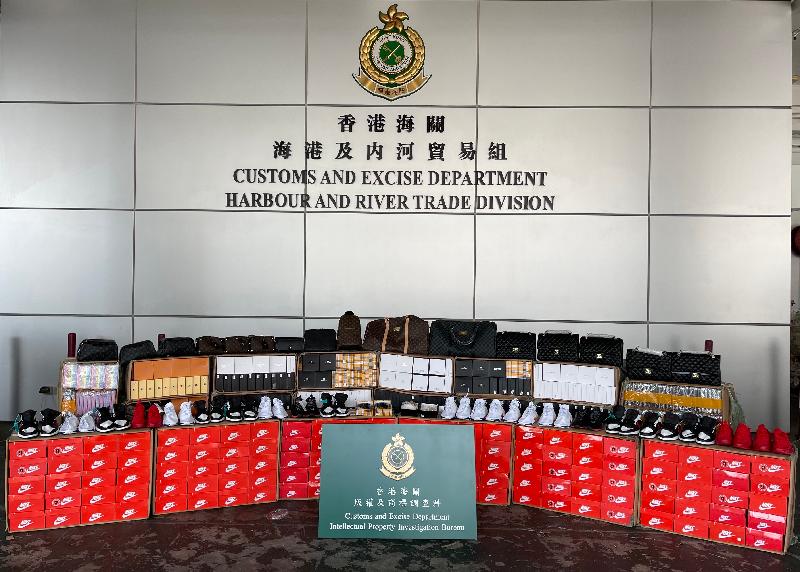
     Hong Kong Customs seized about 22 000 items of suspected counterfeit goods with an estimated market value of about $2.7 million at the Tuen Mun River Trade Terminal on April 13.

     Through risk assessment, Customs officers on that day inspected two 40-foot containers arriving in Hong Kong from Nansha, Guangdong. Upon inspection, Customs officers found inside the two containers the batch of suspected counterfeit goods, including mobile phone accessories, handbags, shoes and watches.  

     Initial investigations revealed that the two batches of suspected counterfeit goods would have be re-exported to North American and Middle East countries. 

     Investigation is ongoing.

     Hong Kong Customs will continue to closely monitor the smuggling trends of counterfeit goods and maintain close co-operation with Mainland Customs and overseas law enforcement agencies to combat the relevant illegal activities vigorously through intelligence exchanges and joint enforcement actions.

     Under the Trade Descriptions Ordinance, any person who imports or exports any goods to which a forged trademark is applied commits an offence. The maximum penalty upon conviction is a fine of $500,000 and imprisonment for five years.

     Members of the public may report any suspected counterfeiting activities to Customs' 24-hour hotline 2545 6182 or its dedicated crime-reporting email account (crimereport@customs.gov.hk).

Photo