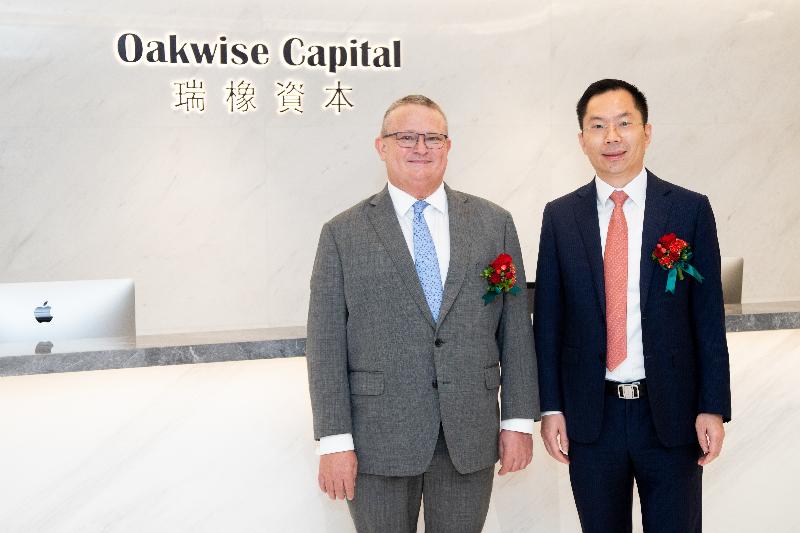
Oakwise Capital launches family office business in Hong Kong (with photo)

     Oakwise Capital Holding Limited announced today (April 21) that it has launched its family office business in Hong Kong, leveraging the city's status as a premier international financial centre, as well as the dominant investment gateway for Mainland China, to offer one-stop asset management services for its ultra-high-net-worth clients.
      
     Oakwise Capital manages assets from a wide range of investors, including state-owned enterprises, local government financing vehicles, financial institutions, listing companies, family offices and high-net-worth individuals. It has 10 funds covering fixed income, public and private equities, with total assets under management exceeding US$2 billion, according to its Founder and Chairman Dr Eric Wang.
      
     Speaking at the opening, Dr Wang said, "The launch today of the Family Office division is in response to the request of some of our ultra-high-net-worth investors. There is no better time to launch this business in Hong Kong, given Hong Kong's unrivalled position as a global investment hub and the Hong Kong Special Administrative Region Government's determination to grow the family office sector. I feel very confident and optimistic.”
      
     Partner of Oakwise Capital and Head of Family Office, Mr Richard Zhang, said, "Hong Kong, as one of the world most important financial centres, has a friendly business environment, world-class infrastructure and a deep pool of talents. The city is not only a gateway to Mainland China for international capital, but also enjoys the benefits of both offshore and onshore financial centres, which offers exciting business opportunities for us."
      
     Director-General of Investment Promotion, Mr Stephen Phillips, offered his congratulations on the opening of Oakwise Capital's family office in Hong Kong. He said, "Hong Kong as a premier international financial centre and wealth management centre offers many unique advantages for family offices to operate and grow. We look forward to working with Oakwise Capital and other market players to promote the city as a leading family office hub in the region."
      
About Oakwise Capital
      
     Founded by Dr Eric Wang in 2018, Oakwise Capital Holding Limited has established Oakwise Capital Management Limited, Oakwise Trust, and Oakwise Capital Management (Singapore) Co Ltd. It holds asset management licenses issued by the Hong Kong Securities and Futures Commission and the Monetary Authority of Singapore, as well as a trust service provider licence in Hong Kong. The company is committed to provide investors with one-stop asset management services with integrity, professionalism, stability and innovative ideas. COSCO Shipping Investment Holdings Co, Ltd is a strategic investor and partner of the company. For more information, please visit www.oakwise.com.hk.
       
About InvestHK
          
     Invest Hong Kong is the department of the Hong Kong Special Administrative Region Government responsible for attracting foreign direct investment and supporting overseas and Mainland businesses to set up or expand in Hong Kong. It provides free advice and customised services for overseas and Mainland companies. For more information, please visit www.investhk.gov.hk.
      
     For a photo, please visit www.flickr.com/photos/investhk/albums/72157718979010209.
 

Photo  


Retailer convicted of supplying unsafe whitening cream

     A sole proprietor of a retailer was convicted and sentenced to imprisonment for two months suspended for one year and fine of $2,000 today (April 21) at Eastern Magistrates' Courts for supplying unsafe whitening cream and supplying whitening cream failing to comply with the bilingual labelling requirement, in contravention of the Consumer Goods Safety Ordinance (CGSO) and its subsidiary legislation, the Consumer Goods Safety Regulation (CGSR). The sole proprietor was also ordered by the court to reimburse the testing and relevant costs of about $34,000 to the Government.

     Customs earlier received referrals from a relevant department that there was suspected unsafe whitening cream being sold in the market. Customs officers immediately conducted inspection and test-purchased the type of whitening cream from a retail shop in Central. A total of 133 items of whitening cream of the same type were further seized in the premises during a follow-up operation.

     Safety test results revealed that the product contains a mercury level of between 11 000 and 18 000 parts per million. According to the relevant cosmetic hygienic standard, the mercury levels exceed the maximum permitted limit by 11 000 to 18 000 times, and thereby fail to comply with the general safety requirements of the CGSO.

     In addition, the product packages fail to bear Chinese and English bilingual warnings or cautions, in contravention of the CGSR.

     Customs reminds traders to comply with the requirements of the CGSO and the CGSR. Members of the public should observe the following tips when purchasing and using beauty products:
 

  • Check the trade descriptions and compositions of the beauty products' packages during transactions;
  • Do not buy or use beauty products from doubtful sources;
  • Check carefully before using the beauty products and stop using the products if they have stains or odd smells;
  • Stop using the beauty products and seek medical attention immediately if feeling unwell after use; and
  • Purchase beauty products at reputable retail shops.

     Under the CGSO, it is an offence to supply, manufacture or import consumer goods unless the goods comply with the general safety requirements for consumer goods. Under the CGSR, where consumer goods or their packages are marked with warnings or cautions with respect to their safe keeping, use, consumption or disposal, such warnings or cautions shall be in both English and Chinese languages. Moreover, the warning or caution phrases must be legibly and conspicuously shown on the goods, any package of the goods, a label securely affixed to the package or a document enclosed in the package. The maximum penalty upon conviction is a fine of $100,000 and imprisonment for one year on first conviction, and $500,000 and imprisonment for two years on subsequent conviction.

     Members of the public with information relating to unsafe or law-breaking consumer goods may make a report via Customs' 24-hour hotline 2545 6182 or its dedicated crime-reporting email account (crimereport@customs.gov.hk).


Import of poultry meat and products from areas in Poland suspended

     The Centre for Food Safety (CFS) of the Food and Environmental Hygiene Department announced today (April 21) that in view of a notification from the General Veterinary Inspectorate of Poland about outbreaks of highly pathogenic H5N8 avian influenza in Sztumski District of Pomorskie Region, EÅ‚cki District of WarmiÅ„sko-mazurskie Region, and PÅ‚ocki District of Mazowieckie Region in Poland, the CFS has instructed the trade to suspend the import of poultry meat and products (including poultry eggs) from the above-mentioned areas with immediate effect to protect public health in Hong Kong.

     A CFS spokesman said that according to the Census and Statistics Department, Hong Kong imported about 13 500 tonnes of frozen poultry meat and about 39.08 million poultry eggs from Poland last year.

     "The CFS has contacted the Polish authorities over the issues and will closely monitor information issued by the World Organisation for Animal Health and the relevant authorities on the avian influenza outbreaks. Appropriate action will be taken in response to the development of the situation," the spokesman said.


LCQ16: Vaccination for children

     Following is a question by Dr the Hon Pierre Chan and a written reply by the Secretary for Food and Health, Professor Sophia Chan, in the Legislative Council today (April 21):
 
Question:
 
     Under the Hong Kong Childhood Immunisation Programme (HKCIP), children receive various vaccines in the following three stages: (i) newly born (administered by hospitals), (ii) one to 18 months from birth (administered by the Maternal and Child Health Centres (MCHCs) under the Department of Health (DH)), and (iii) Primary One to Primary Six (administered by the School Immunisation Teams under the Centre for Health Protection of DH). Moreover, children aged between six months and below 12 years are eligible for free and subsidised seasonal influenza vaccination (SIV) under the Government Vaccination Programme (GVP) and Vaccination Subsidy Scheme (VSS) respectively. In this connection, will the Government inform this Council:
 
(1) of the following details of HKCIP last year: the respective numbers of doses of vaccines administered to (i) newborn babies by public/private hospitals, (ii) pre-school children by MCHCs, and (iii) primary school students by DH's School Immunisation Teams at schools, with a tabulated breakdown by the infectious disease involved; how such figures compare with the relevant figures of the preceding two years;
 
(2) of the respective vaccination coverage rates among (i) pre-school children and (ii) primary school students last year; how such figures compare with the relevant figures of the preceding two years;
 
(3) of the numbers of doses of vaccines (i) procured for HKCIP, (ii) discarded due to expiry or damage, and (iii) kept in stock, last year by DH and the Hospital Authority respectively; how such figures compare with the relevant figures of the preceding two years;
 
(4) of the amount of expenditure incurred by the Government for procuring vaccines under HKCIP in each of the past three years;
 
(5) of the respective numbers of primary schools and primary school students participating in the outreach SIV activities at schools in each of the past two years; how such figures compare with the relevant figures of the preceding year; the respective numbers of children for whom free SIV was administered under GVP, VSS and the Residential Care Home Vaccination Programme in each of the past three years; and
 
(6) whether it knows the up-to-date number of children who have not turned up for their scheduled appointments to receive various vaccines since the outbreak of the Coronavirus Disease 2019 in Hong Kong early last year; whether DH has taken follow-up actions; if so, of the details; if not, the reasons for that?
 
Reply:
 
President,
 
     The Centre for Health Protection (CHP) of the Department of Health (DH) has been keeping abreast of the latest position of the World Health Organization on immunisation and vaccination, the scientific evidence of new vaccines, the latest global and local epidemiology of vaccine preventable diseases, and the advice and practical experience of health authorities across the world. The Scientific Committee on Vaccine Preventable Diseases under CHP holds regular meetings and gives science-based advice and recommendations to CHP regarding the types of vaccines to be incorporated into the Hong Kong Childhood Immunisation Programme (HKCIP) from the public health perspective in a timely manner. Under the HKCIP, Bacillus Calmette-Guerin (BCG) vaccine and the first dose of hepatitis B (Hep B) vaccine are first given to newborn babies in hospitals. Pre-school children from birth to five years old receive different types of vaccines and boosters at recommended ages of vaccination at DH's Maternal and Child Health Centres (MCHCs). As for primary school children, vaccination is provided at schools by the DH's outreach School Immunisation Teams (SIT). Apart from DH's free vaccination, parents may also arrange their children to receive vaccination in private healthcare facilities or clinics at their own expense. In consultation with DH and the Hospital Authority (HA), consolidated reply to the various parts of the question is as follows:
 
(1) The numbers of doses of various vaccines administered at public and private hospitals, MCHCs and by the SIT in the past three years are at Annexes 1, 2 and 3 respectively.
 
(2) Starting from 2001, DH has conducted territory-wide immunisation coverage surveys on a regular basis to monitor the immunisation coverage rates of pre-school children in Hong Kong (i.e. the percentage of children having received vaccination at recommended ages under the HKCIP) through checking the immunisation records (or vaccination cards) of a sample of children.  According to the survey results, the overall immunisation coverage rates of various vaccines under HKCIP has been maintained at a very high level of over 95 per cent (details at Annex 4).
 
     In addition, primary school students' immunisation records are also checked by the SIT when it provides vaccination at schools every year. The figures show that the overall immunisation coverage rates of Primary one, Primary five and Primary six students have maintained at a high coverage rate (details at Annex 5).
 
(3) and (4) Before ordering vaccines for the HKCIP, the Government will estimate the required quantity on the basis of the number of births for the year and the coverage rates in the past. The Government will then procure the estimated quantity of vaccines through tender in accordance with the established requirements and procedures. A flexibility clause will normally be included in the conditions of the tender to ensure that after the signing of the contract, the quantities ordered can be appropriately adjusted or the contract period can be extended if necessary, so as to minimise the number of vaccines to be discarded or expired vaccines. Vaccine suppliers are required to supply sufficient quantities of vaccines for the HKCIP according to the terms of contract.
 
     At present, the Government procures for the HKCIP on a contract basis the following nine single or combined vaccines for children, namely (1) BCG vaccine; (2) Hep B vaccine; (3) varicella vaccine; (4) diphtheria, tetanus, acellular pertussis and inactivated poliovirus (DTaP-IPV) vaccine; (5) diphtheria, tetanus, acellular pertussis (reduced dose) and inactivated poliovirus (dTap-IPV) vaccine; (6) 13-valent pneumococcal conjugate (PCV13) vaccine; (7) measles, mumps and rubella (MMR) vaccine; (8) measles, mumps, rubella and varicella (MMRV) vaccine and (9) human papillomavirus (HPV) vaccine. As the HKCIP is an ongoing programme, contracts are signed for different vaccines and the contract periods vary accordingly. Suppliers are normally required under the contracts concerned to provide vaccines for a period of two to three years and the cost for procurement of the vaccines depends on the relevant contract price for the vaccines. Details of the contracts signed with vaccine suppliers that are still valid are at Annex 6.
 
(5) The number of primary schools joining seasonal influenza vaccination school outreach activities and the number of children aged between six months and under 12 who received free or subsidised seasonal influenza vaccination in the past three years are at Annexes 7 and 8.
 
(6) DH has all along closely monitored the immunisation coverage of children. We noticed that since the outbreak of COVID-19 in Hong Kong, some parents have not brought their children to the MCHCs for vaccination according to the recommended schedule. Meanwhile, the suspension of face-to-face class has also affected the vaccination for primary students. MCHC staff and the SIT would respectively contact parents of pre-school children who have not yet received the age-appropriate vaccines and that of Secondary one students who have yet to complete their vaccinations under HKCIP by phone, letter and SMS, to remind them to arrange vaccination as soon as possible. The latter may bring their children to SIT offices or family doctors' clinics for vaccination according to their needs. Since mid-May 2020, upon the resumption of face-to-face class in phases in light of the development of local COVID-19 situation, SIT has liaised with schools and arranged students to receive vaccination at schools or SIT offices with strengthened infection control. DH will continue to follow up these students who have not completed the HKCIP and work closely with schools to arrange vaccination for students as early as possible.
 
     We noted that some of the children have already received vaccination in the private healthcare sector, whilst some children living outside Hong Kong have continued vaccination in their place of residence. DH has also conducted a press briefing and issued a press release to encourage parents to maintain up-to-date immunisation for their children for comprehensive and timely protection against infectious diseases, and not to delay vaccination due to the COVID-19 outbreak. Parents with children who are currently not residing in Hong Kong are advised to continue immunisation in their place of residence.


LCQ17: COVID-19 Vaccination Programme

     Following is a question by the Hon Holden Chow and a written reply by the Secretary for Food and Health, Professor Sophia Chan, in the Legislative Council today (April 21):
 
Question:
 
     There have been, from time to time, serious adverse events in which members of the public felt unwell or even died after receiving the coronavirus disease 2019 (COVID-19) vaccines since the COVID-19 Vaccination Programme commenced on February 26 this year. There are views that although the Expert Committee on Clinical Events Assessment Following COVID-19 Immunisation has, after making assessment, considered that there was no causal relationship between such events and the administration of the vaccines, such events have undoubtedly discouraged some members of the public from getting vaccinated. In this connection, will the Government inform this Council:
 
(1) of the up-to-date number of reports on serious adverse events following COVID-19 vaccination received and, among such reports, the respective numbers on (i) deaths and (ii) other cases; whether it knows the causes for the illness or deaths of the persons concerned; if it knows, set out such information in a table;
 
(2) of the measures put in place to boost public confidence in the safety of the COVID-19 vaccines; whether such measures include disseminating information on the safety of the vaccines through the private doctors and clinics participating in the vaccination programme, so as to allay public concerns; and
 
(3) whether it has discussed with the Mainland authorities allowing Hong Kong residents who hold COVID-19 electronic vaccination records downloaded via the "iAM Smart" mobile application to enter the Mainland without being subject to quarantine; if so, of the progress of such discussion; if not, the reasons for that?
 
Reply:
 
President,
 
     Vaccination is the current focus of the global anti-epidemic work. The Government has implemented the COVID-19 Vaccination Programme since February 26, 2021. So far, about 1.12 million doses of COVID-19 vaccines (including 610 000 doses of the Sinovac vaccine and 510 000 doses of the BioNTech vaccine) have been administered to members of the public. Both vaccines meet the criteria of safety, efficacy and quality. The Government will adopt the concept of "vaccine bubble" as announced earlier as the new direction in fighting the epidemic, with an aim to restoring the normal operations of society in a gradual and orderly manner. However, the premise is that the public needs to work together and get vaccinated proactively in order to help Hong Kong beat the epidemic as soon as possible.
 
     In consultation with the Constitutional and Mainland Affairs Bureau, Innovation and Technology Bureau and Information Services Department, my consolidated reply to the various parts of the question raised by the Hon Holden CHOW is as follows:
 
(1) The Sinovac vaccine and BioNTech vaccine authorised by the Government for emergency use in accordance with the Prevention and Control of Disease (Use of Vaccines) Regulation (Cap. 599K) are safe, efficacious and of good quality. The two vaccines have been administered on over tens of millions and even over a hundred million people around the globe. Their safety and efficacy are beyond doubt.
 
     According to the World Health Organization (WHO), Adverse Events Following Immunisation (AEFI) refers to any untoward medical occurrence which follows immunisation and does not necessarily have a causal relationship with the usage of the vaccine. All along, the Department of Health (DH) has been cooperating with local experts to closely monitor the safety of the relevant vaccines, including enhancing the existing surveillance system and carrying out active surveillance with reference to the guidelines of the WHO. The purpose is early identification of rare or delayed serious adverse events following large-scale immunisation. In addition to encouraging healthcare providers and the pharmaceutical industry to report AEFIs through the enhanced existing surveillance system, DH also partners with the University of Hong Kong to conduct the "COVID-19 Vaccines Adverse Events Response and Evaluation Programme (CARE Programme)" to actively monitor Adverse Events of Special Interest related to COVID-19 vaccines.
 
     As at April 4, there were about 556 100 doses of COVID-19 vaccines administered in Hong Kong. During the same period, DH received a total of 1 357 AEFI reports (about 0.24 per cent of all doses administered). Among the AEFI reports, there are 754 hospitalisation cases reported by the Hospital Authority (HA). The symptoms of the cases mainly included chest discomfort, chest pain, dizziness, fever, headache, hypertension, numbness, palpitation, etc. As regards the four cases reported by private hospitals, the symptoms mainly included blurred vision, chest pain, headache and increased blood pressure. Apart from the abovementioned AEFI reports, during the same period, DH also received 584 other AEFI reports with milder conditions which did not require hospitalisation, such as dizziness, headache, chest discomfort, rash, palpitation, etc.
 
     The remaining 15 cases are death case reports by HA with history of COVID-19 immunisation. Existing information indicates that most of these cases died of cardiovascular diseases. The Expert Committee on Clinical Events Assessment Following COVID-19 Immunisation (Expert Committee) has already concluded three of these reports that there was no causal relationship between the deceased's outcome and COVID-19 vaccination. The medical history and preliminary autopsy findings of the remaining cases showed that the outcomes of the deceased persons were not directly associated with COVID-19 vaccination. Their assessment will be concluded by the Expert Committee when necessary further information is available.
 
     According to the mortality data in Hong Kong, during the same period in 2019 (i.e. February 26 to April 4), among people aged 55 or above, there were 17.2 deaths per 100 000 population due to ischaemic heart diseases and 28.1 deaths per 100 000 population due to heart disease. The Expert Committee has basically concluded that the reported death cases were not related to vaccination. The above figures also indicate that the rate of occurrence of deaths from cardiovascular diseases among all people who have been vaccinated (3.1 deaths per 100 000 population) is in fact lower than that of the general population.  Statistically, there is no sign that the relevant death cases are caused by vaccination. The Expert Committee has reviewed these data and considered that so far there is no unusual pattern identified after administration of vaccines. The Expert Committee will continue to closely monitor the situation.
 
     The Government will regularly publish the summary report on safety monitoring of COVID-19 vaccines in Hong Kong on the thematic website for the COVID-19 Vaccination Programme. The latest report is available at www.drugoffice.gov.hk/eps/do/en/doc/Safety_Monitoring_of_COVID-19_Vaccines_in_Hong_Kong.pdf.
 
(2) Since the implementation of the vaccination programme, the Government has disseminated to members of the public information on the benefits of vaccination and correct messages, the views of experts and details of the vaccination programme, etc. via different channels, in adherence to the principles of openness and transparency and based on scientific evidence. Government officials have also explained the progress of the vaccination programme and information on the vaccines at different occasions through the media. We have also set up a thematic website for the COVID-19 Vaccination Programme to enable members of the public to obtain the latest information and accurate messages through an official channel, including how the vaccines work, their protection and vaccination fact sheets, etc. We have also stepped up monitoring of false information on vaccines within the community and made clarifications as necessary.
 
     On the other hand, DH has issued guidelines (www.covidvaccine.gov.hk/pdf/VSS_DoctorsGuide.pdf) to private doctors participating in the vaccination programme and conducted seminars to explain the content of the relevant programme and the arrangements for vaccination, etc. DH has also reminded the private doctors that they should provide to the vaccine recipient the pamphlets with vaccination fact sheets, explain the content of the pamphlets, respond to the recipient's questions, assess whether the recipient's health situation is suitable for vaccination and if there are any contraindications or precautions and handle enquiries, etc.
 
     Furthermore, together with various healthcare professional groups, DH has developed and promulgated the "Interim Guidance Notes On Common Medical Diseases and COVID-19 Vaccination In Primary Care Settings" (www.covidvaccine.gov.hk/pdf/Guidance_Notes.pdf) to provide medical workers with health guidance on handling different target groups and administration of vaccines. DH has also invited doctors to assist in the production of short clips and messages for dissemination on social media and other media platforms, with a view to enhancing the vaccination rate of COVID-19 vaccines. Details can be found under the section "Education & Media Resources" of the thematic website for the COVID-19 Vaccination Programme.
 
(3) Since the implementation of the COVID-19 Vaccination Programme, members of the public will be provided with a hard copy of vaccination records after vaccination. They can also download their electronic vaccination records using the "iAM Smart" mobile app. Both paper and electronic vaccination record bear a verifiable QR code which adopts digital signing technology to ensure that the data it contains is tamper-proof. Related technology also supports the verification and collection of vaccination records through scanning of the QR codes. To facilitate the gradual resumption of cross-boundary people flow between the two places, we have already commenced technical discussion on the interfacing of vaccination records and technology platform with the Guangdong Provincial Government to enhance the interconnectivity of relevant digital records and technology platform.
 
     On the other hand, the Hong Kong Special Administrative Region (HKSAR) Government has been communicating and liaising closely with the relevant authorities in the Mainland and Macao Special Administrative Region (SAR) Government on disease prevention and control measures, as well as on arrangements for cross-boundary travel for residents of the three places.  We are actively exploring the resumption of normal cross-boundary activities amongst residents of the three places in a gradual and orderly manner when the epidemic situation in the three places is under control and without increasing public health risks.
 
     As a first step to gradually resume the cross-boundary flow of people amongst Hong Kong, Guangdong and Macao in an orderly manner, the HKSAR Government introduced the Return2hk Scheme on November 23, 2020 to facilitate Hong Kong residents who are currently in Guangdong Province or Macao to return to Hong Kong. The Scheme has been operating smoothly. As at April 18, 2021, more than 130 000 return journeys have been made by Hong Kong residents upon fulfilment of specified conditions under the Scheme without being subject to compulsory quarantine. The HKSAR Government is planning to extend the scope of the Return2hk Scheme for Hong Kong residents returning to Hong Kong from other places in the Mainland by the end of April. Meanwhile, we are planning to launch the Come2hk Scheme in mid-May for non-Hong Kong residents in Guangdong and Macao to enter Hong Kong without being subject to compulsory quarantine, upon fulfilment of specified conditions under the Scheme. 
 
     The HKSAR Government will maintain close communication with the relevant authorities in the Mainland and Macao SAR Government to discuss the resumption of cross-boundary people flow amongst the three places in a gradual and orderly manner having regard to the latest epidemic situation.