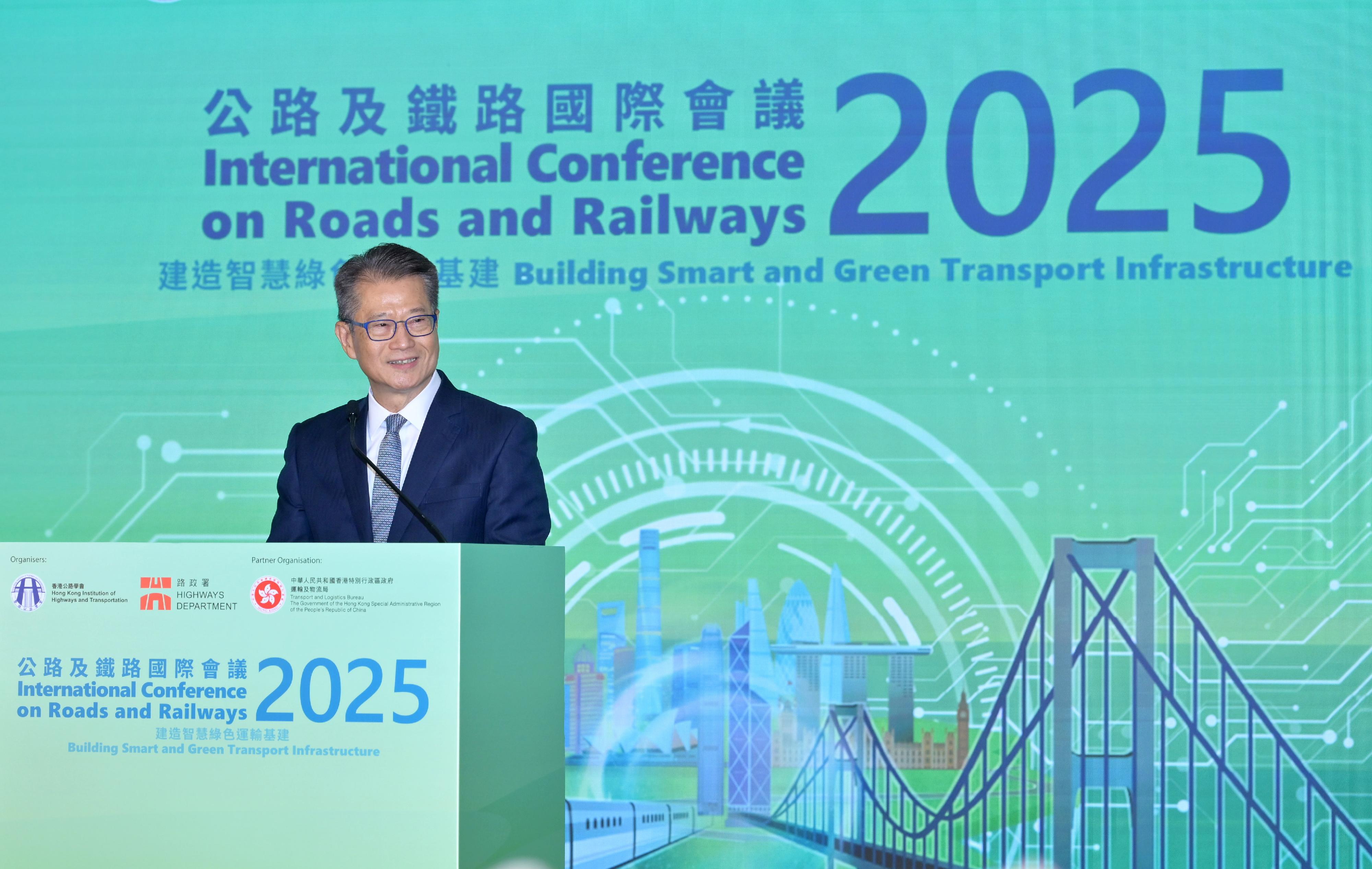
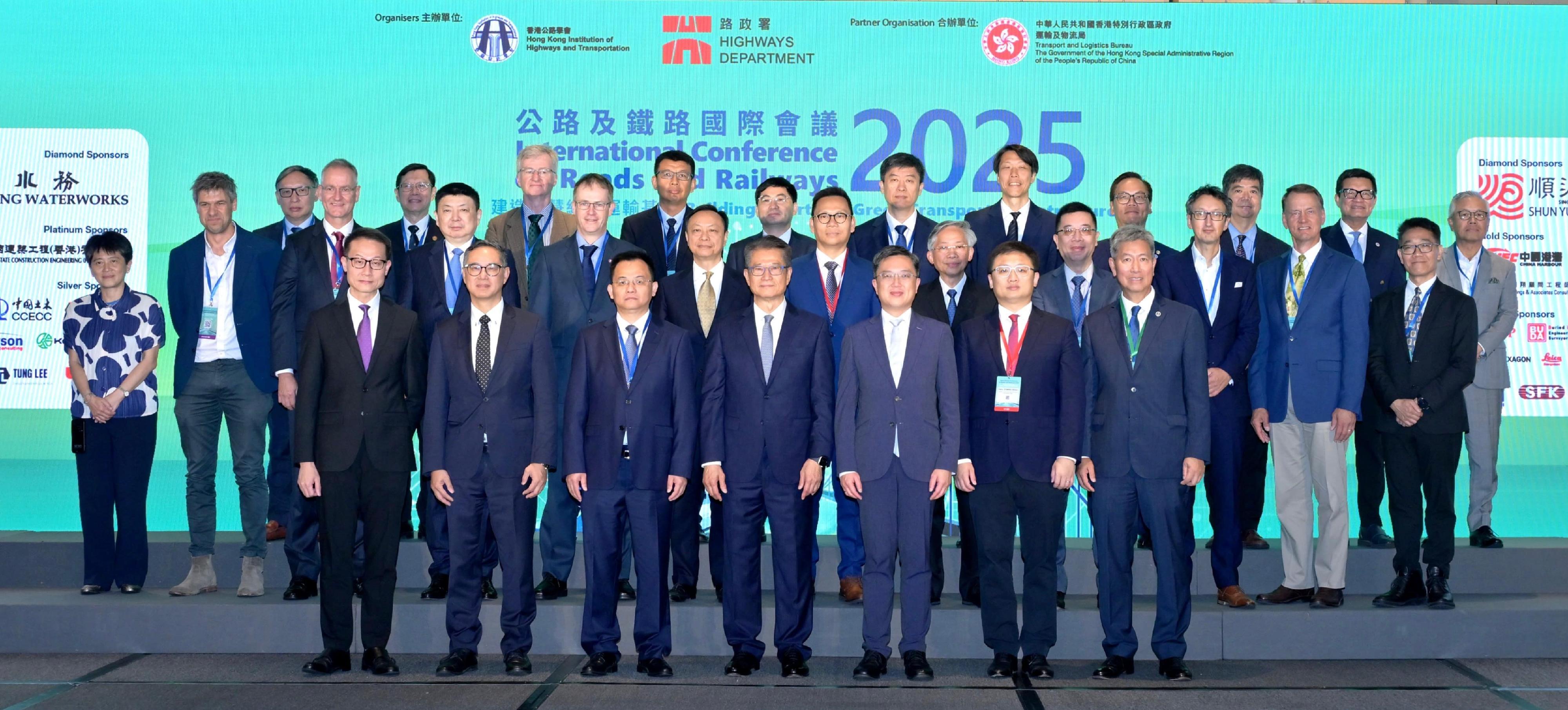
Following is the speech by the Financial Secretary, Mr Paul Chan, at the International Conference on Roads and Railways 2025 today (June 12):
Alfred (President of the Hong Kong Institution of Highways and Transportation, Mr Alfred Leung), Vice President Wang (Vice President of the Research Institute of Highway of the Ministry of Transport of the People's Republic of China Mr Wang Shuiyin), Tony (Director of Highways, Mr Tony Yau), distinguished guests and speakers, ladies and gentlemen,
Good morning. It is a great pleasure to join you today at the inaugural International Conference on Roads and Railways – a timely and important gathering that brings together a distinguished community of policymakers, engineers, academics and industry leaders to explore the future of connectivity and sustainable mobility.
To our guests from the Mainland and overseas, a very warm welcome to Hong Kong.
The future of roads and railways
Roads and railways have long been the backbone of economic growth and social advancement. They are more than just physical infrastructure; they are public goods that connect people, expand opportunities, foster mutual understanding, and enable more inclusive development.
In an era of rapid technological advancement and growing climate urgency, we are called not only to build infrastructure, but to build it smarter and greener. Transportation systems must be designed, constructed, operated, and maintained in ways that align with the sustainable development goals and meet the needs of future generations.
Around the world, the momentum towards smart and sustainable mobility is accelerating. Emerging technologies, from artificial intelligence and the Internet of Things, to automation and digital twin systems, are transforming how we plan and manage transport infrastructure. These innovations are helping us optimise construction engineering, enable real-time traffic management, and apply AI-powered predictive maintenance that cuts costs, reduces downtime and enhances safety.
In short, we are seeing a profound shift from traditional infrastructure to intelligent assets that adapt, learn and improve over time.
At the same time, the global push for decarbonisation is reshaping the transport landscape, calling for action on multiple fronts such as using low-carbon materials in construction; designing infrastructure to support green logistics; and investing in EV charging networks as critical enablers of clean transport. It also means leveraging smart technologies, such as optimising energy consumption through AI, sensor-based monitoring, modular construction, and more, to reduce emissions across the life cycle of transport assets.
Green infrastructure, once a goal, is now a necessity.
A key strategy in this transition is transit-oriented development, or TOD, which is a planning approach that integrates high-density urban development with efficient public transport systems. It clusters housing, commercial services and amenities around transit hubs, reducing reliance on private vehicles and cutting greenhouse gas emissions.
Studies show that well-executed TOD can reduce urban carbon emissions by up to 25 per cent, while also enhancing liveability, walkability and economic vitality. In essence, TOD is about building communities that are compact, connected and carbon-conscious.
Hong Kong's experience
So where does Hong Kong stand in all these – and how can we contribute? I believe there are several areas that Hong Kong can share experience with our peers.
First, technological expertise and professional excellence. Hong Kong's pathway in transport infrastructure is built on advanced engineering know-how, precision planning, and a commitment to innovation. Mable, our Secretary for Transport and Logistics, will soon provide a detailed account of how we are taking the projects forwards and how we are applying advanced technologies. But allow me to highlight a few unique features of our experience.
Hong Kong is a compact and high-density city, where land is scarce and infrastructure must coexist with tight urban spaces. This has made us a pioneer in TOD, with railways serving as the backbone of urban development. Our railway-led planning integrates transport, housing and commercial uses to create seamlessly connected and lower-emission communities.
A good example is the Northern Metropolis, envisioned as a major innovation and technology hub. With a projected population of 2.5 million and over 650 000 new jobs, its development will be "infrastructure-led" and "capacity-creating" – with key projects such as the Northern Metropolis Highway and the Northern Link driving connectivity and growth in the region.
Given our dense built environment, careful planning and community engagement are essential to avoid undue disruption. While this can be time-consuming, it reminds us of the need to build infrastructure that is responsive to public aspirations and socially inclusive.
Cross-boundary land transport infrastructure is a defining characteristic of Hong Kong. We have nine land boundary control points. From the Hong Kong-Zhuhai-Macao Bridge to the High Speed Rail, we have experience in integrating different engineering standards, operational models and even legal frameworks. A good example is the co-location of Mainland's and Hong Kong's customs, immigration and quarantine facilities at the Hong Kong West Kowloon Station. These projects require a high degree of agility, co-ordination with our counterparts and innovation.
Second, smart and green innovation. Hong Kong is committed to making our transport systems smarter and greener, both as an innovator of new technologies and a user of cutting-edge solutions.
On the innovation side, we are investing heavily in four key technology areas: AI and robotics, biotech, fintech, and new energy and materials. Our goal is to become an international innovation and technology hub, with AI at its core.
We already have a vibrant ecosystem of some 4 700 start-ups. In addition, we have been making good progress in attracting strategic enterprises to establish their presence, including R&D centres, here in Hong Kong. These include companies engaged in EVs, autonomous driving, smart traffic management and green materials, many of which are eager to seek global partners to expand their applications.
On the application side, our high-density urban environment demands the use of advanced technologies to maintain efficiency and reliability of the transportation system. The opportunities in this space are vast, and we warmly welcome tech innovators from around the world to share solutions, co-create new applications, and shape the future of mobility together.
Finally, financing the future. Hong Kong's role as an international financial centre gives us a unique and powerful lever to support infrastructure development globally.
With a full suite of funding options, Hong Kong is where infrastructure projects from around the world can raise funds. This is particularly relevant for green, low-carbon infrastructure projects. We are Asia's leading green bond market, accounting for nearly half of the region's total issuance.
And we are also pioneering innovative financing models to unlock capital for infrastructure development. One such example is securitisation of infrastructure loans, a mechanism that transforms mature, revenue-generating brownfield assets into investment products, thereby freeing up capital for new greenfield projects. To date, Hong Kong has issued two such tranches, totalling US$800 million, supporting over 50 projects across the Middle East, Asia-Pacific and Latin America.
In regions where infrastructure funding gap remains urgent and significant – particularly in the Global South – Hong Kong offers practical and scalable ways to accelerate the delivery of essential and sustainable transport networks.
Concluding remarks
Ladies and gentlemen, to conclude, I believe the path to smarter and greener mobility is full of potential – and it is through collaboration, innovation and shared commitment that we will realise it.
On this note, I would like to extend my heartfelt thanks to the Transport and Logistics Bureau, the Highways Department, and the Hong Kong Institution of Highways and Transportation for organising this meaningful conference.
I wish the conference every success, and I look forward to the ideas and partnerships that will emerge from these three exciting days. Thank you very much.