A male police constable preliminarily tested positive for COVID-19

     A 35-year-old male police constable who is posted to the Patrol Sub-unit of Wan Chai Division, preliminarily tested positive for the Coronavirus Disease (COVID-19). He felt unwell on May 29 and sought medical treatment at a clinic with arrangement of COVID-19 test. He was preliminarily tested positive for COVID-19 today (May 31). He has no travel history in the past 14 days. He wore face masks during his tour of duty. His last working day was May 31.

     Police are highly concerned and have the following messages:

     (1) While awaiting further assessment and recommendation by the Department of Health (DH), all police officers and civilian staff who might have been in contact with the officer concerned have been arranged to undergo COVID-19 test as instructed by the DH;

     (2) All facilities in the office concerned have been sterilised;

     (3) All officers have been reminded to reduce social contact to minimise risks of infection, and to pay attention to physical health. If feeling unwell, they should consult a doctor and report the case immediately;

     (4) Police will deploy resources flexibly to ensure provision of policing services of the areas concerned remains unaffected.

     Police will maintain close communication with the DH and provide assistance in tracing the pathology, by proactively providing information such as the duty record and roster of the officer concerned. Arrangements will be made for close contacts to be conveyed to quarantine centres to undergo quarantine.


Speech by SJ at “Why Use Hong Kong Law” webinar (English only)(with photo)

     Following is the speech by the Secretary for Justice, Ms Teresa Cheng, SC, at the "Why Use Hong Kong Law" webinar today (May 31):

Mr Justice Poon (the Chief Judge of the High Court), distinguished panellists, ladies and gentlemen,

     I am delighted to welcome you to the third edition of the "Why Hong Kong" series – "Why Use Hong Kong Law".

     Hong Kong is renowned for having a sound and mature legal system, supported by an independent judiciary and a strong rule of law tradition. Hong Kong is the only jurisdiction within China practicing common law, as entrenched in the Basic Law. The common law system in Hong Kong has a history of 150 years with ample precedents. Hong Kong cases are frequently cited in overseas jurisprudence, reflecting the quality of our judiciary and legal system.

     The respect our independent judiciary enjoys is evidenced and supported by eminent judges from other common law jurisdictions sitting on our highest court, the Court of Final Appeal. As Lord Sumption, a former Judge of the United Kingdom Supreme Court and a Non-Permanent Justice of the Hong Kong Court of Final Appeal remarked: "the presence of foreign judges on Hong Kong's Court of Final Appeal is one of the most striking pointers to the standing of Hong Kong as a world city." He further observed that the permanent judiciary of Hong Kong is completely committed to judicial independence and the rule of law. 

     Additionally, Hong Kong is home to legal, deal making and dispute resolution professionals from all over the world, symbolising the international connectivity of the profession. As of March 2021, there are 1 540 registered foreign lawyers in Hong Kong from 33 jurisdictions and 86 registered foreign law firms.

     The strength of Hong Kong law, especially in the civil and commercial fields, is internationally recognised. In the World Competitiveness Yearbook 2020, Hong Kong's ranking remained first globally in the "Business legislation" sub-factor and in the indicator "Legal and regulatory framework".

     We must however not be complacent. Riding on the "one country, two systems" policy, we establish unique arrangements with Mainland China that no other jurisdiction in the world would be otherwise entitled to.

     In arbitration, under the interim measures arrangement and the supplemental arrangement on the enforcement of arbitral awards we have concluded with the Mainland, parties to Hong Kong arbitrations can seek protection measures from the Mainland courts such as the freezing of assets and injunction during the arbitration, and at the start of the court proceedings for recognition and enforcement of the Hong Kong awards. These arrangements are unique to Hong Kong.

     By an arrangement with the Mainland on the reciprocal recognition and enforcement of civil and commercial judgments, Hong Kong court judgments will be enforceable in the Mainland. Going one step further, beyond what the Hague Judgments Convention currently provides, this unique arrangement additionally includes mutual enforcement of certain intellectual property judgments.

     The most recent unique arrangement arising out of the "one country, two systems" policy is in the area of insolvency and restructuring. Under a new co-operation mechanism between Hong Kong and the Mainland, liquidators and provisional liquidators from Hong Kong may apply to a court in Shanghai, Xiamen and Shenzhen for recognition and assistance. On the other hand, bankruptcy administrators from the Mainland may continue to apply to our High Court for recognition and assistance according to the existing common law principles in Hong Kong. Hong Kong is the only jurisdiction to establish such a unique co-operation mechanism with the Mainland in this area.

     On the domestic front, our laws are continuously updated to attract businesses. One of the strongest infrastructures in Hong Kong is its financial system and as you will hear later, we have recently passed the Limited Partnership Fund Ordinance to introduce a new entity type for private equity and venture capital funds for Hong Kong. Further amendments have been introduced to the Inland Revenue Ordinance to allow for tax concessions for carried interest of private equity funds operating in Hong Kong.

     Ladies and gentlemen, may I conclude by thanking the organisers and speakers and sponsors for their support, and hope that you will see more clearly the benefits of choosing Hong Kong law as the governing law for your transactions. Thank you.
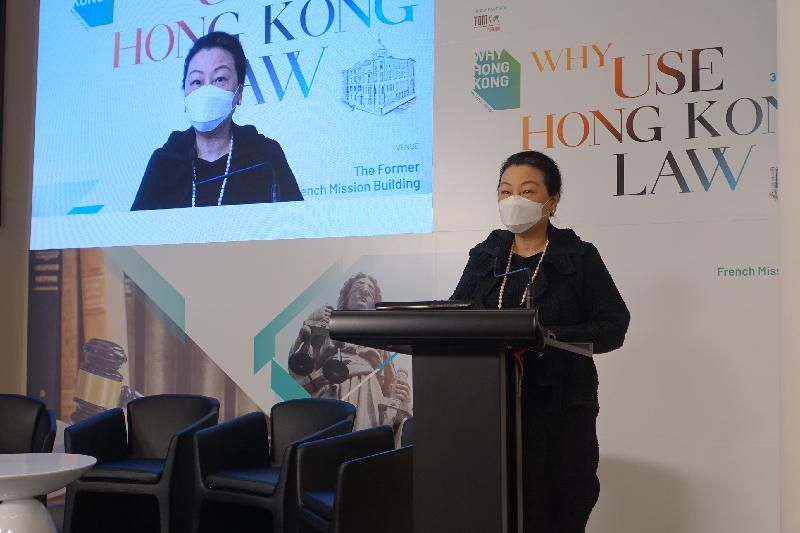
Photo  


Monetary statistics for April 2021

The following is issued on behalf of the Hong Kong Monetary Authority:
 
     According to statistics published today (May 31) by the Hong Kong Monetary Authority, excluding the deposits created by the initial public offering (IPO)-related loans, total deposits and Hong Kong dollar deposits with authorised institutions increased by 0.3 per cent and 0.1 per cent respectively in April 2021. In the year to end-April, total deposits and Hong Kong dollar deposits grew by 1.2 per cent and 2.2 per cent respectively.
 
     Large-scale IPO activities at the end of March caused an increase in deposits that resulted in a high base effect. As these IPO activities ended and issuers returned application monies, total deposits remained virtually unchanged in April. Among the total, Hong Kong dollar deposits declined by 0.5 per cent, while overall foreign currency deposits increased by 0.6 per cent. Renminbi deposits in Hong Kong increased by 1.2 per cent to RMB782.0 billion at the end of April. The total remittance of renminbi for cross-border trade settlement amounted to RMB561.8 billion in April, compared with RMB676.4 billion in March. It should be noted that changes in deposits are affected by a wide range of factors, such as interest rate movements and fund-raising activities. It is therefore more appropriate to observe the longer-term trends, and not to over-generalise fluctuations in a single month.
 
     Excluding the IPO-related loans, total loans and advances edged up by 0.2 per cent in April, and increased by 2.6 per cent in the year to end-April. As IPO activities ended and customers repaid subscription loans, total loans and advances edged down by 0.2 per cent in April. Among the total, loans for use in Hong Kong (including trade finance) and loans for use outside Hong Kong decreased by 0.2 per cent and 0.1 per cent respectively. The Hong Kong dollar loan-to-deposit ratio edged down to 83.2 per cent at the end of April from 83.3 per cent at the end of March, as Hong Kong dollar deposits decreased at a slower pace than Hong Kong dollar loans.
 
     Hong Kong dollar M2 and M3 both went down by 0.6 per cent in April, but grew by 8.1 per cent and 8.0 per cent respectively compared to a year ago. The seasonally-adjusted Hong Kong dollar M1 edged up by 0.2 per cent in April, and rose by 27.4 per cent compared to a year ago, reflecting in part investment-related activities. Total M2 and M3 both edged up by 0.1 per cent in April, and rose by 5.6 per cent and 5.5 per cent respectively from a year earlier. Excluding the deposits created by the IPO-related loans, Hong Kong dollar M2 and M3 both edged down by 0.1 per cent in April, but both went up by 2.0 per cent in the year to end-April; total M2 and M3 both increased by 0.3 per cent in April, and both increased by 1.0 per cent in the year to end-April.
 
     As monthly monetary statistics are subject to volatilities due to a wide range of transient factors, such as seasonal and IPO-related funding demand as well as business and investment-related activities, caution is required when interpreting the statistics.


Public hospitals daily update on COVID-19 cases

The following is issued on behalf of the Hospital Authority:

     As at 9am today (May 31), no COVID-19 confirmed patient was discharged from hospital in the last 24 hours. So far, a total of 11 572 patients with confirmed or probable infection have been discharged.
 
     At present, there are 619 negative pressure rooms in public hospitals with 1 130 negative pressure beds activated. A total of 25 confirmed patients are currently hospitalised in 13 public hospitals and the North Lantau Hospital Hong Kong Infection Control Centre, among which one patient (case number: 6794) is in critical condition, one (case number: 9907) is in serious condition and the remaining 23 patients are in stable condition.
 
     The Hospital Authority will maintain close contact with the Centre for Health Protection to monitor the latest developments and to inform the public and healthcare workers on the latest information in a timely manner.


CHP investigates suspected case of food poisoning

     The Centre for Health Protection (CHP) of the Department of Health is today (May 31) investigating a suspected food poisoning case involving consumption of mushrooms.

     The case involves a 56-year-old woman who developed nausea, vomiting and abdominal pain about four and a half hours after consuming mushrooms purchased from a store in Tseung Kwan O and cooked at home on May 30. The patient was discharged after seeking medical attention at the Accident and Emergency Department of Tseung Kwan O Hospital today. She has been in stable condition all along.

     The CHP investigations are ongoing and the Food and Environmental Hygiene Department was also alerted to the case.

     "Mushroom poisoning is generally acute. Common presentations include gastrointestinal symptoms such as nausea, vomiting and abdominal pain appearing shortly after ingestion. Depending on the mushroom species, patients may also have other symptoms like profuse sweating, hallucination, coma or other neurological symptoms as well as liver failure. Death may result in severe cases," a CHP spokesman said.

     "We advise the public to buy mushrooms from reputable and reliable suppliers and not to buy mushroom products which may be mixed with unknown species. Members of the public should not pick wild mushrooms for consumption as it is difficult to distinguish edible mushroom species from inedible ones. Mixing of edible species with inedible or poisonous species of mushroom will not dilute toxicity. Cooking in most cases does not destroy toxicity," the spokesman added.

     "If mushroom poisoning is suspected, the patient should seek immediate medical attention and bring along any available remnant for identification," the spokesman said.