COVID-19 Vaccination Programme statistics

     The COVID-19 Vaccination Programme has been implemented for 97 days since February 26, 2021.
 
     So far, about 2 466 500 doses of vaccines have been administered under the Vaccination Programme. Details are as follows:
 

  Number of persons  receiving Sinovac vaccine Number of persons receiving BioNTech vaccine Total number of doses
First vaccine dose 617 300 801 800 1 419 100
Second vaccine dose 447 100 600 300 1 047 400

* The numbers are rounded to the nearest hundred.
 
     In the 24 hours ending at 8pm today (June 2), about 32 400 persons have received vaccination and about 41 700 new vaccination bookings have been made online. Details are as follows:
 

  Sinovac vaccine BioNTech vaccine
Number of persons receiving first dose 11 300 8 400
Number of persons receiving second dose 5 400 7 200
Overall percentage of persons receiving vaccines at Community Vaccination Centres (CVCs) 96% 97%
Number of online bookings for receiving first and second vaccine doses 15 200 26 500

* The numbers are rounded to the nearest hundred.
 
     In the 24 hours ending at 0.00am today, there were five cases of ambulance transfer to hospital from CVCs or designated general out-patient clinics of the Hospital Authority. They were sent to hospital after experiencing common side effects after vaccination and were in stable condition. Four of them were discharged and one person was admitted for observation.


Update on monitoring COVID-19 vaccination

     â€‹In the preceding week till 11.59pm on May 30, the Department of Health (DH) received 183 reports (Note 1) of adverse events following COVID-19 immunisation. No death case was reported by the Hospital Authority (HA) involving individuals who had received vaccines within 14 days before they passed away.
      
     As at 8pm on May 30, about 2.36 million doses of COVID-19 vaccines had been administered for members of the public. Around 1.35 million people had received at least one dose of vaccine, accounting for 20.7 per cent of the population aged 16 or above. The DH received 3 289 reports (Note 1) of adverse events (0.14 per cent of the total vaccine doses administered), including 21 death cases with vaccination within 14 days before they passed away (0.0009 per cent of total vaccine doses administered).
      
     As at May 30, the Expert Committee on Clinical Events Assessment Following COVID-19 Immunisation (Note 2) had concluded that six death cases had no causal relationship with vaccination, and preliminarily considered that 15 cases were not associated with vaccination. The Expert Committee considered that there is no unusual pattern identified so far, and will continue to closely monitor the relevant situation and collect data for assessment.
      
     According to information from the HA, during the period from May 3 to May 30, the ratio of death cases out of those without a vaccination record was 54.8 cases for every 100 000 people, whereas the ratio of death cases for those with a vaccination record was 2.9 cases for every 100 000 people. The overall death rate is similar to that recorded in the past three years. Out of those without a vaccination record, the ratio of death cases with acute stroke or acute myocardial infarction was 2.6 cases for every 100 000 people, whereas the ratio of death cases under the same category for those with a vaccination record was 0.4 cases for every 100 000 people. Furthermore, the ratio of miscarriage cases out of those without a vaccination record was 25.0 cases for every 100 000 people, whereas the ratio of miscarriage cases for those who had a vaccination record was 4.2 cases for every 100 000 people. Based on the statistical analysis of the above figures, there is no evidence that vaccination increases the risk of death or miscarriage for recipients. The relevant reference statistics will be uploaded to the thematic website for the COVID-19 Vaccination Programme.
      
     The majority of non-death cases of adverse events received so far are relatively minor cases. The relevant details can be found in the "Report on the Safety Monitoring of COVID-19 Vaccines in Hong Kong" (www.drugoffice.gov.hk/eps/do/en/doc/Safety_Monitoring_of_COVID-19_Vaccines_in_Hong_Kong.pdf).
      
     The Expert Committee convened a regular meeting on June 1 to assess one death case within 14 days following COVID-19 immunisation during the period from May 17 to May 30. The relevant details are in Annex.

Note 1: Provisional figures

Note 2: The Expert Committee on Clinical Events Assessment Following COVID-19 Immunisation performs continuous monitoring of the possible adverse events following administration of COVID-19 vaccines, and provides professional views and suggestions on safety monitoring of the authorised COVID-19 vaccines. The membership list and the key functions of the Expert Committee can be found at the following website (www.covidvaccine.gov.hk/en/expert).


Government to gazette compulsory testing notice

     â€‹The Government will exercise the power under the Prevention and Control of Disease (Compulsory Testing for Certain Persons) Regulation (Cap. 599J) and publish in the Gazette a compulsory testing notice, which requires any person who had been present at six specified premises during the specified period (persons subject to compulsory testing) to undergo a COVID-19 nucleic acid test.

     A spokesman for the Food and Health Bureau reminded the public that persons who have completed a COVID-19 vaccination course would be taken to have complied with the requirements set out in the compulsory testing notices and hence are not required to undergo compulsory testing. Completion of the vaccination course in general means having received two doses of COVID-19 vaccine 14 days ago.

     Since there were outbreaks of upper respiratory tract infection and/or influenza-like illness in six schools, and the symptoms of the diseases concerned are similar to those of COVID-19, for prudence's sake, five schools and the specified level of another school are covered in the compulsory testing notice today (June 2). Under existing practice, the Centre for Health Protection (CHP) will provide schools subject to compulsory testing with stool specimen bottles and deep throat saliva specimen collection packs direct.
      
     Details of the compulsory testing notice are in Annex 1.

     In addition, subsequent to the announcement by the CHP on the updated quarantine arrangements of local COVID-19 cases with the N501Y mutant strain, persons who resided or worked within the same building as the residence of relevant cases and had been released from the quarantine centres will be subject to compulsory testing on the third, seventh, 12th and 19th day counting from the announcement of the relevant confirmed case by the Department of Health (DH). Relevant persons have to undergo testing on specified dates. They will also be required to undergo self-monitoring until the 21st day (see the details of the buildings and dates of testing at www.coronavirus.gov.hk/pdf/CTN_Specified_premises_and_Dates_of_Testing.pdf).

     In accordance with the compulsory testing notice issued earlier, all household members of close contacts are required to undergo compulsory testing. Any person who had lived with a person placed under quarantine pursuant to section 22 of the Prevention and Control of Disease Regulation (Cap. 599A) (person under quarantine) in the same residential unit on the date of commencement of quarantine or during the 14 days before that day, and who becomes aware of the quarantine of the person under quarantine when the relevant quarantine has not yet been completed, has to undergo testing within two days of him or her becoming aware that the person under quarantine has been placed under quarantine and report to the Government the result of the test by phone (6275 6901), fax (2530 5872) or email (ct@csb.gov.hk) within three days of undergoing the test.

     Currently, there are a total of 21 community testing centres (CTCs) providing testing services for the public, including free service for persons subject to compulsory testing. Booking and walk-in services are available. Members of the public only need to provide simple personal information on the 24-hour booking system (www.communitytest.gov.hk/en). The system was enhanced to show the booking status of the centres for the coming two weeks to facilitate the public's planning and selection of a suitable testing centre and a time slot for testing. The testing centres will accord priority to serve individuals with advance bookings. The number of tests available for appointments at CTCs has been increased to over 46 000 per day, and additional manpower has been deployed to serve the public. As of 6pm today, there were around 34 000 booking places available for tomorrow (June 3) at the CTCs, and around 85 per cent and 91 per cent availability for booking places for the coming seven days and 14 days respectively. Members of the public may call the testing centres for enquiries on the availability of bookings or walk-in quotas before visiting the centres.

      Coupled with the 21 CTCs, there will be a total of 36 CTCs/mobile specimen collection stations in various districts tomorrow to provide free service for persons subject to compulsory testing. The testing capacity should be sufficient to meet the demand. The opening dates and operating hours of the mobile specimen collection stations in various districts providing free COVID-19 nucleic acid testing services for the general public are stated in Annex 2. Persons subject to compulsory testing and those with the "LeaveHomeSafe" COVID-19 exposure notification or SMS notification from the CHP reminding them to undergo testing as soon as possible may receive free testing at CTCs or mobile specimen collection stations (if the service scope is applicable).

     Persons subject to compulsory testing may choose to undergo testing via the following routes:

1. To visit any of the mobile specimen collection stations (see the list and target groups (if applicable) at www.coronavirus.gov.hk/eng/early-testing.html) for testing;
2. To attend any of the CTCs (see the list at www.communitytest.gov.hk/en);
3. To obtain a deep throat saliva specimen collection pack from any of the 121 post offices, vending machines set up at 20 MTR stations or 47 designated general outpatient clinics (GOPCs) of the Hospital Authority and return the specimen to one of the designated specimen collection points (see the distribution points and times, and the specimen collection points and times, at www.coronavirus.gov.hk/eng/early-testing.html);
4. To undergo testing at any of the GOPCs of the Hospital Authority as instructed by a medical professional of the Hospital Authority;
5. To self-arrange testing provided by private laboratories which are recognised by the DH and can issue SMS notifications in respect of test results (see the list at www.coronavirus.gov.hk/pdf/List_of_recognised_laboratories_RTPCR.pdf); or
6. To use a specimen bottle distributed to the relevant specified premises by the CHP (if applicable), and return the specimen bottle with the sample collected as per relevant guidelines.

     The spokesman cautioned that testing received at Accident and Emergency Departments of the Hospital Authority or during hospital stays, or testing provided by private laboratories which cannot issue SMS notifications in respect of test results, does not comply with the requirements of the aforementioned compulsory testing notice.

     "If persons subject to compulsory testing have symptoms, they should seek medical attention immediately and undergo testing as instructed by a medical professional. They should not attend the mobile specimen collection stations or the CTCs."

     Persons subject to compulsory testing must keep the SMS notifications containing the result of the test for checking by a law enforcement officer when the officer requires the persons to provide information about their undergoing the specified test.

     Furthermore, persons subject to testing under the compulsory testing notices should, as far as reasonably practicable, take appropriate personal disease prevention measures including wearing a mask and maintaining hand hygiene, and, unless for the purpose of undergoing the specified test, stay at their place of residence and avoid going out until the test result is ascertained as far as possible.

     Any enquiries on compulsory testing arrangements may be addressed to the hotline at 6275 6901, which operates daily from 9am to 6pm. If persons subject to compulsory testing plan to conduct testing at any of the CTCs, they can check the centre's appointment status in advance. The hotlines of the CTCs are available at www.communitytest.gov.hk/en/info.

     The Government will continue to trace possibly infected persons who had been to the relevant premises, and seriously verify whether they had complied with the testing notices. Any person who fails to comply with the testing notices commits an offence and may be fined a fixed penalty of $5,000. The person would also be issued with a compulsory testing order requiring him or her to undergo testing within a specified time frame. Failure to comply with the order is an offence and the offender would be liable to a fine at level 4 ($25,000) and imprisonment for six months.

     Relevant officers of different government departments are empowered to perform certain functions under the relevant Regulations under the Prevention and Control of Disease Ordinance (Cap. 599), including requesting individuals to provide information and assistance when necessary. Any person who fails to comply with the relevant request commits an offence and would be liable to a fine at level 3 ($10,000). Collection and use of any personal data for conducting COVID-19 tests must meet the requirements under the Personal Data (Privacy) Ordinance (Cap. 486). Government departments or testing service providers which handle the relevant information may provide the data to the DH or other relevant departments for anti-epidemic purposes as necessary. The workflow does not involve the provision of any personal data to organisations or persons outside Hong Kong.

     The spokesman said, "The Government urges all individuals who are in doubt about their own health conditions, or individuals with infection risks (such as individuals who visited places with epidemic outbreaks or contacted confirmed cases), to undergo testing promptly for early identification of infected persons."


Government welcomes passage of Inland Revenue (Amendment) (Miscellaneous Provisions) Bill 2021

     The Secretary for Financial Services and the Treasury, Mr Christopher Hui, welcomed the passage of the Inland Revenue (Amendment) (Miscellaneous Provisions) Bill 2021 by the Legislative Council today (June 2).
 
     It will implement four areas of amendments to the Inland Revenue Ordinance (Cap. 112), namely the tax treatment for amalgamation of companies under the court-free procedures as provided for under the Companies Ordinance (Cap. 622); the tax treatment for transfer or succession of specified assets under certain circumstances; refining the statutory framework for the furnishing of tax returns; and enhancing the foreign tax deduction regime.
 
     Mr Hui said, "The Ordinance codifies the tax treatment with regard to qualifying amalgamations and the transfer or succession of specified assets, offering better clarity and certainty of the relevant matters.

     "It would also provide the legal basis to enable more businesses to voluntarily file tax returns, including financial statements, electronically, with the ultimate goal of implementing electronic filing of profits tax returns through the Business Tax Portal.
 
     "Enhancing the foreign tax deduction regime will reduce the tax liability of Hong Kong branches of foreign corporations, in particular foreign banks, and holders of intellectual property. It would help foster a more favourable business environment, particularly reinforcing Hong Kong's attractiveness as a banking location, and promoting Hong Kong as a research and development hub."
 
    The Ordinance will come into operation on its gazettal date (June 11). Amendments in relation to foreign tax deduction will take effect from the year of assessment 2021/22.


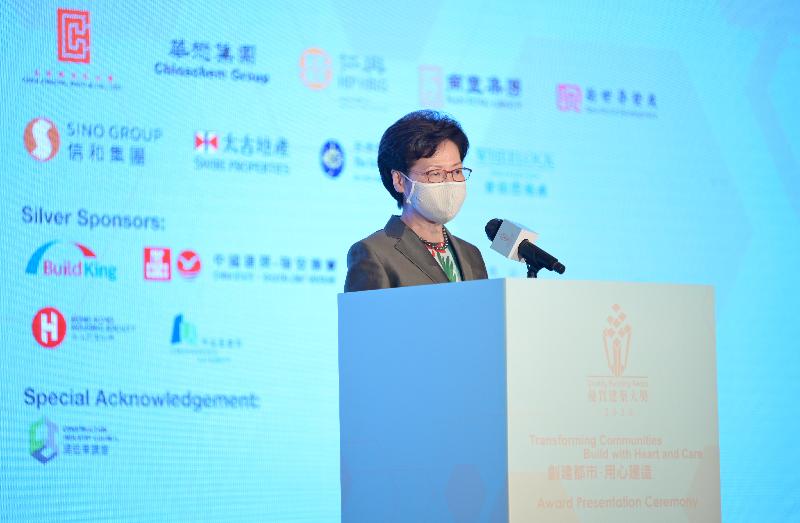
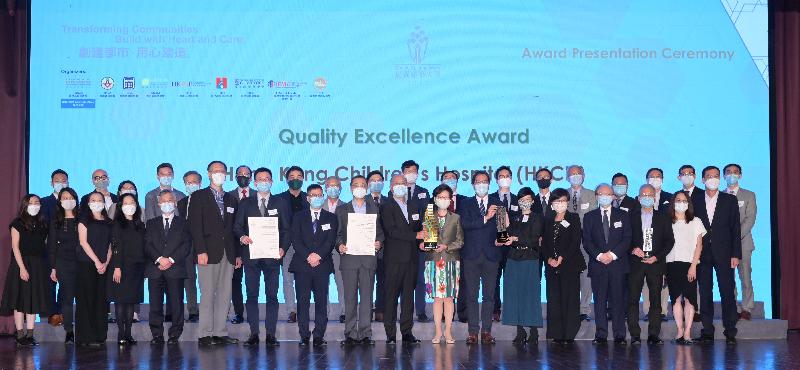
Speech by CE at Quality Building Award 2020 Award Presentation Ceremony (English only)(with photos/video)

     Following is the speech by the Chief Executive, Mrs Carrie Lam, at the Quality Building Award 2020 Award Presentation Ceremony today (June 2):
 
Ir Peter Mok (Chairman of the Organising Committee of the Quality Building Award 2020), distinguished guests, colleagues, ladies and gentlemen,
 
     Good afternoon. It is a pleasure to join you for the presentation ceremony of the Quality Building Award 2020.
 
     As some of you may recall, I was a frequent attendee in these biennial events.
 
     The pandemic, as you know, put an unfortunate pause on last year's ceremony. So I'm delighted that we are able to come together today to honour the 2020 winners of the Quality Building Award in this biennial presentation's 10th anniversary edition.
 
     "Transforming Communities, Build with Heart and Care", is the theme of the 2020 Award. While it may have been devised before the pandemic, it is a resounding reminder to all of us about the critical importance of building Hong Kong into a better city for all of us, and for the generations to follow us.
 
     "Building with heart" demands that you fulfil the wide-ranging needs of our community. In our continuing fight against the pandemic, those needs focus on healthcare. In this regard, I'm heartened and grateful at the speed with which the building industry responded to the emergency needs for quarantine and medical facilities. Applying modular integrated construction (MiC) technology, the first purpose-built quarantine facility with about 350 units was completed within two months at Lei Yue Mun Park. The speedy completion of the quarantine centre has been acclaimed by the Institution of Civil Engineers of the United Kingdom. Then came the sizeable North Lantau Hospital Hong Kong Infection Control Centre, featuring six ward blocks and a medical centre, which was completed in just four months. And since January 2020, more than 4 000 quarantine facility units, many of which in Penny's Bay, have been built, also through MiC. I visited those projects during their construction to thank the staff involved and was much impressed by their care and dedication.
 
     The "building with heart" philosophy goes also to the transitional housing units, many of which are also using the MiC method. As you all know, for years, Hong Kong has been haunted by the acute shortage of housing and we are now faced with a deterioration in the average waiting times for public rental housing. While my government has adopted a multi-pronged approach in finding land for housing, many of our efforts were hitherto frustrated by opposition at the planning and legislative process, let alone some organised localism activities aiming to obstruct our city's progress. In order to provide relief to families living in poor conditions, we have expanded and accelerated the provision of transitional housing with a pledge of 15 000 units in three years' time. I am pleased to say that sufficient temporary land has been identified for this purpose. The Transport and Housing Bureau's latest initiative to launch a pilot programme to support NGOs renting hotels and guesthouses to increase supply will also enable some early provision. 
 
     "Build with care" calls for caring for the environment as well as for the people. In 2017, more than 60 per cent of our carbon emissions came from generating electricity for our buildings. There is enormous potential to reduce our carbon footprint and, in doing so, contribute to the Government's climate pledge, that is to achieve carbon neutrality before 2050. In this, I am encouraged to note that many of the finalist projects for the Quality Building Award adopted energy-efficient design and green construction methods and materials.
 
     Whether you are "building with heart" or "building with care", you could be assisted by innovation and the application of technology. That is why the Development Bureau has been taking forward with the support of the industry various initiatives to implement "Construction 2.0". For this purpose, the HK$1 billion Construction Innovation and Technology Fund was set up in 2018 to support projects promoting technology innovation and talent development. So far, about 1 800 applications have been approved and more than 8 500 technology-training places subsidised.
 
     Considered design and management can enable the integration of new buildings with existing ones, as well as the communities that surround them. Our finalist projects have set a high benchmark for others to follow: in providing open space for users and the neighbourhood; in ensuring good relations with local residents; and, where applicable, in conserving heritage. As former Secretary for Development, I embrace such an approach and I am thrilled these days whenever I read positive news about our harbourfront and the tiny public play areas that we have created in co-operation with our talented designers. These projects have shown that installation of creative street furniture, the stylish use of space, the removal of certain conventional restrictions, and finally the trust placed in the users are offering smart leisure areas for activities across generations and create a sense of belonging among the residents in the community.
 
     In our highly compact city, where land resources are precious, embracing a multiple-use concept and ensuring versatility in designing buildings and public space are particularly relevant. In this regard, my Government supports a creative use of government sites. This includes the concept of "one site, multiple uses" as well as enabling NGOs to make use of unallocated land with no immediate use or rehabilitated landfills. 
 
     Ladies and gentlemen, as you are aware, we have recently enacted local legislation to implement an improved electoral system in accordance with the amended Annex I and Annex II to the Basic Law approved by the Standing Committee of the National People's Congress. The improved electoral system will ensure the faithful implementation of "One Country, Two Systems" and "patriots administering Hong Kong", effectively putting an end to the political chaos which impeded Hong Kong's progress in recent years. It will provide an environment for all of us to build Hong Kong's future, and I do mean it literally. The Government will spend at least HK$100 billion annually in capital works projects in the coming years. Together with the private sector, we forecast that the annual construction output in Hong Kong will total around $300 billion, generating over 300 000 employment opportunities. Our building and construction sector, and the wide-ranging industries and companies that drive it, can look forward to a future filled with opportunities. Judging by the Award entries, I'm confident that you will fill those opportunities with professionalism, care and passion.
 
     Allow me now to offer my gratitude to the record-high 49 submissions received for the 2020 Quality Building Award and the 25 shortlisted finalists. And my congratulations to the winners in the six award categories, as well as the overall winner to be announced in just a moment.
 
     My thanks to the Award's distinguished jurors and the organising committee for their long hard work, amid the daunting face of the pandemic, to make this gala event possible. My thanks, too, to the organisers, including the nine institutions which are essential to the success of Hong Kong's building and construction sector. 
 
     Ladies and gentlemen, I wish you all an enjoyable evening, and a year ahead filled with health, vitality and the best of business. Thank you.

Photo  Photo