LegCo Panel on Transport visits Citybus and New World First Bus Depot (with photos)

The following is issued on behalf of the Legislative Council Secretariat:

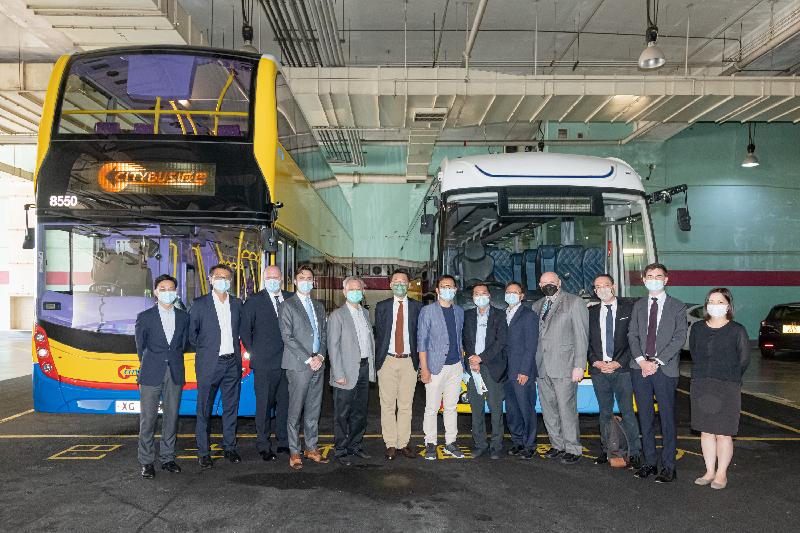
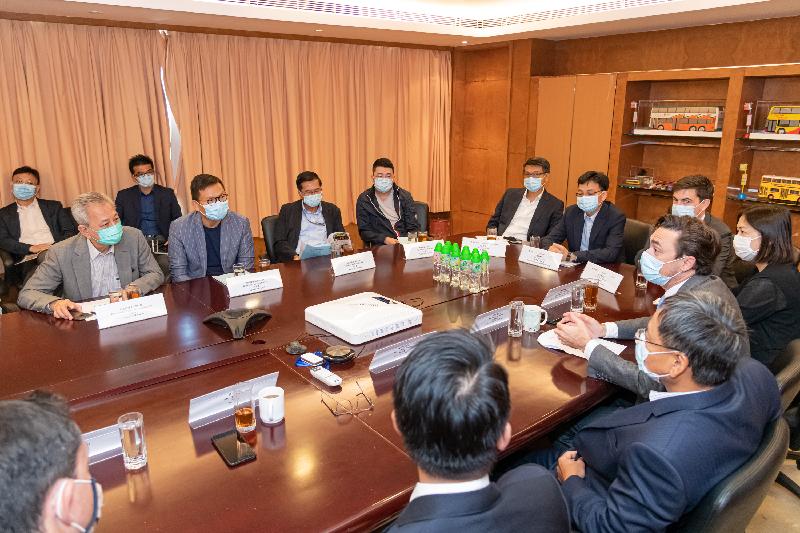
     The Legislative Council Panel on Transport (Panel) conducted a visit to the Citybus and New World First Bus Depot today (June 8) to understand the new features of buses and the operation of the bus depot.

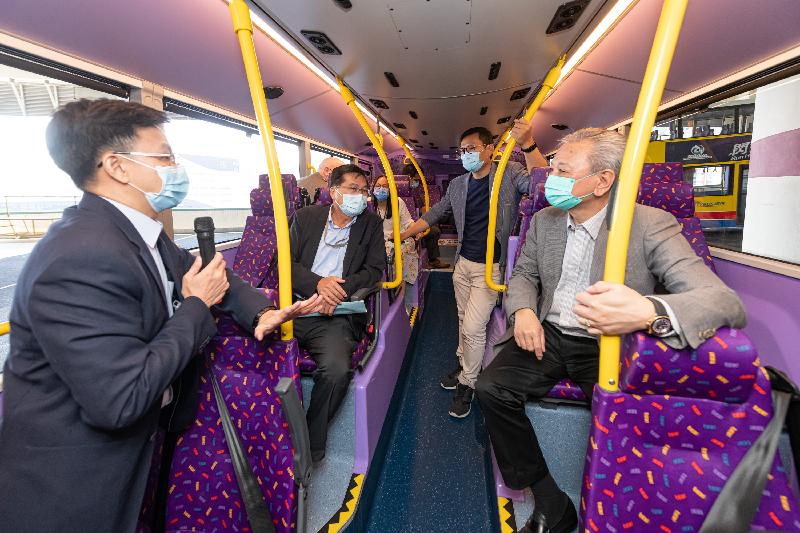
     Members took a Citybus to the bus depot in Chai Wan. They took the opportunity to learn more about various safety enhancement features and passenger-friendly facilities on the bus, including the electronic stability control system, active speed limiting system, advanced driver-assistance system that can monitor the driver's conditions, as well as the installation of seat belt on all seats, etc.

     Members were then briefed by representatives of the bus operators on their bus services and future development after arriving at the depot. They also exchanged views on issues of mutual concern. Members then had a tour in the bus depot and observed a new plug-in hybrid electric coach.  

     Members who participated in the visit were the Chairman of the Panel, Mr Frankie Yick; the Deputy Chairman, Mr Chan Han-pan; Panel Members Mr Poon Siu-ping and Mr Lau Kwok-fan.

Photo  Photo  Photo  


Hong Kong Customs seizes suspected dangerous drugs worth over $17 million in series of anti-narcotics operations (with photos)

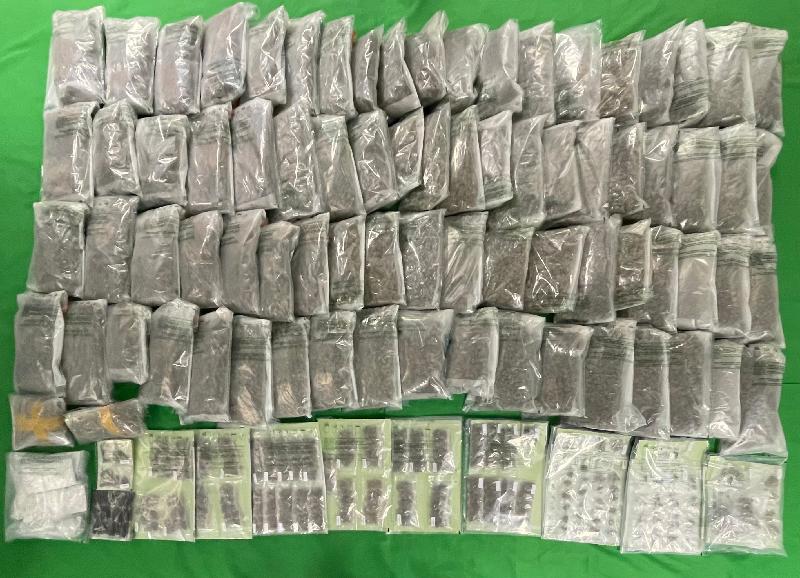
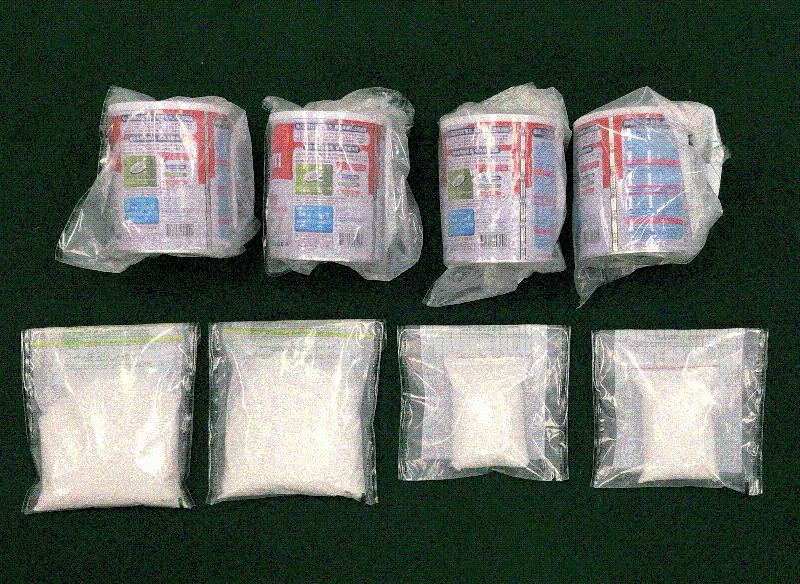
     Hong Kong Customs conducted a series of anti-narcotics operations between June 5 and today (June 8) and detected four dangerous drugs trafficking cases. A batch of suspected dangerous drugs worth about $17.3 million in total was seized in various districts and Hong Kong International Airport (HKIA), including about 41 kilograms of suspected cannabis buds, about 5kg of suspected cocaine, about 1.75kg of suspected ketamine, about 1.3kg of suspected cannabis resin and about 1kg of suspected methamphetamine. Nine men and two women, aged between 15 and 49, were arrested during the operations.

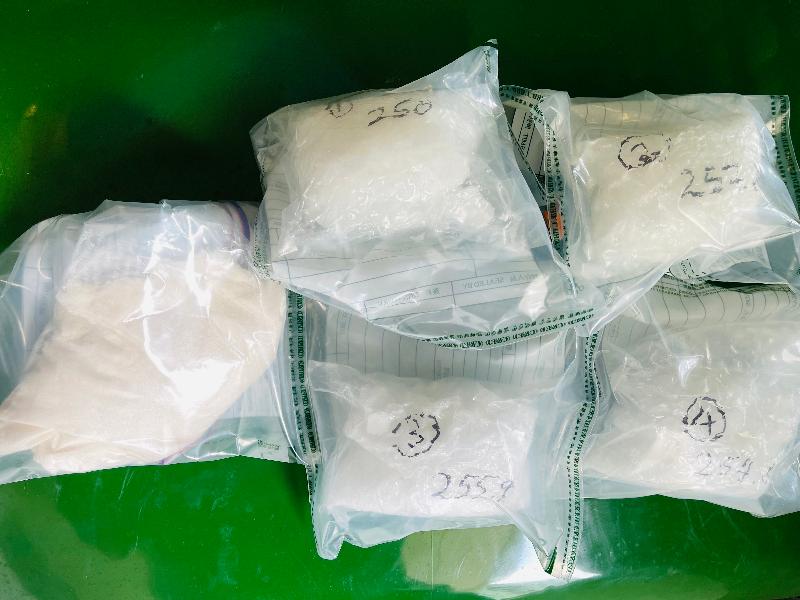
     Customs officers on June 5 inspected an air mail parcel arriving Hong Kong from the United Kingdom at HKIA and seized about 250 grams of suspected ketamine inside the parcel. After follow-up investigation, Customs officers today arrested a 40-year-old man suspected to be in connection with the case at a residential unit in Tai Wo Hau, where about 1kg of suspected methamphetamine and a batch of drug-packaging paraphernalia were further seized.

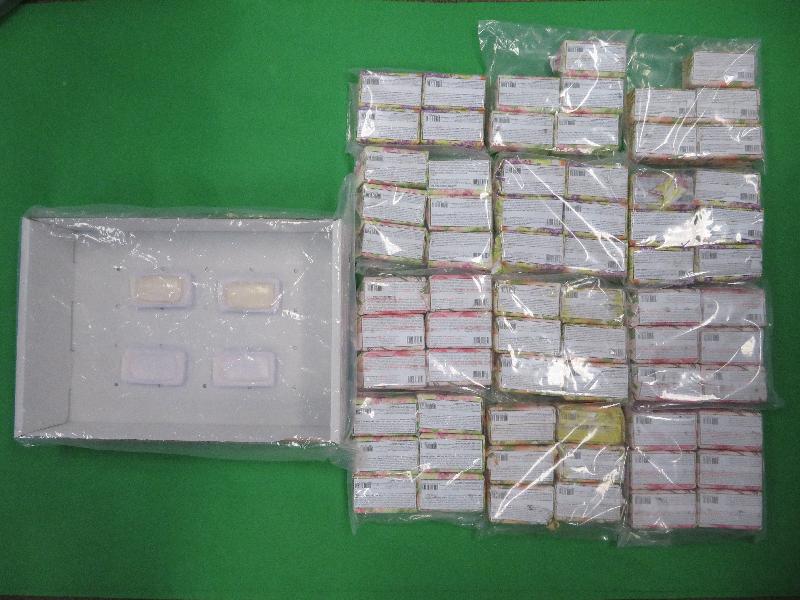
     On the next day (June 6), Customs officers inspected an air consignment at HKIA, declared as carrying soaps and cosmetics, arriving in Hong Kong from Brazil via Turkey. About 5kg of suspected cocaine was found concealed inside 70 bars of soap out of 864 bars. Four men and two women, aged between 15 and 49, suspected to be connected with the case were arrested in Yuen Long yesterday (June 7).

     Also, Customs officers had conducted anti-narcotics operations in town yesterday. The officers intercepted three men, aged between 29 and 43, in Tai Kok Tsui and Ma On Shan. About 41kg of suspected cannabis buds, about 1.3kg of suspected cannabis resin and a batch of drug-packaging paraphernalia were seized in one man's possession and the plastic bag he was carrying, in a residential unit in Tai Kok Tsui, a sub-divided unit in an industrial building in Tsuen Wan and a residential unit in Ma On Shan.

     During another anti-narcotics operation conducted in Ngau Chi Wan, Customs officers yesterday evening raided a 17-year-old man's residential unit in the district and found about 1.5kg of suspected ketamine concealed inside four metal cans. He was then arrested.

     Investigations of the four abovementioned cases are ongoing.

     Customs will continue to enhance enforcement against drug trafficking activities through intelligence analysis. The department also reminds members of the public to stay alert and not to participate in drug trafficking activities for monetary returns. They must not accept hiring or delegation from another party to carry controlled items into and out of Hong Kong. They are also reminded not to carry unknown items for other people, nor to release their personal data or home address to others for receiving parcels or goods.

     Under the Dangerous Drugs Ordinance, trafficking in a dangerous drug is a serious offence. The maximum penalty upon conviction is a fine of $5 million and life imprisonment.

     Members of the public may report any suspected drug trafficking activities to Customs' 24-hour hotline 2545 6182 or its dedicated crime-reporting email account (crimereport@customs.gov.hk).

Photo  Photo  Photo  Photo  


Government to gazette compulsory testing notice

     The Government will exercise the power under the Prevention and Control of Disease (Compulsory Testing for Certain Persons) Regulation (Cap. 599J) and publish in the Gazette a compulsory testing notice, which requires any person who had been present at seven specified premises during the specified period (persons subject to compulsory testing) to undergo a COVID-19 nucleic acid test.
     
     Since there were outbreaks of upper respiratory tract infection and/or influenza-like illness in seven schools, and the symptoms of the diseases concerned are similar to those of COVID-19, for prudence's sake, three schools and the specified level of four schools are covered in the compulsory testing notice today (June 8). Under existing practice, the Centre for Health Protection (CHP) will provide schools subject to compulsory testing with stool specimen bottles and deep throat saliva specimen collection packs direct.

     Details of the compulsory testing notice are in Annex 1.

     Subsequent to the announcement by the CHP on the updated quarantine arrangements of local COVID-19 cases with the N501Y mutant strain, persons who resided or worked within the same building as the residence of relevant cases and had been released from the quarantine centres will be subject to compulsory testing on the third, seventh, 12th and 19th day counting from the announcement of the relevant confirmed case by the Department of Health (DH). Relevant persons have to undergo testing on specified dates. They will also be required to undergo self-monitoring until the 21st day (see the details of the buildings and dates of testing at www.coronavirus.gov.hk/pdf/CTN_Specified_premises_and_Dates_of_Testing.pdf).

     In accordance with the compulsory testing notice issued earlier, all household members of close contacts are required to undergo compulsory testing. Any person who had lived with a person placed under quarantine pursuant to section 22 of the Prevention and Control of Disease Regulation (Cap. 599A) (person under quarantine) in the same residential unit on the date of commencement of quarantine or during the 14 days before that day, and who becomes aware of the quarantine of the person under quarantine when the relevant quarantine has not yet been completed, has to undergo testing within two days of him or her becoming aware that the person under quarantine has been placed under quarantine and report to the Government the result of the test by phone (6275 6901), fax (2530 5872) or email (ct@csb.gov.hk) within three days of undergoing the test.

     Persons who have completed a COVID-19 vaccination course would be taken to have complied with the requirements set out in the compulsory testing notices and hence are not required to undergo compulsory testing. Completion of the vaccination course in general means having received two doses of COVID-19 vaccine 14 days ago.

     Currently, there are a total of 21 community testing centres (CTCs) providing testing services for the public, including free service for persons subject to compulsory testing. Booking and walk-in services are available. Members of the public only need to provide simple personal information on the 24-hour booking system (www.communitytest.gov.hk/en). The system shows the booking status of the centres for the coming week to facilitate the public's planning and selection of a suitable testing centre and a time slot for testing. The testing centres will accord priority to serve individuals with advance bookings. The number of tests available for appointments at CTCs has been increased to over 46 000 per day, and additional manpower has been deployed to serve the public. As of 6pm today, there were around 36 000 booking places available for tomorrow (June 9) at the CTCs, and around 87 per cent availability for booking places for the coming seven days. Members of the public may call the testing centres for enquiries on the availability of bookings or walk-in quotas before visiting the centres.
 
     Outdoor mobile specimen collection stations will be closed if the Strong Wind Signal No. 3 or Red Rainstorm Warning Signal is hoisted while all mobile specimen collection stations together with all CTCs will be closed when the No. 8 Gale or Storm Signal or higher, or Black Rainstorm Warning Signal is hoisted.
 
     Coupled with the 21 CTCs, there will be a total of 38 CTCs/mobile specimen collection stations in various districts tomorrow to provide free service for persons subject to compulsory testing. The testing capacity should be sufficient to meet the demand. The opening dates and operating hours of the mobile specimen collection stations in various districts providing free COVID-19 nucleic acid testing services for the general public are stated in Annex 2. Persons subject to compulsory testing and those with the "LeaveHomeSafe" COVID-19 exposure notification or SMS notification from the CHP reminding them to undergo testing as soon as possible may receive free testing at CTCs or mobile specimen collection stations (if the service scope is applicable).

     Persons subject to compulsory testing may choose to undergo testing via the following routes:

1. To visit any of the mobile specimen collection stations (see the list and target groups (if applicable) at www.coronavirus.gov.hk/eng/early-testing.html) for testing;
2. To attend any of the CTCs (see the list at www.communitytest.gov.hk/en);
3. To obtain a deep throat saliva specimen collection pack from any of the 121 post offices, vending machines set up at 20 MTR stations or 47 designated general outpatient clinics (GOPCs) of the Hospital Authority and return the specimen to one of the designated specimen collection points (see the distribution points and times, and the specimen collection points and times, at www.coronavirus.gov.hk/eng/early-testing.html);
4. To undergo testing at any of the GOPCs of the Hospital Authority as instructed by a medical professional of the Hospital Authority;
5. To self-arrange testing provided by private laboratories which are recognised by the DH and can issue SMS notifications in respect of test results (see the list at www.coronavirus.gov.hk/pdf/List_of_recognised_laboratories_RTPCR.pdf); or
6. To use a specimen bottle distributed to the relevant specified premises by the CHP (if applicable), and return the specimen bottle with the sample collected as per relevant guidelines.

     A spokesman for the Food and Health Bureau cautioned that testing received at the Accident and Emergency Departments of the Hospital Authority or during hospital stays, or testing provided by private laboratories which cannot issue SMS notifications in respect of test results, does not comply with the requirements of the aforementioned compulsory testing notice.

     "If persons subject to compulsory testing have symptoms, they should seek medical attention immediately and undergo testing as instructed by a medical professional. They should not attend the mobile specimen collection stations or the CTCs."

     Persons subject to compulsory testing must keep the SMS notifications containing the result of the test for checking by a law enforcement officer when the officer requires the persons to provide information about their undergoing the specified test.

     Furthermore, persons subject to testing under the compulsory testing notices should, as far as reasonably practicable, take appropriate personal disease prevention measures including wearing a mask and maintaining hand hygiene, and, unless for the purpose of undergoing the specified test, stay at their place of residence and avoid going out until the test result is ascertained as far as possible.

     Any enquiries on compulsory testing arrangements may be addressed to the hotline at 6275 6901, which operates daily from 9am to 6pm. If persons subject to compulsory testing plan to conduct testing at any of the CTCs, they can check the centre's appointment status in advance. The hotlines of the CTCs are available at www.communitytest.gov.hk/en/info.

     The Government will continue to trace possibly infected persons who had been to the relevant premises, and seriously verify whether they had complied with the testing notices. Any person who fails to comply with the testing notices commits an offence and may be fined a fixed penalty of $5,000. The person would also be issued with a compulsory testing order requiring him or her to undergo testing within a specified time frame. Failure to comply with the order is an offence and the offender would be liable to a fine at level 4 ($25,000) and imprisonment for six months.

     Relevant officers of different government departments are empowered to perform certain functions under the relevant Regulations under the Prevention and Control of Disease Ordinance (Cap. 599), including requesting individuals to provide information and assistance when necessary. Any person who fails to comply with the relevant request commits an offence and would be liable to a fine at level 3 ($10,000). Collection and use of any personal data for conducting COVID-19 tests must meet the requirements under the Personal Data (Privacy) Ordinance (Cap. 486). Government departments or testing service providers which handle the relevant information may provide the data to the DH or other relevant departments for anti-epidemic purposes as necessary. The workflow does not involve the provision of any personal data to organisations or persons outside Hong Kong.

     The spokesman said, "The Government urges all individuals who are in doubt about their own health conditions, or individuals with infection risks (such as individuals who visited places with epidemic outbreaks or contacted confirmed cases), to undergo testing promptly for early identification of infected persons."
CHP closely monitors human case of avian influenza A(H5N6) in Chengdu

     The Centre for Health Protection (CHP) of the Department of Health (DH) is today (June 8) closely monitoring a human case of avian influenza A(H5N6) in Chengdu, Sichuan Province, and again urged the public to maintain strict personal, food and environmental hygiene both locally and during travel.
 
     The case involved a 49-year-old woman living in Chengdu. She developed symptoms on May 1, and was admitted for treatment on the same day. The patient is now in serious condition.
 
     From 2014 to date, 31 human cases of avian influenza A(H5N6) have been reported by the Mainland health authorities.
 
     "All novel influenza A infections, including H5N6, are notifiable infectious diseases in Hong Kong," a spokesman for the CHP said.
 
     Travellers to the Mainland or other affected areas must avoid visiting wet markets, live poultry markets or farms. They should be alert to the presence of backyard poultry when visiting relatives and friends. They should also avoid purchasing live or freshly slaughtered poultry, and avoid touching poultry/birds or their droppings. They should strictly observe personal and hand hygiene when visiting any place with live poultry.
 
     Travellers returning from affected areas should consult a doctor promptly if symptoms develop, and inform the doctor of their travel history for prompt diagnosis and treatment of potential diseases. It is essential to tell the doctor if they have seen any live poultry during travel, which may imply possible exposure to contaminated environments. This will enable the doctor to assess the possibility of avian influenza and arrange necessary investigations and appropriate treatment in a timely manner.
 
     While local surveillance, prevention and control measures are in place, the CHP will remain vigilant and work closely with the World Health Organization and relevant health authorities to monitor the latest developments.
 
     The public should maintain strict personal, hand, food and environmental hygiene and take heed of the advice below when handling poultry:
 

  • Avoid touching poultry, birds, animals or their droppings;
  • When buying live chickens, do not touch them and their droppings. Do not blow at their bottoms. Wash eggs with detergent if soiled with faecal matter and cook and consume the eggs immediately. Always wash hands thoroughly with soap and water after handling chickens and eggs;
  • Eggs should be cooked well until the white and yolk become firm. Do not eat raw eggs or dip cooked food into any sauce with raw eggs. Poultry should be cooked thoroughly. If there is pinkish juice running from the cooked poultry or the middle part of its bone is still red, the poultry should be cooked again until fully done;
  • Wash hands frequently, especially before touching the mouth, nose or eyes, before handling food or eating, and after going to the toilet, touching public installations or equipment such as escalator handrails, elevator control panels or door knobs, or when hands are dirtied by respiratory secretions after coughing or sneezing; and
  • Wear a mask if fever or respiratory symptoms develop, when going to a hospital or clinic, or while taking care of patients with fever or respiratory symptoms.

    
     The public may visit the CHP's pages for more information: the avian influenza page, the weekly Avian Influenza Reportglobal statistics and affected areas of avian influenza, the Facebook Page and the YouTube Channel.


CHP closely monitors human case of avian influenza A(H5N6) in Chengdu

     The Centre for Health Protection (CHP) of the Department of Health (DH) is today (June 8) closely monitoring a human case of avian influenza A(H5N6) in Chengdu, Sichuan Province, and again urged the public to maintain strict personal, food and environmental hygiene both locally and during travel.
 
     The case involved a 49-year-old woman living in Chengdu. She developed symptoms on May 13, and was admitted for treatment on May 16. The patient is now in serious condition.
 
     From 2014 to date, 31 human cases of avian influenza A(H5N6) have been reported by the Mainland health authorities.
 
     "All novel influenza A infections, including H5N6, are notifiable infectious diseases in Hong Kong," a spokesman for the CHP said.
 
     Travellers to the Mainland or other affected areas must avoid visiting wet markets, live poultry markets or farms. They should be alert to the presence of backyard poultry when visiting relatives and friends. They should also avoid purchasing live or freshly slaughtered poultry, and avoid touching poultry/birds or their droppings. They should strictly observe personal and hand hygiene when visiting any place with live poultry.
 
     Travellers returning from affected areas should consult a doctor promptly if symptoms develop, and inform the doctor of their travel history for prompt diagnosis and treatment of potential diseases. It is essential to tell the doctor if they have seen any live poultry during travel, which may imply possible exposure to contaminated environments. This will enable the doctor to assess the possibility of avian influenza and arrange necessary investigations and appropriate treatment in a timely manner.
 
     While local surveillance, prevention and control measures are in place, the CHP will remain vigilant and work closely with the World Health Organization and relevant health authorities to monitor the latest developments.
 
     The public should maintain strict personal, hand, food and environmental hygiene and take heed of the advice below when handling poultry:
 

  • Avoid touching poultry, birds, animals or their droppings;
  • When buying live chickens, do not touch them and their droppings. Do not blow at their bottoms. Wash eggs with detergent if soiled with faecal matter and cook and consume the eggs immediately. Always wash hands thoroughly with soap and water after handling chickens and eggs;
  • Eggs should be cooked well until the white and yolk become firm. Do not eat raw eggs or dip cooked food into any sauce with raw eggs. Poultry should be cooked thoroughly. If there is pinkish juice running from the cooked poultry or the middle part of its bone is still red, the poultry should be cooked again until fully done;
  • Wash hands frequently, especially before touching the mouth, nose or eyes, before handling food or eating, and after going to the toilet, touching public installations or equipment such as escalator handrails, elevator control panels or door knobs, or when hands are dirtied by respiratory secretions after coughing or sneezing; and
  • Wear a mask if fever or respiratory symptoms develop, when going to a hospital or clinic, or while taking care of patients with fever or respiratory symptoms.

    
     The public may visit the CHP's pages for more information: the avian influenza page, the weekly Avian Influenza Reportglobal statistics and affected areas of avian influenza, the Facebook Page and the YouTube Channel.