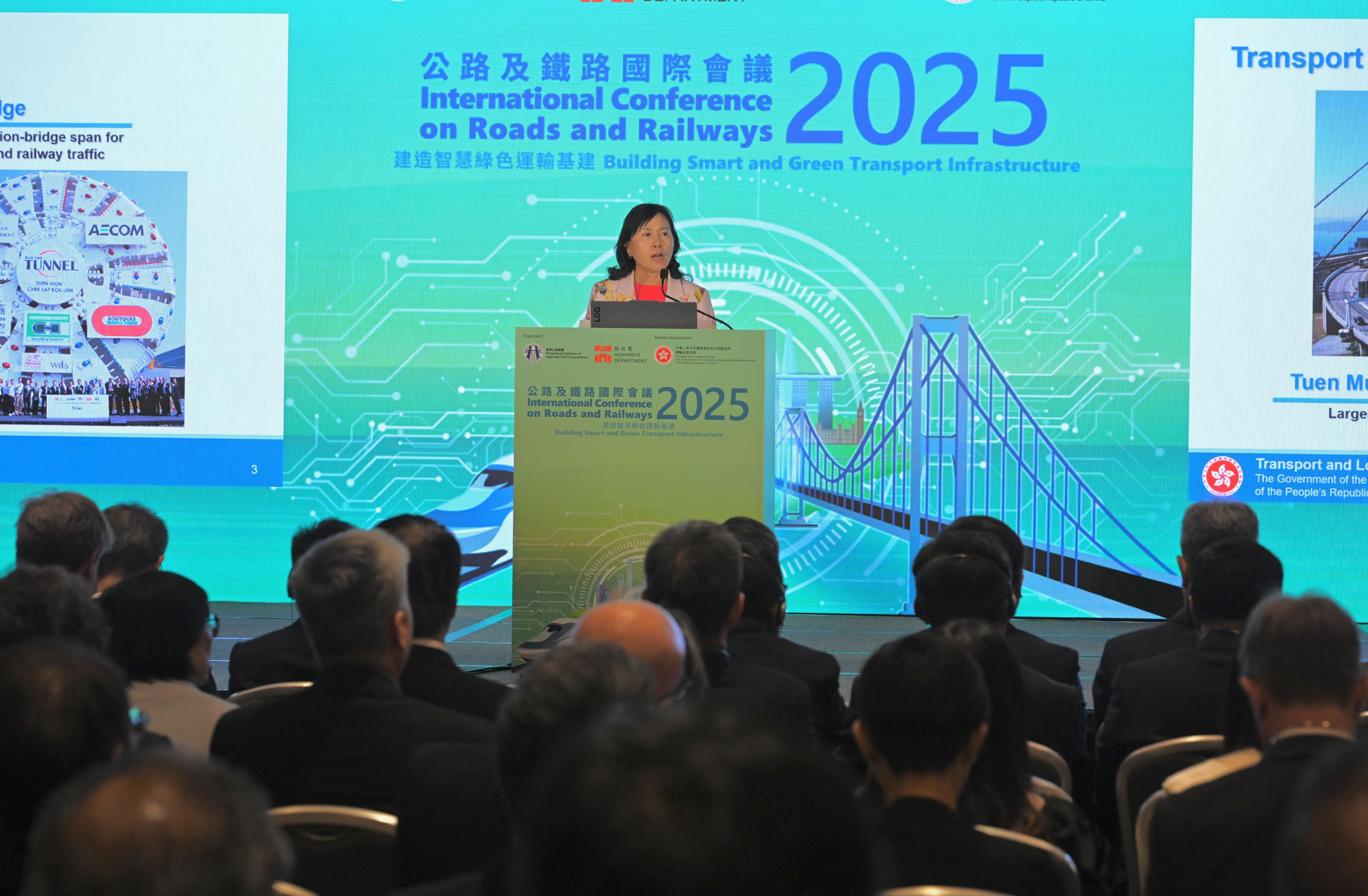
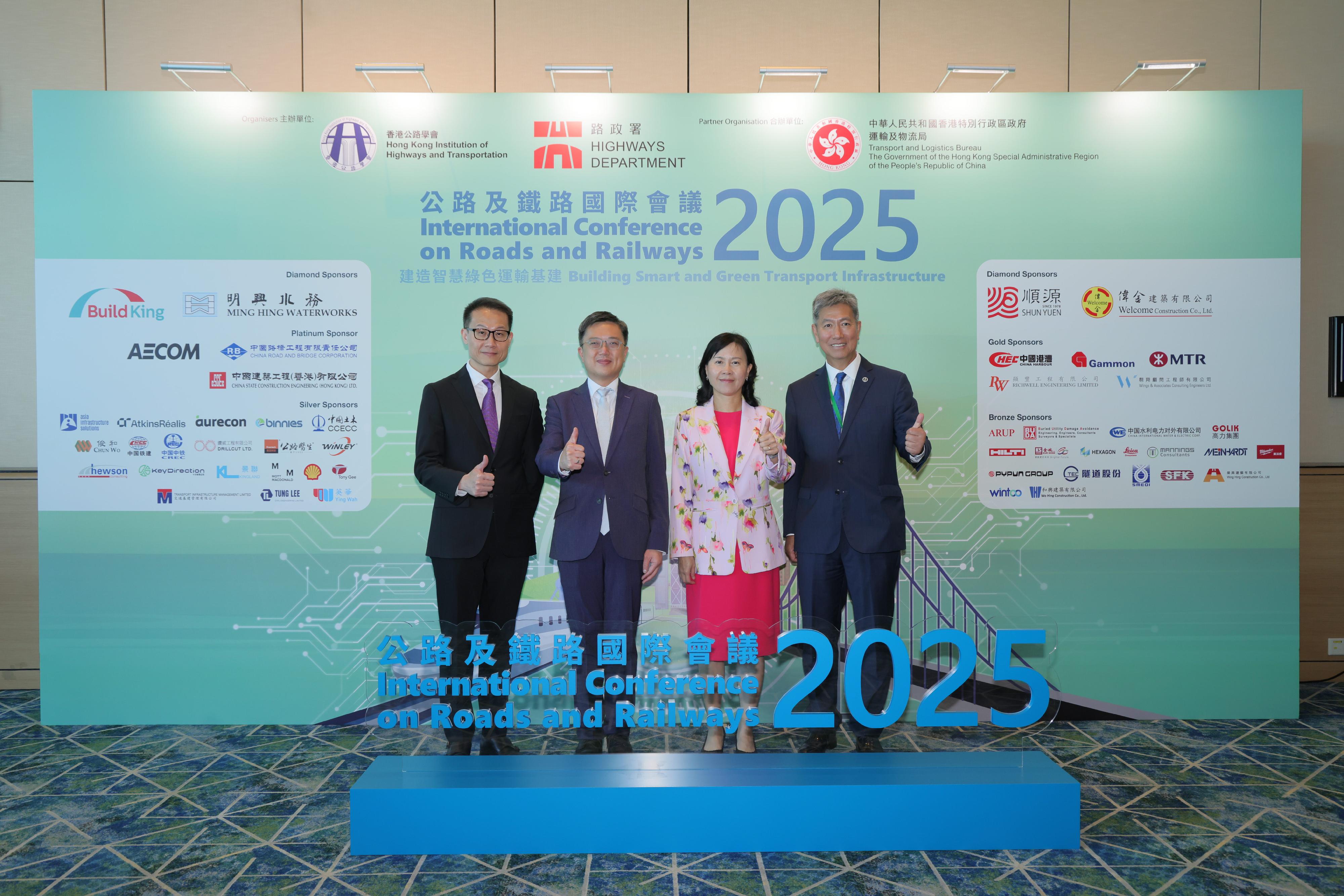
Following is the speech by the Secretary for Transport and Logistics, Ms Mable Chan, at the International Conference on Roads and Railways 2025 today (June 12):
Alfred (President of the Hong Kong Institution of Highways and Transportation, Mr Alfred Leung), Gary (Legislative Council Member, Mr Gary Zhang), Vice President Wang (Vice President of the Research Institute of Highway of the Ministry of Transport of the People's Republic of China Mr Wang Shuiyin), representatives from Consulates-General, distinguished guests, esteemed speakers, ladies and gentlemen,
Good morning. It is my great pleasure to welcome you all to the International Conference on Roads and Railways 2025, to discuss "Building Smart and Green Transport Infrastructure". It is indeed a very precious occasion for such a diverse and accomplished group of industry leaders, global experts, and innovators from around the world to gather together to exchange knowledge, share innovative practices and explore cutting-edge technologies. Taking this opportunity, I would like to share with you the exciting journey of Hong Kong's transport infrastructure development, a journey that embodies our relentless pursuit of excellence – from innovation to expedition.
Vision of Hong Kong transport development
No journey would be easy without a vision. Hong Kong's vision is to build a livable, competitive and sustainable city by driving development through transport infrastructure, guided by the planning principles of "infrastructure-led" and "capacity-building". Our goal is to establish a diverse and highly efficient public transport system, with railways as our backbone complemented by an extensive road network, meeting our commuting demands while supporting the city's long-term development. We also actively promote cross-boundary integration with the Mainland, especially with other cities in the Guangdong–Hong Kong–Macao Greater Bay Area (Greater Bay Area), seamlessly linking Hong Kong with our motherland and facilitating our integration into national development.
With this vision in mind, we have been implementing transport infrastructure in full strength which has become the key to Hong Kong's long-term development, and we never stop being the trailblazer. Just to quote two examples officially recorded in the Guinness World Records, the Tsing Ma Bridge in Hong Kong, constructed back in 1997, remains the longest suspension-bridge span for combined road and railway traffic in use nowadays with a main span of 1 377 meters. The second one is the tunnel boring machine (TBM) named "Qin Liangyu" used in the excavation of the Tuen Mun – Chek Lap Kok Tunnel in 2019 which holds the title of the largest TBM in the world, boasting a shield diameter of 17.63m – equivalent to the height of a six-story building. These are undeniably a testament to Hong Kong’s engineering excellence.
Adoption of the dual-innovation mindset
In developing transport infrastructure, while quality and safety have always been our top priorities, we also keep three key principles in mind: saving costs, speeding up delivery and maximising social benefits. To push ourselves to aim higher, think bigger and go further, we embrace the dual-innovation mindset, combining policy and technology innovation in implementing transport infrastructure projects.
In the next few minutes, let me to take you on a virtual tour of our compact yet vibrant city, where a wide range of infrastructure projects are being driven forward with the dual-innovation mindset at their core.
Policy innovation
First, on the policy front, as a city developed over decades, Hong Kong's robust system is accompanied by protocols accumulated over time. It is therefore paramount that we continuously evolve our regulatory environment to respond swiftly to emerging challenges and embrace opportunities. Over the past two years, we have streamlined statutory procedures to shorten infrastructure projects, enabling us to address social needs more promptly.
We do not confine ourselves to the traditional delivery mode. Take the unexpected rise of the national AI model DeepSeek as an example; it has now become the benchmark in China's technology sector. By staying open to cutting-edge ideas, we drive progress. Hence, we constantly explore innovative solutions to advance transport infrastructures.
Holistic planning and phased implementation
Let us now turn our attention to the Northern Metropolis, Hong Kong's future new growth engine, which was also highlighted earlier by our Financial Secretary this morning. The Northern Metropolis Highway (NM Highway) is by far the largest single road project in Hong Kong. Consisting of four major road sections, it will serve as a major route for the new development areas in the Northern Metropolis in the future. Unlike the conventional practice of implementing the road sections separately based on individual district's transport demands, we are carrying out the planning and advancing works for the entire NM Highway as one integrated project. This includes optimising of alignment, completing statutory procedures, and conducting site investigations, among all other tasks. As transport demand arises in specific road schemes subject to ongoing development, we can promptly begin detailed design and construction works once funding is secured, translating to a much more efficient delivery.
Alternative procurement methods
The recently introduced Smart and Green Mass Transit Systems, in short, SGMTS projects, are underway in three totally different areas of Hong Kong. First, it is within the long-developed and bustling Kowloon East with its hilly terrain; if I remember correctly, I just signed off the gazette plan for the whole section of the Kowloon East Line yesterday, which is a whole bunch of large maps covering different areas along the Kowloon East, and by the way, I was travelling along the Kowloon East this morning because of the traffic congestion. It was a really bustling area and I can see the various new stations and the adjustment in the alignments as embedded in those gazette plans. Second, as for the Kai Tak district, a newly transformed residential and business area built on the old airport runway; and thirdly is the developing Hung Shui Kiu/Ha Tsuen area located in the northwest part of the city. Each area has very different topographies and community needs. This diversity exemplifies our new approach of adopting alternative procurement methods to enhance cost-effectiveness and encourage innovative proposals from the private sector.
This new approach leverages various procurement options, including "design-and-build" and "early contractor involvement" models, again, to improve project efficiency and maximise social benefits. By inviting system suppliers and operators to submit expressions of interest early, we can optimise project constructability and streamline delivery. It is particularly valuable for the SGMTS, which brings in new technologies, new procurement methods and operational models in the city, requiring close co-ordination across design, construction, and operation stages.
Cross-boundary collaboration
Turning to the collaboration with our motherland. To facilitate cross-boundary transportation and support the "one-hour living circle" in the Greater Bay Area, we have been strengthening transport links between Hong Kong and the Mainland. Beyond the Hong Kong-Zhuhai-Macao Bridge and the Express Rail Link, we are working with the Mainland authorities to jointly develop two very important cross-boundary railway projects, building the "Greater Bay Area on the Rail".
The Task Force for Hong Kong and Shenzhen Co-operation on Cross-Boundary Railway Infrastructure was established by the Hong Kong Government and Shenzhen Municipal People's Government to take forward key projects, including the above-mentioned two important projects, i.e. the Hong Kong-Shenzhen Western Rail Link (Hung Shui Kiu – Qianhai) and the Northern Link Spur Line, ensuring co-ordinated planning, design, and construction efforts. These projects will boost connectivity between Hong Kong and Shenzhen, ease passenger flow, drive the regional economy, and solidify Hong Kong as a pivotal Greater Bay Area transportation hub.
This collaborative approach not only accelerates project delivery and enhances design compatibility, but also lets us tap into proprietary technologies and construction methods developed on the Mainland. While the differences in the design standards and construction practices between the two places can be challenging, we are absolutely confident that this will open up new opportunities and we would work steadfastly to embrace this challenge and opportunity. We will explore how to incorporate Mainland approaches into our cross-boundary railways projects – such as adopting their design standards and construction specifications where appropriate – so we can blend Hong Kong's versatility with the Mainland's strengths in infrastructure. Together, these efforts illustrate the strong commitment from both governments to build a seamless, efficient railway network across the Greater Bay Area, helping to deepen the regional integration and expand living circle.
Technological innovation
The other core pillar of the dual-innovation mindset is technological innovation. As we stand on the brink of a new era, advanced technologies are reshaping roads and railways development, making it very crucial to fully harness their transformative potential.
Adoption of advanced technology
Our city has long invested in cutting-edge technologies to drive efficiency and sustainability. The three SGMTS projects I have mentioned before are prime examples of our commitment, by combining green and smart technologies, to improve transport efficiency, safety and convenience. These systems use energy-efficient solutions and real-time data to manage traffic, adjust services and keep passengers informed, lifting up the overall commuting experience. I know that my colleagues are working very hard in preparing for the tender invitation for these smart and green innovative systems. Not only do we have to focus on the technologies and construction, we also have to embrace and consolidate passenger needs on real-time traffic data and the deployment of this kind of train to facilitate the integration of their commuting with the heavy rail or any other public transports as well.
Smart motorways
Our city by far has done a lot in smart motorways as well. I am sure our friends from afar will experience firsthand the vibrant and well-connected motorways in Hong Kong. However, this also presents challenges in maintaining its resilience. To enhance the road network's robustness and make the best use of our road space, that’s where the artificial intelligence comes in. Our full-coverage Automatic Incident Detection System can quickly spot traffic incidents, stationary vehicles, or other road issues. It then responds swiftly using variable messages and speed limit signs, and even opening the hard shoulder when needed. This significantly improves our efficiency in handling incidents, and how far and how fast we can respond to them.
Use of digital site supervision
Digital technologies are now seamlessly integrated throughout the entire project lifecycle of our public works projects. The Digital Works Supervision System (DWSS) has been widely adopted to enhance site safety, workmanship and contract management efficiency. Currently, over 180 public works contracts valued at more than HK$200 billion are using the DWSS, engaging over 10 000 users from the Government and the industry. A highlight is the Central Kowloon Route project, led by the Highways Department. Located in the heart of Kowloon, it connects the world-famous Temple Street with the Kai Tak area, reducing a journey that once took 30 minutes to just five minutes. This project is the first to unify data from six separate contracts into a single integrated platform. This allows real-time monitoring of site activities and automatic generation of key performance indicators, boosting construction efficiency and reducing the need for on-site supervisors. The local industry has widely recognised the project's success as a pioneering step in our digital transformation journey. I know that many of the guests and speakers will be invited to a site visit to our Central Kowloon Route project which is expected to be commissioned in the latter half of this year.
Development and use of new materials
Innovation doesn't stop at technology. We are also embracing new materials and engineering solutions to improve productivity and quality. Our tour now takes us to the east side of Hong Kong – Tseung Kwan O, a dense residential and industrial area with around 400 000 residents. Surrounded by hills and the sea, it is relatively secluded, which is why we built the Cross Bay Link (CBL) to improve its connectivity. This CBL is our first marine viaduct with cycle path and footway, we used high-strength steel for its double-arch steel design for the first time locally. The material choice for the arch, along with other innovations such as prefabricated elements that reduce on-site risks, helped cut out carbon emissions by 30 000 tonnes. The CBL has become another iconic landmark, and notably, it won the Institute of Civil Engineers' Brunel Award in 2021 for its excellence in decarbonisation.
Building on this success, we partnered with the Hong Kong Polytechnic University to develop a range of new paving materials tailored to different road types. These materials offer enhanced durability and safety, and have now been fully rolled out across suitable locations across the territory, significantly elevating the overall quality of road pavement and driving comfort. I am not sure whether you have the opportunity to tour some of our booths which I am sure will display some of the innovative materials, but our departments and companies in Hong Kong will certainly have a lot of opportunities to adopt solutions to embrace overseas innovative expertise so as to consolidate and create synergy in future railway projects.
Concluding remarks
Hong Kong has taken pride in its transport efficiency, with our public transport system consistently ranking among the top in the world. We are really leading in the world, no doubt about it. Recently, Hong Kong was crowned the city with the best public transport in the world, achieving a near-perfect 98 per cent satisfaction rate among local residents. And do remember this, this award was not given by or calculated by public institutions, it was all given by our local residents based on a survey which gathered their opinions. They voted for us, our public and our locals voted for our local public transport system.
Our journey is not over yet, we have certainly come a long way. Looking ahead, we have got to keep innovating and staying flexible to keep up with the city's evolving needs. Hong Kong will and always has been a trailblazer, and with our dual-innovation mindset, we are ready to keep pushing the boundaries. We do not underestimate the challenges ahead, and they call for bold and fresh ideas. Luckily, this conference is the perfect platform to swap stories, build partnerships and spark the creativity that will shape the next generation of roads and railways.
At the end of my little virtual tour with you today, I would like to extend again my deepest gratitude to all the speakers, guests and participants who have joined us today. Your expertise and insights are vital to advancing our shared vision for a sustainable and efficient transport system. I wish you all a very inspiring and rewarding conference, as well as an enjoyable stay in Hong Kong. Thank you very much.