EMEAP Central Banks to promote green bond investment through Asian Bond Fund

The following is issued on behalf of the Hong Kong Monetary Authority:
     
     The Executives' Meeting of East Asia-Pacific Central Banks (EMEAP) (Note 1) is pleased to announce today (November 5) that the recent project to promote investment in green bonds through the Asian Bond Fund (ABF) (Note 2) has been finalised.
 
     As announced in the previous press statement (Note 3) dated July 12, 2021, the EMEAP ABF Oversight Committee had requested IHS Markit, the index administrator of the iBoxx ABF Index (the Index) to review the rules of the Index to promote the inclusion of green bonds. The review has been completed and IHS Markit has decided to make the following adjustments to the Index. (Note 4)

(1) Setting the definition of green bonds

(i) Bonds that are labelled green by Climate Bonds Initiative (CBI); or

(ii) Bonds that are self-labelled and externally-reviewed as green in alignment with the Green Bond Principles of the International Capital Market Association (ICMA).

(2) Setting a lower minimum outstanding notional threshold for sub-sovereign green bonds issued in different markets.

(3) Changing the sub-sovereign issuer limit to 10 per cent per issuer in each single market index, from the current limit of 5 bonds per issuer.

     The new rules will take effect from the index rebalance date of March 31, 2022, on which date all new bonds will be added and the new thresholds for sub-sovereign green bonds become effective. The sub-sovereign bonds that become eligible for index inclusion on March 31, 2022 will be included through monthly rebalancing over six months, each with equal weight (Note 5), in order to facilitate a smooth transition.

     The EMEAP believes this initiative will help catalyse further deepening of local currency-denominated bond markets, in particular green bond markets in the region. The EMEAP will continue to explore ways to further contribute to the development of the local currency denominated bond market.

Note 1: The EMEAP is a group of the following 11 central banks and monetary authorities in the East Asia and Pacific region: Reserve Bank of Australia, People's Bank of China, Hong Kong Monetary Authority, Bank Indonesia, Bank of Japan, Bank of Korea, Bank Negara Malaysia, Reserve Bank of New Zealand, Bangko Sentral ng Pilipinas, Monetary Authority of Singapore, and Bank of Thailand.

Note 2: The current ABF initiative was established in 2005 to support the development of local currency-denominated bond markets in the region. The ABF, comprising the Pan-Asia Bond Index Fund (PAIF) and eight single-market funds, tracks the iBoxx ABF Index and is managed passively by private-sector fund managers with the BIS as the administrator. It invests in local currency-denominated bonds in the EMEAP economies other than Japan, Australia and New Zealand.

Note 3: See "New Press Statement – EMEAP Central Banks Agreed to Promote Green Bond Investment through Asian Bond Fund" (July 12, 2021).

Note 4: https://www.markit.com/NewsInformation/GetLinkedNews/2992021Results-of-the-iBoxx-Asian-Annual-Index-Review-2021?Product=IBoxx

Note 5: One-sixth of the market value will be included at each of the six rebalances


Grading of beach water quality released

     The Environmental Protection Department (EPD) today (November 5) released the latest grading of water quality for nine gazetted beaches that are open for swimming in November.

     Four beaches were rated as Good (Grade 1), four as Fair (Grade 2) and one as Poor (Grade 3).
 
Grade 1 beaches are:

Clear Water Bay Second Beach Repulse Bay Beach
Deep Water Bay Beach Stanley Main Beach

 
Grade 2 beach are:

Big Wave Bay Beach Middle Bay Beach
Golden Beach Silverstrand Beach

 
Grade 3 beach is:
Silver Mine Bay Beach
 
     Compared with the grading released last week, Middle Bay Beach has been changed from Grade 1 to Grade 2, and Silver Mine Bay Beach from Grade 2 to Grade 3.
 
     "The changes are generally within the normal range of fluctuation of the bacteriological water quality of the beaches," an EPD spokesman said.
 
     Under the present grading system, beaches are classified into four grades, namely Good (Grade 1), Fair (Grade 2), Poor (Grade 3) and Very Poor (Grade 4), according to the level of E. coli in the water. Grades are calculated on the basis of the geometric mean of the E. coli counts on the five most recent sampling occasions.
 
     While the ratings represent the general water quality at the beaches, an EPD spokesman reminded members of the public that water quality could be temporarily affected during and after periods of heavy rain. Bathers should avoid swimming at beaches for up to three days after a storm or heavy rainfall.
 
     A summary of beach grades is published weekly before the weekend. The latest beach grades based on the most current data may be obtained from the EPD's website on Beach Water Quality (www.epd.gov.hk/epd/beach) or the beach hotline, 2511 6666.


Government’s response to unsuccessful tender of Tung Chung Traction Substation property development

     The Government has noted the MTR Corporation Limited's announcement today (November 5) that it will not accept any of the tenders received in relation to the property development project at Tung Chung Traction Substation.

     A Government spokesperson said, "The Government has adopted a multi-pronged approach to increase private housing land supply. Apart from railway development projects, the land supply sources include government land sale, projects of the Urban Renewal Authority and private development/redevelopment projects. As at the third quarter of this year, the total private housing land supply in 2021-22 was estimated to have a capacity to produce about 13 700 units, higher than the private housing supply target (12 900 units). The unsuccessful tender of the Tung Chung Traction Substation development project will not bring about any material impact on the total private housing land supply in 2021-22."

     To ensure a steady land supply for the market, the Government will continue to expedite land and housing production, and put up sites from different sources for sale in the fourth quarter of this year, the spokesperson added.


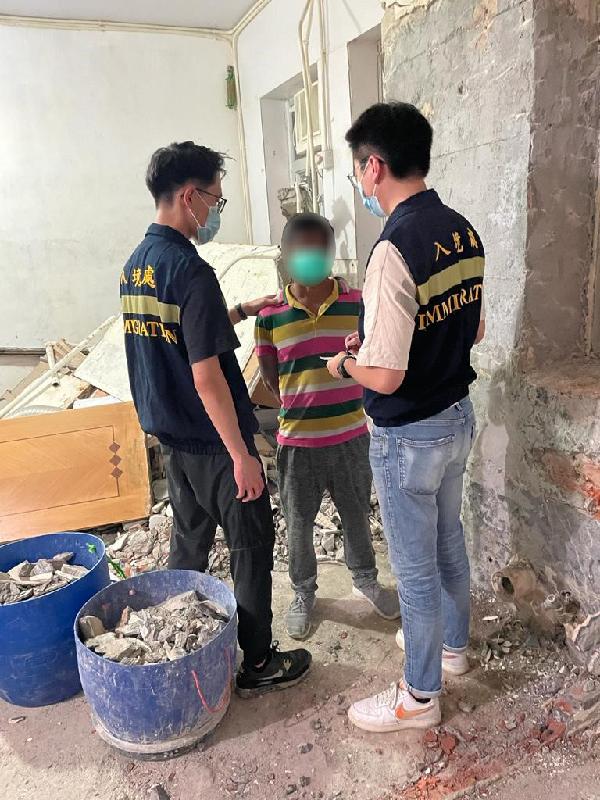
Fifteen persons arrested during anti-illegal worker operations (with photo)

     The Immigration Department (ImmD) has mounted a series of territory-wide anti-illegal worker operations codenamed "Twilight" and "Contribute" for three consecutive days from November 2 to yesterday (November 4). A total of 14 suspected illegal workers and one suspected employer were arrested.

     During the operations, ImmD Task Force officers raided 18 target locations including a construction site, a container yard, a food stall, a factory, a massage parlour, premises under renovation, restaurants and warehouses. A total of 14 suspected illegal workers and one suspected employer were arrested. The arrested suspected illegal workers comprised six men and eight women, aged 27 to 53. Among them, two men and four women were holders of recognisance forms, which prohibit them from taking any employment. Furthermore, one man, aged 42, was suspected of employing the illegal workers.

     "Any person who contravenes a condition of stay in force in respect of him shall be guilty of an offence. Also, visitors are not allowed to take employment in Hong Kong, whether paid or unpaid, without the permission of the Director of Immigration. Offenders are liable to prosecution and upon conviction face a maximum fine of $50,000 and up to two years' imprisonment. Aiders and abettors are also liable to prosecution and penalties," an ImmD spokesman said.

     The spokesman warned that, as stipulated in section 38AA of the Immigration Ordinance, an illegal immigrant, a person who is the subject of a removal order or a deportation order, an overstayer or a person who was refused permission to land is prohibited from taking any employment, whether paid or unpaid, or establishing or joining in any business. Offenders are liable upon conviction to a maximum fine of $50,000 and up to three years' imprisonment.

     The spokesman reiterated that it is a serious offence to employ people who are not lawfully employable. Under the Immigration Ordinance, the maximum penalty for an employer employing a person who is not lawfully employable, i.e. an illegal immigrant, a person who is the subject of a removal order or a deportation order, an overstayer or a person who was refused permission to land, has been significantly increased from a fine of $350,000 and three years' imprisonment to a fine of $500,000 and 10 years' imprisonment to reflect the gravity of such offences. The director, manager, secretary, partner, etc of the company concerned may also bear criminal liability. The High Court has laid down sentencing guidelines that the employer of an illegal worker should be given an immediate custodial sentence.

     According to the court sentencing, employers must take all practicable steps to determine whether a person is lawfully employable prior to employment. Apart from inspecting a prospective employee's identity card, the employer has the explicit duty to make enquiries regarding the person and ensure that the answers would not cast any reasonable doubt concerning the lawful employability of the person. The court will not accept failure to do so as a defence in proceedings. It is also an offence if an employer fails to inspect the job seeker's valid travel document if the job seeker does not have a Hong Kong permanent identity card. Offenders are liable upon conviction to a maximum fine of $150,000 and to imprisonment for one year. In that connection, the spokesman would like to remind all employers not to defy the law by employing illegal workers. The ImmD will continue to take resolute enforcement action to combat such offences.

     Under the existing mechanism, the ImmD will, as a standard procedure, conduct initial screening of vulnerable persons, including illegal workers, illegal immigrants, sex workers and foreign domestic helpers, who are arrested during any operation with a view to ascertaining whether they are trafficking in persons (TIP) victims. When any TIP indicator is revealed in the initial screening, the officers will conduct a full debriefing and identification by using a standardised checklist to ascertain the presence of TIP elements, such as threats and coercion in the recruitment phase and the nature of exploitation. Identified TIP victims will be provided with various forms of support and assistance, including urgent intervention, medical services, counselling, shelter, temporary accommodation and other supporting services. The ImmD calls on TIP victims to report crimes to the relevant departments immediately.

Photo  


Hong Kong’s latest foreign currency reserve assets figures released

The following is issued on behalf of the Hong Kong Monetary Authority:

     The Hong Kong Monetary Authority (HKMA) announced today (5 November) that the official foreign currency reserve assets of Hong Kong amounted to US$498.1 billion as at the end of October 2021 (end-September 2021: US$494.9 billion) (Annex).

     There were no unsettled foreign exchange contracts at end-October 2021 and end-September 2021.

     The total foreign currency reserve assets of US$498.1 billion represent about seven times the currency in circulation or 48 per cent of Hong Kong dollar M3.
 
****************************************************************
     At present, four press releases relating to the Exchange Fund's data are issued by the HKMA each month. Three of these releases are issued to disseminate monetary data in accordance with the International Monetary Fund's Special Data Dissemination Standard (SDDS). The fourth press release, on the Exchange Fund's Abridged Balance Sheet and Currency Board Account, is made in accordance with the HKMA's policy of maintaining a high level of transparency. For the month of November 2021, the scheduled dates for issuing the press releases are as follows:
 

November 5 SDDS International Reserves
(Hong Kong's Latest Foreign Currency Reserve Assets Figures)
November 12 SDDS Analytical Accounts of the Central Bank
(Analytical Accounts of the Exchange Fund)
November 30 SDDS Template on International Reserves and Foreign Currency Liquidity
November 30 Exchange Fund Abridged Balance Sheet and Currency Board Account