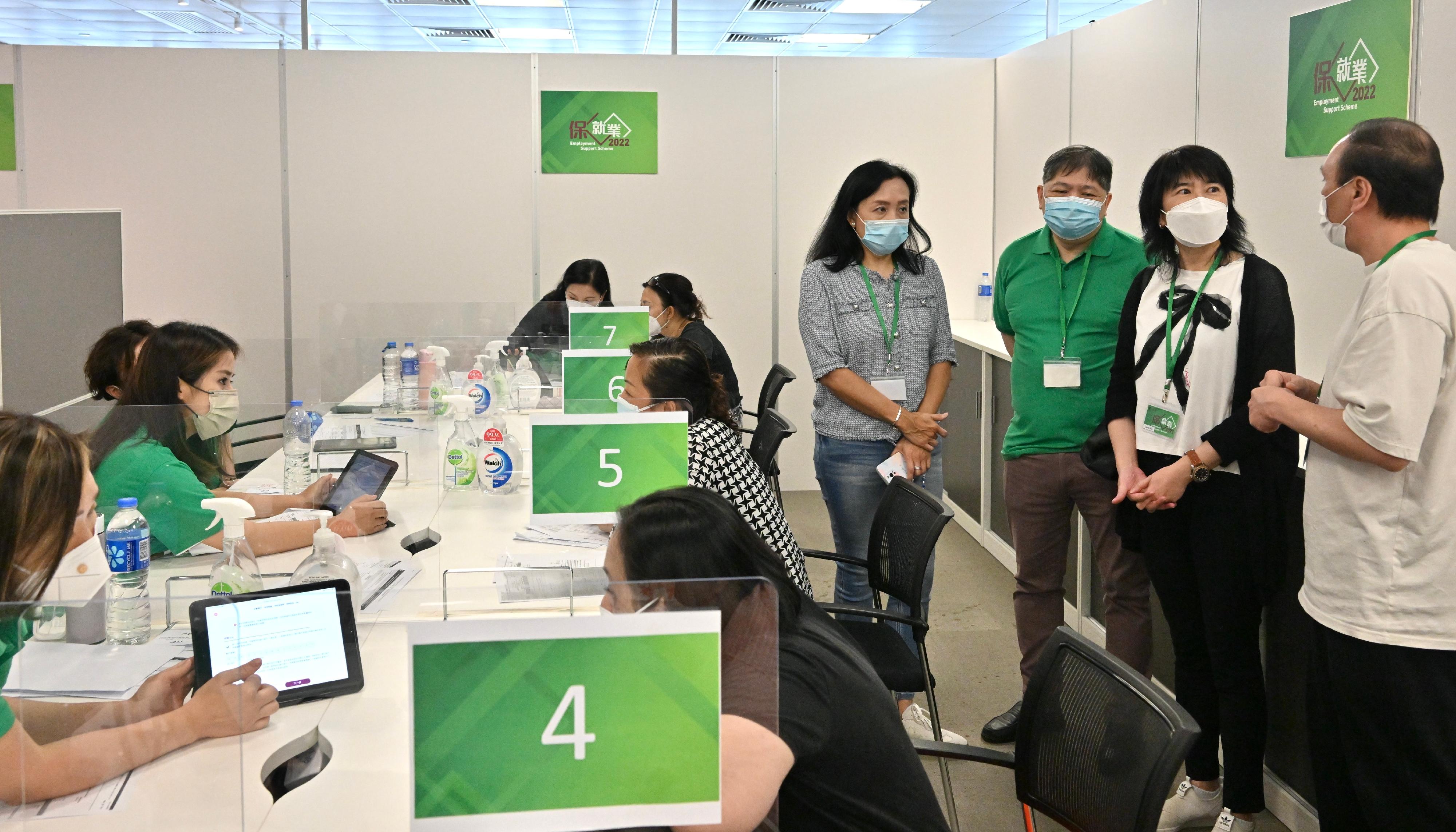
2022 Employment Support Scheme meets with overwhelming response on first application day (with photo)

     A Government spokesman said today (April 29) that the 2022 Employment Support Scheme (2022 ESS) started off with an overwhelming response on its first day of the two-week application period.
 
     "The online application portal was launched at 8am today and has been operating smoothly throughout the day. Up to 6pm today, we have received a total of over 42 000 applications from employers and about 27 000 applications from self-employed persons ," the Government spokesman said.
 
     The 2022 ESS provides three-month wage subsidies (i.e. May to July 2022) to eligible employers. There are a two-tier subsidy rates – a flat rate of $8,000 per month for each eligible employee with monthly income of $8,000 or more; and a flat rate of $4,000 per month for each employee with monthly income of $3,000 or more but less than $8,000, or each employee aged 65 or above earning less than $3,000 each month. Moreover, the scheme provides a one-off subsidy of $8,000 to eligible self-employed persons. Employers and self-employed persons should submit their applications online through the 2022 ESS website (www.ess.gov.hk/en/) by 11.59pm on May 12 (Thursday).
 
     "To provide more flexibility for employers under the 2022 ESS, the actual subsidy amount and committed employee headcount are calculated based on employers’ chosen subsidised headcount. The 2020 ESS records or the records as at the fourth quarter of 2021 (2021 Q4 records) only serve as the cap for employers' chosen subsidised headcount. Therefore, for applicants who were granted 2020 ESS subsidy and expect the number of employees during the subsidy period will be less, we suggest these applicants choosing the 2020 ESS records as the basis for calculating the cap.  This is because the 2020 ESS records can provide enough subsidy headcount while having the advantages of shortening the vetting procedure and enabling faster payment," the Government spokesman said.
 
     Before filling out the online application form, applicants are advised to have the information and documents required ready and read the terms and conditions to ensure that the information to be submitted is complete and meets the vetting requirements. Applicants may refer to the 2022 ESS website (www.ess.gov.hk/en/) to understand more about the eligibility criteria and information required.

     Enquiries can be made through the hotline at 183 6122 or live chat function at the 2022 ESS website or by email to enquiry@ess.gov.hk.
 
     If applicants need assistance in person, they may schedule an appointment through the hotline (183 6122) and visit one of the five service centres.
 
Addresses of the service centres are as follows (appointments must be made through the hotline first):
Room 1501, AT Tower, 180 Electric Road, North Point
Suite 1004, Kwun Tong View, 410 Kwun Tong Road, Kwun Tong
Suite 601-2, 9 Wing Hong Street, Cheung Sha Wan
Suite 2310, Metropole Square, 2 On Yiu Street, Shek Mun, Shatin
Units 3301-3303, 33/F The Octagon, 6 Sha Tsui Rd, Tsuen Wan
 
Service hours of the service centres:
During application period (April 29 to May 12): 9am to 6pm

Photo  


Government gazettes compulsory testing notice

     The Government exercises the power under the Prevention and Control of Disease (Compulsory Testing for Certain Persons) Regulation (Cap. 599J) and publishes in the Gazette a compulsory testing notice, which requires any person who had been present at 40 specified places during the specified period (persons subject to compulsory testing) to undergo a COVID-19 nucleic acid test.

     In view of a number of cases testing positive, 40 specified places are included in the compulsory testing notice. The Government strongly reminds members of the public to strictly follow the compulsory testing requirements and undergo testing on time as required. Mobile specimen collection stations have been set up by the Government in different districts to facilitate testing to be conducted in compliance with the compulsory testing notice. The above compulsory testing requirement applies to those who have completed a COVID-19 vaccination course as well.

     Persons who have tested positive in the past three months (including positive cases tested either by nucleic acid tests recorded by the Department of Health (DH) or by rapid antigen tests (RATs) that have been self-declared to the DH) do not need to undergo compulsory testing. For those who are subject to compulsory testing (save for those who have declared their positive RAT results as mentioned above), they must undergo nucleic acid tests in accordance with relevant compulsory testing notices and cannot use RATs to fulfil the requirement of such notices. In other words, a negative RAT result cannot be deemed as fulfilling the compulsory testing requirement. Furthermore, unless a person subject to compulsory testing has obtained a medical certificate proving that he or she is unfit to undergo testing using a sample taken through combined nasal and throat swabs because of health reasons, the person cannot provide a deep throat saliva sample to fulfil the compulsory testing requirement.

     Details of the compulsory testing notice are available on the Centre for Health Protection (CHP)'s website via the following link: www.chp.gov.hk/files/pdf/ctn_20220429.pdf.

     If any persons test positive under compulsory testing, such positive cases will be handled in the same manner as in those identified through other nucleic acid tests or self-declared through RATs. Their isolation arrangements (as well as the quarantine arrangements of their household members) are no different from other positive cases.

     Persons subject to compulsory testing in accordance with a compulsory testing notice must go to any of the mobile specimen collection stations, community testing centres (CTCs) or recognised local medical testing institutions to undergo professional swab sampling in fulfilling the requirements for compulsory testing. Young children may continue to undergo the test using a stool specimen.

     The Comirnaty and CoronaVac vaccines are highly effective in preventing severe cases and deaths from COVID-19. They can provide protection to those vaccinated to prevent serious complications and even death after infection. The Government appeals to persons who are not yet vaccinated to get vaccinated without delay. The Government is working towards the goal of boosting the vaccination rates of children, teenagers and the elderly by the end of April so that they can be protected by the vaccines as early as possible. Furthermore, the Scientific Committee on Vaccine Preventable Diseases and the Scientific Committee on Emerging and Zoonotic Diseases under the CHP of the DH has updated the consensus interim recommendations, and persons aged 60 or above who have taken three doses of vaccine are recommended to receive an additional dose (i.e. fourth dose) of either Comirnaty vaccine or CoronaVac vaccine at least three months after their last dose. Members of the public who are eligible should get the fourth dose as early as possible for better protection.

     CTCs provide testing services for the public. Booking and walk-in services are available. Members of the public only need to provide simple personal information on the 24-hour booking system (www.communitytest.gov.hk/en). The system shows the booking status of the centres for the coming two weeks to facilitate the public's planning and selection of a suitable testing centre and a time slot for testing. The testing centres will accord priority to serve individuals with advance bookings. As of 6pm today (April 29), there was around 97 per cent availability for booking places for the coming two weeks. Members of the public may call the testing centres for enquiries on the availability of bookings or walk-in quotas before visiting the centres.
 
    The Government will set up a mobile specimen collection station at Lei Muk Shue Estate in Tsuen Wan tomorrow (April 30), and the mobile specimen collection station at Chuk Yuen North Estate in Wong Tai Sin will cease operation tomorrow. Separately, ticketing machines have been installed in a number of service points for on-site ticket arrangement. Members of the public who have obtained a ticket can visit the CTC website (www.communitytest.gov.hk/en) to check the real-time queueing ticket status. Booking service is also provided for some large-scale mobile specimen collection stations, and members of the public may use the 24-hour booking system (www.communitytest.gov.hk/en) to reserve a suitable time slot for testing.
 
     Other than persons subject to compulsory testing, all members of the public may conduct free testing at CTCs or mobile specimen collection stations (if the service scope is applicable). The opening dates and operating hours of the mobile specimen collection stations are stated in the Annex.

     Persons subject to compulsory testing may choose to undergo testing via the following routes:

(a) For tests which require using a sample taken through combined nasal and throat swabs
1. To visit any of the mobile specimen collection stations (see the list and target groups (if applicable) at www.coronavirus.gov.hk/eng/early-testing.html) for testing;
2. To attend any of the CTCs (see the list at www.communitytest.gov.hk/en);
3. To self-arrange testing provided by private laboratories which are recognised by the DH and can issue SMS notifications in respect of test results (see the list at www.coronavirus.gov.hk/pdf/List_of_recognised_laboratories_RTPCR.pdf), and the relevant sample must be taken through combined nasal and throat swabs; or
4. To use a specimen bottle distributed to the relevant specified premises by the CHP (if applicable), and return the specimen bottle with the stool sample collected as per relevant guidelines.

(b) For persons holding a medical certificate issued by a registered medical practitioner proving that they are unfit to undergo testing using a sample taken through combined nasal and throat swabs because of health reasons
1. To obtain a deep throat saliva specimen collection pack from post offices, vending machines set up at MTR stations or designated general out-patient clinics (GOPCs) of the Hospital Authority and return the specimen to one of the designated specimen collection points (see the distribution points and times, and the specimen collection points and times, at www.coronavirus.gov.hk/eng/early-testing.html);
2. To undergo testing at any of the GOPCs of the Hospital Authority as instructed by a medical professional of the Hospital Authority; or
3. To self-arrange testing provided by private laboratories which are recognised by the DH and can issue SMS notifications in respect of test results.

     A spokesman for the Food and Health Bureau cautioned that testing received at the Accident and Emergency Departments of the Hospital Authority, or testing provided by private laboratories which cannot issue SMS notifications in respect of test results, does not comply with the requirements of the aforementioned compulsory testing notice.

     "If persons subject to compulsory testing have symptoms, they should seek medical attention immediately and undergo testing as instructed by a medical professional. They should not attend the mobile specimen collection stations or the CTCs."

     Persons subject to compulsory testing must keep the SMS notifications containing the result of the test and the relevant medical certificate (if applicable) for checking by a law enforcement officer when the officer requires the persons to provide information about their undergoing the specified test.

     Any enquiries on compulsory testing arrangements may be addressed to the hotline at 6275 6901, which operates daily from 9am to 6pm.

     The Government will continue to trace possibly infected persons who had been to relevant premises, and seriously verify whether they had complied with the testing notices. Any person who fails to comply with the testing notices commits an offence and the maximum penalty upon conviction is a fine at level 4 ($25,000) and imprisonment for six months. The fixed penalty for discharging the liability is $10,000. The person may also be issued with a compulsory testing order requiring him or her to undergo testing within a specified time frame. Any person in breach of the compulsory testing order would be liable to a fine at level 5 ($50,000) and imprisonment for six months.

     The spokesman said, "The Government urges all individuals who are in doubt about their own health conditions, or individuals with infection risks (such as individuals who visited places with epidemic outbreaks or had contact with cases tested positive), to undergo testing promptly for early identification of infected persons."


DH launches revamped Centralised Organ Donation Register system

     In order to enable members of the public to register online using "iAM Smart", the Department of Health (DH) smoothly launched the revamped Centralised Organ Donation Register (CODR) system yesterday (April 28).

     Upon launching the revamped CODR system, members of the public can now choose to register online using "iAM Smart", or in-person by providing their Hong Kong identity cards for identity verification on the spot. The new registration methods would enable verification of the applicants' identity upfront at the application stage and remove the need for subsequent phone verification.

     Applicants who do not wish to use "iAM Smart" for registration or provide their Hong Kong identity cards for identity verification can continue to apply for the CODR registration by submitting their applications using the pre-existing options of submitting applications online, by post or in-person followed by subsequent identity verification by phone. Regardless of the application methods, applicants who successfully register will be notified of their registration results within 14 days after submitting their applications.

     Introduction of the new registration methods will not affect the existing records in the CODR. As such, there is no need for existing CODR registrants to re-register.

     A spokesman for the DH appeals to the public to register for organ donation. The spokesman said: "Despite medical advancement, for some patients with organ failure, organ transplant remains the only hope to live on. Due to limited supply from donations of transplantable organs, more than 2 000 patients in Hong Kong are waiting for organ transplants every day, and many patients would die before the right organ match comes.

     "To shorten patients' waiting times for organ transplants and to bring new life, active support for organ donation by members of the public is important. You are welcome to register your wish to donate organs at the CODR website at: www.codr.gov.hk."

     For more information on organ donations, please visit the thematic website at: www.organdonation.gov.hk or the "Organ Donation@HK" Facebook page at: www.facebook.com/organdonationhk.


DH launches revamped Centralised Organ Donation Register system

     In order to enable members of the public to register online using "iAM Smart", the Department of Health (DH) smoothly launched the revamped Centralised Organ Donation Register (CODR) system yesterday (April 28).

     Upon launching the revamped CODR system, members of the public can now choose to register online using "iAM Smart", or in-person by providing their Hong Kong identity cards for identity verification on the spot. The new registration methods would enable verification of the applicants' identity upfront at the application stage and remove the need for subsequent phone verification.

     Applicants who do not wish to use "iAM Smart" for registration or provide their Hong Kong identity cards for identity verification can continue to apply for the CODR registration by submitting their applications using the pre-existing options of submitting applications online, by post or in-person followed by subsequent identity verification by phone. Regardless of the application methods, applicants who successfully register will be notified of their registration results within 14 days after submitting their applications.

     Introduction of the new registration methods will not affect the existing records in the CODR. As such, there is no need for existing CODR registrants to re-register.

     A spokesman for the DH appeals to the public to register for organ donation. The spokesman said: "Despite medical advancement, for some patients with organ failure, organ transplant remains the only hope to live on. Due to limited supply from donations of transplantable organs, more than 2 000 patients in Hong Kong are waiting for organ transplants every day, and many patients would die before the right organ match comes.

     "To shorten patients' waiting times for organ transplants and to bring new life, active support for organ donation by members of the public is important. You are welcome to register your wish to donate organs at the CODR website at: www.codr.gov.hk."

     For more information on organ donations, please visit the thematic website at: www.organdonation.gov.hk or the "Organ Donation@HK" Facebook page at: www.facebook.com/organdonationhk.


Government responds to media enquiries on revised testing and quarantine arrangements for air crew

     In response to media enquiries about the revised testing and quarantine arrangements for air crew, a Government spokesman said the following today (April 29):
 
     In view of the latest developments of the epidemic situation including the enhanced capacity in tackling the local epidemic, and considering the overall socio-economic needs, the Government recently announced a series of adjustments regarding control measures on inbound travellers with effect from May 1, including allowing non-Hong Kong residents to enter Hong Kong from overseas places and adjusting the route-specific flight suspension mechanism.
 
     In tandem with the adjustments to the inbound control measures, the Government considers it appropriate to adjust the testing and quarantine arrangements applicable to air crew with effect from May 1. The adjustments are made on a risk-based approach and are considered necessary to safeguard public health, while being of utmost importance to Hong Kong's aviation, trade and logistics industries.
 
     For air crew members who are spending a short layover in Hong Kong and are not entering the local community, they will be subject to a stringent closed-loop arrangement during their stay in Hong Kong. They are required to produce a negative result of a pre-departure rapid antigen test (RAT), use only a dedicated channel while within Hong Kong International Airport (HKIA), take only point-to-point transport between HKIA and an airport hotel, which is designated to receive air crew under the closed-loop arrangement only. They are also required to self-isolate in the airport hotel rooms until they leave via point-to-point transport and a dedicated channel in HKIA, and depart from Hong Kong.
 
     The Government will also adjust the testing and self-isolation requirements applicable to locally based air crew, with a view to relieving local airlines' manpower constraints and thus capacity to mount flights to and from Hong Kong. Having due regard to the fact that locally based passenger crew are subject to a stringent closed-loop arrangement when they lay over in outports, they will be subject to self-isolation in a designated quarantine hotel until obtaining a negative result of a polymerase chain reaction-based nucleic acid test conducted on the third day following their return to Hong Kong. For locally based cargo crew, not only are they subject to stringent closed-loop arrangement when they lay over in outports, they also have no passengers to interact with throughout their flight duties. As such, they will no longer be subject to self-isolation requirements upon their return to Hong Kong. However, they are required to undergo a "test-and-hold" arrangement at HKIA to obtain a negative result of a nucleic acid test before leaving HKIA. Moreover, all of these locally based air crew are subject to medical surveillance until the 14th day following their arrival, during which they are required to conduct repeated nucleic acid tests. They shall also conduct daily RATs, avoid mask-off activities in public places, refrain from going to crowded places and mass gatherings, and keep a log of their activities until the seventh day following their arrival. In cases of non-compliance, the designation status of relevant air crew members will be revoked.
 
     The adjustments will provide Hong Kong's aviation, trade and logistics industries, particularly air cargo operations between Hong Kong and the rest of the world, the much needed survival space. The Government calls for the aviation industry to work hand in hand to uphold Hong Kong's status as an international aviation hub, while remaining vigilant to guard against the virus. In particular, the Government has requested airlines to introduce robust mechanisms to ensure that their air crew members fully comply with the relevant requirements during the medical surveillance period. Airlines will be held responsible to oversee the activity logs of their air crew and conduct regular checks on such logs. In the event that airlines are found not to be exercising due diligence over their air crew's compliance, the designation status of their air crew will be revoked.
 
     Moreover, from May 1 onwards, all air crew members deployed by local airlines for operating flights in and out of Hong Kong will have completed three doses of vaccines.
 
     The Government attaches great importance to the international aviation hub status of Hong Kong and will continue to keep in view the local and global epidemic situation, and review and adjust the testing and quarantine arrangements for air crew as and when appropriate.