LCQ18: Supply of niches

     â€‹Following is a question by the Hon Paul Tse and a written reply by the Secretary for Food and Health, Professor Sophia Chan, in the Legislative Council today (May 4):
 
Question:
 
     It is reported that since the outbreak of the coronavirus disease 2019 (COVID-19) epidemic, the cumulative number of deaths in Hong Kong has exceeded 4 000 and an acute shortage of coffins was once recorded. On the other hand, a report released by the Consumer Council in March this year indicates that the prices of private columbarium niches in Hong Kong have surged, with the most expensive double niche costing up to $5.2 million. A member of the public has relayed to me that the supply of niches in Hong Kong has long been insufficient, while the waiting time for public niches is long and the prices of private columbarium niches have been on the rise. For private columbarium niches, whilst management fees are payable on top of the prices, it is feared that the period of ownership of some of such niches will not go beyond 2047. This member of the public is worried that the increase in the number of deaths arising from the epidemic will further exacerbate the shortage of niches in Hong Kong and ramp up the market prices of homes for the dead. This member of the public has also criticised that the Private Columbaria Licensing Board's exceedingly slow progress in issuing licences has led to a prolonged shortage of private columbarium niches. In this connection, will the Government inform this Council:
 
(1) of the respective numbers of licence applications from private columbaria approved and rejected by the authorities in each of the past four years and since January this year, as well as the number of licence applications being processed currently;
 
(2) whether it has projected the supply and demand of niches in Hong Kong in each of the coming 10 years;
 
(3) of the current number of applicants waiting for public niches; whether it has compiled statistics on the average waiting time of each application;
 
(4) given that the mortality rate after contracting COVID-19 in Hong Kong is reportedly the highest in the world, and the number of deaths arising from the epidemic has hit record high, whether it has assessed if the waiting time for public niches will become longer in the future;
 
(5) whether it has examined the reason why the prices of private columbarium niches keep standing high, and the extent to which such reason is related to the persistent short supply of niches in Hong Kong; and
 
(6) of the policies or measures in place to alleviate the shortage of niches in Hong Kong, so that the acute shortage of coffins will not be followed by an acute shortage of niches?
 
Reply:
 
President,
 
     With a growing and ageing population in Hong Kong, there is a great demand for burial facilities. To ensure the supply of niches can meet the public demand, the Government adopts a three-pronged strategy: firstly, to increase the supply of public niches; secondly, to ensure that private columbaria are in compliance with relevant laws and government requirements and that they adopt a sustainable mode of operation through the regulation under the Private Columbaria Ordinance (Cap. 630); and thirdly, to actively promote green burial to encourage the public to handle ashes of the deceased in a more environmentally-friendly and sustainable manner.
      
     My reply to the question raised by the Hon Paul Tse is as follows:
 
(1) As at end-April 2022, the Private Columbaria Licensing Board (PCLB) received a total of 362 applications for specified instruments (SIs) from 147 columbaria. Apart from the applications from 16 columbaria that have been withdrawn by the applicants, the PCLB has processed applications from 75 columbaria, including rejecting applications from 29 columbaria and granting approval or approval-in-principle to applications for SIs (i.e. licence/exemption/temporary suspension of liability (TSOL)) from 46 columbaria, with the latter involving 360 440 sold niches which accounted for over 70 per cent of the total sold niches of private columbaria in Hong Kong before the cut-off date. The PCLB is processing the remaining applications from 56 columbaria. It is expected that certain decisions, including approval or approval-in-principle or rejection of applications for licence/exemption/TSOL, will be made by mid-2023.
 
(2) We have projected the demand for public niches from a macro perspective, taking into account key considerations such as the projected number of deaths in the population estimates published by the Census and Statistics Department, the cremation rate, and the trend of co-location of ashes and green burial. At present, cremation is the mainstream mode of burial arrangements, with the number of cremation accounting for over 90 per cent of the number of deaths. Green burial is also gaining more public acceptance. In the past three years, the number of green burial accounted for more than 15 per cent of the number of deaths.
 
     Regarding the supply of niches, they are mainly provided by public columbaria, columbaria in private cemeteries and private columbaria.
      
     In respect of public niches, the Government implements a district-based scheme for developing new public columbaria. As at end-April 2022, the Government has consulted the relevant District Councils on 12 public columbarium projects, which would altogether provide around 600 000 new public niches. Among them, the six projects at Diamond Hill, Cheung Chau, Wong Nai Chung Road in Wan Chai, Lai Chi Yuen in Mui Wo, Tsang Tsui in Tuen Mun and Wo Hop Shek sites have been completed, providing around 210 000 public niches, which are already open for application for allocation. The two projects at Cape Collinson Road in Eastern District and Shek Mun in Sha Tin, which have obtained funding for their construction, are expected to be completed by the end of 2022 and 2024, providing 25 000 and 40 000 public niches respectively.
      
     The Government will continue to take forward the remaining projects under the district-based scheme and continue to identify other suitable sites for the construction of new public columbaria to meet the needs of the public as far as possible.
      
     In respect of private cemeteries, the columbarium projects at the Tsuen Wan Chinese Permanent Cemetery and the Junk Bay Chinese Permanent Cemetery under the Board of Management of the Chinese Permanent Cemeteries are underway. These two projects are estimated to be completed in this year and in 2024 respectively the earliest, providing a total of about 81 000 niches.
      
     As for private columbaria, the supply of niches depends on factors such as the operating plans of individual operators and the progress of licence applications.
 
(3), (4) and (6) With the completion of the Tsang Tsui Columbarium in 2020, a substantial and steady supply of niches has become available. In addition to the comprehensive allocation of public niches once a year, the Food and Environmental Hygiene Department (FEHD) is also providing about 1 700 niches at the Tsang Tsui Columbarium on a monthly basis for public application starting from December 2020. The current supply of public niches is adequate. In fact, since mid-2020, all eligible applicants for the FEHD's annual comprehensive allocation or monthly allocation exercise (a total of some 66 000 applicants) have been successfully allocated with niches without the need to wait.
 
     Given the sufficient supply of public niches at present, COVID-19 death cases do not have significant impact on the overall demand and supply of public niches. The bereaved families may apply for public niches through the FEHD's annual or monthly niche allocation exercise.
      
     As it takes time to carry out such work as district consultation, planning application and construction for a new public columbarium, the Government will continue to proactively take forward public columbarium projects under the district-based scheme so as to ensure the steady supply of public niches in the medium to long term.
      
     Besides, the FEHD has implemented the following administrative measures to optimise the use of public niches:
 
(i) relaxing the restriction for co-location of ashes in public niches: it includes relaxation of the definition of "close relative" and cancellation of the limit on the number of sets of ashes that can be placed in each public niche; and
 
(ii) implementing an extendable arrangement for public niches: starting from April 2019, each public niche will be provided an initial interment period of 20 years, which can be extended at 10-yearly intervals thereafter. If the related persons have not sought extension of deposit or removed the ashes from the niches within two years after the expiry date of the deposit period, the FEHD will remove the ashes from the niches and dispose the ashes by means of green burial upon failing to contact the related persons after repeated attempts. The relevant public niches will then be reallocated to eligible persons.
 
     The Government has also made efforts in demand management to actively promote green burial through various channels so as to encourage the public to handle ashes of the deceased in a more environmental-friendly and sustainable manner. These measures included the launch of a central register in January 2019 to enable the public to register their wish for green burial free of charge so that they can plan in advance their after-death arrangements and make it known to their families. The scattering of cremated ashes at the Gardens of Remembrance or at sea is also encouraged through public education and publicity efforts.
 
(5) The pricing of niches in private columbaria is a matter of business decision of the operators, which may be subject to various factors. As for public niches, the current supply is sufficient. At present, the fees for a standard niche and a large niche for the initial 20 years are $2,400 and $3,000 respectively. After an initial interment period of 20 years, the interment can be extended for 10 years recurrently on application and on payment of a fee equivalent to half of the fee for 20-year interment period prevailing at that time.
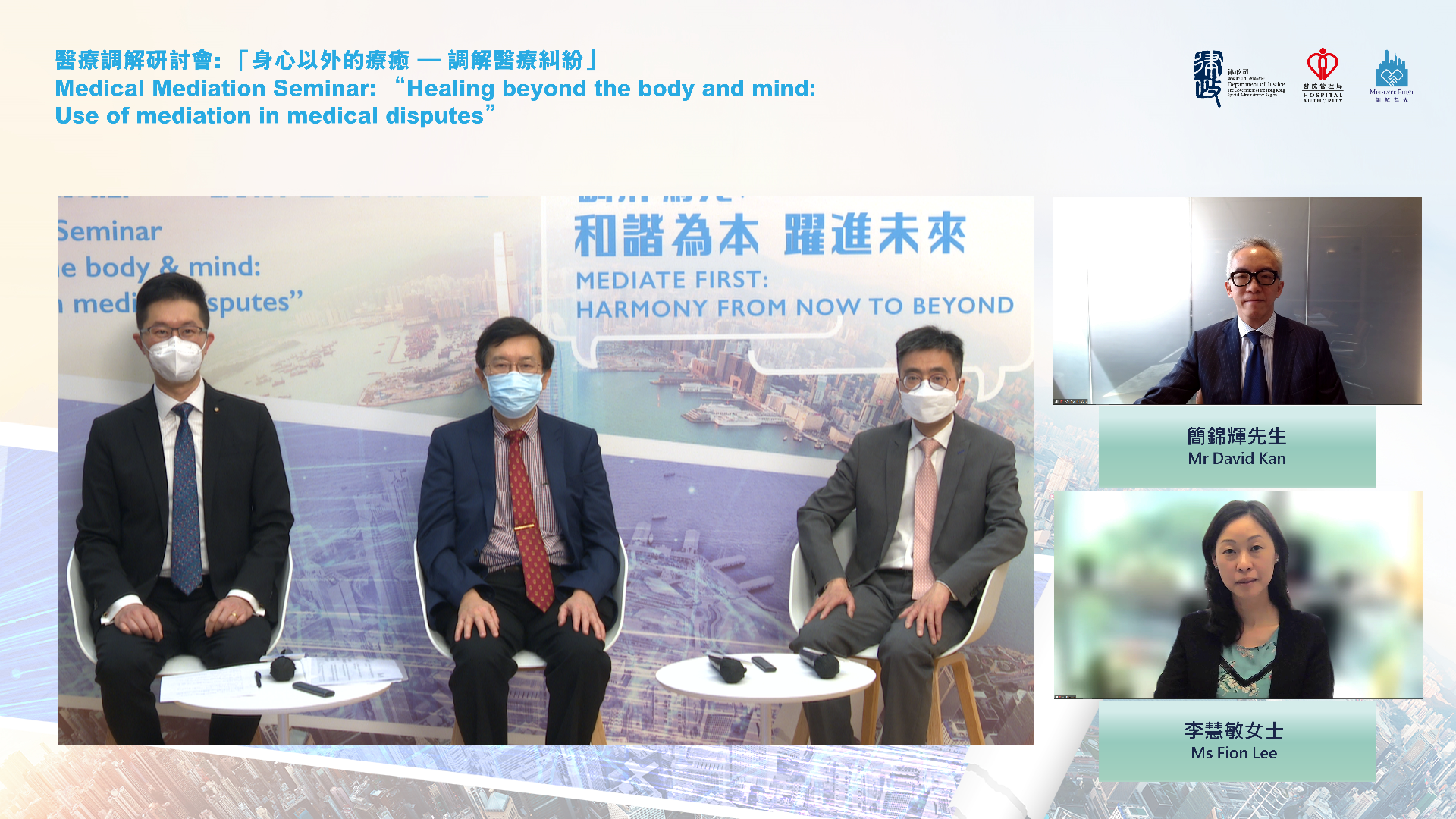

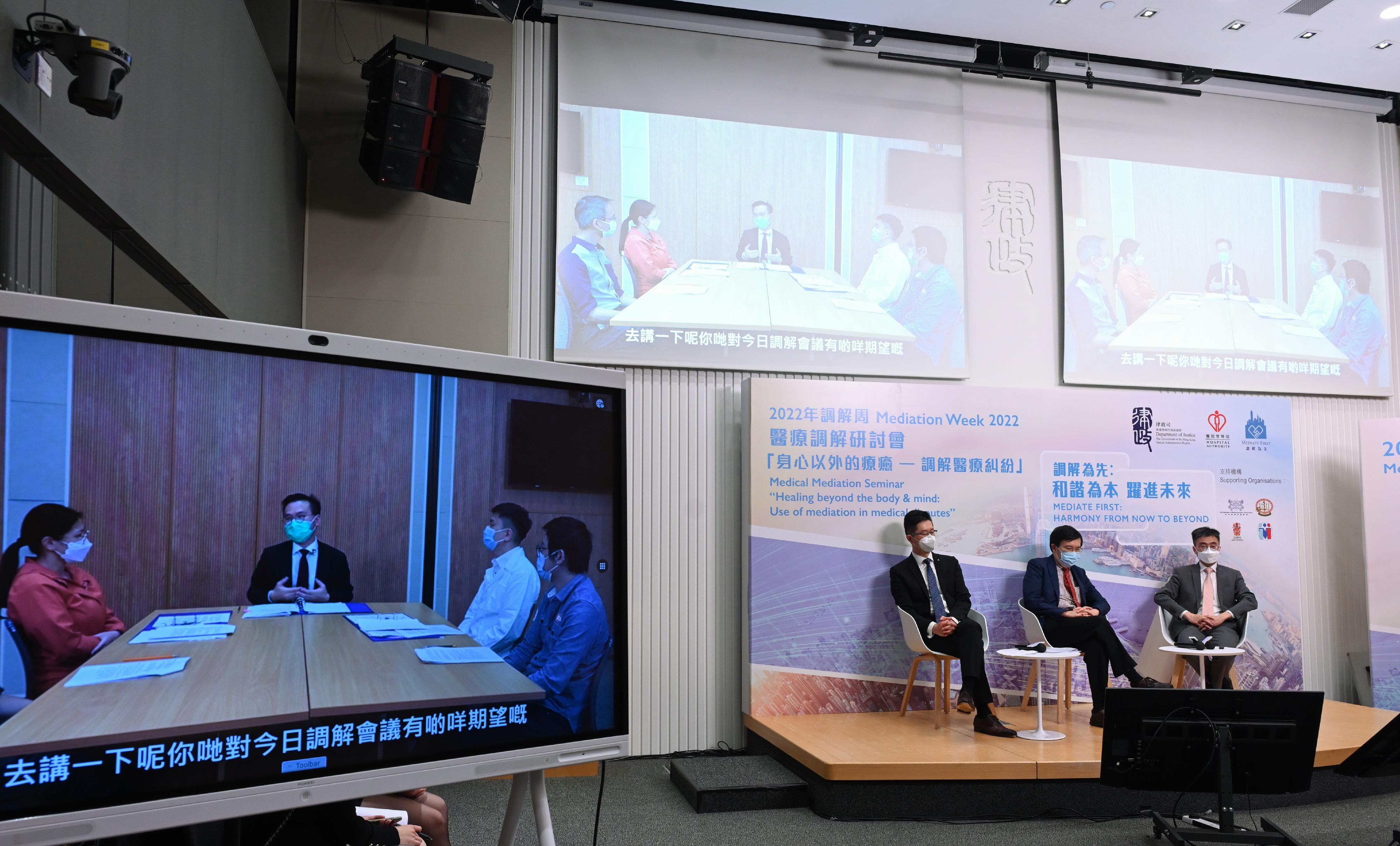

Medical mediation seminar successfully held (with photos)

     Co-organised by the Department of Justice and the Hospital Authority, the medical mediation seminar entitled "Healing beyond the body and mind: Use of mediation in medical disputes" has come to fruition today (May 4). The seminar is the third thematic event held during the Mediation Week 2022, attracting over 500 participants who attended virtually.

     The seminar commenced with the welcoming remarks by the Chief Executive of Hospital Authority, Dr Tony Ko, who explained that the Hospital Authority, as a "people-first" organisation, encourages their staff to use mediation and mediation skills to facilitate communication and build trust with patients in order to achieve early resolution of disputes in a medical setting.

     During the seminar, distinguished guest speakers Mr David Kan, Professor Albert Lee, Dr Danny Lee and Ms Fion Lee shared their views from legal and dispute resolution, regulatory, patient relations and hospital administration angles, on the use of mediation in resolving medical disputes arising in public and private hospital settings, with the aid of a short dramatisation of a medical dispute based on a real-life medical case, and demonstrations of mediation sessions.

     The individual presentations were followed by an armchair discussion hosted by the moderator, Dr Peter Pang. The vibrant discussions included the benefits and challenges in the use of mediation to resolve medical disputes, the takeaways from the hospital in-house complaints-handling mechanism, and salient matters that require more attention for mediation to be more widely adopted in a medical setting. The prospect of introducing mediation into the disciplinary procedures of the Medical Council of Hong Kong was also explored with reference to the Singapore model.

     For more information on the seminar and the Mediation Week 2022, please visit the dedicated event website.

Photo  Photo  Photo  


LCQ15: Regulation of food delivery online platforms

     Following is a question by the Hon Cheung Kwok-kwan and a written reply by the Secretary for Food and Health, Professor Sophia Chan, in the Legislative Council today (May 4):
 
Question:
 
     Amid the epidemic, many members of the public stay home to fight the epidemic and reduce dining out, resulting in the rapid development of food delivery online platforms (such platforms). However, the Consumer Council indicated in February this year that the number of complaints relating to such platforms had surged sharply by more than five times from 2019 to 2021, and such complaints were mainly about delays in meal delivery, cancellation of delivery, etc. In this connection, will the Government inform this Council:
 
(1) of the number of complaints relating to such platforms received by the Government in each of the past three years, with a breakdown by type of cases;
 
(2) whether it has examined, for the food ordered through such platforms, the respective legal liabilities of such platforms as well as the restaurants and the meal delivery couriers involved when food safety problems arise due to delays in meal delivery;
 
(3) of the government department currently responsible for regulating the food safety of the food delivered through such platforms; and
 
(4) as it is learnt that currently the websites of a majority of such platforms contain limitation of liability clauses, rendering it difficult for customers to seek reasonable compensation for situations like such platforms' delay in or cancellation of delivery and missing orders, whether the Government will study the establishment of a mechanism for regulating such platforms, so as to protect the rights and interests of consumers; if so, of the details; if not, the reasons for that?
 
Reply:
 
President,
 
     Food safety and consumers' rights are currently protected by various laws in Hong Kong. In consultation with the Commerce and Economic Development Bureau, our consolidated reply to the various parts of the question on online food delivery platforms is as follows:
 
     E-commerce activities such as online platform operations have been gaining popularity amid the COVID-19 epidemic. In the past three years, the number of complaints against online food delivery platforms received by the Food and Environmental Hygiene Department (FEHD) and the Customs and Excise Department respectively in relation to food safety and common unfair trade practices, e.g. false trade descriptions and misleading omissions, regulated by the Trade Descriptions Ordinance (Cap. 362) are as follows:
 

Year 2019 2020 2021 Total
Number of complaints concerning food safety 9 69 164 242
Number of complaints concerning the Trade Descriptions Ordinance 17 20 77 114

 
     Under section 54 of the Public Health and Municipal Services Ordinance (Cap. 132), all food for sale for human consumption in Hong Kong, whether imported or locally produced, must be fit for human consumption. Offenders are subject to a maximum fine of $50,000 and imprisonment for six months upon conviction. Moreover, section 52 of the Ordinance stipulates that any person who sells to the prejudice of a purchaser any food which is not of the nature, or not of the substance, or not of the quality, of the food demanded by the purchaser shall be guilty of an offence. The maximum penalty is a fine of $10,000 and three months' imprisonment. Regarding the above food safety complaints, the follow-up actions taken by the FEHD included instituting prosecutions under the Ordinance against the operators of the food premises involved in two respective cases concerning foreign substances in food with sufficient evidence. The persons connected with these cases were convicted.
 
     In addition, according to the Food Business Regulation (Cap. 132X), "food business" generally means any trade or business for the purpose of which a person engages in the handling of food. These trades or businesses shall apply to the FEHD for the relevant food business licences having regard to their actual operation and business modes. At present, licensed food premises providing takeaway and food delivery services (including online food sale) have to comply with the relevant licensing conditions, including those relating to food containers, food storage and temperatures for food delivery, in order to ensure food safety and public health. If licensed food premises are found breaching the licensing conditions, the FEHD will take appropriate actions, which include issuing warnings and considering cancelling the licences of food premises in persistent breach of the relevant licensing conditions. 
 
     The Centre for Food Safety of the FEHD has issued a reminder on the points to note about food delivery amid the COVID-19 epidemic to major local online food delivery service providers, urging them to maintain cleanliness and hygiene and ensure proper temperature control for delivered foods to ensure food safety. 
 
     As food delivery operations of online platforms are becoming more popular, the FEHD plans to make it clear under the existing licensing regime that the licensee of a food premises shall ensure that the foods delivered for him by an online platform or a delivery service contractor meet the requirements of the relevant licensing conditions. These include ensuring that takeaway and delivered foods are stored at a safe and proper temperature at all times and kept free from tampering during transportation to reduce the risk of cross-contamination. The FEHD will formulate the detailed arrangements of the plan later on so as to further ensure food safety.
 
     Meanwhile, existing laws in Hong Kong impose controls on contracts relating to consumer transactions. For instance, section 7(1) of the Control of Exemption Clauses Ordinance (Cap. 71) stipulates that a person cannot by reference to any contract term or any notice given to persons generally or particular persons, exclude or restrict his liability for death or personal injury resulting from negligence. In addition, section 5 of the Supply of Services (Implied Terms) Ordinance (Cap. 457) provides that where the supplier is acting in the course of a business, the supplier shall carry out the service with reasonable care and skill; section 8(1) stipulates that if a party to a contract is a consumer, the other party cannot, by reference to any contract term, exclude or restrict any of his liability arising under the contract by virtue of that Ordinance. Depending on the actual circumstances of the cases concerned (including contract terms), consumers may lodge claims under contract law and/or any other relevant laws.
 
     On the other hand, consumers may also seek assistance from the Consumer Council (the Council). The Council acts as a conciliator in handling disputes between consumers and traders. It assists traders and complainants to resolve their disputes, for instance, by trying to contact the traders with a view to helping both parties reach a mutually satisfactory settlement through conciliation.


Effective Exchange Rate Index

     The effective exchange rate index for the Hong Kong dollar on Wednesday, May 4, 2022 is 98.9 (down 0.4 against yesterday's index).


LCQ20: Epidemic-related expenditure of Hospital Authority

     Following is a question by the Hon Mrs Regina Ip and a written reply by the Secretary for Food and Health, Professor Sophia Chan, in the Legislative Council today (May 4):

Question:

     Will the Government inform this Council of the amount of additional funding provided, from January 23, 2020 when the first confirmed case of the Coronavirus Disease 2019 appeared in Hong Kong to February 28, 2022, by the Government to the Hospital Authority to assist it in coping with the epidemic, with a breakdown of the use of such funding by expenditure items (e.g. employment of healthcare personnel, provision of allowances to healthcare personnel, procurement of drugs, purchase of medical devices and equipment)?
 
Reply:
 
President,

     Since the outbreak of the Coronavirus Disease 2019 (COVID-19) in Hong Kong in 2019-20, the Government has provided additional resources to support the Hospital Authority (HA) in combatting the COVID-19 epidemic. These include:

(a) $4.7 billion from the Anti-epidemic Fund allocated in February 2020 to provide additional resources for the HA in tackling the COVID-19 epidemic, in particular for ensuring sufficient support and protection for frontline healthcare staff;

(b) an additional funding of $3.044 billion allocated to the HA in September 2020 to strengthen its service capacity in combatting the fourth wave of epidemic;

(c) an additional subvention of $7.5 billion allocated to the HA in 2022-23 for enhancing its capacity in combatting the new wave of COVID-19 epidemic and sustaining anti-epidemic measures; and

(d) $1.141 billion provided to the HA in view of its continued support on various fronts, including the operation of the North Lantau Hospital Hong Kong Infection Control Centre (HKICC), COVID 19 Vaccination Programme, Enhanced Laboratory Surveillance (ELS) programme at General Outpatient Clinics (GOPCs), etc.

     The HA has been flexibly deploying the funding for carrying out various anti-epidemic initiatives, which include:

(a) personnel-related expenditure for frontline staff involved in anti-epidemic efforts, including the provision of special allowances (e.g. Special Allowance for Designated Settings), extending and enhancing rates under the Special Honorarium Scheme, and recruiting more temporary and agency staff;

(b) establishment and operation of the HKICC and other isolation and treatment facilities, including the Treatment Centre for COVID-19 at AsiaWorld-Expo, the Community Isolation Facility at Penny’s Bay Quarantine Centre, etc.;

(c) procuring additional personal protective equipment (PPE) and other necessary accessories for healthcare staff;

(d) enhancing support for laboratory testing and procuring drugs and medical equipment;

(e) enhancing hospital support services and supplies, etc.;

(f) widening ELS programme for COVID-19 at GOPCs; 

(g) supporting the COVID-19 Vaccination Programme; and

(h) procuring rapid antigen test kits for patients and HA staff, etc.

     As at February 28, 2022, the HA has incurred around $8.565 billion for implementing various anti-epidemic measures, among which about $3.1 billion is for manpower related expenditure; about $1.3 billion for expenditure regarding establishment and operation of extra isolation and treatment facilities (excluding manpower related expenditure); and about $4.2 billion for remaining expenditure items (including support for testing, vaccination, procurement of drugs and medical equipment, PPE and other equipment, etc.).