Additional CoronaVac vaccine doses purchased by Government arrive in Hong Kong

     The Government announced today (May 5) that about 600 000 extra doses of the CoronaVac vaccine have been purchased to cope with the demand for COVID-19 vaccination. The batch of vaccines has been delivered to Hong Kong from Beijing today. Together with the earlier batches, about 9.1 million doses of the CoronaVac vaccine have been purchased in total.

     Soon after the arrival of the new batch of the CoronaVac vaccine, staff carried out stringent checking and inspection on the vaccine in accordance with established procedures to ensure that it complies with the product specifications and that the transportation process follows the relevant cold-chain requirements.

     "Given the high transmissibility of the Omicron mutant strain, members of the public must still stay vigilant even if the epidemic situation has subsided a little recently. Deaths and severe cases involving children and elderly persons, who are our focus of protection in vaccination, have been recorded in the fifth wave of the epidemic. Vaccination is highly effective in preventing severe cases or deaths from COVID-19. We strongly appeal to members of the public who have not been vaccinated to get vaccinated with no delay. Members of the public who are currently eligible for a third or fourth dose should also get the dose as soon as possible. Details of the programme can be found at the designated website (www.covidvaccine.gov.hk)," a spokesman for the Government said.


Monetary Authority Announces Countercyclical Capital Buffer Ratio for Hong Kong

The following is issued on behalf of the Hong Kong Monetary Authority:

     The Monetary Authority announced today (May 5) that the countercyclical capital buffer (CCyB) ratio for Hong Kong remains unchanged at 1 per cent.
      
     "The latest economic indicators point to a slowdown of economic activities in Hong Kong in the first quarter of 2022, and uncertainties about the global and domestic economic environment have increased," the Monetary Authority, Mr Eddie Yue, said. "It is therefore appropriate to keep the CCyB ratio unchanged at the current level for the time being and continue to monitor the situation closely."
      
     Further details of the decision may be found in the Announcement of the CCyB to Authorized Institutions on the Hong Kong Monetary Authority website.
 
Background
 
     In setting the CCyB ratio the Monetary Authority considered a series of quantitative indicators and qualitative information including an "indicative buffer guide" (which is a metric providing a guide for CCyB ratio based on the gap between the ratio of credit to GDP and its long term trend, and between the ratio of residential property prices to rentals and its long term trend). The latest indicative buffer guide, calculated based on 2021 Q4 data, signals a CCyB of 1 per cent. The projection based on all available data suggests that the indicative buffer guide would likely signal a CCyB lower than 1 per cent when all relevant 2022 Q1 data become available.
      
     Whilst the indicative buffer guide, as its name suggests, provides only a "guide" for CCyB decisions, the determination of the jurisdictional CCyB ratio for Hong Kong is not a mechanical exercise and, in addition to the indicative buffer guide, the Monetary Authority also reviewed a range of other reference indicators. The latest economic indicators point to a slowdown of economic activities in Hong Kong in 2022 Q1, and uncertainties about the global and domestic economic environment have increased. It is therefore appropriate to keep the CCyB ratio unchanged at 1 per cent for the time being and continue to monitor the situation closely.
      
     The CCyB is an integral part of the Basel III regulatory capital framework and is being implemented in parallel by Basel Committee member jurisdictions worldwide. The CCyB has been designed by the Basel Committee to increase the resilience of the banking sector in periods of excess credit growth. The banking sector can then act as a "shock absorber" in times of stress, rather than as an amplifier of risk to the broader economy.
      
     The power to implement the CCyB in Hong Kong is provided by the Banking (Capital) Rules, which enable the Monetary Authority to announce a CCyB ratio for Hong Kong. The specific CCyB requirement applicable to a given Authorized Institution (AI) is expressed as a percentage of its CET1 capital to its total risk-weighted assets. Each AI's CCyB requirement may vary depending on the geographic mix of its private sector credit exposures and the CCyB applicable in each jurisdiction where it has such exposures.


Hong Kong and New Zealand conduct fourth Joint Commission meeting under Closer Economic Partnership Agreement (with photos)

     The Joint Commission established under the Closer Economic Partnership Agreement (CEP Agreement) between Hong Kong and New Zealand concluded its fourth meeting via video conferencing today (May 5).
 
     Those attending the meeting concurred that the CEP Agreement, since its entry into force in January 2011, had been implemented smoothly and effectively, providing better market access and certainty to businesses of both sides through total elimination of tariffs on trade in goods and broad trade in services liberalisation commitments in sectors including business and professional services, communication services, financial services and transport services.
 
     At the meeting, both sides also exchanged views on enhancing co-operation to mitigate the impact of the COVID-19 pandemic and prepare for post-pandemic recovery.
 
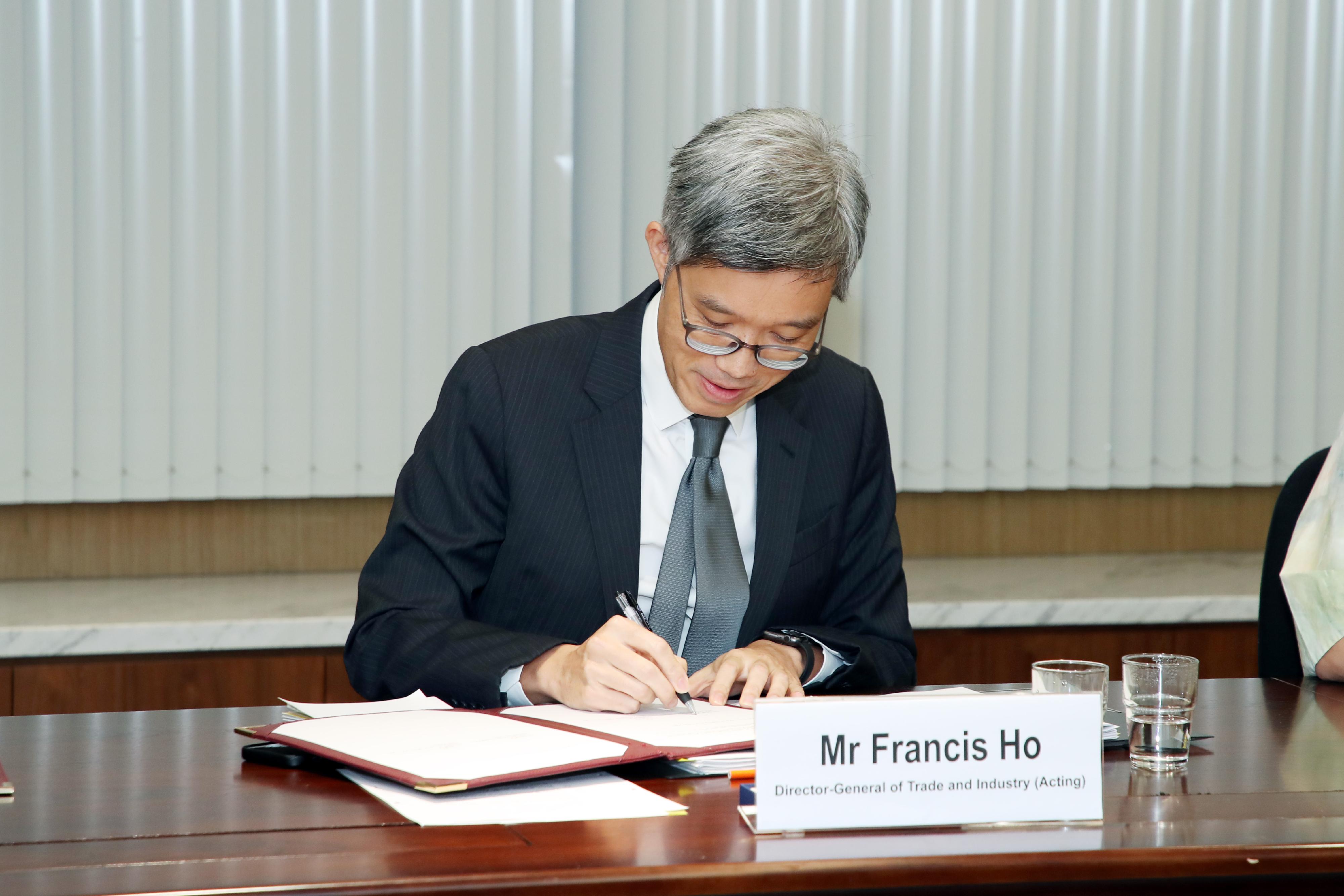
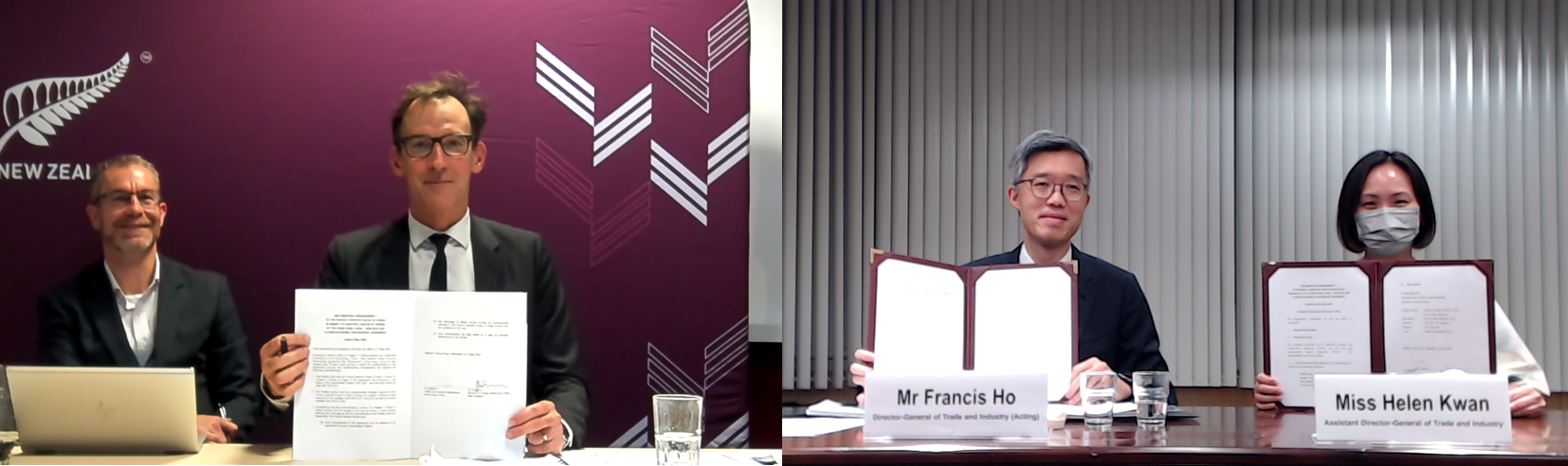
     The meeting was co-chaired by the Acting Director-General of Trade and Industry, Mr Francis Ho, and the Divisional Manager of the Trade Policy Engagement and Implementation Division of the Ministry of Foreign Affairs and Trade of New Zealand, Mr Greg Andrews.
 
     To further the co-operation between Hong Kong and New Zealand under the CEP Agreement, three implementing arrangements were signed at the meeting to facilitate the ongoing co-operation and communication in the areas of rules of origin, sanitary and phytosanitary measures, and government procurement.
 
     Hong Kong and New Zealand also agreed in principle to update commitments on trade in services pursuant to the most favoured nation treatment provision under the CEP Agreement. Under this, the service providers of each side will be able to enjoy the other side's additional service commitments in its future free trade agreements (FTAs) with other trading partners. Both sides will continue to work closely with a view to promulgating details of the services sectors involved as soon as possible. The updated commitments will help boost trade and investment flows as well as create more opportunities for businesses and investors in Hong Kong and New Zealand during the post-pandemic economic recovery.
 
     Mr Ho said, "New Zealand is a valuable trading partner and the first foreign economy we entered into an FTA with. Since the implementation of the Agreement in 2011, the bilateral merchandise trade between Hong Kong and New Zealand grew by 18 per cent to $9.7 billion in 2021.
 
     "Despite the rising protectionism and uncertainties in the global trade environment amidst the pandemic situation, the CEP Agreement has demonstrated our mutual commitment to free and open trade and investment. We look forward to working closely together with New Zealand to strengthen our trade and investment ties."
 
     Both sides also had a discussion on Hong Kong's request for accession to the Regional Comprehensive Economic Partnership (RCEP), of which New Zealand is a member. Hong Kong reiterated its readiness to begin substantive discussions with RCEP members and that its accession would bring mutual benefits to both Hong Kong and RCEP members. Both sides will continue to maintain communication in this regard.
 
     To date, Hong Kong has signed eight FTAs with 20 economies, namely the Mainland, the Macao Special Administrative Region, the 10 member states of the Association of Southeast Asian Nations, Australia, Chile, the four member states of the European Free Trade Association, Georgia and New Zealand, all of which have entered into force.

Photo  Photo  


CSD latest arrangements in light of epidemic developments

     The Correctional Services Department (CSD) said today (May 5) that as the epidemic trend of COVID-19 continues to stabilise in the community and correctional institutions, all social and official visit arrangements to correctional institutions will resume as normal from May 9 except for additional social visits which will continue to be suspended. 

     To reduce the risk of the spread of the virus into the institutions, the CSD will continue to implement the following measures: (i) visitors are required to conduct a rapid antigen test by themselves with a negative result on the day of the visit, and declare the test result in a health declaration form upon arrival at the correctional institutions; and (ii) save for exempted persons, visitors are required to follow the dosage schedule for the Vaccine Pass issued by the Government to present the corresponding vaccination record and/or relevant proof of recovery or infection for Vaccine Pass purposes, as well as to use the "LeaveHomeSafe" mobile app to register before being allowed to enter the correctional institutions for visits. For details of the dosage schedule for the Vaccine Pass, please refer to the government website at www.coronavirus.gov.hk/pdf/vp_t1_ENG.pdf. The visit arrangements and relevant measures may be subject to change according to the epidemic developments in correctional institutions, and visitors should pay attention to the announcements by the CSD and the departmental website.

     Visitors should also note that all persons in custody (PICs) testing positive for COVID-19 and their close contact groups are not allowed to receive visits as they are subject to isolation for treatment and observation, during which they will be allowed to receive approved hand-in articles on one occasion. For the types and maximum quantities of the approved hand-in articles, please refer to the CSD website. Registered users of the HKCSD Mobile App may use the app to enquire about whether individual PICs are allowed to receive visits. Visitors may also call the staff of the Rehabilitation Unit or visit room of the respective correctional institutions (please refer to the departmental website for the telephone numbers) or the CSD hotline 2511 3511 in advance to enquire about the visit status of individual PICs.


Provisional statistics of retail sales for March 2022

     The Census and Statistics Department (C&SD) released the latest figures on retail sales today (May 5).

     The value of total retail sales in March 2022, provisionally estimated at $23.8 billion, decreased by 13.8% compared with the same month in 2021. The revised estimate of the combined value of total retail sales in January and February 2022 decreased by 4.9% compared with the same period a year earlier. For the first quarter of 2022, it was provisionally estimated that the value of total retail sales decreased by 7.6% compared with the same period in 2021.

     Of the total retail sales value in March 2022, online sales accounted for 11.7%. The value of online retail sales in that month, provisionally estimated at $2.8 billion, increased by 30.9% compared with the same month in 2021. The revised estimate of the combined value of online retail sales in January and February 2022 increased by 39.0% compared with the same period a year earlier. For the first quarter of 2022, it was provisionally estimated that the value of online retail sales increased by 36.3% compared with the same period in 2021.

     After netting out the effect of price changes over the same period, the provisional estimate of the volume of total retail sales in March 2022 decreased by 16.8% compared with a year earlier. The revised estimate of the combined volume of total retail sales in January and February 2022 decreased by 7.6% compared with the same period a year earlier. For the first quarter of 2022, the provisional estimate of the total retail sales decreased by 10.4% in volume compared with the same period in 2021.

     Analysed by broad type of retail outlet in descending order of the provisional estimate of the value of sales and comparing March 2022 with March 2021, the value of sales of other consumer goods, not elsewhere classified decreased by 1.9%. This was followed by sales of electrical goods and other consumer durable goods, not elsewhere classified (-4.5% in value); food, alcoholic drinks and tobacco (-3.3%); commodities in department stores (-16.9%); jewellery, watches and clocks, and valuable gifts (-36.8%); medicines and cosmetics (-7.0%); wearing apparel (-39.4%); motor vehicles and parts (-15.0%); fuels (-15.7%); furniture and fixtures (-23.7%); Chinese drugs and herbs (-9.2%); books, newspapers, stationery and gifts (-17.7%); footwear, allied products and other clothing accessories (-55.4%); and optical shops (-42.8%).

     On the other hand, the value of sales of commodities in supermarkets increased by 2.6% in March 2022 over a year earlier.

     Based on the seasonally adjusted series, the provisional estimate of the value of total retail sales decreased by 14.9% in the first quarter of 2022 compared with the preceding quarter, while the provisional estimate of the volume of total retail sales decreased by 16.3%.

     These retail sales statistics measure the sales receipts in respect of goods sold by local retail establishments and are primarily intended for gauging the short-term business performance of the local retail sector. Data on retail sales are collected from local retail establishments through the Monthly Survey of Retail Sales (MRS). Local retail establishments with and without physical shops are covered in MRS and their sales, both through conventional shops and online channels, are included in the retail sales statistics. Starting from January 2020, data on online retail sales have been collected in MRS. The relevant results were first published in the January 2021 issue of the "Report on Monthly Survey of Retail Sales".

     The retail sales statistics cover consumer spending on goods but not on services (such as those on housing, catering, medical care and health services, transport and communication, financial services, education and entertainment) which account for over 50% of the overall consumer spending. Moreover, they include spending on goods in Hong Kong by visitors but exclude spending outside Hong Kong by Hong Kong residents. Hence they should not be regarded as indicators for measuring overall consumer spending.

     Users interested in the trend of overall consumer spending should refer to the data series of private consumption expenditure (PCE), which is a major component of the Gross Domestic Product published at quarterly intervals. Compiled from a wide range of data sources, PCE covers consumer spending on both goods (including goods purchased from all channels) and services by Hong Kong residents whether locally or abroad. Please refer to the C&SD publication "Gross Domestic Product (Quarterly)" for more details.

Commentary

     A government spokesman said that the value of retail sales fell sharply further in March from a year earlier, as the fifth wave of local epidemic and the resultant social distancing measures continued to constrain people flow and dampen consumption sentiment.

     Looking ahead, the spokesman pointed out that the improved local epidemic situation of late and thus the progressive relaxation of social distancing measures, along with the disbursement of the first batch of electronic consumption vouchers in early April, will render support to the retail sector. It is thus vital for the community to continue to work in unison with the Government to further stabilise the local epidemic situation.

Further information

     Table 1 presents the revised figures on value index and value of retail sales for all retail outlets and by broad type of retail outlet for February 2022 as well as the provisional figures for March 2022. The provisional figures on the value of retail sales for all retail outlets and by broad type of retail outlet as well as the corresponding year-on-year changes for the first quarter of 2022 are also shown.

     Table 2 presents the revised figures on value of online retail sales for February 2022 as well as the provisional figures for March 2022. The provisional figures on year-on-year changes for the first quarter of 2022 are also shown.

     Table 3 presents the revised figures on volume index of retail sales for all retail outlets and by broad type of retail outlet for February 2022 as well as the provisional figures for March 2022. The provisional figures on year-on-year changes for the first quarter of 2022 are also shown.

     Table 4 shows the movements of the value and volume of total retail sales in terms of the year-on-year rate of change for a month compared with the same month in the preceding year based on the original series, and in terms of the rate of change for a three-month period compared with the preceding three-month period based on the seasonally adjusted series.

     The classification of retail establishments follows the Hong Kong Standard Industrial Classification (HSIC) Version 2.0, which is used in various economic surveys for classifying economic units into different industry classes.

     More detailed statistics are given in the "Report on Monthly Survey of Retail Sales". Users can download this publication at the website of the C&SD (www.censtatd.gov.hk/en/EIndexbySubject.html?pcode=B1080003&scode=530). Alternatively, the historical series of retail sales statistics can be downloaded in the form of a statistical table at the website of the C&SD (www.censtatd.gov.hk/en/EIndexbySubject.html?pcode=D5600089&scode=530).

     Users who have enquiries about the survey results may contact the Distribution Services Statistics Section of the C&SD (Tel: 3903 7400; email: mrs@censtatd.gov.hk).