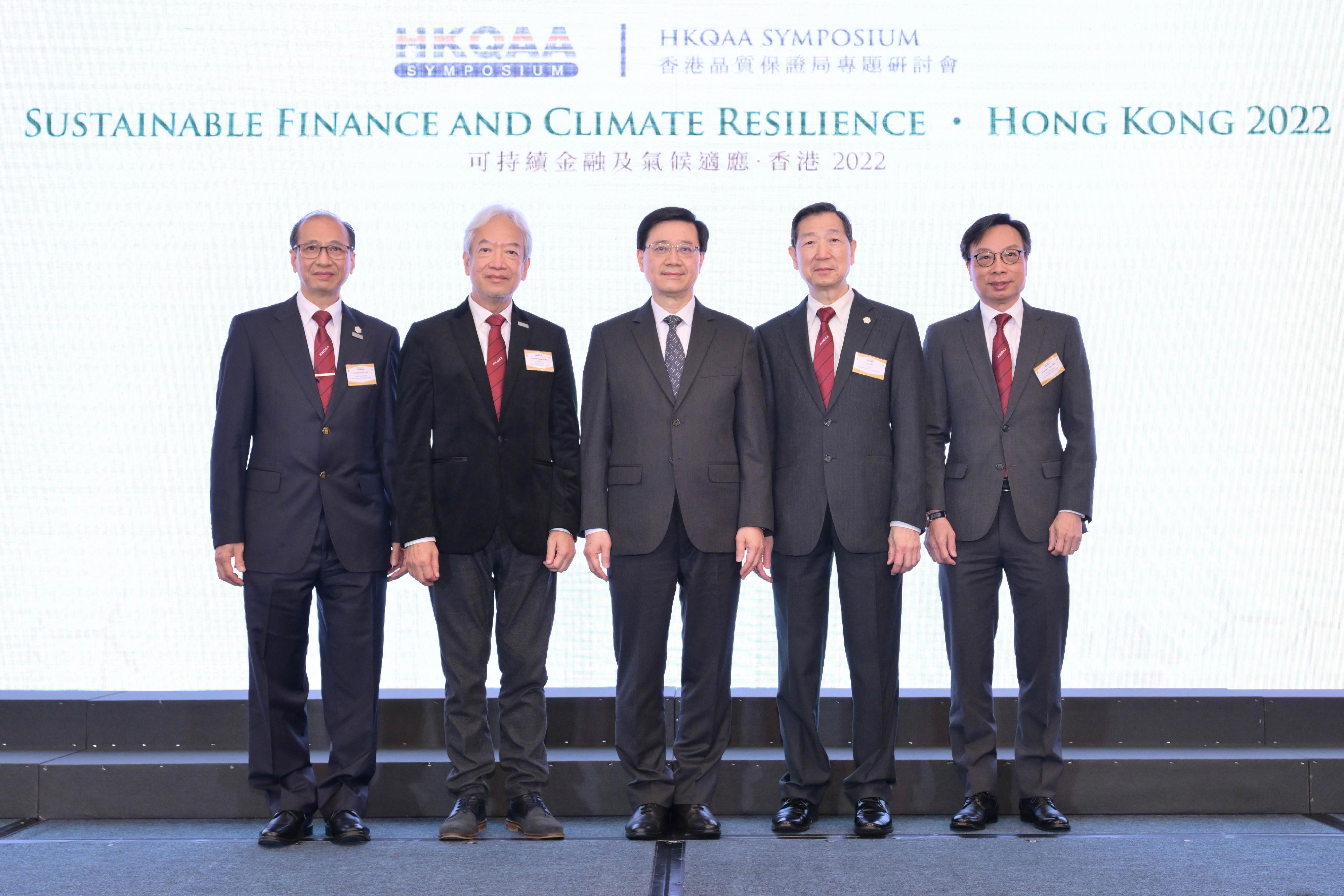
Speech by CE at HKQAA International Symposium – Sustainable Finance and Climate Resilience · Hong Kong 2022 (English only) (with photos/video)

     Following is the speech by the Chief Executive, Mr John Lee, at the HKQAA International Symposium – Sustainable Finance and Climate Resilience · Hong Kong 2022 today (December 1):
 
Ir C S Ho (Chairman of the Hong Kong Quality Assurance Agency (HKQAA), Mr Ho Chi-shing), distinguished guests, ladies and gentlemen,
 
     Good afternoon. I am pleased to join you for the Hong Kong Quality Assurance Agency's International Symposium, under the theme "Sustainable Finance and Climate Resilience". My thanks to the Agency for organising this year's gathering, for hosting this symposium every year since 2001.
 
     It has been a full and rewarding afternoon, I'm delighted to say. Nearly 1 000 high-profile professionals, in-house and online, have heard from a wealth of speakers representing international organisations, regulatory bodies, governments and businesses local and global. All of you focused on advancing green and sustainable finance in Hong Kong, in the Guangdong-Hong Kong-Macao Greater Bay Area, throughout our country and around the world.
 
     Climate change is a global problem, and it demands a global solution. Concerted, collective action.
 
     President Xi Jinping underlined that in his written speech at the APEC CEO Summit in Bangkok, just two weeks ago. The President emphasised the importance of building an Asia-Pacific community with a shared future – and a shared responsibility. And I quote, "It is important for us to pursue green and low-carbon development, foster green economic sectors, promote green finance, and speed up the establishment of an Asia-Pacific green cooperation framework".
 
     Hong Kong, as you know, is working closely with our motherland in pursuing those goals. To align with the country's commitment to peak carbon before 2030 and carbon neutrality before 2060, Hong Kong is determined to achieve carbon neutrality before 2050. By 2035, we aim to reduce our total carbon emissions from our 2005 level by half.
 
     Hong Kong's Climate Action Plan 2050 details four ambitious decarbonisation strategies on the road to carbon neutrality: "net-zero electricity generation", "energy saving and green buildings", "green transport" and "waste reduction".
 
     We need, as well, to adopt a comprehensive adaptation and resilience strategy if we are to safeguard the life, health and property of our people and our community from extreme weather.
 
     This is particularly challenging given that Hong Kong is a coastal city. We are, as you well know, susceptible to tropical cyclones, rainstorms, storm surges and other weather-induced threats.
 
     In response, we are strengthening our critical public infrastructure, stepping up coastal protection, boosting the city's flood resistance, stabilising slopes, and more, to minimise extreme weather's chaotic consequences.
 
     We will continue, too, to enhance building design and promote urban forestry to alleviate and cope with rising temperatures. Over the next 15 to 20 years, the Hong Kong SAR Government will allocate about HK$240 billion to combat climate change through such strategies as green buildings, renewable energy, green transport, waste management and more. The money will also fund such adaptation strategies as strengthening coastal management, stabilising slopes and improving drainage.
 
     Meanwhile, we are creating, and we will continue to create, manifold opportunities for the development of green and sustainable finance.
 
     That means issuing government green bonds. To date, we've issued close to US$10 billion worth. It also means providing subsidies to cover the expenses of bond issuers and loan borrowers in their issuances and external review services. It means, too, supporting green finance talent training, developing climate-related disclosure reporting standards. All these will, rest assured, be aligned with global practices.
 
     In my Policy Address, I made it clear that developing green and sustainable finance is essential to our future. Next month, we will move another determined step in that direction with the opening of a new Office of Climate Change and Carbon Neutrality in the Hong Kong SAR Government. It will help us strengthen co-ordination and promote decarbonisation. 
 
     There's more. The Council for Sustainable Development will be reorganised, becoming the Council for Carbon Neutrality and Sustainable Development. It will offer advice on decarbonisation strategies and promote community participation.
 
     We need the involvement, the commitment, the participation of everyone – government, business and, yes, the community, if we are to achieve carbon neutrality and enhance our adaptive capacity.
 
     In that regard, I am grateful for the support of the Hong Kong Quality Assurance Agency in our continuing low-carbon transformation as a leading climate-resilient city. Your experience and technical expertise, your participation in the development of national and international standards, your wide-ranging role in our progress as a regional green and sustainable finance hub, is as welcome as it is essential.
 
     Allow me, as well, to thank the many green and sustainable finance issuers, and professionals and service providers from so many related sectors, here for today's symposium. Your continuing support and wide-ranging efforts to support Hong Kong's rise as a regional green and sustainable finance hub will be instrumental to our ultimate success.
 
     Ladies and gentlemen, I look forward to your co-operation, and collaboration, in the year to come – and every year that follows on our collective mission to carbon neutrality. To the flourishing future we all want.
 
     Thank you.
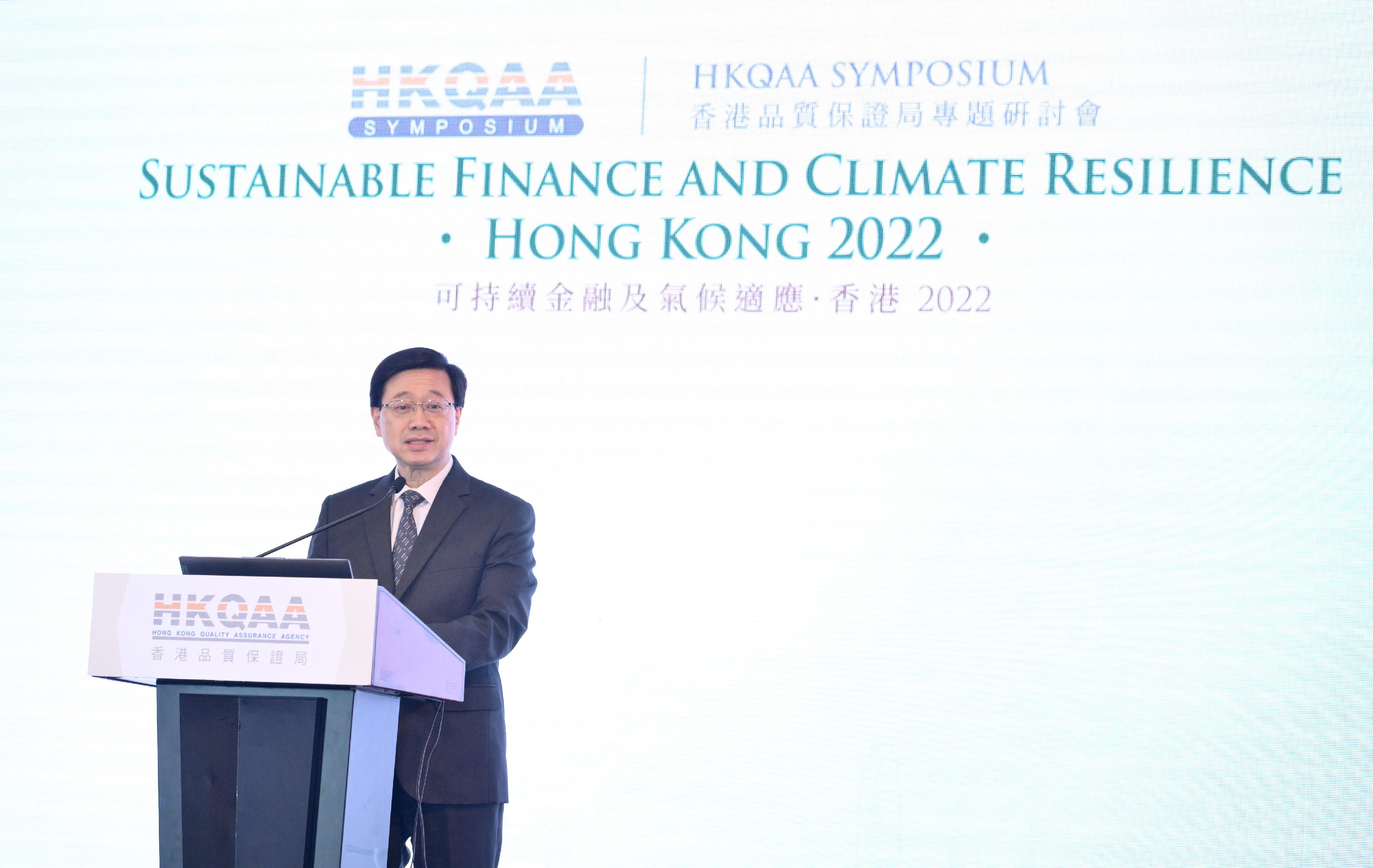
Photo  Photo  


Provisional Statistics of Retail Sales for October 2022

     The Census and Statistics Department (C&SD) released the latest figures on retail sales today (December 1).

     The value of total retail sales in October 2022, provisionally estimated at $31.9 billion, increased by 3.9% compared with the same month in 2021. The revised estimate of the value of total retail sales in September 2022 increased by 0.3% compared with a year earlier. For the first 10 months of 2022 taken together, it was provisionally estimated that the value of total retail sales decreased by 0.7% compared with the same period in 2021.

     Of the total retail sales value in October 2022, online sales accounted for 10.7%. The value of online retail sales in that month, provisionally estimated at $3.4 billion, increased by 34.7% compared with the same month in 2021. The revised estimate of online retail sales in September 2022 increased by 26.8% compared with a year earlier. For the first 10 months of 2022 taken together, it was provisionally estimated that the value of online retail sales increased by 23.8% compared with the same period in 2021.

     After netting out the effect of price changes over the same period, the provisional estimate of the volume of total retail sales in October 2022 increased by 2.4% compared with a year earlier. The revised estimate of the volume of total retail sales in September 2022 decreased by 1.4% compared with a year earlier. For the first 10 months of 2022 taken together, the provisional estimate of the total retail sales decreased by 3.5% in volume compared with the same period in 2021.

     Analysed by broad type of retail outlet in descending order of the provisional estimate of the value of sales and comparing October 2022 with October 2021, the value of sales of electrical goods and other consumer durable goods not elsewhere classified increased by 11.4%. This was followed by sales of jewellery, watches and clocks, and valuable gifts (+13.6% in value); other consumer goods not elsewhere classified (+2.2%); food, alcoholic drinks and tobacco (+2.1%); medicines and cosmetics (+5.9%); motor vehicles and parts (+57.6%); fuels (+5.3%); books, newspapers, stationery and gifts (+36.3%); Chinese drugs and herbs (+8.3%); and optical shops (+3.8%).

     On the other hand, the value of sales of commodities in supermarkets decreased by 2.7% in October 2022 over a year earlier. This was followed by sales of commodities in department stores (-17.1% in value); wearing apparel (-5.8%); furniture and fixtures (-5.7%); and footwear, allied products and other clothing accessories (-3.7%).

     Based on the seasonally adjusted series, the provisional estimate of the value of total retail sales increased by 5.0% in the three months ending October 2022 compared with the preceding three-month period, while the provisional estimate of the volume of total retail sales increased by 5.3%.

Commentary

     A government spokesman said that the value of retail sales recorded an accelerated year-on-year increase in October alongside the disbursement of a new batch of consumption vouchers. Business of many types of retail outlet saw improvement, with sales of consumer durable goods, and jewellery, watches and clocks, and valuable gifts registering double-digit increases.

     Looking ahead, the spokesman pointed out that improved labour market conditions and the Consumption Voucher Scheme will continue to provide support to the retail sector, though tightened financial conditions will partly offset the effects. Moreover, as long as the local epidemic situation remains under control and the various restrictive measures can be relaxed in an orderly manner, consumption-related activities should gradually regain momentum. It remains vital for the community to work together with the Government to contain the epidemic.

Further information

     Table 1 presents the revised figures on value index and value of retail sales for all retail outlets and by broad type of retail outlet for September 2022 as well as the provisional figures for October 2022. The provisional figures on the value of retail sales for all retail outlets and by broad type of retail outlet as well as the corresponding year-on-year changes for the first 10 months of 2022 taken together are also shown.

     Table 2 presents the revised figures on value of online retail sales for September 2022 as well as the provisional figures for October 2022. The provisional figures on year-on-year changes for the first 10 months of 2022 taken together are also shown.

     Table 3 presents the revised figures on volume index of retail sales for all retail outlets and by broad type of retail outlet for September 2022 as well as the provisional figures for October 2022. The provisional figures on year-on-year changes for the first 10 months of 2022 taken together are also shown.

     Table 4 shows the movements of the value and volume of total retail sales in terms of the year-on-year rate of change for a month compared with the same month in the preceding year based on the original series, and in terms of the rate of change for a three-month period compared with the preceding three-month period based on the seasonally adjusted series.

     The classification of retail establishments follows the Hong Kong Standard Industrial Classification (HSIC) Version 2.0, which is used in various economic surveys for classifying economic units into different industry classes.

     These retail sales statistics measure the sales receipts in respect of goods sold by local retail establishments and are primarily intended for gauging the short-term business performance of the local retail sector. Data on retail sales are collected from local retail establishments through the Monthly Survey of Retail Sales (MRS). Local retail establishments with and without physical shops are covered in MRS and their sales, both through conventional shops and online channels, are included in the retail sales statistics.

     The retail sales statistics cover consumer spending on goods but not on services (such as those on housing, catering, medical care and health services, transport and communication, financial services, education and entertainment) which account for over 50% of the overall consumer spending. Moreover, they include spending on goods in Hong Kong by visitors but exclude spending outside Hong Kong by Hong Kong residents. Hence they should not be regarded as indicators for measuring overall consumer spending.

     Users interested in the trend of overall consumer spending should refer to the data series of private consumption expenditure (PCE), which is a major component of the Gross Domestic Product published at quarterly intervals. Compiled from a wide range of data sources, PCE covers consumer spending on both goods (including goods purchased from all channels) and services by Hong Kong residents whether locally or abroad. Please refer to the C&SD publication "Gross Domestic Product (Quarterly)" for more details.

     More detailed statistics are given in the "Report on Monthly Survey of Retail Sales". Users can download this publication at the website of the C&SD (www.censtatd.gov.hk/en/EIndexbySubject.html?pcode=B1080003&scode=530). Alternatively, the historical series of retail sales statistics can be downloaded in the form of a statistical table at the website of the C&SD (www.censtatd.gov.hk/en/EIndexbySubject.html?pcode=D5600089&scode=530).

     Users who have enquiries about the survey results may contact the Distribution Services Statistics Section of C&SD (Tel: 3903 7400; email: mrs@censtatd.gov.hk).


Government follows up on positive results of sewage surveillance and appeals to residents to undergo virus testing

     The Government announced today (December 1) that in order to fight the coronavirus epidemic, the Environmental Protection Department and the Drainage Services Department have been collecting sewage samples for virus testing in all districts, and had detected positive results in some areas, indicating that there may be hidden cases in the premises within these areas.
 
Rapid test
 
     As regards positive sewage testing results with relatively high viral loads in the following areas, the respective District Offices will commence distributing about 40 000 sets of the COVID-19 rapid antigen test (RAT) kits to residents, cleaning workers and property management staff working in the following areas for them to take the test on their own, in order to help identify infected persons:
 

  • Yuen Long District – Central Park Towers Phase 2 and Vianni Cove
  • Tuen Mun District – Miami Beach Towers
  • Tai Po District – Wang Fuk Court

 
     Members of the public may refer to (www.coronavirus.gov.hk/rat/eng/rat.html) for enquiries relating to the use of the RAT kits.
 
     When using an RAT kit, please pay attention to and follow the instructions from the manufacturer to perform the test and read the result properly. It is advisable to record the displayed result by taking a photo immediately after reading. Users should wash their hands before and after performing the tests, and avoid placing non-essential items within the specimen collection area. After completing the test, wrap and seal all components of the test kit carefully and dispose properly. If the household environment is contaminated during the specimen collecting process, disinfection should be conducted with 1 in 49 diluted bleach solution or 70 per cent alcohol.
 
     People who obtained a positive result through an RAT for the first time can report via the online platform "Declaration System for individuals tested positive for COVID-19 using Rapid Antigen Test" (www.chp.gov.hk/ratp). If individuals encounter difficulties using the online platform, they can call the automated system at 183 6119 to register their identification document and telephone number. The Centre for Health Protection of the Department of Health will contact the relevant person later to finish the report procedure.


S for S speaks on national security and FCC premises tenancy contract

     Following is the transcript of remarks by the Secretary for Security, Mr Tang Ping-keung, at a media session after attending the meeting of the Legislative Council today (November 30):
 
Reporter: Firstly, why is the Government now deciding to enforce against these protests that we are seeing in Hong Kong, and did you also say that these protests are seeing a sign of colour revolution? Are you calling these protests a form of colour revolution? Secondly, what sort of measures that the Government want to follow up on these protests, now that you decided that these are threats of national security? What are these measures? And lastly, we also want to ask about the lease renewal of the FCC (Foreign Correspondents' Club). There are some national security measures put in the tenancy agreement. Can you confirm whether these are applied? What are these agreements? What is the reason for these new national security terms?
 
Secretary for Security: First of all, in the past few days, what we have observed that happened inside the universities and on the street corners are that there are people using this opportunity to incite against the Central Government. We can see some of the familiar faces who were actively participating in the illegal acts in 2019. And the second question regarding the FCC, although you know I am not involved in the contract, I think it is very sensible that if a location is being used to act against the national interests of our country, why we should allow them to use the premises. I think this is a very simple question.


Update on supplies from Mainland

     The Task Force on Supplies from the Mainland led by the Transport and Logistics Bureau (TLB) has been working closely with the Guangdong Provincial Government and the Shenzhen Municipal People's Government to explore various means to stabilise the supply of goods from the Mainland to Hong Kong.
 
     A spokesperson for the TLB said that the "Sea Express" water transportation service from the Mainland to Hong Kong has been fully launched and its capacity is rising to increase the supplies of fresh food, other daily necessities and manufacturing materials. The current supply of fresh food from the Mainland is stable.
 
     The spokesperson said today (November 30) that Shenzhen operated 62 cargo vessel trips and transported around 4 760 twenty-foot equivalent units (TEUs) of cross-boundary supplies by water yesterday (November 29), equivalent to about 25 970 tonnes of goods, of which around 10 TEUs (about 120 tonnes) were fresh food and around 4 750 TEUs (about 25 850 tonnes) were non-fresh food, according to information from the Mainland authorities.
 
     Since the launch of services from the three ports in Shenzhen since February 18 to yesterday, a total of around 1 307 330 TEUs of cross-boundary supplies have been transported, equivalent to about 6 194 930 tonnes of goods, of which around 2 950 TEUs (about 24 960 tonnes) were fresh food and around 1 304 380 TEUs (about 6 169 970 tonnes) were non-fresh food.
 
     Meanwhile, to avoid a spillover of the epidemic, the Transport Department (TD) arranges for dedicated staff to conduct rapid nucleic acid tests, using nasopharyngeal swabs for specimen collection, for cross-boundary goods vehicle drivers at various land boundary control points. Only drivers with a negative result are allowed to enter the Mainland. A total of 4 025 rapid nucleic acid tests were conducted yesterday, of which seven cases that tested preliminarily positive or indeterminate were found. The TD has passed the cases to the Department of Health for follow-up.
 
     The TLB will closely monitor the situation and co-operate with the Mainland authorities to facilitate and implement various measures to ensure both smooth cross-boundary land transport and a stable goods supply to Hong Kong, while reducing the risk of epidemic transmission in both the Mainland and Hong Kong.