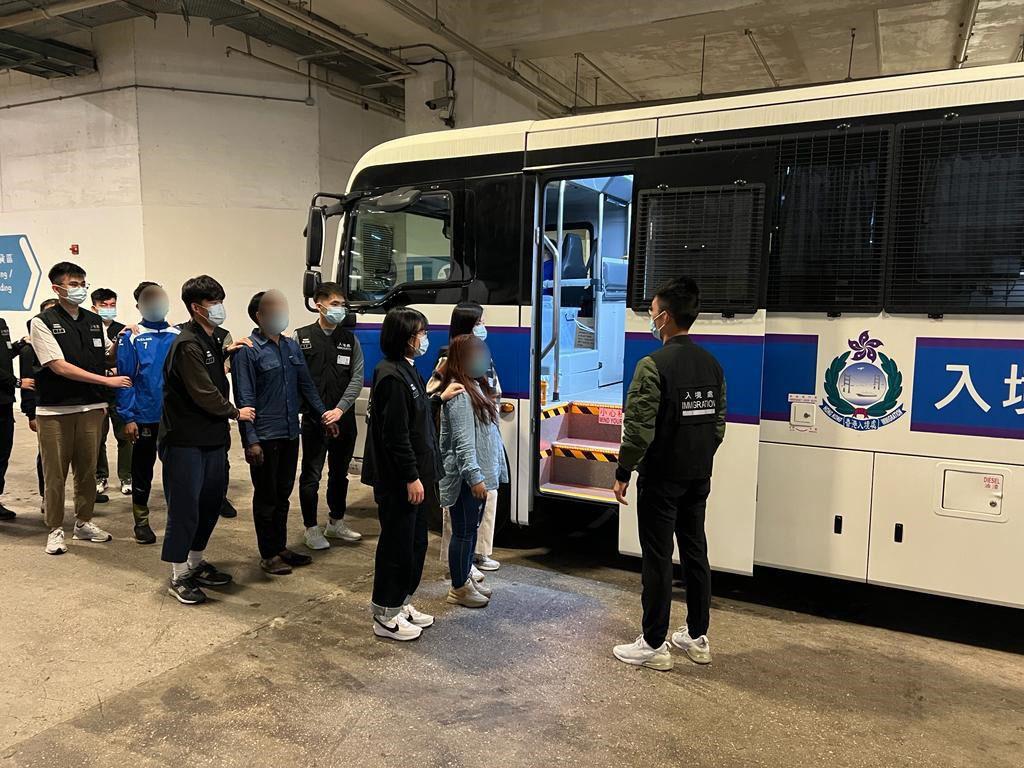
Seventeen persons arrested during anti-illegal worker operations (with photo)

    The Immigration Department (ImmD) mounted a series of territory-wide anti-illegal worker operations codenamed "Lightshadow" and "Twilight", and joint operations with the Hong Kong Police Force codenamed "Champion" and "Powerplayer" for four consecutive days from December 5 to yesterday (December 8). A total of 10 suspected illegal workers, two suspected employers, three overstayers, one illegal immigrant and one suspected aider and abettor were arrested.

     During the anti-illegal worker operations, ImmD Task Force officers raided 53 target locations including commercial buildings, a garage, a massage parlour, a residential building, restaurants and a warehouse. A total of eight suspected illegal workers and one suspected employer were arrested. The arrested suspected illegal workers comprised four men and four women, aged 38 to 53. Among them, three women were holders of recognisance forms, which prohibit them from taking any employment. In addition, one woman was suspected of using and being in possession of Hong Kong identity cards related to another person. Furthermore, one man, aged 54, was suspected of employing the illegal workers and was also arrested. One man, aged 22, suspected of aiding and abetting persons who breached the condition of stay in Hong Kong, was also arrested.

     In addition, during operations "Champion" and "Powerplayer", enforcement officers raided 24 target locations in Central district and New Territories North Region including a garage, a restaurant and a warehouse. A total of two suspected illegal workers, one suspected employer, three overstayers and one illegal immigrant were arrested. The suspected illegal workers comprised two men, aged 31 and 35. Among them, one man was a holder of a recognisance form, which prohibits him from taking any employment. One man, aged 40, was suspected of employing the illegal workers. Three female overstayers, aged 33 to 54, were arrested. Furthermore, one male illegal immigrant was also arrested. In addition, he was suspected of using and being in possession of a false instrument. Among them, two suspected illegal workers, two overstayers and one suspected employer were handled by the ImmD.

     An ImmD spokesman said, "Any person who contravenes a condition of stay in force in respect of him or her shall be guilty of an offence. Also, visitors are not allowed to take employment in Hong Kong, whether paid or unpaid, without the permission of the Director of Immigration. Offenders are liable to prosecution and upon conviction face a maximum fine of $50,000 and up to two years' imprisonment. Aiders and abettors are also liable to prosecution and penalties."

     The spokesman warned, "As stipulated in section 38AA of the Immigration Ordinance, an illegal immigrant, a person who is the subject of a removal order or a deportation order, an overstayer or a person who was refused permission to land is prohibited from taking any employment, whether paid or unpaid, or establishing or joining in any business. Offenders are liable upon conviction to a maximum fine of $50,000 and up to three years' imprisonment. Under the prevailing laws, it is an offence to use or possess a forged Hong Kong identity card or a Hong Kong identity card related to another person. Offenders are liable to prosecution and upon conviction face a maximum fine of $100,000 and up to 10 years' imprisonment."

     The spokesman reiterated that it is a serious offence to employ people who are not lawfully employable. Under the Immigration Ordinance, the maximum penalty for an employer employing a person who is not lawfully employable, i.e. an illegal immigrant, a person who is the subject of a removal order or a deportation order, an overstayer or a person who was refused permission to land, has been significantly increased from a fine of $350,000 and three years' imprisonment to a fine of $500,000 and 10 years' imprisonment to reflect the gravity of such offences. The director, manager, secretary, partner, etc, of the company concerned may also bear criminal liability. The High Court has laid down sentencing guidelines that the employer of an illegal worker should be given an immediate custodial sentence.

     According to the court sentencing, employers must take all practicable steps to determine whether a person is lawfully employable prior to employment. Apart from inspecting a prospective employee's identity card, the employer has the explicit duty to make enquiries regarding the person and ensure that the answers would not cast any reasonable doubt concerning the lawful employability of the person. The court will not accept failure to do so as a defence in proceedings. It is also an offence if an employer fails to inspect the job seeker's valid travel document if the job seeker does not have a Hong Kong permanent identity card. Offenders are liable upon conviction to a maximum fine of $150,000 and to imprisonment for one year. In that connection, the spokesman would like to remind all employers not to defy the law by employing illegal workers. The ImmD will continue to take resolute enforcement action to combat such offences.

     Under the existing mechanism, the ImmD will, as a standard procedure, conduct an initial screening of vulnerable persons, including illegal workers, illegal immigrants, sex workers and foreign domestic helpers, who are arrested during any operation with a view to ascertaining whether they are trafficking in persons (TIP) victims. When any TIP indicator is revealed in the initial screening, the ImmD officers will conduct a full debriefing and identification by using a standardised checklist to ascertain the presence of TIP elements, such as threats and coercion in the recruitment phase and the nature of exploitation. Identified TIP victims will be provided with various forms of support and assistance, including urgent intervention, medical services, counselling, shelter or temporary accommodation and other supporting services. The ImmD calls on TIP victims to report crimes to the relevant departments immediately.
Photo  


Update on supplies from Mainland

     The Task Force on Supplies from the Mainland led by the Transport and Logistics Bureau (TLB) has been working closely with the Guangdong Provincial Government and the Shenzhen Municipal People's Government to explore various means to stabilise the supply of goods from the Mainland to Hong Kong.
 
     A spokesperson for the TLB said that the "Sea Express" water transportation service from the Mainland to Hong Kong has been fully launched and its capacity is rising to increase the supplies of fresh food, other daily necessities and manufacturing materials. The current supply of fresh food from the Mainland is stable.
 
     The spokesperson said today (December 9) that Shenzhen operated 44 cargo vessel trips and transported around 3 390 twenty-foot equivalent units (TEUs) of cross-boundary supplies by water yesterday (December 8), equivalent to about 17 200 tonnes of goods, of which around 10 TEUs (about 90 tonnes) were fresh food and around 3 380 TEUs (about 17 110 tonnes) were non-fresh food, according to information from the Mainland authorities.
 
     Since the launch of services from the three ports in Shenzhen since February 18 to yesterday, a total of around 1 346 660 TEUs of cross-boundary supplies have been transported, equivalent to about 6 392 570 tonnes of goods, of which around 3 100 TEUs (about 26 230 tonnes) were fresh food and around 1 343 560 TEUs (about 6 366 340 tonnes) were non-fresh food.
 
     Meanwhile, to avoid a spillover of the epidemic, the Transport Department (TD) arranges for dedicated staff to conduct rapid nucleic acid tests, using nasopharyngeal swabs for specimen collection, for cross-boundary goods vehicle drivers at various land boundary control points. Only drivers with a negative result are allowed to enter the Mainland. A total of 4 124 rapid nucleic acid tests were conducted yesterday, among which 10 cases that tested preliminarily positive or indeterminate were found. The TD has passed the cases to the Department of Health for follow-up.
 
     The TLB will closely monitor the situation and co-operate with the Mainland authorities to facilitate and implement various measures to ensure both smooth cross-boundary land transport and a stable goods supply to Hong Kong, while reducing the risk of epidemic transmission in both the Mainland and Hong Kong.


Update on dengue fever

     The Centre for Health Protection (CHP) of the Department of Health today (December 9) reported the latest number of dengue fever (DF) cases, and urged the public to maintain strict environmental hygiene, mosquito control and personal protective measures both locally and during travel.

     From December 2 to yesterday (December 8), the CHP recorded three imported DF cases. The patients had been to Nepal, Malaysia and Thailand respectively during the incubation periods.

     As of yesterday, 25 imported cases of DF had been recorded in 2022. In 2021, two imported cases of DF were recorded. Detailed information on the latest DF situation in Hong Kong, as well as neighbouring and overseas countries and areas, has been uploaded to the CHP's website (www.chp.gov.hk/files/pdf/df_imported_cases_and_overseas_figures_eng.pdf). Members of the public should stay vigilant and carry out effective mosquito prevention and control measures.

     "Apart from general measures, travellers returning from areas affected by DF should apply insect repellent for 14 days upon arrival in Hong Kong. If feeling unwell, seek medical advice promptly and provide travel details to the doctor," a spokesman for the CHP said.

     The public should take heed of the following advice on mosquito control:
 

  • Thoroughly check all gully traps, roof gutters, surface channels and drains to prevent blockage;
  • Scrub and clean drains and surface channels with an alkaline detergent compound at least once a week to remove any deposited mosquito eggs;
  • Properly dispose of refuse, such as soft drink cans, empty bottles and boxes, in covered litter containers;
  • Completely change the water of flowers and plants at least once a week. The use of saucers should be avoided if possible;
  • Level irregular ground surfaces before the rainy season;
  • Avoid staying in shrubby areas; and
  • Take personal protective measures such as wearing light-coloured long-sleeved clothes and trousers and apply insect repellent containing DEET to clothing or uncovered areas of the body when doing outdoor activities.

     
     â€‹DEET-containing insect repellents are effective and the public should take heed of the tips below:
 

  • Read the label instructions carefully first;
  • Apply right before entering an area with risk of mosquito bites;
  • Apply on exposed skin and clothing;
  • Use DEET of up to 30 per cent for pregnant women and up to 10 per cent for children*;
  • Apply sunscreen first, then insect repellent; and
  • Re-apply only when needed and follow the instructions.

* For children who travel to countries or areas where mosquito-borne diseases are endemic or epidemic and where exposure is likely, those aged 2 months or above can use DEET-containing insect repellents with a DEET concentration of up to 30 per cent.

     The public should call 1823 in case of mosquito problems and may visit the following pages for more information: the DF page of the CHP and the Travel Health Service, the latest Travel Health Newstips for using insect repellents, and the CHP Facebook Page and YouTube Channel.


Seven persons sentenced for violating Prevention and Control of Disease (Disclosure of Information) Regulation

     Seven persons were each fined $6,000 by the Kwun Tong Magistrates' Courts on December 8 for violating the Prevention and Control of Disease (Disclosure of Information) Regulation (Cap. 599D).

     During the epidemiological investigation of the Centre for Health Protection of the Department of Health (DH) in May, the seven persons, comprising five women and two men aged 29 to 46, provided false information to authorised officers about their presence at a food factory in Kwun Tong. They were charged with contravening section 3(4) of Cap. 599D and were each fined $6,000 by the Kwun Tong Magistrates' Courts on December 8.

     Under Cap. 599D, it is a criminal offence for any person to provide false or misleading information to authorised officers. Offenders face a maximum fine of $10,000 and imprisonment for six months.

     â€‹A spokesman for the DH said that it is a grossly irresponsible act to conceal or provide false or misleading information to an authorised officer, as this may hinder the contact tracing process and pose a serious threat to public health. The spokesman reiterated that resolute actions will be taken against anyone who has breached the relevant regulations.


CHP investigates locally acquired SARS-CoV-2 virus cases with 2 986 cases tested positive by nucleic acid tests and 10 291 cases by RATs as well as 647 imported cases

     The Centre for Health Protection (CHP) of the Department of Health (DH) today (December 9) announced the latest epidemic situation of COVID-19. As of 0.00am, December 9, the CHP was investigating 13 277 additional locally acquired cases that tested positive for the SARS-CoV-2 virus, comprising 2 986 cases that tested positive by nucleic acid tests (1 517 confirmed cases, 1 155 asymptomatic cases and 314 cases with pending status) and 10 291 cases that tested positive by rapid antigen tests (RATs) in the past 24 hours.

     Separately, 647 additional imported cases were reported, including 543 cases that tested positive by nucleic acid tests (98 confirmed cases, 419 asymptomatic cases and 26 cases with pending status) and 104 cases that tested positive by RATs. Among the additional imported cases, 358 of them involved samples at the airport, 207 of them involved samples during Day 1 to Day 3, and the remaining 82 involved samples during Day 4 to Day 7.

     Hong Kong has recorded a total of 1 079 682 and 1 138 032 cases that have tested positive by nucleic acid tests and RATs respectively for the SARS-CoV-2 virus so far.

     The CHP is continuing with epidemiological investigations of the cases. Please refer to the Annex and the "COVID-19 Thematic Website" (www.coronavirus.gov.hk) for more information.

     The CHP has been closely monitoring the situation of positive cases involving mutant strains by genetic analysis. As of 0.00am, December 9, the DH's Public Health Laboratory Services Branch (PHLSB) had identified 226 cases of sub-lineage XBB, six of XBD, eight of BA.2.75.2, seven of BA.4.6, 13 of BF.7 and 38 of BQ.1.1 among imported cases in Hong Kong, while 120 cases of sub-lineage XBB, 18 of XBD, one of BA.2.75.2, five of BF.7 and 140 of BQ.1.1 have also been detected among local cases.

     Among the specimens received by the DH's PHLSB during November 30 to December 6 for verification testing of local cases, 0 per cent and about 64.24 per cent of them (seven-day moving average) are related to the sub-lineages BA.2.12.1 and BA.4/BA.5 (including suspected cases) of the Omicron mutant strain respectively.

     In addition, as of 0.00am, December 9, a total of 10 701 death cases that had tested positive for the SARS-CoV-2 virus during the fifth wave (since December 31, 2021) were recorded, with 10 603 and 94 deaths reported from the Hospital Authority and public mortuaries respectively as well as four deaths reported from private hospitals. Hong Kong has so far recorded a total of 10 914 death cases that tested positive for the SARS-CoV-2 virus.

     Furthermore, among the earlier cases by nucleic acid tests reported, there were cases (including pending cases) changed to confirmed, asymptomatic or re-positive cases. As at yesterday (December 8), the total number of confirmed cases was 470 004, while the figures for asymptomatic cases, re-positive cases and pending/unknown cases recorded since January 1 were 358 549, 31 and 247 569 respectively.

     The spokesman for the CHP said that COVID-19 vaccines are highly effective in preventing severe cases and deaths from the SARS-CoV-2 virus. They can provide effective protection to those vaccinated in preventing serious complications and even death after infection. People who have yet to receive vaccination, especially senior citizens, chronic patients, children and other immunocompromised persons who face a higher chance of death after COVID-19 infection, should get vaccinated as early as possible for self-protection and to reduce the risk of falling seriously ill and death should they get infected.

     The CHP appeals to the community to keep on maintaining personal hygiene and comply with social distancing measures in order to jointly contain the risk of virus transmission. The spokesman reminded members of the public that they can call various hotlines to make enquiries on COVID-19 (www.coronavirus.gov.hk/eng/index.html#hotline).