Hospital Authority welcomes the announcement of Primary Healthcare Blueprint

The following is issued on behalf of the Hospital Authority:
 
     The Hospital Authority (HA) welcomes the Primary Healthcare Blueprint announced by the Health Bureau today (December 19). The HA will dovetail with the government's policy direction to promote primary healthcare, so as to cope with the challenges arising from the ageing population, the increasing prevalence of chronic diseases and the increase in healthcare service demand.
      
     The HA Chairman, Mr Henry Fan, said, "The blueprint formulates a roadmap for the development of primary healthcare service of Hong Kong in future, which would enhance primary healthcare service with district-based and family-oriented model."
      
     The HA supports that the Health Bureau shifts the centre of gravity of the healthcare system from treatment-oriented and hospital-based, to prevention-focused and community-based.
      
     Mr Fan added that the policy direction and the related initiatives can improve the health of the public, provide convenient and coherent healthcare services, and establish a sustainable healthcare system to help strengthen the primary healthcare service and alleviate the pressure of public healthcare system in Hong Kong.
      
     The HA will continue to strengthen the support to patients with chronic diseases, enhance service quality and provide sustainable and comprehensive primary healthcare service to the public.
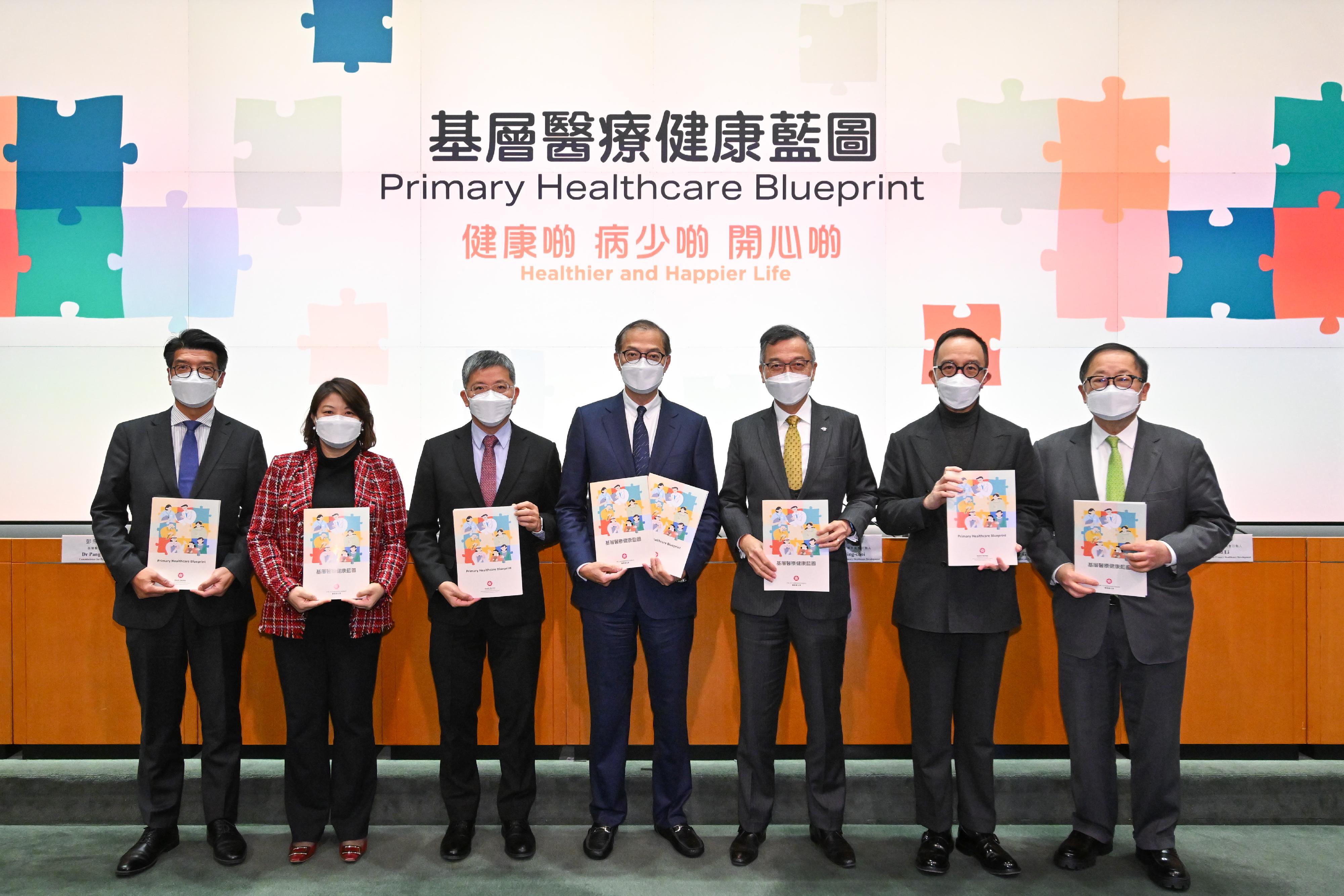


Government releases Primary Healthcare Blueprint (with photo)

     The Government released the Primary Healthcare Blueprint today (December 19) to formulate the direction of development and strategies for strengthening Hong Kong's primary healthcare system to address the challenges brought about by an ageing population and the increasing prevalence of chronic disease, with a view to enhancing the overall health and quality of life of citizens. 
 
     The Secretary for Health, Professor Lo Chung-mau said, "In face of the pressure brought about by an ageing population and the increasing prevalence of chronic diseases, it is unsustainable to cope with the ever-rising healthcare demand solely through increasing public healthcare expenditure for subsidising public hospital services. Therefore, Hong Kong needs to introduce a systemic reform of the healthcare system to shift the focus of the present healthcare system from curative treatment to disease prevention, change its emphasis and people's mindset from treatment-oriented to prevention-focused."
 
     He pointed out that primary healthcare is the first point of contact for individuals and families in a continuous healthcare process. It is also the most essential component in a well-functioning healthcare system. The COVID-19 epidemic has further accentuated the importance of a robust community-based primary healthcare system. 
 
     "The Blueprint sets out our vision, concrete recommendations and implementation plans, and outlines a strategic roadmap for the future development of primary healthcare in Hong Kong. We hope to push ahead primary healthcare reform through the Blueprint with a view to providing accessible and coherent healthcare services and establishing a sustainable healthcare system, thereby improving the overall health status of the population."
 
     The Blueprint puts forward five major directions of primary healthcare reform. Key recommendations are listed below:

(1) Develop a community-based primary healthcare system

  • to further develop the district-based, family-centric community healthcare system based on the service model of District Health Centres;
  • to strengthen the concept of "Family Doctor for All";
  • to introduce the Chronic Disease Co-Care Scheme to provide targeted subsidies to citizens for diagnosis and management of target chronic diseases (in particular hypertension and diabetes) in the private healthcare service sector; and
  • to migrate primary healthcare services under the Department of Health to the district-based community health system progressively to reduce service duplication.

​
(2) Strengthen primary healthcare governance

  • to progressively transform the Primary Healthcare Office currently under the Health Bureau into the Primary Healthcare Commission, with a view to better managing the provision of primary healthcare services, standard setting, quality assurance and training of primary healthcare professionals under one roof;
  • to require all family doctors and healthcare professionals providing primary healthcare services to be enlisted on the Primary Care Register to ensure the quality of primary healthcare services; and
  • to establish a two-way referral mechanism between primary healthcare services and specialist and hospital services, emphasising the case management and gate-keeping role of primary healthcare service providers.

 (3) Consolidate primary healthcare resources

  • to make wider use of market capacity and adopt the "co-payment" principle in providing government-subsidised primary healthcare programmes;
  • to enhance the Elderly Health Care Voucher Scheme and other subsidised services;
  • to oversee the development and implementation of primary healthcare strategic purchasing programmes via the Strategic Purchasing Office; and
  • to enhance the co-ordination of development and redevelopment of government buildings and premises for healthcare facilities at the community level.

 
(4) Reinforce primary healthcare manpower

  • to review the manpower projection model and formulate strategies to project the demand for primary healthcare professionals and increase manpower supply; and
  • to strengthen primary healthcare-related training for all primary healthcare service providers and the role of Chinese medicine practitioners, community pharmacists and other primary healthcare professionals in the delivery of primary healthcare services.

 
(5) Improve data connectivity and health surveillance

  • to transform the Electronic Health Record Sharing System (eHealth) into a comprehensive and integrated healthcare information infrastructure for healthcare data sharing, service delivery and process management;
  • to require all primary healthcare service providers to use eHealth; and
  • to develop a population-based health dataset and conduct on-going data analytics and surveys to support the Government in formulating healthcare policy.

     Professor Lo said, "We strongly believe that the recommendations set out in the Blueprint will guide the direction of development of our healthcare system and enable us to maintain a sustainable and healthy healthcare system that supports every citizen in Hong Kong in the decades ahead."

     He thanked the Steering Committee on Primary Healthcare Development for comprehensively analysing the structural situation of the primary healthcare system and offering constructive and invaluable advice to the Government during the formulation of the Blueprint. 
 
     "I take this opportunity to express my heartfelt gratitude for members' significant contributions. Based on the recommendations in the Blueprint and with the support of the Steering Committee, the Government will engage stakeholders to formulate detailed plans and implementation timetable. We look forward to joining hands with citizens to build a healthier society in Hong Kong."
 
     Full text and pamphlet of the Blueprint are available at the Health Bureau’s thematic website (www.primaryhealthcare.gov.hk).
 

Photo  


Home and Youth Affairs Bureau officer tests positive for COVID-19

     A spokesman for the Home and Youth Affairs Bureau today (December 19) said a staff member of the Bureau had tested positive for COVID-19 through a rapid antigen test. 

     The officer is the Press Secretary to the Secretary for Home and Youth Affairs. The officer wore masks and followed relevant disease prevention measures at work. She has no recent travel history and last went to work on December 16. 

     The Secretary for Home and Youth Affairs, Miss Alice Mak, has been taking COVID-19 rapid tests every day and the results are all negative.


Prepackaged bamboo shoot sample in breach of food labelling regulation

     The Centre for Food Safety (CFS) of the Food and Environmental Hygiene Department announced today (December 19) that a sample of prepackaged bamboo shoot was found to contain sulphur dioxide, a preservative which is allowed to be used in certain foods, but the functional class and the name of the additive were not declared on the food label. Members of the public should not consume the affected batch of the product. The trade should also stop using or selling the affected batch of the product immediately if they possess it.

     Product details are as follows:

Product name: Square Bamboo Shoot
Brand: NATURE
Net weight: 500 grams
Place of origin: China
Distributor: (Not available in English)
Best-before date: September 1, 2023

     "The CFS collected the above-mentioned bamboo shoot sample from an online shop for testing under its routine Food Surveillance Programme. The test result showed that the sample contained sulphur dioxide. Although the sulphur dioxide level is below the maximum permitted level under the Preservatives in Food Regulation (Cap. 132BD), the functional class and name of the additive were not declared on the food label," a CFS spokesman said.

     "The CFS has informed the vendor concerned of the irregularity and instructed it to stop sales and remove from shelves the affected batch of the product. According to the CFS's instructions, the vendor concerned has initiated a recall on the affected batch of the product. Members of the public may call its hotline at 9034 5978 during office hours for enquiries about the recall of the product concerned," the spokesman added.

     Sulphur dioxide is a commonly used preservative in a variety of foods including dried vegetables, dried fruits, pickled vegetables and salted fish products. Sulphur dioxide is water soluble, and most of it can be removed through washing and cooking. However, susceptible individuals who are allergic to this preservative may experience breathing difficulties, headaches and nausea after consumption.

     The spokesman reminded the food trade that the use of preservatives in food must comply with the Preservatives in Food Regulation (Cap. 132BD). Furthermore, the Food and Drugs (Composition and Labelling) Regulations (Cap. 132W) require that prepackaged food shall be legibly marked or labelled with a list of ingredients. The regulations also state that for all prepackaged food for sale in Hong Kong containing sulphite in a concentration of 10 parts per million or more, the functional class of the sulphite and its name shall be specified in the list of ingredients. Offenders are liable to a maximum fine of $50,000 and six months' imprisonment upon conviction.

     The CFS will alert the trade, continue to follow up on the incident and take appropriate action. An investigation is ongoing.


Consultation on enhancing regulation of crowdfunding activities launched

     The Financial Services and the Treasury Bureau (FSTB) published today (December 19) a consultation paper on the proposal to enhance regulation of crowdfunding activities, and launched a three-month public consultation exercise.
 
     The consultation paper sets out various recommendations on enhancing the transparency and accountability of crowdfunding activities, which include requiring in-principle future crowdfunding activities to make application and obtain permission before commencement; and ensuring sufficient transparency to the public during and after the conduct of crowdfunding activities. The paper suggests setting up a Crowdfunding Affairs Office (CAO) to centrally process regulatory and administrative matters related to crowdfunding activities.
 
     "In Hong Kong, we currently do not have a clear mechanism in regulating the increasingly prevalent online crowdfunding activities, which poses risks to public interest and safety. The consultation paper proposes building a comprehensive mechanism that can strengthen public confidence to participate in lawful and proper crowdfunding activities, and prevent lawbreakers from engaging in activities that are fraudulent, jeopardising public interest, or endangering public and national security in the name of crowdfunding," a spokesman for the FSTB said.
 
     Major features of the crowdfunding regulatory regime proposed in the consultation paper are as follows:
 
* all fundraising activities, online or offline, that raise funds publicly from individuals or entities of Hong Kong, or individuals or entities located in Hong Kong, are required to apply in advance to the newly proposed CAO, regardless of their purpose or location;
 
* when processing applications, the CAO will consider factors including the honesty, reputation and reliability of the applicant; proportionality of the purpose of the crowdfunding activity to its scale; as well as risks brought about by the activity to public interests, public safety and national security;
 
* the CAO will co-ordinate with relevant government departments with a view to streamlining procedures for fundraising activities which are subject to existing regulation, such as donation activities held physically in public places, or lottery sales;
 
* the new regulatory regime will not apply to commercial fundraising activities in the market which are already well regulated by financial regulators under existing legislation;
 
* exemptions and facilitation measures are proposed to facilitate smooth operation and timely commencement of crowdfunding activities which are widely recognised by the society and charitable crowdfunding projects which address sudden and urgent needs;
 
* fundraisers are required to disclose objectives and arrangements of their crowdfunding activities, use local bank account and keep proper records of fund movements;
 
* suggest consideration be given to setting up a registration system for online crowdfunding platforms; and
 
* empower law enforcement agencies to cease unlawful crowdfunding activities and prosecute offenders.
 
     The spokesman for the FSTB said, "We welcome members from all quarters of the community to give views on the proposal of the consultation paper. We will fully consider the views received which will pave the way for our subsequent legislative work."
 
     The consultation paper is available on the webpage of the FSTB at www.fstb.gov.hk/fsb/en/publication/consult/consult-policy.html.
 
     Members of the public may submit views to the FSTB by post (15/F, Queensway Government Offices, 66 Queensway, Hong Kong), by fax (2869 4195) or by email (cf-consult@fstb.gov.hk) on or before March 20, 2023.