Speech by S for S at Regional Customs High-level Drug Enforcement Forum (English only) (with photo)
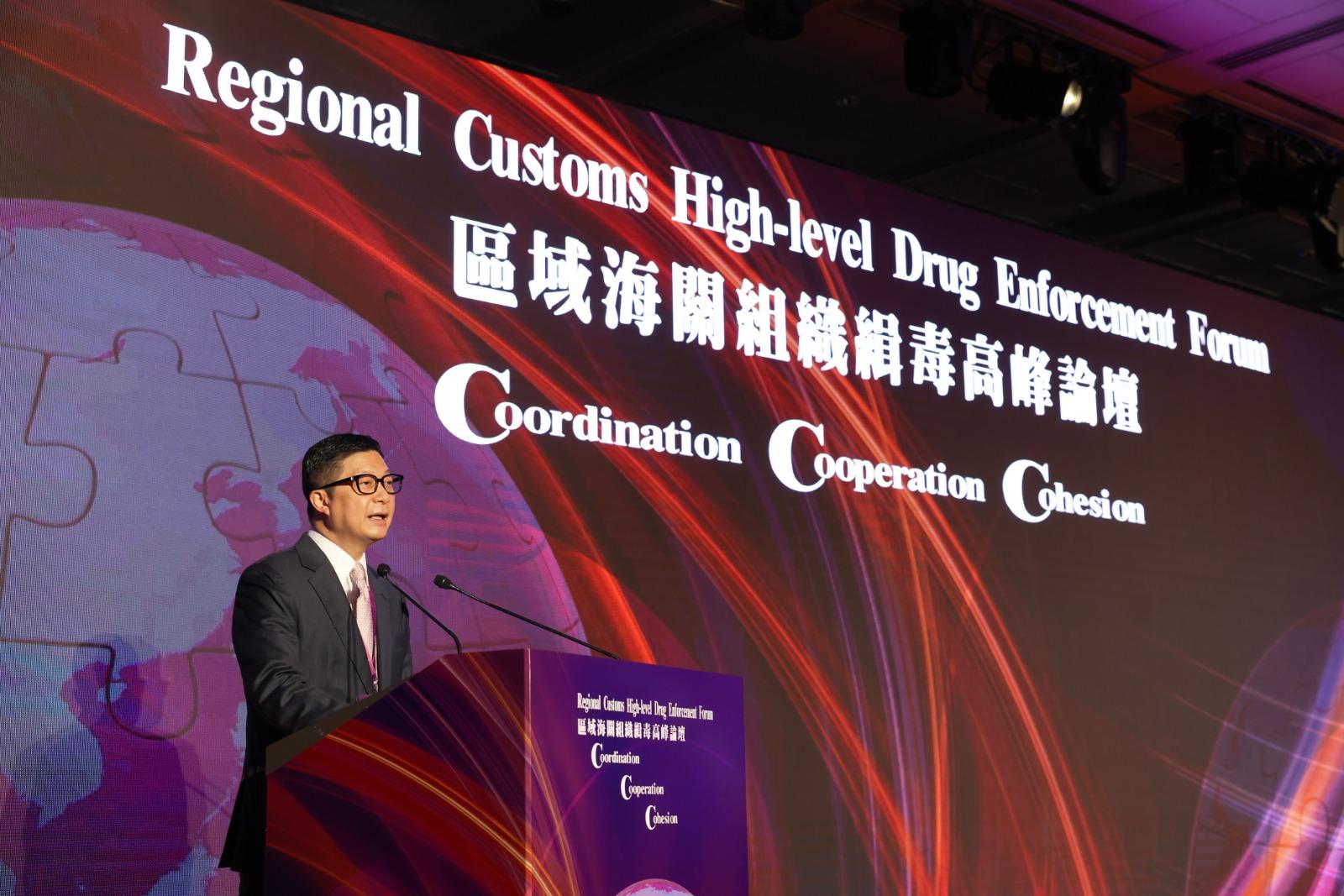
Following is the keynote speech by the Secretary for Security, Mr Tang Ping-keung, at the Regional Customs High-level Drug Enforcement Forum today (February 16):
Secretary for Justice, Mr Paul Lam; Vice-minister of the General Administration of Customs, Mr Wang Lingjun; Commissioner of Customs and Excise, Ms Louise Ho; distinguished guests, ladies and gentlemen,
Good morning. It gives me great pleasure today to speak at this Regional Customs High-level Drug Enforcement Forum. I'm delighted to know that more than 100 of you coming from over 40 delegations from all over the world, as well as representatives from the World Customs Organization (WCO), are taking part in this forum. To those who have come from afar, a very warm welcome to Asia's world city.
Your presence here is a clear sign that Hong Kong is back on the world stage and the world is also back to normal. As we look ahead to exciting new developments in the post-COVID-19 era, I am sure you will agree with me that there will be new challenges in the drug enforcement arena as well. With the relaxation of travel restrictions, and recovery of the global supply chains, a surge of illegal drug trade was anticipated, and hence immediate attention should be paid to the latest trend. I thank my colleagues in Hong Kong Customs for organising this timely event, which is indeed a perfect timing.
The theme of today's forum is "Cooperation, Coordination and Cohesion", and it has its meaning. It symbolises the importance of working together in the fight of drug trafficking across boundaries.
It also echoes the strategy of the United Nations Office on Drugs and Crime (UNODC) 2021-2025 to strengthen national law enforcement capacity to address the problems caused by drugs in a sustainable manner, among other priorities. In the latest World Drug Report 2022, the UNODC also calls for jurisdictions in stepping up cross-border law enforcement co-operation and intelligence-sharing to disrupt transnational trafficking enterprises. As we all recognise that smuggling and illicit supply of dangerous drugs encourage drug abuse and bring about profound public-health and social cost, international co-operation between governments, in particular customs administrations and law enforcement agencies, is part and parcel of the duty in curbing the inflow of drugs for every jurisdiction.
It is my great honour to have the opportunity today to share with you the strategies and experience of Hong Kong in combating drug-related offences. We hope that it would shed light on how law enforcement agencies may strengthen co-operation, enhance co-ordination, and build cohesion in the fight against drugs in the Asia-Pacific region and beyond.
Before I talk about the overall strategy of Hong Kong in drug enforcement, a brief overview of the drug situation in Hong Kong and the threat that we are facing would be helpful for those who are less familiar with our drug scene. In general, drugs are primarily smuggled into Hong Kong by air, sea or mail. The criminal structure of drug trafficking varies from retail-level traffickers to syndicates with layers of management. Meanwhile, being an international aviation and maritime centre as well as a logistics hub, our well-developed transportation network and logistics support, coupled with the highly-efficient customs clearance policy that facilitates the flow of passengers and goods, have increased the risk of drug transshipment through Hong Kong to a certain extent. It is not uncommon that drugs smuggled into Hong Kong are indeed for supply to other jurisdictions in the Asia-Pacific region and other places.
Against the unique context of Hong Kong, the HKSAR (Hong Kong Special Administrative Region) Government attaches great emphasis to stemming drug trafficking activities and we are tough on drug criminals. We have adopted multipronged strategies, and to this end, I will cover a few aspects today, namely our legal framework, co-operation and co-ordination within and beyond the Government, use of technology, and cohesion of the society.
Our robust legal framework is the bedrock of our drug enforcement work. There are a number of laws in Hong Kong that together provide a comprehensive framework in tackling drug trafficking activities and empower Hong Kong Customs' law enforcement duties. The Government reviews the laws concerned from time to time to ensure that they are adequate to deal with the prevailing drug trend. For instance, appropriate amendments were made to the Dangerous Drugs Ordinance and the Control of Chemicals Ordinance in the past few years to include new substances, such as clonazolam, kratom and APAA, under statutory control, so as to ensure that law enforcement agencies could respond effectively to emerging dangerous drugs, including countering their import and export, with a view to protecting public health.
In Hong Kong, we understand that co-ordination and co-operation among agencies in both the public and private sectors is an essential part in combating drug trafficking activities. Through intelligence exchange, key law enforcement agencies in Hong Kong, including the Hong Kong Police Force and Hong Kong Customs, collaborate closely in developing intelligence-based strategies in combating drug trafficking activities. Police and Customs also work proactively with other government departments to tackle drug trafficking activities in different modes. For example, in a case in early 2022, in seizing about 1 400 kilograms of drugs, huge transformers and industrial-use, anti-vibratory rubber were suspected to be used for concealing the drugs. Dismantling these heavy industrial devices, without damaging the drugs inside, required considerable expertise and extensive experience. In this regard, we had the assistance of the Fire Services Department in deploying professional firemen for that particular drug seizure exercise, which demonstrates the co-ordinated efforts among different government departments in Hong Kong.
Co-ordination with citizens and the private sector is equally important. An information notification mechanism has been established by Customs with the five major express courier operators in Hong Kong. This is particularly useful in strengthening the Government's partnership with the logistics and transportation industry, which in turn facilitates the exchange of information and knowledge, identification of suspicious cargoes, and co-operation against drug trafficking via the express parcel channel.
As drug trafficking activities in Hong Kong are by nature cross-border, co-operation with other regional and international law enforcement agencies is instrumental to the sharing of useful information and analysis on drug trafficking trends and targeted enforcement, as well as the exchange of intelligence and joint operations against individual cases. To this end, Hong Kong, China has been a member of the World Customs Organization since 1987. Hong Kong Customs actively participates in the WCO's enforcement programmes, including narcotics interdiction, and regularly seconds officers to the WCO and its institutions. Customs has also maintained close collaboration with other regional customs administrations and law enforcement agencies, through the WCO's network of the Regional Intelligence Liaison Offices, the International Criminal Police Organization, and agency-to-agency mutual co-operation.
We understand the importance in gearing up ourselves in terms of technology in facing changes and challenges ahead. The Government is committed to tackling drug trafficking activities and supports Hong Kong Customs and other law enforcement agencies in acquiring and deploying manpower and advanced equipment, which can help enforce the law and respond to evolving smuggling trends. In recent years, advanced examination devices, such as Gantry Type X-ray Vehicle Inspection Systems, Mobile X-Ray Vehicle Scanning Systems, auto-detection devices for existing X-ray checkers with artificial intelligence functions to be embedded, computed tomography scanners, etc, have been introduced and deployed to assist in Customs' law enforcement work with satisfactory result.
We can never win the fight against drugs without the support of the community. In Hong Kong, we are glad that we are backed by the strong cohesion of the society in the anti-drug cause. A dedicated Narcotics Division has been established under the Security Bureau that I lead to co-ordinate policies and measures across the public sector, non-government organisations and the community to combat drug-related problems. Through the multipronged approach, comprising preventive education and publicity, treatment and rehabilitation, legislation and law enforcement, external co-operation and research, stakeholders in the society were fully engaged in the anti-drug cause. With the strong cohesion of our society in standing firm to knock drugs out, our drug enforcement work has been well received and supported by all walks of the community.
Moving on to our drug enforcement experience, I am pleased to share with you the efforts we have made under the challenging circumstances in these past years. Amid the COVID-19 pandemic, law enforcement agencies have maintained their co-ordination and co-operation, domestically and internationally, in combating drug trafficking. In the course of the pandemic development, drug syndicates kept adjusting their drug trafficking modus operandi, from relying heavily on air passengers before the pandemic to utilising express parcels during 2020 due to the stringent immigration control measures imposed globally. Between 2021 and 2022, we have seen organised drug syndicates shifting to trafficking in a large quantity of drugs via airborne and seaborne channels, in a bid to avoid stockpiling of drug inventory in the source jurisdictions and reduce the risk of interception by law enforcement agencies. In 2021 alone, seven high-value cases each with seizure value over HK$100 million, which is around US$13 million, were detected by Customs.
By adopting a risk-based and intelligence-led mode of operation, and adjusting our enforcement tactics, from 2019 to 2020, the number of drug cases increased from around 2 500 to 3 900, up by 56 per cent, and the drug seizures surged from around 3 200 kg to around 5 600 kg, showing a 75 per cent increase.
The upward trend of the drug enforcement figures continued throughout the pandemic. In 2022, the number of drug cases detected stood at around 4 000, involving a 5 per cent increase as compared with that in 2020. Meanwhile, a total of around 66 000 kg of drugs were seized in 2022, representing a significant twelvefold surge in the seizure quantity as compared with that in 2020.
Ladies and gentlemen, despite our concerted enforcement efforts, the fight against drugs will never end and requires a sustained momentum from all of us. In the post-COVID-19 era, the anti-drug work of Customs will become not only more wide-ranging but also much more complex than before.
The forum today provides a golden opportunity for us to re-advocate the importance of co-operation, co-ordination and cohesion. Through co-operation among government agencies, business sectors, non-government organisations and members of the public; co-ordination in anti-drug efforts among jurisdictions; and cohesion within the customs and the community at large, I am sure we can join hands together to make the world a safer place than before.
In closing, I wish you all a rewarding forum and a very pleasant stay in Hong Kong.
Thank you.