LCQ10: Provision of support for elderly singletons and carers

     Following is a question by the Hon Shang Hailong and a written reply by the Secretary for Labour and Welfare, Mr Chris Sun, in the Legislative Council today (June 7):

Question:

     The editorial of a newspaper has pointed out that recently, tragedies resulting from elderly singletons and carers with disabilities lacking support have happened one after another in Hong Kong. Such situations are worrying and have also highlighted the necessity for the authorities to step up support work. Regarding the provision of support for elderly singletons and carers, will the Government inform this Council:

(1) as there are currently no emergency support services targeted at carers in Hong Kong, and if carers fall ill, they cannot entrust their family members who need to be looked after to the care of others, whether the Government will consider setting up one-stop centres for carers in various districts to provide emergency support services;

(2) whether it will consider, in collaboration with social welfare organisations, encouraging kaifongs to care for their elderly singleton neighbours and motivating elderly singletons to participate more in community activities through work such as organising talks and setting up street counters in different locations, as well as conducting publicity door to door in buildings, thereby strengthening the spirit of neighbourliness, and co-building a harmonious and friendly society;

(3) whether it will strengthen co-operation with social welfare organisations and non-governmental organisations to make every effort to enhance the work of identifying "hidden elderly singletons" and "hidden carers"; and

(4) whether it will leverage district organisations and District Services and Community Care Teams to strengthen the outreach work in support of elderly singletons and carers (e.g. distributing promotional leaflets door to door in public housing estates, and even delivering meals to elderly singletons), so as to build up district networks and assist in finding out more hidden elderly singletons and hidden carers?

Reply:

President,

     My reply to the question raised by the Member is as follows:

(1) The Government provides subsidy for non-governmental organisations (NGOs) to operate respite services to provide short-term residential or day care services for elderly persons and persons with disabilities living in the community who require personal care assistance from family members or relatives and to reduce the pressure of carers. Moreover, the Government provides home-based support services (including home respite service) for elderly persons and persons with disabilities through the Integrated Home Care Services (Frail Cases), the Enhanced Home and Community Care Services, the Home Care Service for Persons with Severe Disabilities and the Integrated Support Service for Persons with Severe Physical Disabilities.

     Respite service users are not required to undergo the Standardised Care Need Assessment Mechanism and may directly approach service units for enquiry and application. Persons in need may also be referred by Integrated Family Service Centres (IFSCs)/Integrated Service Centres (ISCs), Medical Social Services Units (MSSUs), elderly service units, special schools or rehabilitation service units. If elderly persons or persons with disabilities have urgent short-term residential care needs, they or their carers can search for the vacancy situation of the designated respite service places provided by residential care homes (RCHs) under the Enhanced Bought Place Scheme or the Bought Place Scheme for Private Residential Care Homes for Persons with Disabilities through the "Vacancy Enquiry System for Residential Respite Service for Persons with Disabilities, Residential Respite Service for the Elderly and Emergency Placement for the Elderly" of the Social Welfare Department (SWD). They or their carers may approach the relevant RCHs directly to confirm the vacant places and arrange for admission. If they have other service needs, the RCHs will, after admitting the elderly persons or persons with disabilities, refer them to the relevant service units for follow-up.

     Besides, the SWD provides various community support services for elderly persons, persons with disabilities, patients who are chronically ill as well as their carers directly or through subvented NGOs. The service units include IFSCs/ISCs, MSSUs, District Elderly Community Centres (DECCs), Neighbourhood Elderly Centres (NECs), District Support Centres for Persons with Disabilities, Integrated Community Centres for Mental Wellness, Parents/Relatives Resource Centres, Support Centres for Persons with Autism, home care services, etc. These service units provide a series of prevention and support services, such as case management, counselling, outreaching service, referral service, mutual aid groups, carer skills training, stress relieving groups and recreational activities, with a view to providing comprehensive support to carers and enhancing their caregiving abilities and quality of life.

(2) There are currently 213 subvented DECCs and NECs (Elderly Centres) providing a range of support services for elderly persons at the community level, including counselling, referral, assistance in applying for long-term care services, emotional support and carer training, etc to facilitate elderly persons to age in place. The Elderly Centres also collaborate with community support service units in the district to make more effective use of community resources in building an elderly-friendly community.

     The Elderly Centres also organise various activities in the districts, including seminars, carer training courses, volunteer trainings, mobile counter services, outreaching activities, etc, in order to encourage elderly persons to actively participate in community activities.

(3) and (4) The Government has been closely collaborating with various subvented NGOs and welfare organisations to provide support for elderly persons, persons with disabilities and their carers in need. The Government is progressively setting up District Services and Community Care Teams (Care Teams) in 18 districts to rally community resources and efforts. The Labour and Welfare Bureau and the SWD are actively exploring the Care Teams' participation and assistance in supporting the related work.


Food Safety Day 2023 stresses importance of observing “Five Keys to Food Safety”

     The Centre for Food Safety (CFS) of the Food and Environmental Hygiene Department kick-started its annual Food Safety Day 2023 campaign today (June 7) to raise awareness of the simple actions that the food trade and the public can take to prevent foodborne illnesses and curb the emergence of antimicrobial resistance (AMR). As food businesses fully resume operations after the pandemic, it is crucial for everyone to adopt good food hygiene practices to reduce the risk of the spread of infections along the food chain.

     On World Food Safety Day today, the CFS will join Codex Alimentarius Committee China to attend the virtual event held by the Food and Agriculture Organization of the United Nations, the World Health Organization and the Codex Alimentarius Secretariat. To tie in with World Food Safety Day 2023, the CFS sets the "Five Keys to Food Safety" as the theme for Food Safety Day 2023. The Five Keys represent five scientifically proven measures that can significantly reduce the incidence of foodborne illnesses:
 

  • Choose safe raw materials;
  • Keep clean;
  • Separate raw and cooked food;
  • Cook thoroughly; and
  • Keep food at safe temperatures.

     "In general, the major contributing factors of food poisoning outbreaks are consumption of raw food, inadequate cooking, storage time and temperature abuse, and cross-contamination including food to food, equipment to food, and person to food," a spokesman for the CFS said. "It is therefore critical for food handlers to make consistent compliance with the Five Keys a priority to reduce the risk of food poisoning and create a safer food environment."

     Separately, as AMR bacteria might be present in ready-to-eat foods, the CFS has launched a thematic webpage on AMR since 2019 to provide a one-stop area for the public and trade to access the latest publicity materials. An extended version of the Five Keys, which elaborates on how each key could address AMR in food, can be found on the thematic webpage.

     To prevent foodborne diseases, the trade and the public are urged to maintain proper hand hygiene as well as observe the "Five Keys to Food Safety" while preparing and handling food. For details of the events under Food Safety Day 2023, please visit the CFS's website (www.cfs.gov.hk).


Special traffic arrangements for race meeting in Happy Valley

     Special traffic arrangements will be implemented in Happy Valley today (June 7). The arrangements will come into effect one and a half hours before the start of the first race and will last until the crowds have dispersed after the race meeting.

A. Traffic arrangements before the commencement of the first race

1. Road closure

     Southbound Wong Nai Chung Road between Queen's Road East and the up-ramp outside the Hong Kong Jockey Club (HKJC) will be closed except for vehicles heading for Aberdeen Tunnel.

2. Traffic diversions

– Southbound Wong Nai Chung Road between Village Road and the up-ramp outside HKJC will be re-routed one way northbound;
– Traffic along eastbound Queen's Road East heading for Wan Chai and Happy Valley will be diverted to turn left to Morrison Hill Road;
– Traffic along southbound Morrison Hill Road heading for Happy Valley will be diverted via Sports Road and Wong Nai Chung Road;
– Traffic along Queen's Road East cannot turn right to Wong Nai Chung Road except for vehicles heading for Aberdeen Tunnel;
– Traffic from Cross Harbour Tunnel heading for Queen's Road East will be diverted via the down-ramp leading from southbound Canal Road flyover to Morrison Hill Road to turn right at the junction of Wong Nai Chung Road and Queen's Road East; and
– Traffic from Cross Harbour Tunnel heading for Happy Valley or Racecourse will be diverted via the down-ramp leading from southbound Canal Road flyover to Canal Road East, southbound Morrison Hill Road, Sports Road and Wong Nai Chung Road.

B. Traffic arrangements before the conclusion of race meeting

1. Road closure

     The following roads will be closed from about 35 minutes before the start of the last race:

– The up-ramp on Wong Nai Chung Road outside HKJC leading to Aberdeen Tunnel;
– Southbound Wong Nai Chung Road between Queen's Road East and the up-ramp leading to Aberdeen Tunnel;
– Southbound Wong Nai Chung Road between Village Road and the Public Stands of HKJC;
– Westbound Leighton Road between Wong Nai Chung Road and Canal Road East; and
– Southbound Morrison Hill Road between Leighton Road and Queen's Road East.

     In addition, southbound Wong Nai Chung Road between the up-ramp leading to Aberdeen Tunnel and the Public Stands of HKJC will be closed from about 10 minutes before the start of the last race.

2. Traffic diversions

     The following traffic diversions will be implemented from about 35 minutes before the start of the last race:

– Eastbound Queen's Road East at its junction with Morrison Hill Road will be reduced to one-lane traffic heading for northbound Canal Road flyover;
– Traffic from Cross Harbour Tunnel heading for Wan Chai will be diverted via the down-ramp leading from southbound Canal Road flyover to Canal Road East, U-turn slip road beneath Canal Road flyover, Canal Road West and Hennessy Road;
– Traffic from Cross Harbour Tunnel heading for Happy Valley will be diverted via the down-ramp leading from southbound Canal Road flyover to Canal Road East, eastbound Leighton Road and Wong Nai Chung Road;
– Traffic along southbound Morrison Hill Road will be diverted to turn left to eastbound Leighton Road;
– Traffic along southbound Morrison Hill Road heading for Happy Valley will be diverted via eastbound Leighton Road and Wong Nai Chung Road; and
– Traffic along westbound Leighton Road will be diverted to Wong Nai Chung Road.

C. Learner drivers prohibition

     Learner drivers will be prohibited to turn left from Caroline Hill Road to Leighton Road between one and a half hours before the start of the first race and one hour after the last race. In addition, learner drivers will be prohibited from accessing the following roads within the above period of time:

– Shan Kwong Road between Yik Yam Street and Wong Nai Chung Road;
– Village Road between its upper and lower junctions with Shan Kwong Road;
– Percival Street between Hennessy Road and Leighton Road;
– Canal Road East; and
– The service road leading from Gloucester Road to Canal Road flyover.

D. Suspension of parking spaces

     Parking spaces on southbound Wong Nai Chung Road between Sports Road and Blue Pool Road will be suspended from 11am to 7pm during day racing, from 4.30pm to 11.59pm during evening racing, and from 5pm to 11.59pm during night racing.

     Any vehicles found illegally parked within the precincts of the above affected areas will be towed away without prior notice.

     Actual implementation of road closure and traffic diversion will be made by the Police at the time depending on traffic conditions in the areas. Motorists should exercise tolerance and patience, and follow the instructions of Police on site.


Red flags hoisted at Big Wave Bay Beach and Clear Water Bay Second Beach

Attention TV/radio announcers:

Please broadcast the following as soon as possible:

     Here is an item of interest to swimmers.

     The Leisure and Cultural Services Department announced today (June 7) that due to big waves, red flags have been hoisted at Big Wave Bay Beach in Southern District, Hong Kong Island; and Clear Water Bay Second Beach in Sai Kung District. Beachgoers are advised not to swim at these beaches.


Hong Kong Customs detects incoming passenger drug trafficking case involving suspected cannabis buds at airport (with photo)

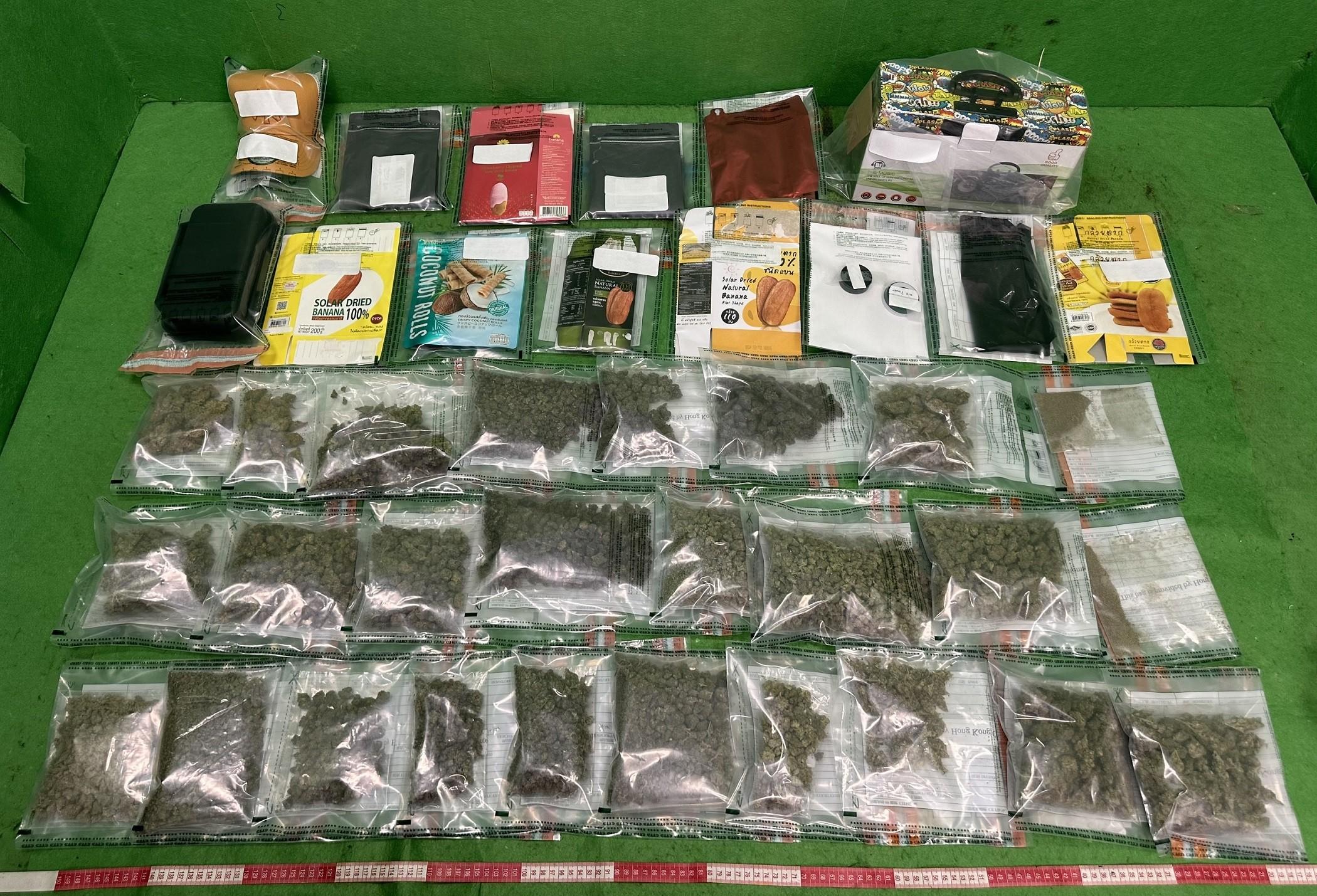
     â€‹Hong Kong Customs yesterday (June 5) detected an incoming passenger drug trafficking case at Hong Kong International Airport and seized about 1.2 kilograms of suspected cannabis buds with an estimated market value of about $240,000.

     A 32-year-old male passenger arrived in Hong Kong from Bangkok, Thailand, yesterday. During customs clearance, Customs officers found 24 bags of suspected cannabis buds, with a total weight of about 1.2kg, inside his checked-in suitcase and hand-carry baggage. Most of the drugs were concealed inside some snacks packaging while the rest were concealed inside different items. Customs officers arrested the man subsequently.

     An investigation is ongoing.

     Following the resumption of normal travel and exchanges with the Mainland and other parts of the world, the number of visitors to Hong Kong has also been increasing steadily. Customs will continue to apply a risk assessment approach and focus on selecting passengers from high-risk regions for clearance to combat transnational drug trafficking activities.

     Under the Dangerous Drugs Ordinance, trafficking in a dangerous drug is a serious offence. The maximum penalty upon conviction is a fine of $5 million and life imprisonment.

     Members of the public may report any suspected drug trafficking activities to Customs' 24-hour hotline 2545 6182 or its dedicated crime-reporting email account (crimereport@customs.gov.hk).

Photo