Statistics of payment cards issued in Hong Kong for fourth quarter 2024

The following is issued on behalf of the Hong Kong Monetary Authority:

     The Hong Kong Monetary Authority (HKMA) published today (March 21) statistics of payment cards issued in Hong Kong for the fourth quarter of 2024.
      
     The payment card statistics (see Annex) include quarterly data on credit and debit cards issued in Hong Kong under the credit and/or debit card schemes of the eight payment card scheme operators (Note 1). The HKMA began to publish the payment card statistics on a quarterly basis in June 2010 to enhance transparency of the payment card industry in Hong Kong, in line with international practice.
      
     According to the quarterly statistics, the total number of credit cards in circulation (Note 2) was 20.94 million by the end of Q4/2024. The figure represents a 3.2 per cent increase from the previous quarter and a 6.4 per cent increase from the previous year. The number and value of credit card transactions (including retail sales and cash advances) (Note 3) are susceptible to seasonal factors and the general economic environment, making the trends more prone to fluctuation. The total number of credit card transactions was 339.27 million for Q4/2024, representing a 3.1 per cent increase from the previous quarter and a 11.9 per cent increase from the same period in 2023. The total value of credit card transactions was HK$271.4 billion for Q4/2024, representing a 9.1 per cent increase from the previous quarter and a 10.8 per cent increase from the same period in 2023. Of the total transaction value, HK$182.8 billion (67.4 per cent) was related to retail spending in Hong Kong, HK$79.3 billion (29.2 per cent) in retail spending overseas and HK$9.3 billion (3.4 per cent) in cash advances.
      
     The total number of debit cards in circulation is not available due to overlapping of debit card brands in a single card. Like the number and value of credit card transactions, the number and value of debit card transactions in relation to retail sales and bills payments (Note 4) are also affected by seasonal factors. On a quarterly basis, the total number of debit card transactions in relation to retail sales and bills payments increased by 2.7 per cent to 55.50 million while the total value increased by 6.6 per cent to HK$73.0 billion in Q4/2024. When compared to the same period in 2023, the total number increased by 14.1 per cent and the total value dropped by 0.2 per cent in Q4/2024.
 
Note 1: The payment card statistics are compiled from data on credit and debit cards issued in Hong Kong by both authorized institutions (AIs) and non-authorized institutions (non-AIs) under the credit and/or debit card schemes of the eight payment card scheme operators ("the card operators"). The card operators, in alphabetical order, are American Express International, Inc., Discover Financial Services (Hong Kong) Limited, EPS Company (Hong Kong) Limited (EPSCO), JCB International (Asia) Ltd, Joint Electronic Teller Services Ltd. (JETCO), MasterCard Asia/Pacific Pte. Ltd., UnionPay International Co. Ltd and Visa Worldwide Pte. Limited.

Note 2: A credit card issued in Hong Kong only carries one credit card brand. The total number of credit cards in circulation refers to the total number of credit cards (i.e. cards with a credit function) issued in Hong Kong under the credit card schemes of card operators (but excluding EPSCO and JETCO, which do not operate a credit card scheme). Some of these credit cards carry debit card functions, i.e. the credit card can be used for making purchases/payments or cash withdrawal at ATMs through directly debiting cardholders' bank accounts.

Note 3: The total number/value of credit card transactions refer to the total number/value of transactions made via credit card accounts of credit cards issued in Hong Kong under the credit card schemes of card operators (excluding EPSCO and JETCO). Starting from March 2015, a Hong Kong/overseas spending breakdown of credit card retail sales transactions is provided.

Note 4: The total number/value of debit card transactions in relation to retail sales/bill payments refers to the total number/value of those transactions made via debiting cardholders' bank accounts. Some of the eight card operators do not operate a debit card scheme. Care should be exercised in combining the credit card retail sales figures and the debit card retail sales/bills payment figures because of the possibility of double counting.
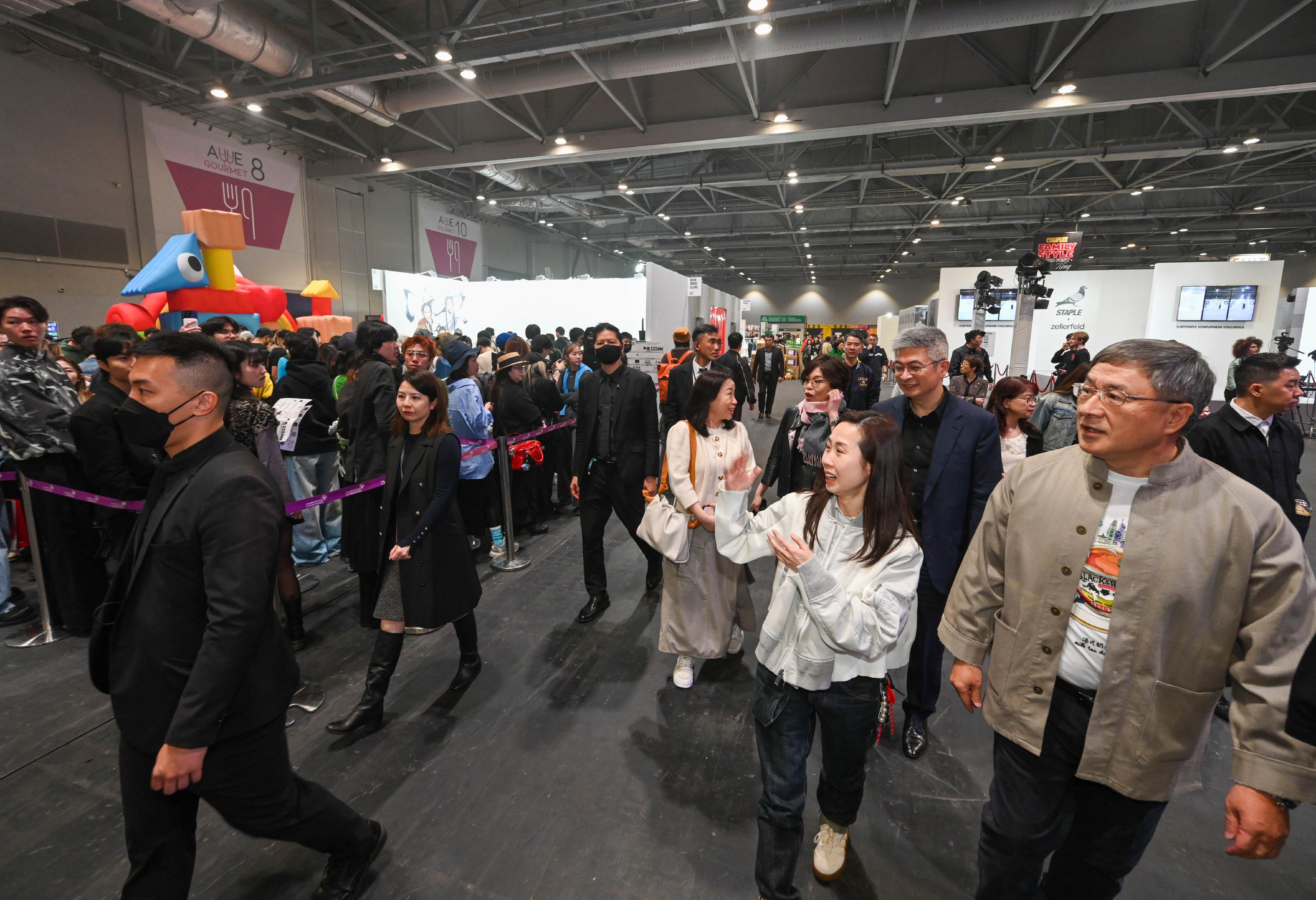



Speech by DCS at Opening Ceremony of ComplexCon Hong Kong 2025 (English only) (with photos)

     Following is the speech by the Deputy Chief Secretary for Administration, Mr Cheuk Wing-hing, at the Opening Ceremony of ComplexCon Hong Kong 2025 today (March 21):

Bonnie (Chief Executive Officer of Complex China, Ms Bonnie Chan Woo), Daniel (Global Artistic Director of ComplexCon, Mr Daniel Arsham), Adrian (Chairman of Mega Arts and Cultural Events Committee, Dr Adrian Cheng), Raistlin (Under Secretary for Culture, Sports and Tourism, Mr Raistlin Lau), distinguished guests, ladies and gentlemen,

     Good afternoon everybody. I am thrilled to join you at the opening ceremony of ComplexCon Hong Kong 2025.

     Last year, the debut of ComplexCon was a tremendous success. It gave us a surprise by bringing an internationally renowned festival of pop culture to Hong Kong, and even to the whole of Asia for the first time. Today, I'm excited to welcome the second edition of ComplexCon with an enhanced line-up and more fabulous programmes returning to Hong Kong again. This loudly reaffirms Hong Kong's position as an international hub for arts and culture and Asia's events capital.

     For the second consecutive year, ComplexCon Hong Kong is supported by the Mega Arts and Cultural Events (Mega ACE) Fund of the Culture, Sports and Tourism Bureau. Bringing together over 100 international and local artists, creators and trendsetting brands, ComplexCon will definitely build an exhilarating platform for international exchanges of arts and culture, attract new talent, brands and artists to Hong Kong, create opportunities for the industry, and give local audiences and visitors from around the world a big treat in trendy culture.

     Globally, the pop culture and live entertainment industry has rapidly evolved and keeps going strong, creating immense opportunities for growth and innovation. With Hong Kong's pre-eminent background as a melting pot of Chinese and Western cultures, and rich heritage and development in fashion and pop culture, the city has the perfect DNA to play a pivotal part in shaping these global trends. We thus love to have ComplexCon in town for the symbiotic development of our cultural and creative industries.

     This month is Hong Kong's "Super March", with an eye-dazzling array of world-class sports, arts and cultural events converging in the city. ComplexCon, as a magnet for pop culture enthusiasts from all over the world, is undoubtedly one of the highlights.

     Lastly, I would like to express my sincerest gratitude to Complex China, especially Bonnie and her team, and all the partners who have been joining hands with us to bring ComplexCon to Hong Kong for the second time. I wish ComplexCon huge success, and all of you an insanely good time in Hong Kong. Thank you.

Photo  Photo  Photo  Photo  


Postal services to United Kingdom subject to delay

     Hongkong Post announced today (March 21) that, as advised by the airlines, Britain's Heathrow Airport has been closed due to a fire incident. Mail delivery services to the United Kingdom are subject to delay.


Employment and vacancies statistics for December 2024

     According to the figures released today (March 21) by the Census and Statistics Department (C&SD), total employment in the private sector surveyed decreased by 0.3% or 7 000 persons in December 2024 compared with a year earlier. The total number of vacancies was 58 410, representing a decrease of 20% or 14 660 over the preceding year.
 
Employment statistics

     In December 2024, the selected industries as a whole employed 2 715 800 persons. The import and export trade engaged 354 500 persons, followed by professional and business services (excluding cleaning and similar services) engaging 311 500 persons, financing and insurance 233 300 persons, retail trade 232 700 persons, and food and beverage services 220 900 persons.
 
     Movements in the employment in different surveyed industries varied when compared with a year earlier. Decreases were mainly observed in the industries of wholesale (-5.4% or -2 700 persons), retail trade (-5.3% or -13 000 persons), import and export trade (-2.2% or -8 100 persons), and food and beverage services (-1.6% or -3 600 persons). On the other hand, employment increased mainly in the industries of real estate (4.6% or 6 400 persons), human health services (3.5% or 5 400 persons), and residential care and social work services (3.1% or 2 200 persons). Employment figures for selected major industries are shown in Table 1.
 
Vacancies statistics

     Among the 58 410 private sector vacancies in December 2024, 5 950 were from the industry of education, 5 670 from professional and business services (excluding cleaning and similar services), 5 480 from food and beverage services, 4 990 from residential care and social work services, and 4 920 from financing and insurance.
 
     Vacancies decreased in majority of the selected industries in December 2024 over a year earlier. Decreases were mainly observed in the industries of human health services (-2 560 or -40%), education (-1 970 or -25%), retail trade (-1 630 or -30%), and arts, entertainment, recreation and other services (-1 570 or -29%). On the other hand, vacancies increased mainly in the industry of import and export trade (410 or 15%). Job vacancies figures for selected major industries are shown in Table 2.
 
     Analysed by major occupation category, private sector vacancies were observed mainly in the categories of service and sales workers (22 190 vacancies), professionals (9 520 vacancies), and associate professionals (8 730 vacancies). Job vacancies figures by major occupation category are shown in Table 3.
 
Seasonally adjusted statistics

     For discerning the latest trend in employment and vacancies in the private sector, it is useful to look at changes over a three-month period in the respective seasonally adjusted figures. Compared with September 2024, the seasonally adjusted total employment and total vacancies in the surveyed industries decreased by 0.1% and 5.3% respectively in December 2024.  The changes over three-month periods in the seasonally adjusted series of employment and vacancies are shown in Table 4.
 
Other information

     The above employment and vacancies statistics were obtained from the Quarterly Survey of Employment and Vacancies and the Quarterly Employment Survey of Construction Sites conducted by the C&SD. In the former survey, some economic activities (e.g. those dominated by self-employment, including taxi operators and hawkers) are not covered. Therefore, the respective employment and vacancies figures relate only to those selected industries included in the survey. In the latter survey on construction sites, employment and vacancies figures relate to manual workers only.
 
     A detailed breakdown of the above statistics is published in the following reports:
"Quarterly Report of Employment and Vacancies Statistics, December 2024"
(www.censtatd.gov.hk/en/EIndexbySubject.html?pcode=B1050003&scode=452)
"Quarterly Report of Employment and Vacancies at Construction Sites, December 2024"
(www.censtatd.gov.hk/en/EIndexbySubject.html?pcode=B1050004&scode=452)
 
     Users can browse and download these publications at the website of the C&SD.
 
     Enquiries on more detailed employment and vacancies statistics can be directed to the Employment Statistics Section of the C&SD (Tel: 2582 5076 or email: employment@censtatd.gov.hk).


Hong Kong’s Balance of Payments and International Investment Position statistics for fourth quarter of 2024 and whole year of 2024

     The Census and Statistics Department (C&SD) released today (March 21) the preliminary Balance of Payments (BoP) and International Investment Position (IIP) statistics of Hong Kong for the fourth quarter of 2024 and the whole year of 2024. This release also included the preliminary External Debt (ED) statistics of Hong Kong for the same period.

I.      Balance of Payments

     Hong Kong recorded a BoP surplus of $31.4 billion (3.8% of Gross Domestic Product (GDP)) in the fourth quarter of 2024.  Reserve assets correspondingly increased by the same amount. This was against a BoP deficit of $23.0 billion (2.8% of GDP) in the third quarter of 2024.

     For 2024 as a whole, there was a BoP deficit of $89.7 billion (2.8% of GDP), compared with a deficit of $79.9 billion (2.7% of GDP) in 2023.

Current account

     The current account recorded a surplus of $96.3 billion (11.5% of GDP) in the fourth quarter of 2024. This reflects that Hong Kong's savings was greater than its investment, enabling Hong Kong to accumulate external financial assets (such as equity securities or debt securities) as a buffer against global financial volatilities. Compared with the current account surplus of $61.5 billion (7.7% of GDP) in the fourth quarter of 2023, the increase in surplus was mainly due to the increase in net inflow of primary income and the switch in goods balance from deficit to surplus.

     The goods account recorded a surplus of $5.4 billion in the fourth quarter of 2024, as against a deficit of $6.9 billion in the same quarter of 2023. Over the same period, the services surplus increased from $28.3 billion to $34.3 billion. The primary income inflow and outflow amounted to $496.8 billion and $434.7 billion respectively, thus yielding a net inflow of $62.1 billion in the fourth quarter of 2024, compared with a net inflow of $44.9 billion in the same quarter of 2023.

     For 2024 as a whole, the current account surplus was $409.5 billion (12.9% of GDP), larger than that of $253.1 billion (8.5% of GDP) in 2023, mainly due to the decrease in goods deficit and the increase in net inflow of primary income.

Financial account

     An overall increase in financial non-reserve assets amounting to $102.5 billion (12.3% of GDP) was recorded in the fourth quarter of 2024, compared with an overall increase of $107.7 billion (13.2% of GDP) in the third quarter of 2024. The overall increase recorded in the fourth quarter of 2024 was due to the net increases in portfolio investment and financial derivatives, partly offset by the net decreases in direct investment and other investment.

     In the fourth quarter of 2024, reserve assets increased by $31.4 billion, as against a decrease of $23.0 billion in the third quarter of 2024.

     For 2024 as a whole, financial non-reserve assets recorded an overall increase of $577.0 billion (18.2% of GDP), compared with an overall increase of $320.9 billion (10.8% of GDP) in 2023. The overall increase recorded in 2024 was due to the net increases in portfolio investment and financial derivatives, partly offset by the net decreases in direct investment and other investment.

     In 2024, reserve assets decreased by $89.7 billion, compared with a decrease of $79.9 billion in 2023.

II.     International Investment Position

     At the end of the fourth quarter of 2024, both Hong Kong's external financial assets and liabilities stood at a very high level, amounting to $52,514.2 billion (16.5 times of GDP) and $36,641.3 billion (11.5 times of GDP) respectively, a typical feature of a prominent international financial centre.

     Hong Kong's net external financial assets (i.e. assets minus liabilities) amounted to $15,872.9 billion (5.0 times of GDP) at the end of the fourth quarter of 2024, compared with $16,055.0 billion (5.1 times of GDP) at the end of the third quarter of 2024. Hong Kong's net external financial assets to GDP ratio is one of the largest in the world, which provides the economy with a strong cushion against sudden external shocks.

III.    External Debt

     At the end of the fourth quarter of 2024, Hong Kong's gross ED amounted to $14,830.0 billion (4.7 times of GDP). Compared with $14,959.6 billion (4.8 times of GDP) at the end of the third quarter of 2024, gross ED decreased by $129.5 billion. This was mainly attributable to the decrease in ED of the banking sector, partly offset by the increase in ED of other sectors.

     As one of the world's major financial centres, Hong Kong has a significant amount of ED held against the local banking sector arising through normal banking businesses. At the end of the fourth quarter of 2024, 53.2% of Hong Kong's ED was attributable to the banking sector. Other ED mainly consisted of ED of other sectors (28.4%) and debt liabilities in direct investment (intercompany lending) (17.5%).

Further information

     BoP is a statistical statement that systematically summarises, for a specific time period (typically a year or a quarter), the economic transactions of an economy with the rest of the world (i.e. between residents and non-residents).

     IIP is a balance sheet showing the stock of external financial assets and liabilities of an economy at a particular time point. The difference between the external financial assets and liabilities is the net IIP of the economy, which represents either its net claim on or net liability to the rest of the world.

     Gross ED, at a particular time point, is the outstanding amount of those actual current, and not contingent, liabilities that are owed to non-residents by residents of an economy and that require payment of principals and / or interests by the debtors at some time points in the future.

     Table 1 presents Hong Kong's BoP. Table 2 presents the detailed current account and capital account, while Table 3 presents the detailed financial account. Table 4 shows Hong Kong's IIP, and Table 5 shows Hong Kong's ED.
 
     Statistics on BoP, IIP and ED for the fourth quarter of 2024 and the whole year of 2024 are preliminary figures, which are subject to revision upon the availability of more data.

     The latest statistical tables of BoP (including seasonally adjusted current account), IIP and ED can be downloaded at the website of the C&SD (www.censtatd.gov.hk/en/scode260.html). Analysis of the statistics, together with the conceptual and methodological details, are presented in the publication Balance of Payments, International Investment Position and External Debt Statistics of Hong Kong, Fourth Quarter 2024 published by the C&SD. Users can download the publication at the website of the C&SD (www.censtatd.gov.hk/en/EIndexbySubject.html?pcode=B1040001&scode=260).

     For enquiries about the BoP, IIP and ED statistics, please contact the Balance of Payments Section of the C&SD (Tel: 3903 6979 or email: bop@censtatd.gov.hk).