Transport Department approves route expansion for autonomous vehicles pilot licence trials in North Lantau

     The Transport Department (TD) announced today (June 18) that a pilot licence for autonomous vehicles (AVs) has been updated in accordance with section 20(3)(b) of the Road Traffic (Autonomous Vehicles) Regulation (Cap. 374AA) to expand the routes for AV trials in North Lantau.

     The applicant has been approved to conduct trials for 10 AVs during a specified time on specified road sections in Tung Chung. Three autonomous private cars can be operated in each road test at most. The specified expanded routes cover Man Tung Road, Ying Hei Road, Yi Tung Road, Tung Chung Eastern Interchange, Yu Tung Road, Chung Yan Road, Shun Tung Road, Tung Chung Waterfront Road and Wai Tung Road.

     A spokesman for the TD said that the North Lantau project, which commenced in December 2024, has made significant progress to date. The TD has expedited ongoing monitoring, proactively taken forward the project and granted approval under the new AV regulatory framework, achieving several technical advancements within months. They included scaling up the trials from a single vehicle to 10 vehicles operating simultaneously to collect multi-vehicle data, conducting designated passenger-carrying trials on specific routes after safety assessment, expanding the trial scope to roads with more complex traffic scenarios, and increasing the maximum speed limit to 50 km/h based on the trial route. This updated pilot licence further expands the trial routes, so that more useful data can be collected to evaluate AV performance in more different road conditions and communities.

     The TD's label for pilot AV shall be displayed on all pilot AVs for identification by other road users. Details of the pilot licence have been uploaded to the TD's website on AV trials.

     The TD welcomes interested organisations or enterprises to submit applications for a pilot licence and act in concert to promote the further development of autonomous driving in Hong Kong. Upon receipt of an application, the TD will consider various factors, including the design operating range and functions of the autonomous system submitted by the applicant, relevant international or national standards/guidelines, and the road test situations, based on the Code of Practice for Trial and Pilot Use of Autonomous Vehicles before approval. The TD will exercise stringent control with a view to promoting AV trials and development in Hong Kong in a safe and orderly manner.


LCQ4: Promoting cross-boundary eco-tourism

     Following is a question by the Hon Dominic Lee and a reply by the Acting Secretary for Culture, Sports and Tourism, Mr Raistlin Lau, in the Legislative Council today (June 18):
 
Question:
 
     It has been reported that the Dapeng Peninsula of Shenzhen, which is adjacent to Yan Chau Tong of Hong Kong, possesses rich ecological resources, and both Shenzhen and Hong Kong have expressed intentions in recent years to strengthen cooperation in eco-tourism and marine conservation. In this connection, will the Government inform this Council:
 
(1) of the details of cooperation projects commenced and co-operation agreements reached between the SAR (Special Administrative Region) Government and the relevant government departments of Dapeng New District, Shenzhen in terms of, among others, eco-tourism, green economy, and marine conservation; whether it has compiled statistics on the specific data and effectiveness of such co-operation projects over the past five years;
 
(2) whether it has plans to promote cross-boundary eco-tourism from Kat O and Tung Ping Chau to the Dapeng Peninsula and devise related sea routes, including the construction of piers for "co-location arrangement" in such areas; if so, of the details and progress of the ongoing negotiations with Shenzhen authorities, including technical feasibility, estimated timetable, and related ancillary facilities; if not, the reasons for that; and
 
(3) whether the Government has assessed the expected benefits of the aforementioned cross-boundary eco-tourism routes for Hong Kong's tourism industry and local economy, as well as the potential risks involved in environmental conservation; if so, of the assessment results, and the policy directions determined in response to such results?
 
Reply:
 
President,
 
     According to the Northern Metropolis (NM) Action Agenda announced in 2023, the Blue and Green Recreation, Tourism and Conservation Circle situated in the easternmost part of the NM comprises Robin's Nest, Lin Ma Hang, Sha Tau Kok, Yan Chau Tong as well as coastal villages and the outlying islands. With abundant blue and green resources including country parks, marine parks and geopark as well as a number of traditional rural townships, this zone has the potential for recreation and tourism development.
      
     As set out in the Development Blueprint for Hong Kong's Tourism Industry 2.0, the Culture, Sports and Tourism Bureau (CSTB) promotes in-depth integration of Hong Kong's unique world-class resources with tourism, and crafts tourism products and projects with distinctive features and strong appeal, with "Ecology+Tourism" being one of the development strategies. On the premises of respecting the nature and protecting the environment, we will appropriately unveil Hong Kong's precious ecological resources to visitors, and at the same time minimise the potential environmental impact due to too many visitors as far as practicable, thereby balancing the needs for conservation and tourism development.
      
     The Agriculture, Fisheries and Conservation Department (AFCD) under the Environment and Ecology Bureau (EEB) has designated places of high ecological value in Yan Chau Tong as country park, marine park and geopark, for conservation and eco-education and recreation purposes.
      
     In taking forth the above work, the wish of some local communities for maintaining a quiet countryside environment should also be considered.
 
     Having consulted the EEB, the Development Bureau, the Security Bureau and the Transport and Logistics Bureau, a consolidated reply in response to the questions raised by the Hon Dominic Lee is as follows:
 
(1) The HKSAR (Hong Kong Special Administrative Region) Government has established mechanisms with the Shenzhen authorities for the cooperation in individual areas. On ecological conservation and environmental protection, following the establishment of the Robin's Nest Country Park last year, the AFCD and the Planning and Natural Resources Bureau of Shenzhen Municipality signed the Cooperation Agreement last year on the establishment of the ecological corridor between Shenzhen Wutong Mountain and Hong Kong Robin's Nest, including jointly removing invasive species, conducting ecological surveys, examining enhancement of animal corridors and enhancing publicity and education. The Hong Kong UNESCO Global Geopark also collaborated with the Shenzhen Dapeng Peninsula National Geological Natural Park to hold science lectures and exhibitions in both locations last year and this year, enabling citizens of both sides to have better understanding of the geological history, landforms, and geoparks of the two places.
 
     On marine conservation, the Environmental Protection Department and the Ecology and Environment Bureau of Shenzhen Municipality have been improving sewage collection and treatment through the Mirs Bay and Deep Bay (Shenzhen Bay) Areas Environmental Management Special Panel. With the concerted efforts of both sides, the water quality of Mirs Bay has been kept at a good level, and it is conducive to the conservation of marine ecology, especially the hard corals in the northeast waters of Hong Kong.
       
     The CSTB has been strengthening co-operation with the Shenzhen authorities in the tourism aspect under the principle of mutual benefits, including encouraging the trade to design eco-tourism products and itineraries on the premise of striking a balance between ecological conservation and tourism development. The travel trade of the Shenzhen and Hong Kong will also organise relevant familiarisation visits to help with the promotion work.
 
(2) and (3) Yan Chau Tong in the northeastern part of Hong Kong possesses unique geological landscape, rich ecology and village culture with long history. The AFCD has, in collaboration with stakeholders and the local community, established visitor centers, cultural trails, land tour routes, island-hopping itineraries, and maritime tour routes, providing tourists an in-depth green tour experience. In addition, the Countryside Conservation Office under the EEB is dedicated to revitalising villages, and held the Countryside Harvest Festival: Kuk Po 'Sound, Sight, Taste Fusion' Tour at Kuk Po in Sha Tau Kok from January to February 2025. The event blended local natural ecology, historical architecture and countryside culture, allowing the public to experience the unique charm of Hong Kong's countryside.
 
     Through the Working Group for Sha Tau Kok Co-operation Zone set up under the Task Force for Collaboration on the Northern Metropolis Development Strategy under the Guangdong-Hong Kong and Hong Kong-Shenzhen co-operation mechanism, the CSTB collaborates with Shenzhen to promote the tourism development in Sha Tau Kok and nearby areas (including Kat O) under the overall principle of "low density, high quality" and through enriching its historical and cultural elements. The CSTB has also been encouraging the business sector to develop diversified tourism products. At present, Mainland visitors can conveniently enter Hong Kong through various boundary control points to join local tours, including eco-tourism itineraries in Hong Kong. Earlier on, in collaboration with the Travel Industry Council of Hong Kong, the CSTB actively engaged with the trade in Hong Kong and Shenzhen. For instance, the CSTB organised the Sha Tau Kok island-hopping familiarisation tour for the travel trade from Yantian District of Shenzhen in December last year, which included visits to Lai Chi Wo, Kat O and Ap Chau, etc, for designing Sha Tau Kok island-hopping tours after crossing the boundary from the Liantang/Heung Yuen Wai Boundary Control Point.

     As regards the construction of piers for "co-location arrangement" for developing cross-boundary ferry routes between the eastern waters of Shenzhen and the NM area of Hong Kong as mentioned in part two of the question, it will indeed involve a number of complex considerations as mentioned in part three of the question, including the long-term market demand for the ferry routes concerned and the carrying capacity of the region; the infrastructure facilities that are required, the consequential change of planning as well as the economic and cost-effectiveness of the infrastructure investment; the security challenges that will have to be faced; and the potential impacts on the ecological environment, etc. which require long-term consideration by both sides of the governments. 
      
     Thank you President.


AFCD to hold Local Organic Watermelon Festival 2025 (with photos)

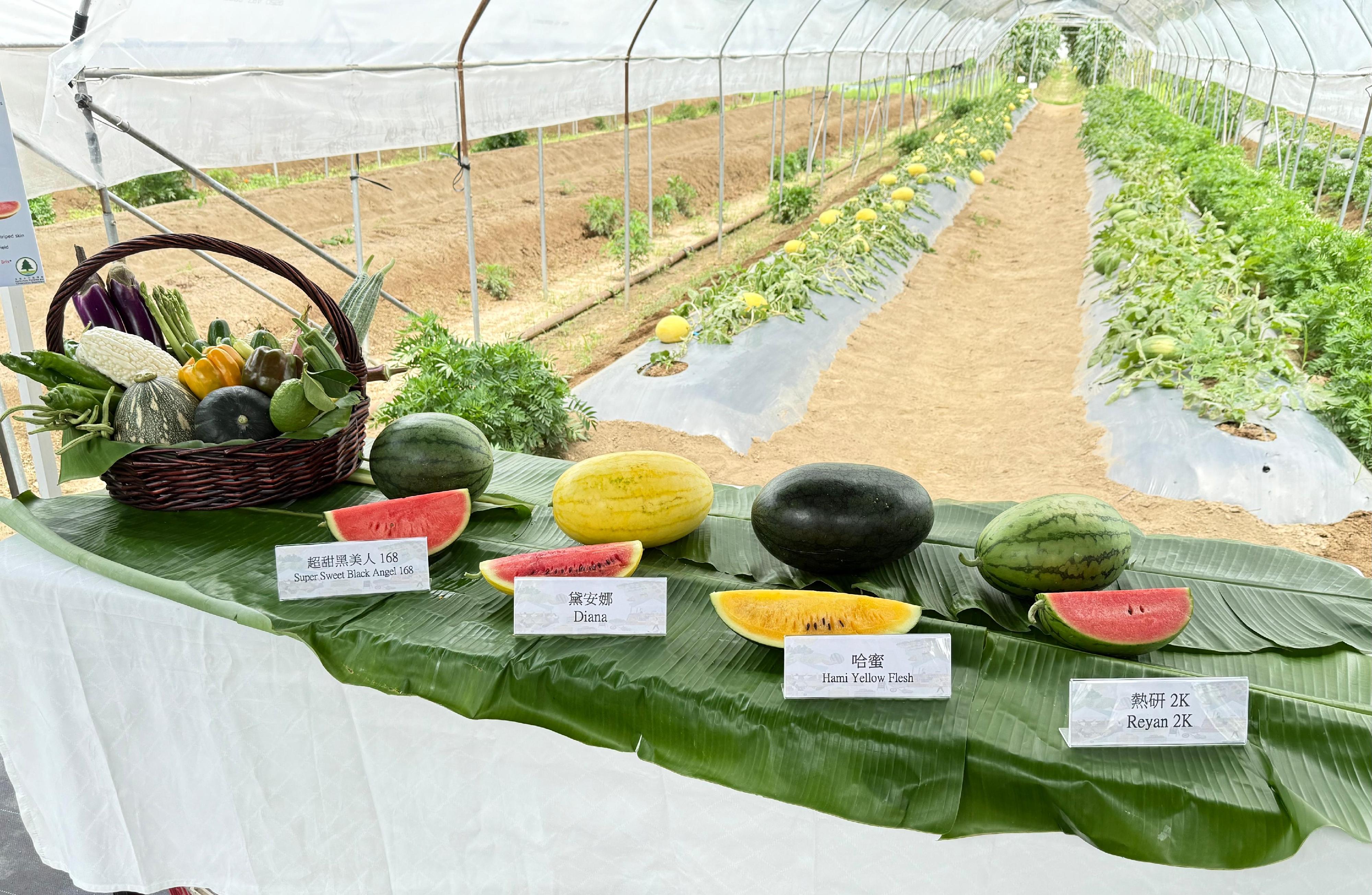
     â€‹The Agriculture, Fisheries and Conservation Department (AFCD) will hold the Local Organic Watermelon Festival 2025 from June 20 to feature four highlighted varieties of organic watermelons this year.

     A spokesman for the AFCD said today (June 18), "The annual Local Organic Watermelon Festival promotes local organic watermelons and other premium agricultural products, enhances sustainability of local agriculture, and provides farmers with opportunities to share their harvests and engage with the public."

     At the Local Organic Watermelon Festival 2025, four highlighted varieties of watermelons, namely Reyan 2K, Hami Yellow Flesh, Super Sweet Black Angel 168 and Diana, will be featured. The Reyan 2K, a new variety introduced this year, is oblong with green, dark striped skin, has a thin rind and intense juicy red flesh with a sweetness of around 12 degrees Brix (degrees of Brix denote the units for measuring sucrose content in solution). The Hami Yellow Flesh, also oblong with dark green, striped skin, has yellowish-orange flesh and a sweetness of around 10 degrees Brix. The Super Sweet Black Angel 168 is small and spherical with dark striped skin and green and bright crimson-coloured flesh, also with a sweetness of around 12 degrees Brix. Diana, oblong with bright striped skin in yellow, features intense red flesh and a sweetness of around 11 degrees Brix. Local organic watermelons generally have a sweetness ranging from 8 to 12 degrees Brix.

     The AFCD, together with the Vegetable Marketing Organization (VMO), the Federation of Vegetable Marketing Co-operative Societies Ltd and the MTR Corporation Limited will co-organise the first four-day organic farmers' market of the Local Organic Watermelon Festival 2025. The public can buy local organic agricultural products at Maritime Square 1 from June 20 to June 23. The event will also feature booth games and workshops, providing recreational activities for the public.

     Furthermore, the AFCD will continue to invite all regular organic farmers' markets to join the Local Organic Watermelon Festival. Starting from July, the public can purchase local organic watermelons and other seasonal vegetables and fruits at organic farmers' markets across various districts. They can also order from the VMO via the "Local Fresh" website (www.localfreshhk.com) and mobile application or purchase from certified organic farmers listed on the Hong Kong Organic Resource Centre Certification Limited website (www.hkorc-cert.org/en). The opening dates and times of these farmers' markets are listed in the Annex. Local organic watermelons as well as other seasonal vegetables and fruits are available for a limited time while stocks last.

     For more details on the Local Organic Watermelon Festival 2025, please visit the AFCD website (www.afcd.gov.hk/english) or Facebook page (www.facebook.com/afcdgovhk).

Photo  Photo  


LCQ6: Safeguarding employment priority for local workers

     Following is a question by the Hon Chan Hak-kan and a reply by the Secretary for Labour and Welfare, Mr Chris Sun, in the Legislative Council today (June 18):
 
Question:
 
     The number of imported workers approved under the Enhanced Supplementary Labour Scheme (ESLS) has exceeded 50 000 to date. On the other hand, the latest unemployment rate announced by the Government is 3.4 per cent, the highest in 27 months. Regarding the safeguarding of the employment priority for local workers, will the Government inform this Council:
 
(1) as it has been reported that some applicant enterprises have set unreasonable criteria to exclude local applicants when conducting local recruitment under ESLS, of the number of complaints or reports involving non-compliant local recruitment procedures in the past three years and, among them, the number of substantiated cases and the relevant penalties; of the mechanism in place for proactively reviewing the reasonableness of such recruitment criteria;
 
(2) as it has been reported that since ESLS requires enterprises to maintain a manning ratio of imported labour to local labour of no less than 1:2, some enterprises have employed local workers on a part-time basis or arranged for imported workers to take up positions inconsistent with those they applied for, whether the Government has looked into such situations; and
 
(3) of the number of illegal workers arrested in the past three years, together with a breakdown by the trade in which they were engaged; whether it has assessed if the existing penal measures against employers of illegal workers and the intermediaries concerned have sufficient deterrent effect?

Reply:
 
President,
 
     To cope with the challenges brought by manpower shortage and on the premise of ensuring employment priority for local workers, the Government has enhanced the mechanism for importation of labour. Apart from launching sector-specific labour importation schemes for the construction sector, transport sector, and residential care homes for the elderly and residential care homes for persons with disabilities, the Labour Department (LD) has implemented the Enhanced Supplementary Labour Scheme (ESLS) since September 4, 2023 to suspend the general exclusion of the 26 job categories as well as unskilled or low-skilled posts from labour importation under the previous Supplementary Labour Scheme for two years.

     In consultation with the Security Bureau, the reply to the Member's question is as follows:
 
(1) The LD has all along been stringently processing each application under ESLS. Applicant employers must undertake a four-week local recruitment exercise and accord priority to employing suitable local workers to fill the job vacancies. The LD will review and ascertain the employment terms, including the entry and academic qualification requirements, monthly salary and hours of work of all job vacancies posted by employers during the local recruitment. Employers taking on local job seekers through any recruitment channels during the local recruitment shall offer them employment terms no less favourable than those agreed by the LD.
 
     Upon completion of the local recruitment procedures, employers shall report the results to the LD and submit recruitment advertisements for verification. The LD will contact each of the local job seekers who is not employed by the employers, and assess whether the employers have sincerity in recruiting local workers. If there is evidence showing that an employer has violated the requirements of local recruitment, or refused to employ qualified local job seekers without reasonable reasons, the LD will impose administrative sanction of terminating the processing of the application submitted by the concerned employer for importation of labour, and refusing to process other applications submitted by the employer in the following year. Since the implementation of ESLS, the LD has not detected any employer who has violated the requirements of local recruitment or received relevant complaint from job seekers.
 
(2) To safeguard the employment opportunities of local workers, ESLS requires relevant employers to meet the manning ratio requirement of full-time local employees to imported workers of 2:1 on a continuous basis. Full-time employees refer to local employees who are directly employed by an employer and work not less than 35 hours per week for operating the relevant business, excluding part-time staff, staff of sub-contractor(s) or self-employed person(s) providing services to the employer. At the same time, the employer shall not displace local workers in employ with imported workers. In the event of redundancy, imported workers should be retrenched first. To ensure that employers will not displace local workers in employ with imported workers, the LD has set up a dedicated hotline of 2150 6363. I appeal to employees who suspect that they have been dismissed owing to the employment of imported workers to call the hotline. The LD will follow up the complaints seriously. If substantiated, the LD will impose administrative sanction on the concerned employers, including withdrawal of approvals for importation of labour previously granted and refusal to process other applications submitted by the employers in the following two years.

     Besides, imported workers under ESLS must be employed under the Standard Employment Contract (SEC) prescribed by the Government, and shall perform specified duties for the specified job at the specific workplace(s) stipulated in the SEC.

     Labour Inspectors of the LD inspect workplaces of imported workers under ESLS from time to time to check whether employers have complied with the Employment Ordinance and the requirements of ESLS, and require employers to report information on full-time local employees and imported workers as well as the relevant manning ratios. If an employer violates the relevant requirements, including failing to meet the manning ratio requirement or arranging imported workers to perform duties other than those stipulated in SEC, the LD will impose administrative sanction on the employer, including withdrawal of approvals for importation of labour previously granted to the employer and refusal to process other applications submitted by the employer for up to two years.
 
(3) Engaging in illegal employment is a serious offence. Employers, illegal workers as well as aiders and abettors of illegal employment will be liable to prosecution in accordance with the Immigration Ordinance (IO). The IO stipulates different provisions targeting relevant offences committed by different groups of people. Visitors, illegal immigrants, overstayers, etc, are prohibited from taking up any employment, whether paid or unpaid, or establishing or joining any business. Aiders and abettors are liable to the same penalties. In addition, the Government amended the IO in 2021 to increase the penalty on employers of illegal workers, with the maximum penalty significantly increased from a fine of $350,000 and three years' imprisonment to a fine of $500,000 and 10 years' imprisonment with a view to reflecting the gravity of such offences. Besides, any person who takes up any employment, whether paid or unpaid, in contravention of a condition of stay shall be guilty of an offence. Upon conviction, he/she is liable to a maximum fine of $50,000 and up to two years' imprisonment. In addition, if local employment agencies or their persons in relation are convicted of breaches of the IO, the LD may consider revoking or refusing the renewal of license for the concerned employment agencies. If the concerned persons apply for operating other employment agencies in future, the LD may also consider rejecting the issue of license. 
 
     The Government is committed to combatting illegal employment, with a view to protecting the job opportunities for the local workforce. Relevant law enforcement agencies will, depending on operational needs, risk assessment and other considerations, flexibly arrange sufficient manpower to continuously conduct intelligence-led operations. When necessary, they will conduct joint operations to rigorously combat crimes related to illegal employment.
 
     According to the records of the Immigration Department, there were respectively 886, 1 304 and 1 268 illegal workers arrested each year during 2022 to 2024. 506 illegal workers were arrested during January to May 2025. The illegal workers arrested were mainly engaged in work related to the catering, construction, cleaning, or retail and wholesale industries.


LCQ12: Repair and maintenance of public roads

     Following is a question by the Hon Chan Siu-hung and a written reply by the Secretary for Transport and Logistics, Ms Mable Chan, in the Legislative Council today (June 18):

Question:

     It is learnt that the Highways Department (HyD) adopts innovative technologies and promotes management digitalisation to enhance the efficiency in road repair and maintenance services. In this connection, will the Government inform this Council:

(1) of the total length of public roads in Hong Kong, the total length of public roads repaired and the total project cost for repair of public roads in each of the past three years; the respective details of the contracts awarded for repair and maintenance of such roads (including but not limited to the names of contractors, districts involved, contract periods, length of the roads involved and contract values);

(2) as the Government indicated in its reply to a question from a Member of this Council on March 27 last year that the HyD aimed to digitalise most inspection and supervision procedures in all road maintenance contracts in 2024, of the progress of the relevant work; whether it has assessed how the adoption of innovative technologies help enhance the efficiency and cost-effectiveness of road inspection, including the savings in manpower expenditure and project cost; if so, of the details; if not, the reasons for that;

(3) given that, according to the information from the HyD, the HyD is using the Road Defect Detection System (RDDS) and the Road Condition Assessment System (RCAS) for inspection of road conditions, of the respective application scenarios, stages of application (e.g. at trial stage or being converted to regular use), efficiency of inspection and cost-effectiveness of the two systems;

(4) given that, according to the estimation of HyD, the introduction of RCAS will be able to free up about one-fourth of the manpower of the contractors' road inspection teams, and the HyD is now evaluating the effectiveness of RCAS and will consider in due course the full scale application of the technology and its incorporation into the standard operating procedures for future road inspections, of the latest progress of the relevant work, and whether it has studied if future deployment will be implemented by adopting both systems, namely RDDS and RCAS, or either one of them; and

(5) given that HyD is one of the selected applicants for the first batch of low-altitude economy Regulatory Sandbox pilot projects, of the details of HyD's pilot projects involving road repair and maintenance as well as road inspection (including but not limited to the contents of the projects, application scenarios, flight paths, route plans and flight distances)?

Reply:

President,

     Having consulted the Highways Department (HyD), my reply to the various parts of the question raised by Hon Chan Siu-hung is as follows:

(1) In the past three years (i.e. from 2022 to 2024), the total length of roads maintained by the HyD each year was 2 223, 2 239 and 2 241 kilometres respectively. The annual expenditure on maintenance of roads and associated road facilities was about $1.70 billion, $1.73 billion, and $1.66 billion respectively.

     The HyD ensures the safety and reliability of the public road network by engaging road maintenance contractors under term contracts to carry out regular inspection and maintenance work. When damage to road surfaces is identified during inspections or damages to roads and ancillary road facilities are reported by the public, the HyD would arrange contractors to carry out repair works as soon as possible to defects that may pose hazard to road users. As such repairs are part of the routine road maintenance work, the HyD does not separately keep statistics on the area of such type of road surface maintained. 

     Moreover, for defects that do not pose immediate danger to road safety, the HyD would formulate appropriate maintenance plan and schedule for such defects after taking into account various factors, such as arranging road resurfacing at a timely juncture. In each of the past three years (i.e. from 2022 to 2024), the areas of roads resurfaced and reconstructed by HyD are about 1.55, 1.77 and 1.65 million square metre respectively.

     Currently, the HyD has a total of 9 road maintenance contracts for the maintenance of all public roads in Hong Kong, details of which are at Annex.

(2) At present, the Road Maintenance Monitoring System (RMMS), which is a system that fully digitalises the monitoring and administrative work of road maintenance, has been used in all road maintenance contracts. In the past, whenever the HyD's staff identified defects in road facilities during inspection, they were required to fill in and send the relevant physical form to the contractors upon completion of the inspections. With the RMMS, staff can now log on to the system during outdoor inspections and electronically notify the contractors of the information on damage to facilities captured on site, so that contractors can receive the relevant data promptly and arrange for repair works accordingly. After completion of repair works, contractors can also use RMMS to report the work done and submit maintenance records. The adoption of RMMS can cut down on complicated paperwork and transmission time to enhance work efficiency, facilitating HyD's staff to monitor the progress of maintenance. It resulted in better maintenance record keeping as well as reduction in the use of paper. In addition, the HyD is now developing the second phase of RMMS, which will incorporate more monitoring and management functions, such as automatic alerts or warnings to contractors with unsatisfactory maintenance progress, as well as digitalised checking procedures, etc.

     In terms of cost-effectiveness, with the full implementation of the first phase of the RMMS, the average time taken by the HyD's staff to handle a case of damaged road facility (from the discovery of damage to road facility to the completion of the repair works) is about 20 per cent faster than before. Subsequently, upon completion and full adoption of the second phase of the RMMS, the HyD will then consider adjusting the manpower requirements of contractors for new road maintenance works. At that time, the HyD would re-assess the savings in manpower expenditure and works cost arising from the use of RMMS, as well as the cost-effectiveness of the system. 

(3) The Road Defect Detection System (RDDS) utilises high-definition cameras installed on inspection patrol vehicles to capture images of road conditions, and employs global satellite positioning technology to record the locations of such images. It then uses artificial intelligence (AI) technology to automatically identify road surface cracks and discoloured road markings, instead of relying on the visual inspection by road inspectors as in the past to ensure that the detection results are objective and accurate (above 90 per cent accuracy). Contractors use inspection patrol vehicles equipped with RDDS to carry out comprehensive inspection of all roads in Hong Kong once every three months. The detection results of road defects will be displayed on a web-based maintenance platform equipped with geographic information system maps, to facilitate maintenance personnel to locate the defects and carry out repair works. Moreover, the RDDS can consolidate relevant information into defect reports for maintenance personnel to record and audit the maintenance status. With enhanced inspection accuracy and maintenance records, the required maintenance works can be completed more swiftly and efficiently. At present, the RDDS has been incorporated as a standard operating procedure for road inspection on a regular basis. With the full adoption of RDDS, the average time taken by the contractors from completion of road inspection work to submission of the relevant inspection report has been substantially reduced from 48 hours to within 24 hours. To further enhance the efficiency of road maintenance, the HyD would expand the analytical capability of the AI system of the RDDS to identify more different types of road defects, such as overgrown vegetation, as well as discoloured/obstructed/bent traffic signs on the road surface.

     The Road Condition Assessment System (RCAS), which scans three-dimensional images of road surfaces, uses patrol vehicles equipped with laser scanning equipment and global satellite positioning technology to drive on a carriageway at normal speed, and can automatically identify and accurately record various types of defects on the road surface such as potholes, rutting etc. It calculates a Pavement Condition Index (PCI) for every 100 metres of the road for the reference of engineering personnel responsible for maintenance to determine whether the section of road should be prioritised for reconstruction or resurfacing works. Compared to the past when road inspectors had to conduct visual inspection and measurement on the road surface after making road closure arrangements, which only covered a few hundred meters of carriageways per day at most, RCAS enables the maintenance team to have a more comprehensive grasp of the latest conditions of all road surfaces without the need for road closures. This allows for more effective use of resources when planning road maintenance works, and also helps avoid disruption to traffic.

     The HyD expects that after using RCAS to inspect all major road sections in Hong Kong, it will be able to make more effective use of resources by prioritising sections with poorer conditions for road maintenance. RCAS is still in the trial stage and is capable of inspecting about 200 km of carriageways per day. It is expected that during the one year trial period, all major road sections in Hong Kong can be inspected and the data collected will be used for establishing a web-based maintenance platform for use by engineering staff.

     As RCAS is still at the trial stage, the cost-effectiveness of the technology is still being assessed. However, according to preliminary estimation, the introduction of RCAS can free up about one-fourth of the manpower of the contractors' road inspection teams to cope with the increasing road maintenance work.

(4) Since 2024, the HyD has engaged various service contractors through road maintenance contracts to participate in the development of RCAS which is used to accurately record the undulations of road surfaces and identify road defects such as potholes, to facilitate the planning of road maintenance work. The aforesaid development project is broadly divided into three stages: in the first stage, the service contractors are required to procure vehicles and install laser scanning equipment and positioning devices on the vehicles; in the second stage, the service contractors are required to develop an AI and geometric analysis algorithm system to automatically detect road defects, assess road conditions, and establish a Geographic Information System (GIS) web-based platform to disseminate the relevant information; and in the third stage, the service contractors are required to utilise this system to scan all road surfaces in Hong Kong and automatically assess road conditions, as well as upload the assessment results to the GIS web-based platform at the same time. The first and second stages have been completed, while work on the third stage has commenced and is anticipated to be completed within this year. The HyD is evaluating the effectiveness of the entire smart road conditions analysis system and would consider incorporating this technology into the standard operating procedures for future road inspections in due course.

     Currently, the RDDS is used for rapid identification of cracks on road surface and discoloured road markings which facilitates maintenance staff to locate road defects and expedite the completion of the required maintenance works, thereby enhancing maintenance efficiency. Meanwhile, RCAS focuses on accurately identifying and recording various types of defects on road surfaces and their degree of deterioration. It calculates the PCI for every 100m of carriageway which will help maintenance staff to determine whether a road section should be prioritised for resurfacing works. In view of the distinctive functions of RDDS and RCAS, as well as their differences in speed and accuracy in detecting road conditions, the positioning of their applications is thus different. These two systems will be implemented in parallel at this stage. However, the HyD will continue to develop the functions of RDDS and RCAS and will not rule out the possibility of merging them in the future when their functions, speed, and accuracy become comparable.

(5) According to the requirements of the existing Small Unmanned Aircraft (SUA) Order, the "pilot" controlling a SUA is required to maintain visual-line-of-sight with SUA under standard operation. The HyD's Regulatory Sandbox project utilises beyond visual-line-of-sight (BVLOS) technology, coupled with 4G/5G command and control links, to enable SUA to operate beyond the pilot's line-of-sight in a safer and more stable manner, up to a distance of several kilometres. This enables flexible deployment for surveying and inspecting road infrastructures and major trunk roads during emergencies, such as landslides, as well as routine operation.

     In emergency situations, with the adoption of BVLOS technology, SUA can swiftly reach a remote landslide site and calculate a three-dimensional model of the slope through aerial photographs taken, which facilitates engineers to accurately measure the area and volume of landslide debris in support of slope restoration work. In addition, under extreme weather condition, SUA can be operated to fly along designated pre-set routes to quickly see whether there are any flooding, fallen trees, or other obstructions on major highways. For routine surveys and inspections, BVLOS technology can assist in the inspections in places such as cross-sea bridges, confined spaces and elevated structures that are difficult for engineering personnel to access or visually inspect. Such technology can be regularly applied to routine operations, such as surface defect inspection of bridge structures and slope restoration works. 

     The test flights of the Regulatory Sandbox project are conducted in stages under different scenarios, at locations including Tai Po Waterfront Pier to Sam Mun Tsai, Tseung Kwan O Tunnel Road, Tseung Kwan O Cross Bay Link, Tate's Cairn Highway, and Ap Lei Chau Bridge. These simulated flights carry out BVLOS inspections of slopes along the roads at the above locations and the related major trunk roads, with flying distances ranging from 200m to 2 000m. Among them, the HyD has already completed the trial flights at the first two test sites, with the remaining three expected to be completed in phases by the end of September 2025.