Temporary closure of Hong Kong Velodrome from April 12 to 23

     The Leisure and Cultural Services Department announced today (March 28) that all facilities (including the service counter and SmartPLAY Self-service Stations) of the Hong Kong Velodrome will be temporarily closed from April 12 to 23 to tie in with the 2025 Hong Kong International Track Cup and the 15th National Games Track Cycling Test Event staged from April 19 to 21.

     During the closure period, members of the public may use similar facilities at Hang Hau Sports Centre, Tseung Kwan O Sports Centre, Tiu Keng Leng Sports Centre, Tsui Lam Sports Centre and Po Lam Sports Centre in the same district.


Wage and payroll statistics for December 2024

Overall Wage and Payroll Statistics
 
     According to the figures released today (March 28) by the Census and Statistics Department (C&SD), the average wage rate for all the selected industry sections surveyed, as measured by the wage index, increased by 3.5% in nominal terms in December 2024 over a year earlier.
 
     About 63% of the companies reported increase in average wage rates in December 2024 compared with a year ago. A total of 33% of the companies recorded decrease in average wage rates over the same period. The remaining 4% reported virtually no change in average wage rates.
 
     After discounting the changes in consumer prices as measured by the Consumer Price Index (A), the overall average wage rate for all the selected industry sections surveyed increased by 1.8% in real terms in December 2024 over a year earlier. 
 
     As for payroll, the index of payroll per person engaged for all the industry sections surveyed increased by 3.4% in nominal terms in the fourth quarter of 2024 over a year earlier. 
 
     After discounting the changes in consumer prices as measured by the Composite Consumer Price Index, the average payroll per person engaged increased by 2.0% in real terms in the fourth quarter of 2024 compared with a year earlier.
 
     The wage rate includes basic wages and other regular and guaranteed allowances and bonuses. Payroll includes elements covered by wage rate as well as other irregular payments to workers such as discretionary bonuses and overtime allowances.  The payroll statistics therefore tend to show relatively larger quarter-to-quarter changes, affected by the number of hours actually worked and the timing of payment of bonuses and back-pay.
 
Sectoral Changes
 
     For the nominal wage indices, year-on-year increases were recorded in all selected industry sections in December 2024, ranging from 3.0% to 4.1%.
 
     For the real wage indices, year-on-year increases were also recorded in all selected industry sections in December 2024, ranging from 1.3% to 2.3%.
 
     The year-on-year changes in the nominal and real wage indices for the selected industry sections from December 2023 to December 2024 are shown in Table 1.
 
     As for the nominal indices of payroll per person engaged, year-on-year increases were recorded in all selected industry sections in the fourth quarter of 2024, ranging from 1.7% to 4.3%.

     For the real payroll indices, year-on-year increases were also recorded in all selected industry sections in the fourth quarter of 2024, ranging from 0.3% to 2.8%.
 
     The year-on-year changes in the nominal and real indices of payroll per person engaged for selected industry sections from the fourth quarter of 2023 to the fourth quarter of 2024 are shown in Table 2. The quarterly changes in the seasonally adjusted nominal and real indices of payroll per person engaged in the same period are shown in Table 3.
 
Commentary
 
     A Government spokesman said that wages and labour earnings saw increases in all surveyed industries in the fourth quarter of 2024 over a year earlier, alongside the tight labour market.
 
     The average wage rate for all selected industries rose by 3.5% in nominal terms in December 2024, at a similar pace of increase in September 2024. After discounting for inflation, the average wage rate increased by an accelerated 1.8% in real terms.
 
     Payroll per person engaged, which includes basic wage, discretionary bonuses and other irregular payments, recorded a steady increase of 3.4% in nominal terms and faster growth of 2.0% in real terms in the fourth quarter of 2024. All selected industries saw increases in payroll per person engaged in both nominal and real terms.
 
     Looking ahead, continued economic expansion should render support to the labour market, as well as wages and labour earnings in the near term, though some industries may be affected by the United States’ trade protection measures and other external uncertainties.
 
Other Information
 
     Both wage indices and payroll indices are compiled quarterly based on the results of the Labour Earnings Survey (LES) conducted by C&SD. Wage index only covers employees up to the supervisory level (i.e. not including managerial and professional employees), whereas payroll index covers employees at all levels and proprietors actively engaged in the work of the establishment.
 
     Apart from the differences in employee coverage, wage statistics are conceptually different from the payroll statistics.  Firstly, wage rate for an employee refers to the sum earned for his normal hours of work. It covers basic wages and other regular and guaranteed allowances and bonuses, but excludes earnings from overtime work and discretionary bonuses, which are however included in payroll per person engaged. Secondly, the payroll index of an industry is an indicator of the simple average payroll received per person engaged in the industry. Its movement is therefore affected by changes in wage rates, number of hours of work and occupational composition in the industry. In contrast, the wage index of an industry is devised to reflect the pure changes in wage rate, with the occupational composition between two successive statistical periods being kept unchanged. In other words, the wage index reflects the change in the price of labour. Because of these conceptual and enumeration differences between payroll and wage statistics, the movements in payroll indices and in wage indices do not necessarily match closely with each other.
 
     It should also be noted that different consumer price indices are used for compiling the real indices of wage and payroll to take into account the differences in their respective occupation coverage. Specifically, the Composite Consumer Price Index, being an indicator of overall consumer prices, is taken as the price deflator for payroll of workers at all levels of the occupational hierarchy.  The Consumer Price Index (A), being an indicator of consumer prices for the relatively low expenditure group, is taken as the price deflator for wages in respect of employees engaged in occupations up to the supervisory level.
 
     Detailed breakdowns of the payroll and wage statistics are published in the "Quarterly Report of Wage and Payroll Statistics, December 2024". Users can browse and download the publication at the website of C&SD (www.censtatd.gov.hk/en/EIndexbySubject.html?pcode=B1050009&scode=210).
 
     For enquiries on wage and payroll statistics, please contact the Wages and Labour Costs Statistics Section (1) of C&SD (Tel:  2887 5550 or email: wage@censtatd.gov.hk).


HKMA Quarterly Bulletin and Half-Yearly Monetary and Financial Stability Report (March 2025 Issue)

The following is issued on behalf of the Hong Kong Monetary Authority:
 
     The Hong Kong Monetary Authority (HKMA) today (March 28) published the March 2025 issue of its Quarterly Bulletin and Half-Yearly Monetary and Financial Stability Report.
      
     The Quarterly Bulletin carries a feature article entitled "The Hong Kong Bond Market in 2024". The Half-Yearly Report provides detailed analyses of the global and local economy, as well as the monetary and financial conditions in Hong Kong. It also examines the recent performance and risks of the local banking sector.
      
     The Quarterly Bulletin and the Half-Yearly Report can be viewed on and downloaded from the HKMA website.


Update on dengue fever

     The Centre for Health Protection (CHP) of the Department of Health today (March 28) reported the latest number of dengue fever (DF) cases, and urged the public to maintain strict environmental hygiene, mosquito control and personal protective measures both locally and during travel.

     From March 21 to yesterday (March 27), the CHP recorded one imported DF case. The patient had travelled to Indonesia during the incubation period.

     As of yesterday, eight imported DF cases were recorded this year. A total of 161 cases of DF were recorded in 2024, including 156 imported and five local cases. In 2023, 62 imported cases of DF were recorded.

     According to the World Health Organization (WHO), the global incidence of DF has markedly increased over the past two decades, posing a substantial public health challenge. In 2023, ongoing transmissions, combined with an unexpected spike in DF cases, resulted in over 6.5 million cases and more than 7 300 dengue-related deaths reported in over 80 countries/territories. In 2024, the WHO recorded over 14 million cases, which was a record number of cases.

     Detailed information on the latest DF situation in Hong Kong, as well as neighbouring and overseas countries and areas, has been uploaded to the CHP website.

     Members of the public returning from areas affected by DF should apply insect repellent for 14 days upon arrival in Hong Kong. If feeling unwell, seek medical advice promptly and provide travel details to a doctor.

     The public should take heed of the following advice on mosquito control:
 

  • Thoroughly check all gully traps, roof gutters, surface channels and drains to prevent blockage;
  • Scrub and clean drains and surface channels with an alkaline detergent compound at least once a week to remove any deposited mosquito eggs;
  • Properly dispose of refuse, such as soft drink cans, empty bottles and boxes, in covered litter containers;
  • Completely change the water of flowers and plants at least once a week. The use of saucers should be avoided if possible;
  • Level irregular ground surfaces before the rainy season;
  • Avoid staying in shrubby areas; and
  • Take personal protective measures such as wearing light-coloured long-sleeved clothes and trousers, and apply insect repellent containing DEET to clothing or uncovered areas of the body when doing outdoor activities.

     â€‹
     â€‹DEET-containing insect repellents are effective and the public should take heed of the tips below:
     

  • Read the label instructions carefully first;
  • Apply right before entering an area with risk of mosquito bites;
  • Apply on exposed skin and clothing;
  • Use DEET of up to 30 per cent for pregnant women and up to 10 per cent for children*;
  • Apply sunscreen first, then insect repellent; and
  • Reapply only when needed and follow the instructions.

     * For children who travel to countries or areas where mosquito-borne diseases are endemic or epidemic and where exposure is likely, those aged 2 months or above can use DEET-containing insect repellents with a DEET concentration of up to 30 per cent.

     The public should call 1823 in case of mosquito problems and may visit the following pages for more information: the DF page of the CHP and the Travel Health Service, the latest Travel Health Newstips for using insect repellents, and the CHP Facebook Page and YouTube Channel.
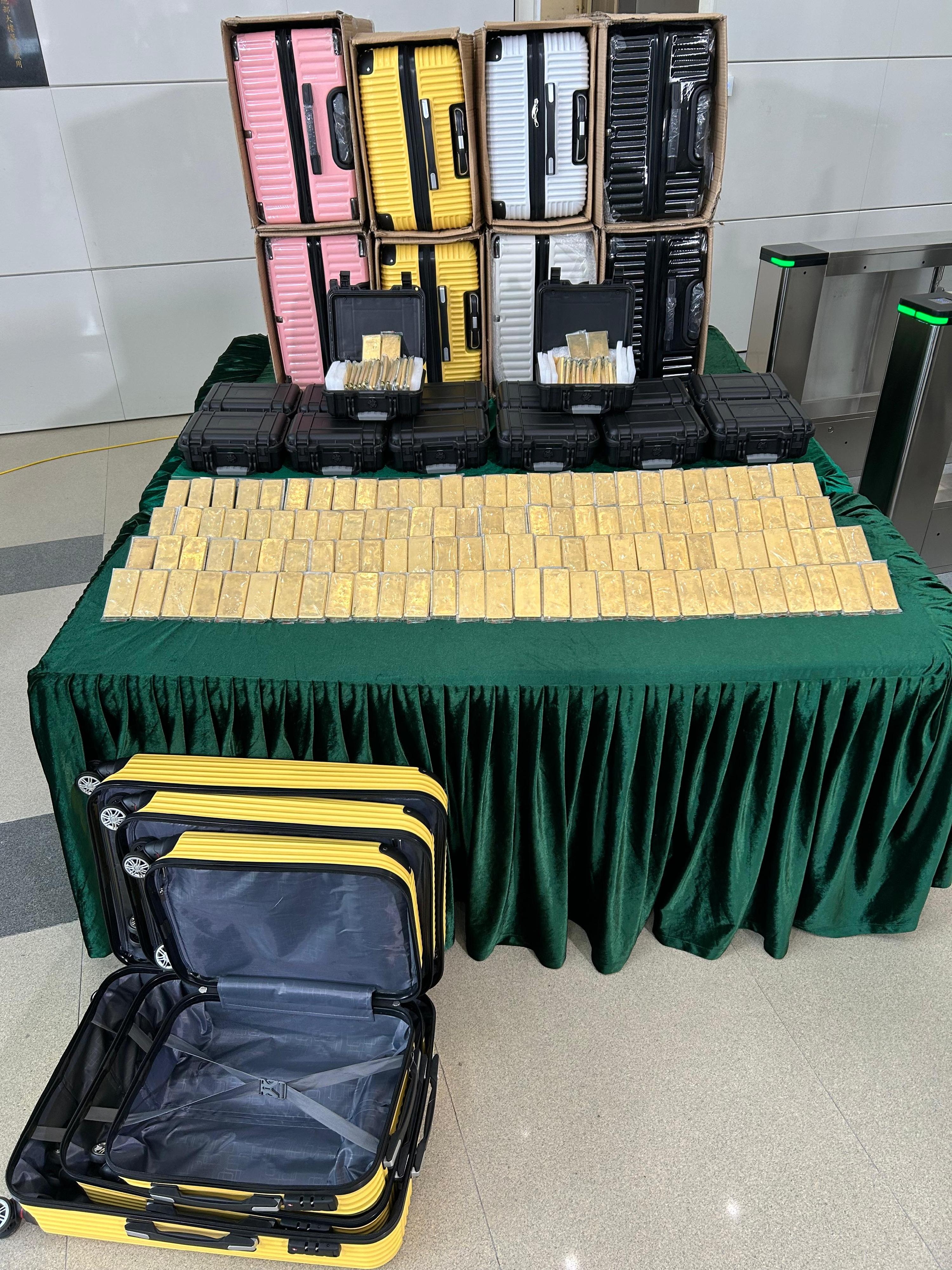


Hong Kong Customs detects suspected gold bullion smuggling case by air worth about $110 million (with photo)

     Hong Kong Customs on March 25 detected a suspected air freight gold bullion smuggling case, and seized about 145 kilograms of suspected gold bullion with an estimated market value of about $110 million, at Hong Kong International Airport (HKIA). This is the largest gold bullion smuggling case detected by Customs on record in terms of the seizure volume and market value.

     Based on risk assessment, Customs on that day examined an outbound air cargo consignment, declared as carrying plastic luggage departing for Japan, at the Customs Cargo Examination Compound at HKIA. Upon inspection, Customs officers found a batch of luggage in 14 carton boxes, and a total of about 145kg of suspected smuggled gold bullion concealed therein.

     An investigation is ongoing. The likelihood of arrests is not ruled out.

     Customs will continue to take stringent enforcement actions against all kinds of smuggling activities through risk assessment and intelligence analysis.

     Smuggling is a serious offence. Under the Import and Export Ordinance, any person found guilty of importing or exporting unmanifested cargo is liable to a maximum fine of $2 million and imprisonment for seven years.
     â€‹
     Members of the public may report any suspected smuggling activities to Customs' 24-hour hotline 182 8080 or its dedicated crime-reporting email account (crimereport@customs.gov.hk) or online form (eform.cefs.gov.hk/form/ced002/).

Photo