An exceptionally hot July

     With a stronger than usual subtropical ridge dominating over southern China for most of the time in the month, July 2024 was exceptionally hot in Hong Kong. The monthly mean minimum temperature of 28.0 degrees, monthly mean temperature of 29.9 degrees and monthly mean maximum temperature of 32.4 degrees were respectively 1.1 degrees, 1.0 degrees and 0.8 degrees above their normals and respectively one of the third, the fourth and one of the ninth highest on record for July. The monthly rainfall was 458.5 millimetres, about 19 per cent above the normal of 385.8 millimetres. The accumulated rainfall recorded in the first seven months of the year was 1 321.9 millimetres, about 10 per cent below the normal figure of 1 468.2 millimetres for the same period.
 
     Under the influence of a southwesterly airstream, there were sunny intervals and a few showers in Hong Kong on the first two days of the month. With the dominance of the subtropical ridge, apart from a few showers and isolated thunderstorms, there was a spell of generally fine and very hot weather in Hong Kong from July 3 to 11. The daily mean temperature of 30.8 degrees and daily minimum temperature of 29.2 degrees on July 6 were both the highest on record for Moderate Heat. Moreover, the daily maximum temperature of 34.0 degrees on the same day was one of the highest on record for Moderate Heat. With plenty of sunshine, the temperature at the Observatory rose to a maximum of 34.8 degrees on the afternoon of July 7, the highest of the month. Furthermore, it was extremely hot on the afternoons of July 7 and 10, with maximum temperatures reaching 35 degrees or above in many places. With the slight weakening of the subtropical ridge, there were generally more showers from July 12 to 14. Despite the extremely hot weather on July 14, heavy showers and squally thunderstorms affected Hong Kong that evening. Over 50 millimetres of rainfall were recorded over Kwai Tsing and parts of Kowloon and Hong Kong Island.
 
     Under the influence of a broad trough of low pressure over the South China Sea, local weather was a mixture of sunny intervals, showers and squally thunderstorms from July 15 to 19. More than 70 millimetres of rainfall were generally recorded over most parts of the territory, and rainfall even exceeded 140 millimetres over Sha Tin, Wong Tai Sin and Kowloon City Districts on these five days. Under the rain, the temperature at the Observatory dropped to a minimum of 26.0 degrees on July 16, the lowest of the month. While Hong Kong was still affected by a few showers and isolated thunderstorms on July 20, the weather improved, with very hot weather and sunny intervals under the influence of the subtropical ridge.
 
     Meanwhile, the Inter-tropical Convergence Zone to the south of the subtropical ridge became active and favoured the formation of tropical cyclones. An area of low pressure over the central part of the South China Sea intensified into a tropical depression on the afternoon of July 19 and tracked west-northwestwards towards Hainan Island. The tropical depression intensified into a tropical storm and was named Prapiroon on the morning of July 21. Prapiroon further intensified and moved across Hainan Island and Beibu Wan July 21 and 22. It then moved into the inland areas of the northern part of Vietnam and progressively weakened into an area of low pressure on July 23. The outer rainbands of Prapiroon brought a few squally showers and thunderstorms to Hong Kong on July 21. With Prapiroon departing from Hong Kong, it was very hot with sunny periods during the day on July 22.
 
     Moreover, another area of low pressure over the seas east of the Philippines intensified into a tropical depression on July 19. It intensified into a tropical storm and was named Gaemi on July 20. Gaemi progressively intensified into a super typhoon during the next four days and headed towards Taiwan. Moving generally northwestwards, Gaemi swept across Taiwan and then Fujian on July 25. It then moved into the inland areas of eastern China and central China, and weakened into an area of low pressure over Hubei on July 28. Under the influence of the outer subsiding air of Gaemi, local weather was very hot with sunny periods from July 23 to 25. The daily minimum temperatures of 29.1 degrees and 29.7 degrees at Ta Kwu Ling and Sheung Shui respectively on July 25 were the highest on record for those stations. Affected by an active southwest monsoon over the South China Sea, local winds strengthened later on July 25 and at first on July 26. As well, the thundery showers triggered by high temperatures affected Hong Kong on the early morning of July 26. More than 60 millimetres of rainfall were recorded over the northern part of the New Territories.
 
     Affected by an active southwest monsoon and the subsequent broad trough of low pressure over the northern part of the South China Sea, it was mainly cloudy with occasional heavy showers and squally thunderstorms from July 27 to 31. More than 150 millimetres of rainfall were generally recorded over most parts of the territory, and rainfall even exceeded 250 millimetres over parts of the eastern territory on these five days.
 
     Three tropical cyclones occurred over the South China Sea and the western North Pacific in July 2024.
 
     Details of issuance and cancellation of various warnings/signals in the month are summarised in Table 1. Monthly meteorological figures and departures from normal for July are tabulated in Table 2.



Land Registry releases statistics for July

     â€‹The Land Registry today (August 2) released its statistics for July 2024.
     
Land registration
——————-
* The number of sale and purchase agreements for all building units received for registration in July was 5 262 (+0.3 per cent compared with June 2024 and +18.9 per cent compared with July 2023)

* The 12-month moving average for July was 4 928 (1.4 per cent above the 12-month moving average for June 2024 but 3.1 per cent below that for July 2023)

* The total consideration for sale and purchase agreements of building units in July was $42.7 billion (+3.8 per cent compared with June 2024 and +29.4 per cent compared with July 2023)

* Among the sale and purchase agreements, 3 723 were for residential units (-3.4 per cent compared with June 2024 but +21.5 per cent compared with July 2023)

* The total consideration for sale and purchase agreements in respect of residential units was $35.7 billion (+3.4 per cent compared with June 2024 and +34.2 per cent compared with July 2023)

     Statistics on sales of residential units do not include sale and purchase agreements relating to sales of units under the Home Ownership Scheme, the Private Sector Participation Scheme, the Tenants Purchase Scheme, etc, unless the premium of the unit concerned has been paid after the sale restriction period.

     Figures on sale and purchase agreements received for the past 12 months, the year-on-year rate of change and breakdown figures on residential sales have also been released.

     As deeds may not be lodged with the Land Registry until up to 30 days after the transaction, these statistics generally relate to land transactions in the previous month.

Land search
————-
* The number of searches of land registers made by the public in July was 396 209 (+11.0 per cent compared with June 2024 but -9.4 per cent compared with July 2023)
     
     The statistics cover searches made at the counter, through the self-service terminals and via the Integrated Registration Information System Online Services.


Research findings of HKMoA’s New Horizons: Ways of Seeing Hong Kong Art in the 80s and 90s released

     The research findings of a Hong Kong Museum of Art (HKMoA) project in collaboration with guest curator Ms Janet Fong, titled New Horizons: Ways of Seeing Hong Kong Art in the 80s and 90s, have been uploaded onto the HKMoA's website hk.art.museum/en/web/ma/resources/hong-kong-art-research-portal/artists-and-research/research-projects/new-horizons.html for public access.
      
     The HKMoA launched this research project in 2019, focussing on eight artists and artist collectives who have strived to make creative breakthroughs in installation art, new media, photography and space, as well as exploring their representative artworks and art spaces, to delve into the development of contemporary art in Hong Kong during the 1980s and 1990s. Further to the exhibition held with the same name, the research team compiled the research findings after years of dedicated efforts, including seven video clips of artists' interviews, three archival fragment videos, six video recordings of the Art Talk Series, and a research project publication.
      
     The HKMoA is devoted to documenting and presenting the research and manifestation of Hong Kong art through study of the museum's collection and exhibition curation. In 2013, the HKMoA began the Hong Kong Art History Research Project, which is a collaboration with art professionals, experts, and scholars to study the ecology and evolution of art in Hong Kong to enrich the discourse on Hong Kong art. The project addressed topics such as "The development of art-making in Western media in Hong Kong from the early 1930s to the pre-1960s" and "Hong Kong's art ecology in the 1960s-70s", of which the research outcomes are continuously uploaded onto the Hong Kong Art Research Portal.
      
     The Hong Kong Art Research Portal is an online platform, established with the vision of providing access to digitised information and material about Hong Kong art. Currently, the HKMoA has initiated the project by sharing Hong Kong art-related material in its possession. This comprises lists of exhibitions, artists, publications, research projects and collection records, and includes links for downloading images, digitised texts, and audio and visual materials. The HKMoA has uploaded 10 research findings and donated artist materials, in approximately 280 files in the form of documents, audio, video and links onto the Hong Kong Art Research Portal: hk.art.museum/en/web/ma/resources/hong-kong-art-research-portal/artists-and-research/research-projects.html to share with the public these invaluable academic resources.


Appeal for information on missing woman in Wong Tai Sin (with photo)

     Police today (August 2) appealed to the public for information on a woman who went missing in Wong Tai Sin.

     Ng Yun-ki, aged 30, went missing after she left her residence in Tsz Ching Estate on June 4. Her family made a report to Police yesterday (August 1).

     She is about 1.6 metres tall, 55 kilograms in weight and of normal build. She has a square face with yellow complexion and long purple and blue hair.

     Anyone who knows the whereabouts of the missing woman or may have seen her is urged to contact the Regional Missing Persons Unit of Kowloon East on 3661 0331 or email to rmpu-ke-2@police.gov.hk, or contact any police station.

Photo  


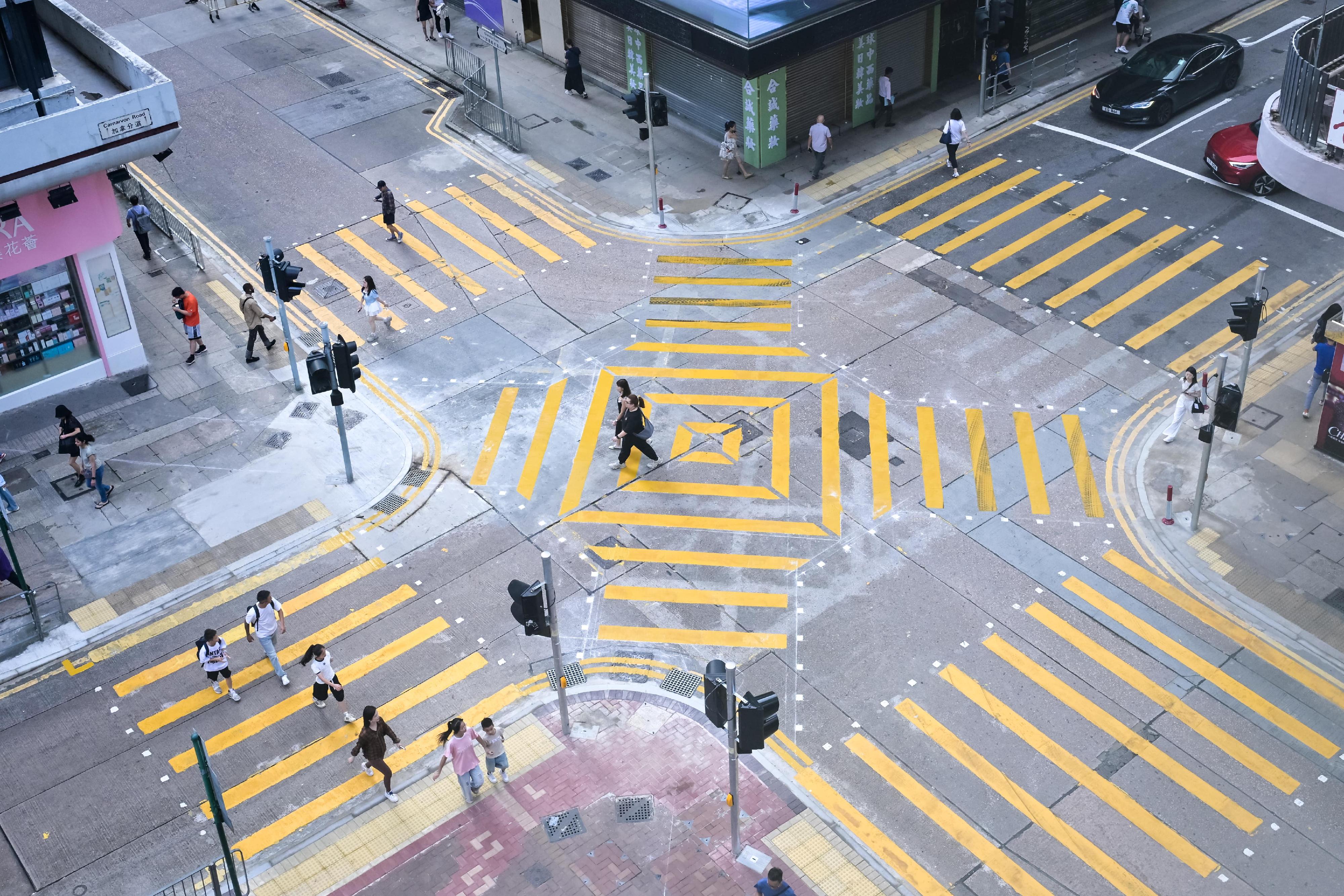
TD launches trial of diagonal crossings at junction of Carnarvon Road and Granville Road in Tsim Sha Tsui (with photo)

     The Transport Department (TD) announced that the works for diagonal crossings at the junction of Carnarvon Road and Granville Road in Tsim Sha Tsui have been completed, and the crossings are open for use today (August 2). This is the second trial location under the trial scheme for diagonal crossings, following the one at the junction of Sha Kok Street and Yat Tai Street in Sha Tin.
      
     The trial scheme provides additional pedestrian crossings through the centre of appropriate junctions to give pedestrians the option to take a diagonal route to cross the road directly to the footpath on the other side, shortening the walking distance and time required. As the traffic flow at junctions in Hong Kong is relatively heavy, the characteristics of individual junctions, including factors such as traffic and pedestrian flows, the crossing distance and time required, need to be carefully examined during the selection of suitable junctions for trial, to ensure that adequate vehicular capacity can still be maintained at signalised junctions after the provision of diagonal crossings to avoid causing serious impact on the overall traffic.
      
     The overall operation of the diagonal crossings at the trial in Sha Tin has been smooth to date. The TD will continue to carefully observe the operation of the two trial locations in Sha Tin and Tsim Sha Tsui, with a view to formulating a design standard for diagonal crossings suitable for the traffic conditions and pedestrians in Hong Kong.

Photo