Speech by CE at 1st Anniversary Ceremony of Hong Kong Ambassadors Club (English only)

     Following is the speech by the Chief Executive, Mr John Lee, at the 1st Anniversary Ceremony of Hong Kong Ambassadors Club today (September 10):

Mr Jeffrey Lam (Founder and Director of Hong Kong Ambassadors Club), Mr Patrick Tsang (Founder and Chairman of Hong Kong Ambassadors Club), Consuls-General, distinguished guests, ladies and gentlemen,

     Good afternoon. It gives me great pleasure to join you today, in celebration of the Hong Kong Ambassadors Club and its cheering first anniversary.

     The Club has a clear mission – "Hong Kong 3.0 – Prosperity Connected Globally", a mission that is visionary and, indeed, shared by the Hong Kong SAR Government's policy priorities.

     The Club brings together companies, entrepreneurs and investors to tell Hong Kong's good stories, and to seek partnerships in strategic markets near and far.

     In just its first year, the Club has been up and running – and running around the world, in fact. The Club has organised seven business delegations to the Middle East – to Dubai and Abu Dhabi in the United Arab Emirates, and to Saudi Arabia, Kuwait and Bahrain. 

     And I note, with delight, that the Club also plans to embrace the promise of ASEAN and the Southeast Asia in general. Your focus in these burgeoning markets is key to our work in boosting friendly ties with the regions.

     The Middle East, of course, is an important partner for our country, and a key link in the Belt and Road Initiative. In May, at the opening ceremony of the Ministerial Conference of the China-Arab States Cooperation Forum, President Xi Jinping emphasised China's keen interest in working with its Middle East partners through five co-operation frameworks: innovation, investment and finance, energy, economic and trade ties, and people-to-people exchanges.

     Meanwhile, the Mainland and ASEAN have been each other's largest trading partners for four consecutive years, to the end of 2023.

     The Hong Kong SAR Government, as you know, has also put a central priority on wide-ranging co-operation with the Middle East and ASEAN.

     Our efforts have proved rewarding, for all concerned. Last year, bilateral trade in goods between Hong Kong and the Middle East totalled US$26.6 billion. Over the past five years, our trade has grown 9.5 per cent per year, on average.

     As for ASEAN, its 10 countries, collectively, have been our second-largest trading partner since 2010. Last year, total trade between us reached US$145 billion, accounting for nearly 13 per cent of our global trade.

     Those good numbers between Hong Kong and the Middle East, and Hong Kong and ASEAN, underline Hong Kong's critical role as a bridge between the Mainland and developing markets around the world.

     To boost that vital role, and our soaring prospects, I led high-level business delegations to the Middle East, in February last year, and to ASEAN in July last year and again this past July.

     Over 100 MOUs and related agreements were signed during those trips. They will enable further co-operation in such sectors as trade, investment, customs, education, logistics, tourism, technology, aviation and finance.

     We are, as well, in negotiations with Saudi Arabia on an Investment Promotion and Protection Agreement. We have signed such Agreements with three of the six countries in the Gulf Cooperation Council: Kuwait, the United Arab Emirates and Bahrain. The well-received agreements have created confidence among our respective businesses and investors.
     
     Following the opening of an Economic and Trade Office in Dubai, nearly three years ago now, we are planning to set up an office in Riyadh, Saudi Arabia's capital. It will help us better serve the region, as well as Hong Kong businesses looking to explore the Middle East market.

     As for ASEAN, our Free Trade Agreement (FTA) and related Investment Agreement entered into full force in 2021, to wide-ranging mutual benefit.

     The FTA's Economic and Technical Cooperation Work Programme, let me add, has allowed us to share best practices for regional growth, promoting people-to-people connections between Hong Kong and ASEAN.

     And I'm pleased to say that we plan to open a fourth Economic and Trade Office in the ASEAN region, in the Malaysian capital of Kuala Lumpur.

     Our country and the 10 member states of ASEAN are all founding members of RCEP – the Regional Comprehensive Economic Partnership, the world's largest free trade agreement.

     All 15 RCEP members are major trading partners for Hong Kong. Together, they accounted for some 70 per cent of our merchandise trade last year, and 48 per cent of our services trade in 2022. So the answer is yes, ladies and gentlemen: Hong Kong is ready, fully prepared and eager to join RCEP.

     Our accession promises wide-ranging benefits, for ASEAN, for all RCEP members and, I'm confident, for Hong Kong. I count on the Hong Kong Ambassadors Club's continuous support of our RCEP accession, and in telling your overseas counterparts about our commitment to multilateralism and regional trade development.

     I'm pleased to add that the ninth Belt and Road Summit opens tomorrow morning, under the theme "Building a Connected, Innovative and Green Belt and Road". 

     The two-day event will bring together some 6 000 senior government officials, business leaders and professionals from Belt and Road countries around the world. That includes those from the Middle East and ASEAN. I invite you all to join us there. To help build a mutually inclusive and rewarding future for all of us.

     My congratulations, once again, to the Hong Kong Ambassadors Club on your first anniversary. I am grateful for your commitment to creating wide-ranging communication and collaboration between Hong Kong and other economies around the world.

     I wish the Club and its members the best of business in the year to come.

     Thank you.
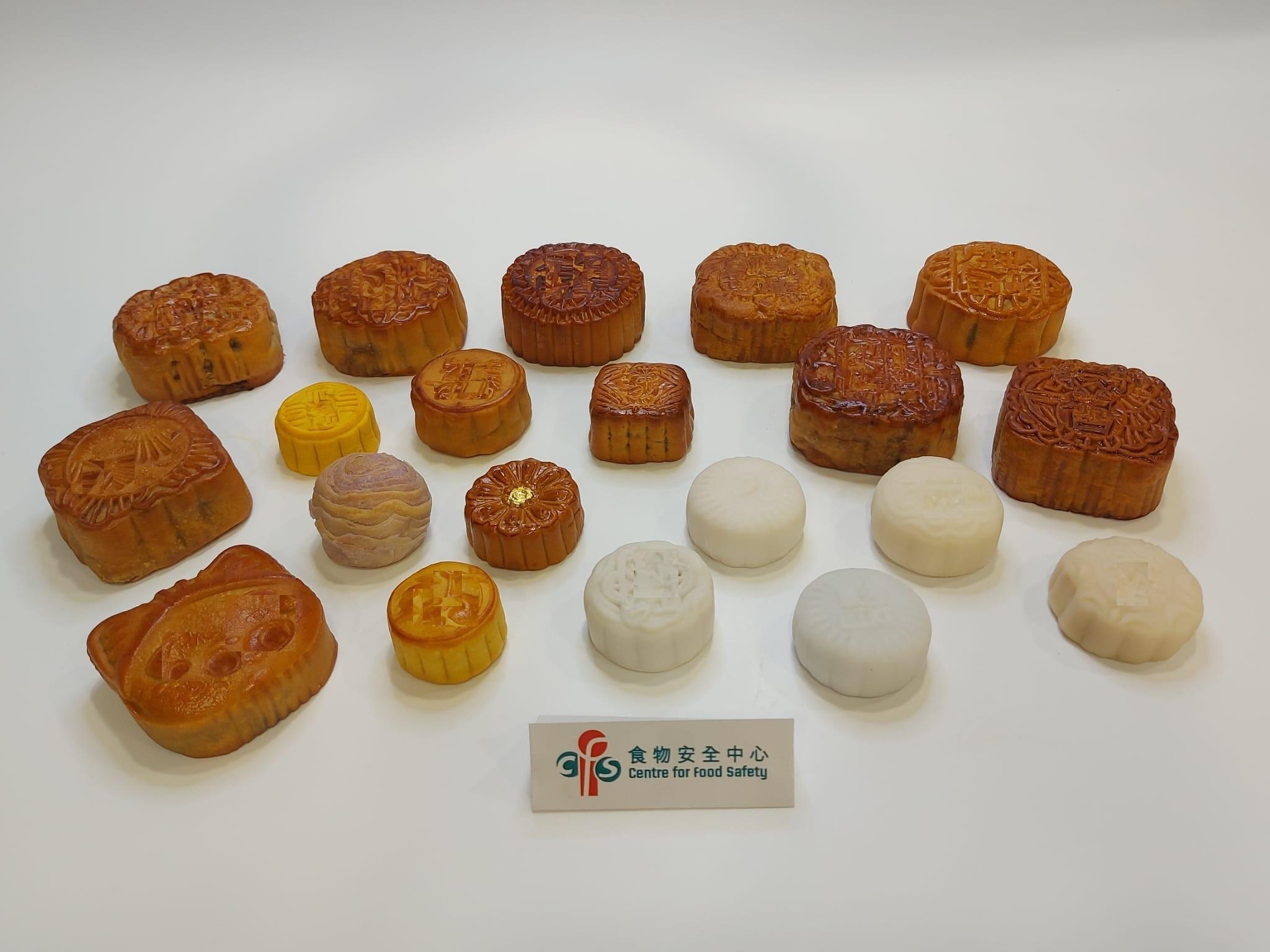


Test results of seasonal food surveillance project on mooncakes (second phase) all satisfactory (with photo)

     â€‹The Centre for Food Safety (CFS) of the Food and Environmental Hygiene Department today (September 10) announced the results of a seasonal food surveillance project on mooncakes (second phase). The results of 186 samples tested were all satisfactory. In summary, all testing results for mooncakes in this project have met the testing standards. 
 
     A spokesman for the CFS said that the first-phase test results on mooncakes had been released earlier. In the second-phase surveillance, the CFS continued to collect samples covering traditional, snowy, ice-cream and other types of mooncakes from various retailers (including online retailers) and food factories for chemical and microbiological tests, and nutrition content analysis.
 
     Chemical tests covered preservatives, antioxidants and mineral oil. Microbiological tests covered various pathogens and hygiene indicators. For nutrition content analyses (covering the contents of energy, protein, total fat, saturated fatty acids, trans fatty acids, carbohydrates, sodium and sugars), the samples were tested to see if they complied with the food labelling requirements.
 
     The spokesman reminded members of the public to maintain a balanced diet and avoid excessive consumption of mooncakes as they are generally high in sugar and fat. Some types of mooncakes also contain relatively high levels of salt. Eating too much fat will increase the risk of being overweight and obese, while dietary sugar intake is a determinant of body weight and dental caries. In addition, excessive sodium intake will increase the risk of developing hypertension, fatal stroke and coronary heart disease.
 
     He advised people to refer to nutrition labels of mooncakes, particularly on the sugar, salt and fat contents, to make a healthier choice. People should avoid choosing mooncakes with high levels of fat or sugar, i.e. containing more than 20 grams of total fat or more than 15g of sugar per 100g of food. As for reducing salt intake, people can choose low-sodium mooncakes, i.e. containing no more than 120 milligrams of sodium per 100g of food.
 
     The spokesman said that people should consider their health conditions and consume mooncakes in an appropriate amount during the Mid-Autumn Festival. He advised people to share mooncakes with their family members and friends, as this not only enhances the festive atmosphere, but also allows them to taste mooncakes of different flavours and avoid overconsumption.
 
     Members of the public should heed the following points in the purchase, storage and consumption of mooncakes to prevent food-borne diseases:
 
*Buy mooncakes from reliable outlets rather than patronising unlicensed hawkers. Check whether the mooncakes are properly packaged, pay attention to the expiry dates before purchase and eat them before the expiry dates;
 
*Store mooncakes according to the instructions on the package if they are not to be consumed immediately. Keep snowy mooncakes at 4 degrees Celsius or below, and ice-cream mooncakes at minus 18 degrees C or below, and consume them as soon as possible after taking them out from the refrigerator;
 
*Use an icebox to carry snowy or ice-cream mooncakes outdoors and consume them as soon as possible;
 
*Wrap mooncakes properly and separate them from raw food when storing in a refrigerator to prevent cross-contamination; and
 
*Maintain good personal hygiene. Wash hands properly with liquid soap and running water before handling and consuming mooncakes.
 
     The spokesman also reminded food traders to adhere to the Good Hygiene Practices. Apart from purchasing food ingredients from reliable suppliers, they should also comply with legal requirements when using food additives.
 
     "Snowy and ice-cream mooncakes, which do not undergo a baking process at high temperature, need to be handled hygienically during processing, transportation and storage to avoid contamination and growth of germs," he said.

Photo  


Government launches new batch of Silver Bond

     The Government announced today (September 10) the launch of a new batch of Silver Bond for subscription by eligible Hong Kong residents. 
 
     The target issuance size of the Silver Bond is HK$50 billion, with each unit offered at HK$10,000 and a tenor of three years. Interest will be paid semi-annually at a rate linked to inflation in Hong Kong, subject to a minimum of 4 per cent. Hong Kong residents who turn 60 in or before 2025 (i.e. those born in 1965 or before) holding a valid Hong Kong identity card will be eligible for subscription. 
 
     The bonds are the retail part of the Infrastructure Bond Programme. Proceeds will be credited to the Capital Works Reserve Fund for investment in infrastructure projects in accordance with the Programme framework. The Government will publish information on the allocation of the proceeds on an annual basis.
 
     The Financial Secretary, Mr Paul Chan, said, "The Hong Kong Special Administrative Region Government continues to issue Silver Bond this year to provide a safe, reliable and low-risk investment option with steady returns for senior citizens, while driving the financial industry to tap into the immense potential of the silver market. This batch of Silver Bond is also issued under the Infrastructure Bond Programme, which will support infrastructure projects for the good of the economy and people's livelihood, and provide our citizens with a 'sense of participation' and a 'sense of gain' in support of Hong Kong's long-term development projects."
 
     The Financial Secretary announced in the 2024-25 Budget that the Government will continue to issue HK$50 billion worth of Silver Bond this year. Subject to market response, the Government may exercise discretion to increase the issuance size to a maximum of HK$55 billion from the original HK$50 billion target.
 
     There will be no secondary market for Silver Bond. Bondholders may sell their bonds before maturity to the Government at par together with accrued but unpaid interest. To encourage greater participation from citizens, a maximum allocation of HK$1 million per investor will be stipulated, meaning that each investor will be allocated 100 units of retail bonds at most.
 
     The subscription period of the Silver Bond will start from 9am on September 30 and end at 2pm on October 14. The bonds will be issued on October 23. Eligible Hong Kong residents may apply for the bonds through one of the placing banks and designated securities brokers. The offering terms and subscription arrangements of the Silver Bond, including the list of placing banks and designated securities brokers, as well as details of the Infrastructure Bond Programme, will be available on the Hong Kong Government Bonds website (www.hkgb.gov.hk).


EDB announces Study Subsidy Scheme for Designated Professions/Sectors for 2025/26 cohort – undergraduate programmes

     The Education Bureau (EDB) announced today (September 10) that the Study Subsidy Scheme for Designated Professions/Sectors (SSSDP) will subsidise a total of 4 916 places in 55 undergraduate programmes, covering 3 365 places in 55 first-year-first-degree (FYFD) programmes and 1 551 places in 44 top-up degree (TUD) programmes of eight post-secondary institutions for the cohort to be admitted in the 2025/26 academic year. 
 
     The programmes of the SSSDP fall under 10 disciplines that have been identified as having keen manpower demand, namely architecture and engineering, computer science, creative industries, financial technology, healthcare, insurance, logistics, sports and recreation, testing and certification, and tourism and hospitality. The programmes include the eight applied degrees introduced under the Pilot Project on the Development of Applied Degree Programmes, which will receive additional subsidies, with a view to further strengthening the vocational and professional education and training progression pathway at the post-secondary level. 
 
     The programmes and numbers of subsidised places under the SSSDP are determined by the EDB in consultation with relevant policy bureaux and departments. Details of the participating institutions, the programmes and the numbers of subsidised places are listed in the Annex. The EDB will continue to work together with relevant policy bureaux and departments to explore covering more suitable programmes in the SSSDP.
 
     The annual subsidy amount for laboratory-based programmes in the 2025/26 academic year will be increased from $79,770 in the 2024/25 academic year to $81,450, while that for non-laboratory-based programmes will be increased from $45,810 to $46,780 in accordance with the movement of the Composite Consumer Price Index. For applied degree programmes, with the additional annual subsidies, the total annual subsidy amounts will be adjusted upward from $87,770 to $89,620 for laboratory-based applied degree programmes and from $50,810 to $51,880 for non-laboratory-based applied degree programmes.
 
     The adjusted subsidy amounts are applicable to both new and continuing eligible students. The subsidy is tenable for the normal duration of the programmes concerned. Subsidised students will pay a tuition fee with the subsidy applied. Students in need may still apply for student financial assistance from the Student Finance Office of the Working Family and Student Financial Assistance Agency in respect of the actual amount of tuition fee payable.
 
     The subsidised FYFD intake places are allocated mainly through the Joint University Programmes Admissions System to ensure that eligible students are selected on a merit basis, whereas the subsidised places of the TUD programmes are allocated in accordance with the existing admission arrangements of the self-financing TUD programmes, i.e. through direct admission by institutions. Students can apply for admission to the programmes directly through the institutions concerned.
 
     The SSSDP was launched in the 2015/16 academic year to subsidise students to pursue designated full-time locally accredited self-financing undergraduate programmes in selected disciplines. The objectives are as follows:
 
(1) To increase the supply of subsidised undergraduate places by leveraging the supply of the self-financing post-secondary education sector;
 
(2) To nurture talent in support of specific industries with keen demand for human resources;
 
(3) To encourage the self-financing post-secondary education sector to offer programmes in selected disciplines that meet Hong Kong's social and economic needs by providing targeted financial support; and
 
(4) To support the healthy and sustainable development of the self-financing post-secondary education sector to complement the University Grants Committee-funded sector in broadening and diversifying study opportunities.
 
     The SSSDP has been expanded to include TUD programmes with effect from the 2023/24 academic year. As for the designated sub-degree programmes, the relevant details for the 2025/26 cohort, including the participating institutions, the sub-degree programmes, the numbers of subsidised places and the subsidy amounts, will be announced in due course. 
 
     Details of the SSSDP are available on the EDB website (www.cspe.edu.hk/sssdp).


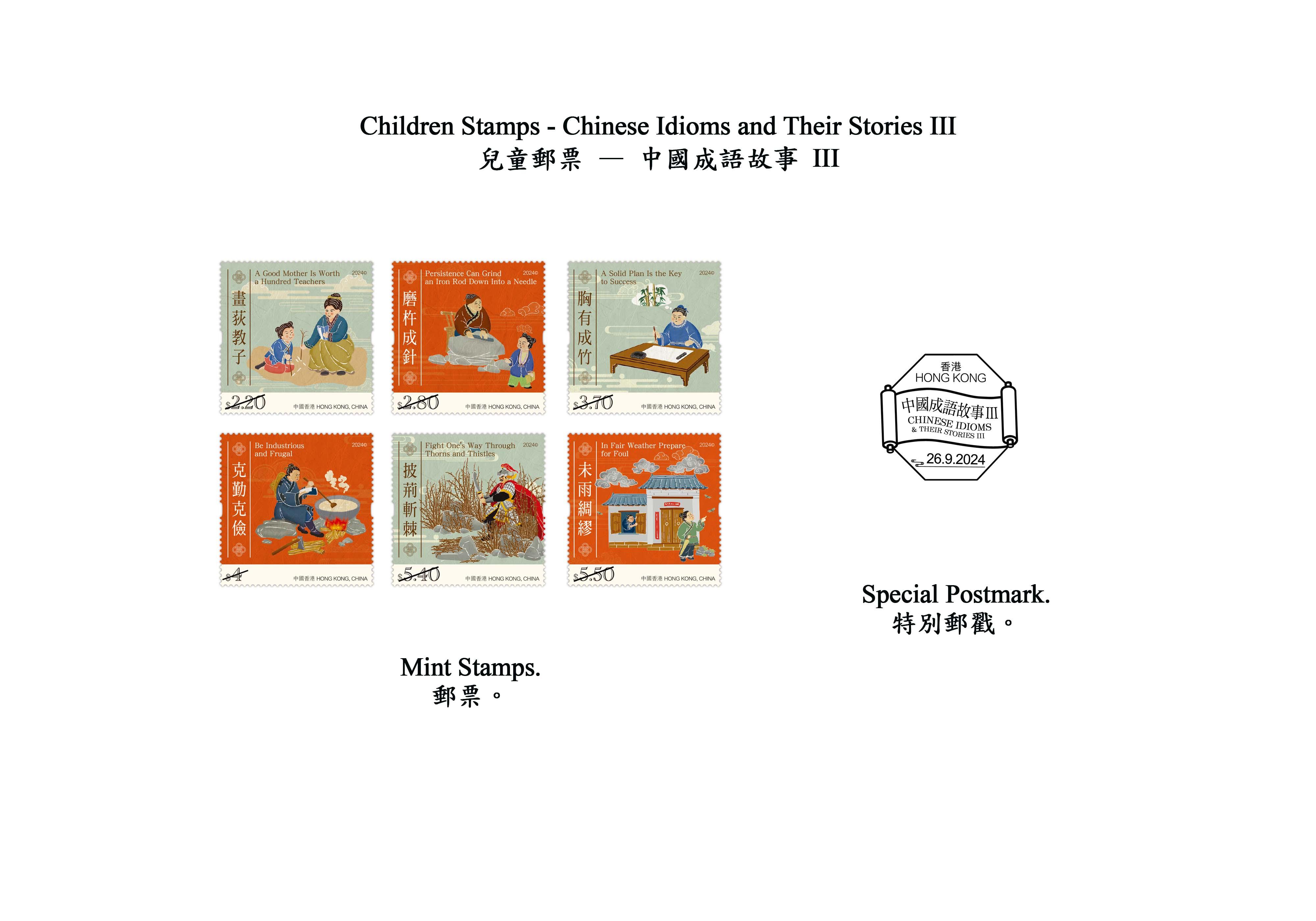
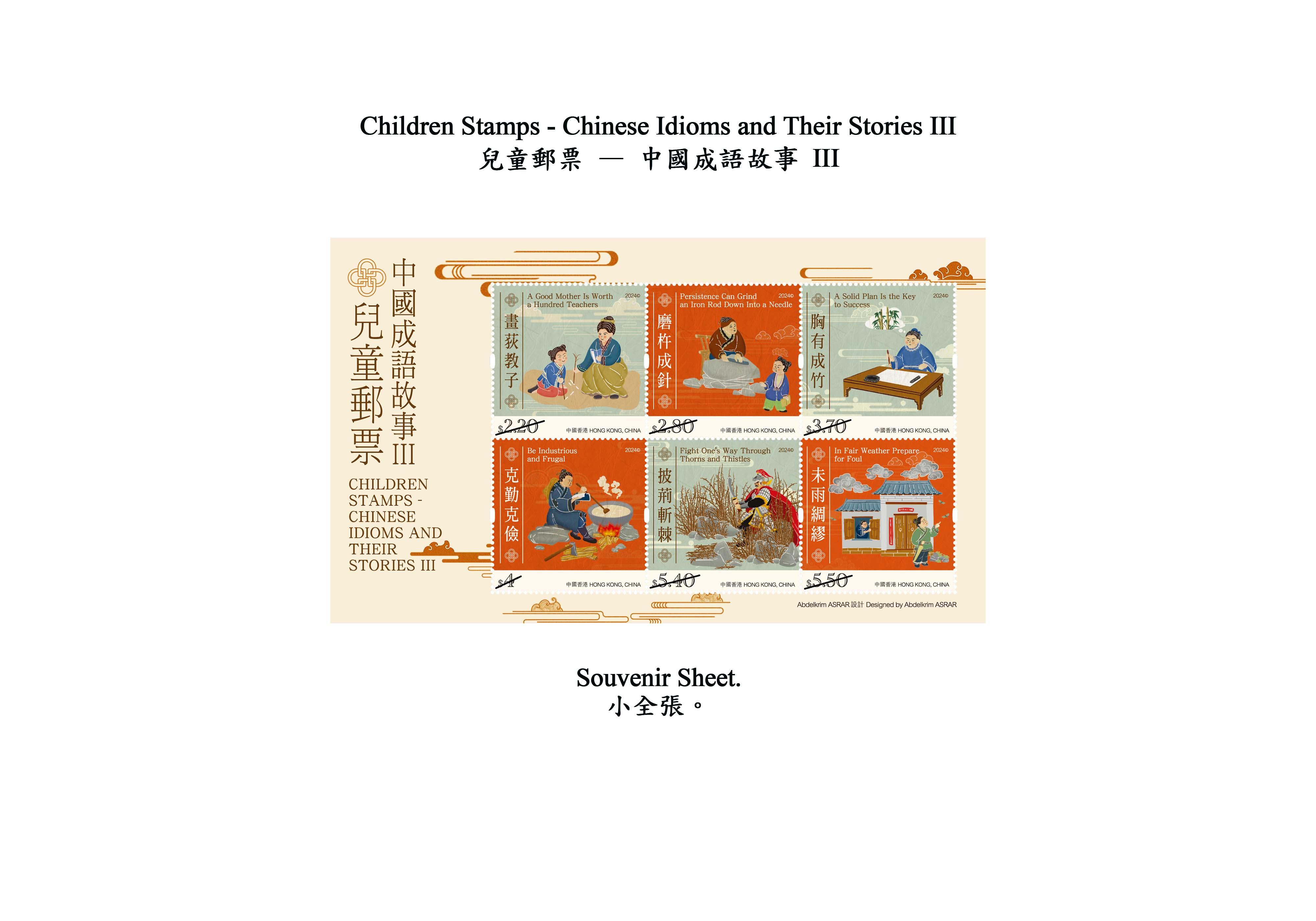
Hongkong Post to issue “Children Stamps – Chinese Idioms and Their Stories III” special stamps (with photos)

     â€‹Hongkong Post announced today (September 10) that a special stamp issue and associated philatelic products on the theme of "Children Stamps – Chinese Idioms and Their Stories III" will be released for sale on September 26 (Thursday).
 
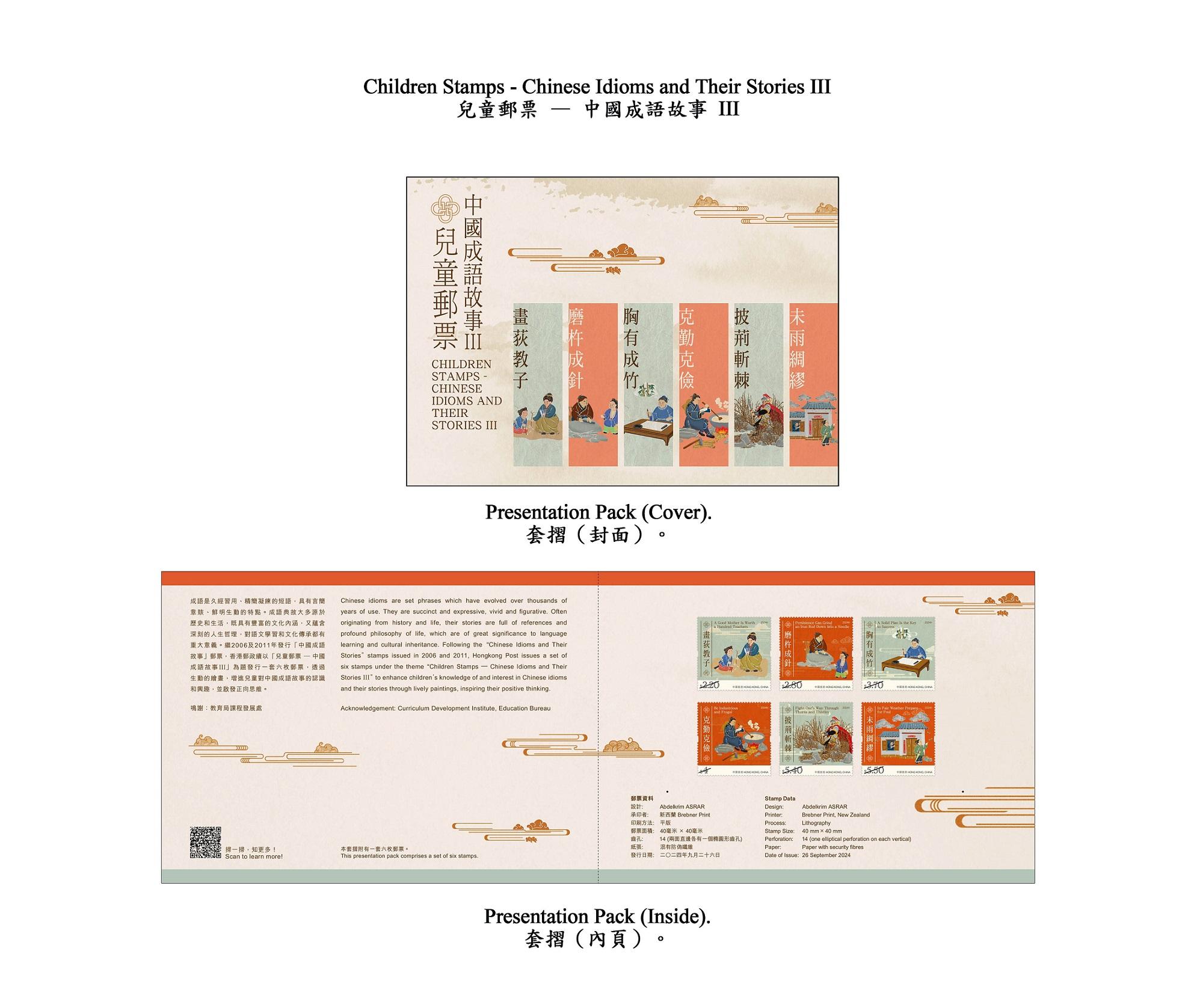
     Chinese idioms are set phrases which have evolved over thousands of years of use. They are succinct and expressive, vivid and figurative. Often originating from history and life, their stories are full of cultural connotations and profound philosophies of life, which are of great significance to language learning and cultural inheritance.
 
     Following the "Chinese Idioms and Their Stories" stamps issued in 2006 and 2011, Hongkong Post will issue a set of six stamps and associated philatelic products under the theme of "Children Stamps – Chinese Idioms and Their Stories III" to enhance children's knowledge of and interest in Chinese idioms and their stories through lively paintings, inspiring their positive thinking.
 
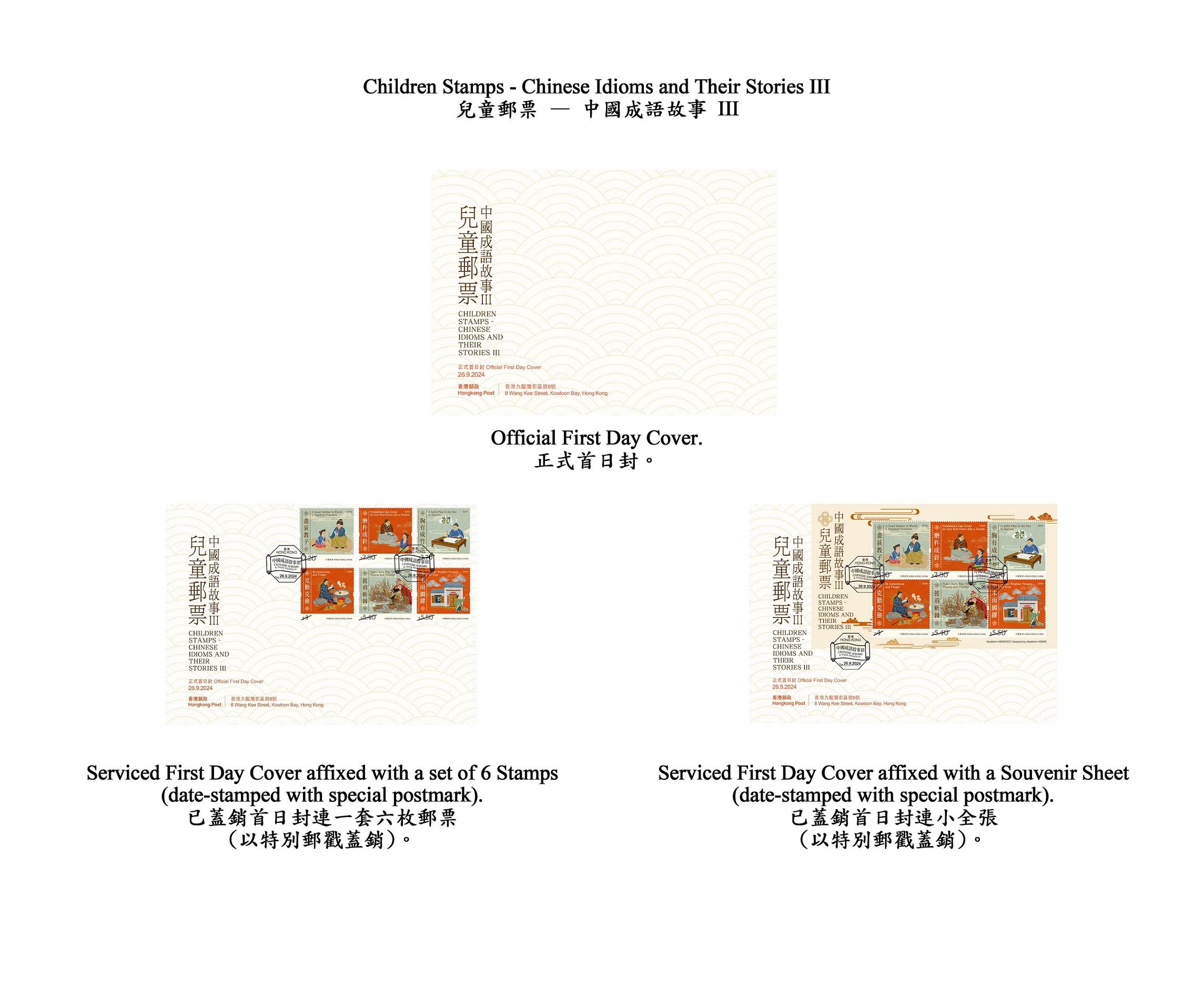
     Official first day covers for "Children Stamps – Chinese Idioms and Their Stories III" will be on sale at all post offices and on Hongkong Post's online shopping mall ShopThruPost (shopthrupost.hongkongpost.hk) from September 11 (Wednesday). This set of special stamps and associated philatelic products will be on sale at all post offices and on ShopThruPost from September 26, while serviced first day covers affixed with the special stamps will be available at philatelic offices only.
 
     A hand-back date-stamping service will be provided on September 26 at all post offices for official first day covers/souvenir covers/privately made covers bearing the first day of issue indication and a local address.
      
     Information about this set of special stamps and associated philatelic products is available on the Hongkong Post Stamps website (stamps.hongkongpost.hk).

Photo  Photo  Photo  Photo