Volume and price statistics of external merchandise trade in July 2024

     Further to the external merchandise trade statistics in value terms for July 2024 released earlier on, the Census and Statistics Department (C&SD) released today (September 16) the volume and price statistics of external merchandise trade for that month.
 
     In July 2024, the volume of Hong Kong's total exports of goods and imports of goods increased by 8.7% and 6.5% respectively over July 2023.
 
     Comparing the first seven months of 2024 with the same period in 2023, the volume of Hong Kong's total exports of goods and imports of goods increased by 7.8% and 4.1% respectively.
 
     Comparing the three-month period ending July 2024 with the preceding three months on a seasonally adjusted basis, the volume of total exports of goods and imports of goods increased by 0.6% and 2.0% respectively.
 
     Changes in volume of external merchandise trade are derived from changes in external merchandise trade value with the effect of price changes discounted.
 
     Comparing July 2024 with July 2023, the prices of total exports of goods and imports of goods increased by 3.9% and 2.8% respectively.
 
     As regards price changes in the first seven months of 2024 over the same period in 2023, the prices of total exports of goods and imports of goods increased by 4.1% and 3.7% respectively.
 
     Price changes in external merchandise trade are reflected by changes in unit value indices of external merchandise trade, which are compiled based on average unit values or, for certain commodities, specific price data.
 
     The terms of trade index is derived from the ratio of price index of total exports of goods to that of imports of goods. Compared with the same periods in 2023, the index increased by 1.0% in July 2024 and 0.4% in the first seven months of 2024.
 
     Changes in the unit value and volume of total exports of goods by main destination are shown in Table 1.
 
     Comparing July 2024 with July 2023, increases were recorded for the total export volume to Vietnam (20.4%), the mainland of China (the Mainland) (16.7%) and the USA (12.2%). On the other hand, the total export volume to Taiwan (-8.0%) and India (-27.6%) decreased.
 
     Over the same period of comparison, the total export prices to the USA (6.0%), the Mainland (5.3%), Taiwan (3.2%) and Vietnam (1.5%) increased. On the other hand, the total export prices to India decreased by 1.4%.
 
     Changes in the unit value and volume of imports of goods by main supplier are shown in Table 2.
 
     Comparing July 2024 with July 2023, increases were recorded for the import volume from Korea (27.3%), Taiwan (17.3%) and the Mainland (8.6%). On the other hand, the import volume from Singapore (-2.8%) and Japan (-5.7%) decreased.
 
     Over the same period of comparison, the import prices from all main suppliers increased: Singapore (5.2%), Korea (5.2%), the Mainland (3.0%), Taiwan (1.5%) and Japan (0.6%).
 
Further information
 
     Details of the above statistics are published in the July 2024 issue of "Hong Kong Merchandise Trade Index Numbers". Users can browse and download the report at the website of the C&SD (www.censtatd.gov.hk/en/EIndexbySubject.html?pcode=B1020006&scode=230).
 
     Enquiries on merchandise trade indices may be directed to the Trade Analysis Section of the C&SD (Tel: 2582 4918).


Hong Kong’s Gross National Income and external primary income flows for the second quarter of 2024

     The Census and Statistics Department (C&SD) released today (September 16) the preliminary statistics on Hong Kong's Gross National Income (GNI) and related figures for the second quarter of 2024.
 
     Hong Kong's GNI, which denotes the total income earned by Hong Kong residents from engaging in various economic activities, increased by 8.1% in the second quarter of 2024 over a year earlier to $847.5 billion at current market prices. The Gross Domestic Product (GDP), estimated at $757.3 billion at current market prices in the same quarter, recorded a 7.6% increase over a year earlier. The value of GNI was larger than GDP by $90.2 billion in the second quarter of 2024, which was equivalent to 11.9% of GDP in that quarter, mainly attributable to a net inflow of investment income.
 
     After netting out the effect of price changes over the same period, Hong Kong's GNI increased by 6.0% in real terms in the second quarter of 2024 over a year earlier. The corresponding GDP in the same quarter increased by 3.3% in real terms.
 
     Hong Kong's total inflow of primary income, which mainly comprises investment income, estimated at $596.2 billion in the second quarter of 2024 and equivalent to 78.7% of GDP in that quarter, recorded an increase of 1.9% over a year earlier. Meanwhile, total primary income outflow, estimated at $506.0 billion in the second quarter of 2024 and equivalent to 66.8% of GDP in that quarter, also increased by 0.1% over a year earlier.
 
     As for the major components of investment income inflow, direct investment income (DII) decreased by 5.0% from a year earlier, mainly due to the decrease in earnings of some prominent local enterprises from their direct investment abroad. Portfolio investment income (PII) recorded an increase of 6.5% over a year earlier, mainly attributable to the increase in interest income received by resident investors from their holdings of non-resident debt securities.
 
     Regarding the major components of investment income outflow, DII decreased by 3.5% from a year earlier, mainly due to the decrease in earnings of some prominent multinational enterprises from their direct investment in Hong Kong. PII decreased by 0.1%, mainly attributable to the decrease in interest payout to non-resident investors from their holdings of resident debt securities.
 
     Analysed by country/territory, the mainland of China continued to be the largest source of Hong Kong's total primary income inflow in the second quarter of 2024, accounting for 39.3%. This was followed by the British Virgin Islands (BVI), with a share of 16.6%. Regarding total primary income outflow, the mainland of China and the BVI remained the most important destinations in the second quarter of 2024, accounting for 37.5% and 19.6% respectively.
 
Further information
 
     GDP and GNI are closely related indicators for measuring economic performance. GDP is a measure of the total value of production of all resident producing units of an economy. GNI denotes the total income earned by residents of an economy from engaging in various economic activities, irrespective of whether the economic activities are carried out within the economic territory of the economy or outside.
 
     Figures of GNI and primary income flows analysed by income component from the third quarter of 2022 to the second quarter of 2024 are presented in Table A, while selected major country/territory breakdowns of primary income inflow and outflow for the same quarters are presented in Tables B(1) and B(2) respectively.
 
     Statistics on GDP and GNI from 2022 onwards and primary income flows from 2023 onwards are subject to revision when more data are incorporated.
 
     More detailed statistics are given in the report "Gross National Income and External Primary Income Flows, Second Quarter 2024". Users can browse and download this publication at the website of the C&SD (www.censtatd.gov.hk/en/EIndexbySubject.html?pcode=B1040005&scode=250).
 
     For enquiries about GNI and related statistics, please contact the Balance of Payments Branch (2) of the C&SD (Tel: 3903 7054 or email:gni@censtatd.gov.hk).


Hong Kong Customs seizes smuggled electronic goods worth about $500 million (with photos)

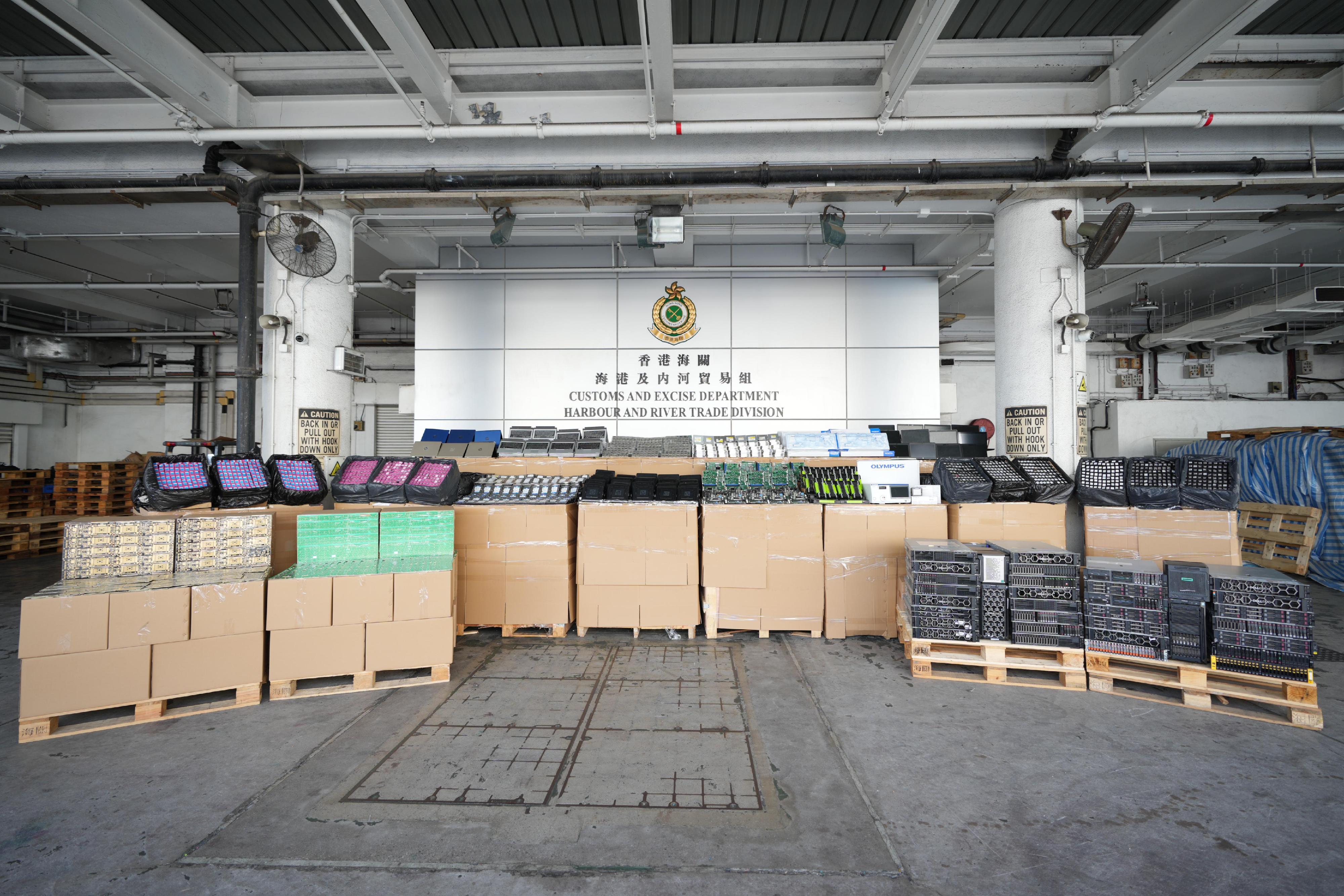
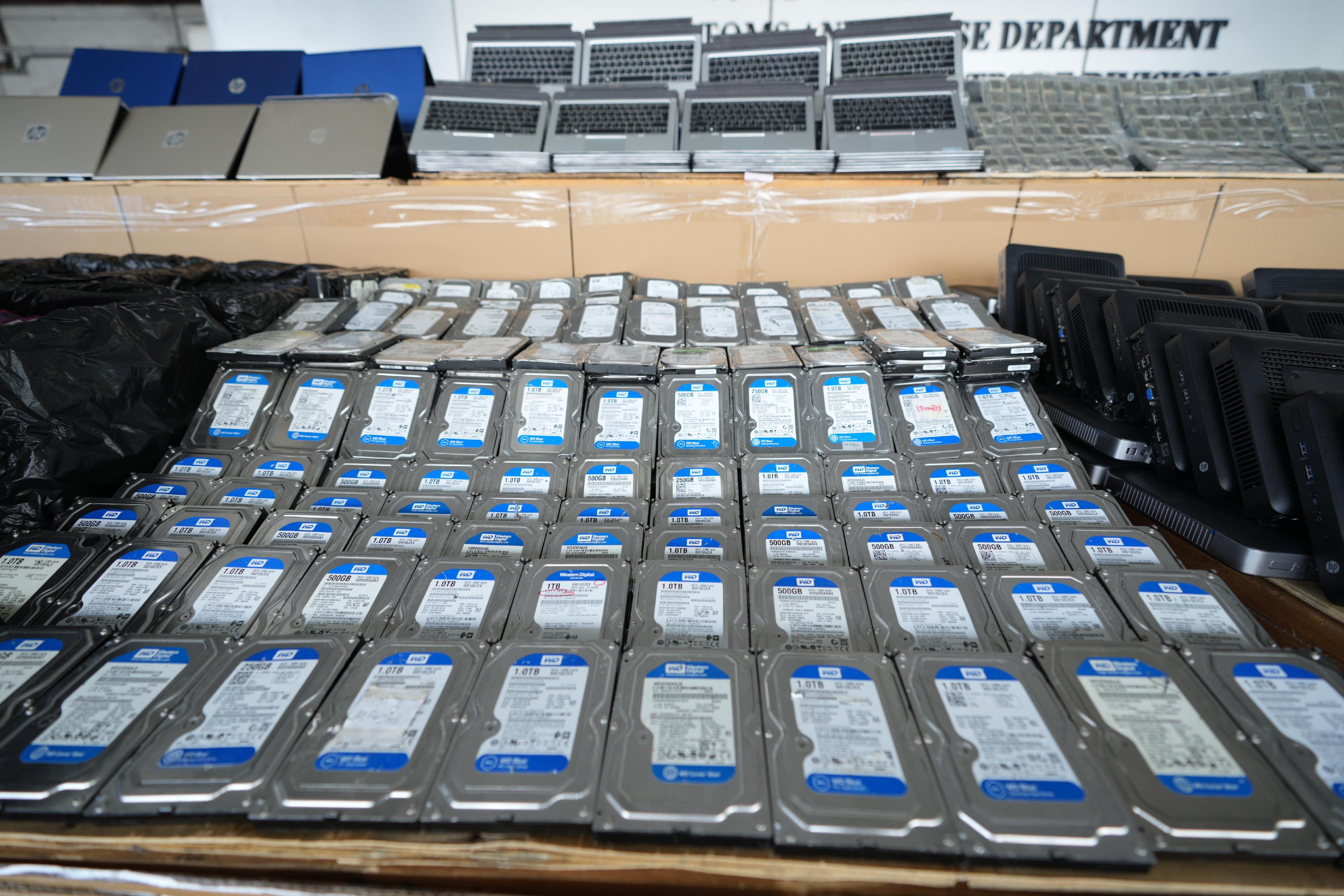
     Hong Kong Customs mounted a special operation codenamed "Sea Guardian" in August and September, with three suspected smuggling cases involving ocean-going vessels detected. A large batch of suspected smuggled electronic goods with a total estimated market value of about $500 million was seized.

     Through intelligence analysis and risk assessment, Customs, suspecting that criminals were using ocean-going vessels to smuggle goods, planned an enforcement operation and identified three suspicious containers scheduled to depart from Hong Kong for Malaysia, as well as a container scheduled to be shipped to Tianjin, via ocean-going vessels for inspection. 

     Customs inspected the four containers that were declared as carrying aluminium materials, aluminium alloys and citric acid respectively on August 20, September 3 and September 9. Upon the examinations, Customs officers found large batches of suspected smuggled electronic goods, including central processing units, display cards, circuit boards and random-access memory in the containers.

     An investigation is ongoing. The likelihood of arrests is not ruled out.

     Being a government department primarily responsible for tackling smuggling activities, Customs has long been combating various smuggling activities at the forefront. Customs will keep up its enforcement action and continue to strategically combat sea smuggling activities through proactive risk management and intelligence-based enforcement strategies, and carry out targeted anti-smuggling operations at suitable times to disrupt relevant crimes.

     Smuggling is a serious offence. Under the Import and Export Ordinance, any person found guilty of importing or exporting unmanifested cargo is liable to a maximum fine of $2 million and imprisonment for seven years upon conviction.

     Members of the public may report any suspected smuggling activities to Customs' 24-hour hotline 2545 6182 or its dedicated crime-reporting email account (crimereport@customs.gov.hk) or online form (eform.cefs.gov.hk/form/ced002).

Photo  Photo  Photo  


Effective Exchange Rate Index

     The effective exchange rate index for the Hong Kong dollar on Monday, September 16, 2024 is 103.5 (same as last Saturday's index).

     The effective exchange rate index for the Hong Kong dollar on Saturday, September 14, 2024 was 103.5 (down 0.1 against last Friday's index).


Inspection of aquatic products imported from Japan

     In response to the Japanese Government's plan to discharge nuclear-contaminated water at the Fukushima Nuclear Power Station, the Director of Food and Environmental Hygiene issued a Food Safety Order which prohibits all aquatic products, sea salt and seaweeds originating from the 10 metropolis/prefectures, namely Tokyo, Fukushima, Ibaraki, Miyagi, Chiba, Gunma, Tochigi, Niigata, Nagano and Saitama, from being imported into and supplied in Hong Kong.
 
     For other Japanese aquatic products, sea salt and seaweeds that are not prohibited from being imported into Hong Kong, the Centre for Food Safety (CFS) of the Food and Environmental Hygiene Department will conduct comprehensive radiological tests to verify that the radiation levels of these products do not exceed the guideline levels before they are allowed to be supplied in the market.
 
     As the discharge of nuclear-contaminated water is unprecedented and will continue for 30 years or more, the Government will closely monitor and step up the testing arrangements. Should anomalies be detected, the Government does not preclude further tightening the scope of the import ban.
 
     From noon on September 13 to noon today (September 16), the CFS conducted tests on the radiological levels of 345 food samples imported from Japan, which were of the "aquatic and related products, seaweeds and sea salt" category, in the past three days (including last Saturday and Sunday). No sample was found to have exceeded the safety limit. Details can be found on the CFS's thematic website titled "Control Measures on Foods Imported from Japan" (www.cfs.gov.hk/english/programme/programme_rafs/programme_rafs_fc_01_30_Nuclear_Event_and_Food_Safety.html).
 
     In parallel, the Agriculture, Fisheries and Conservation Department (AFCD) has also tested 150 samples of local catch for radiological levels. All the samples passed the tests. Details can be found on the AFCD's website (www.afcd.gov.hk/english/fisheries/Radiological_testing/Radiological_Test.html).
 
     The Hong Kong Observatory (HKO) has also enhanced the environmental monitoring of the local waters. No anomaly has been detected so far. For details, please refer to the HKO's website
(www.hko.gov.hk/en/radiation/monitoring/seawater.html).
 
     From August 24, 2023, to noon today, the CFS and the AFCD have conducted tests on the radiological levels of 84 401 samples of food imported from Japan (including 54 005 samples of aquatic and related products, seaweeds and sea salt) and 19 354 samples of local catch respectively. All the samples passed the tests.