China pledges enhanced livelihood for people in difficulties

Chinese government has pledged enhanced efforts to ensure the basic livelihoods for people in difficulties.

A circular issued by the General Office of the State Council and published on Thursday said the work to guarantee basic livelihoods for people in difficulties matters to fairness, morality and harmony in society, noting that there should be no decline or weakening in help.

The circular called for intensified efforts to identify people of such groups and streamline policies for assisting those affected by natural disasters.

The document said housing problems should be solved by the end of this year for those who were resettled in temporary residences last year due to floods and other disasters.

Also, program will be launched to help rural residents who are caught in difficulties by serious illnesses.

The assistance efforts for those who are in extreme need, disabled people, left-behind children, orphans and vagrants will also be strengthened, according to the circular.


China on alert against firework crime

Chinese police are on alert for firework crimes and violations.

A statement by the Ministry of Public Security on Thursday said that the ministry has ordered police nationwide to intensify checks of illegal production, sales, transport and storage of fireworks and firecrackers.

Chinese people traditionally set off fireworks and firecrackers during the Spring Festival, China’s lunar New Year.

The ministry statement said that police nationwide have dealt with 203 pyrotechnic cases since December and a total of 419 suspects have been taken into custody.

The statement also advised the public to reduce the use of fireworks for safety and environmental reasons.


Report: China’s sex ratio to balance out by 2030

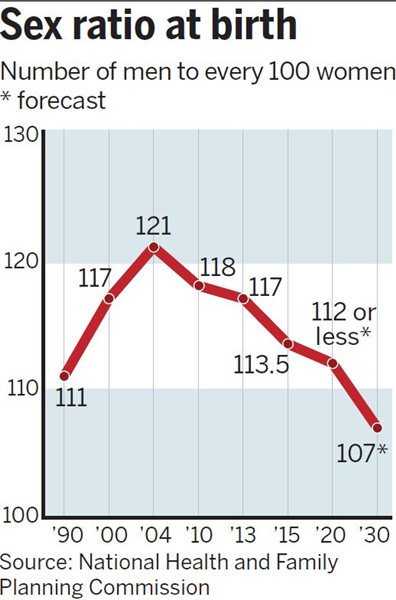
China’s sex ratio at birth will keep falling and eventually reach a balance within 15 years due to economic and social development and the relaxed family planning policy, the central government has predicted.

The ratio, which was 113.5 men to every 100 women in 2015, one of the highest in the world, is forecast to drop below 112 by 2020 and 107 by 2030, according to the National Population Development Outline released Wednesday by the State Council.

The normal range is between 103 and 107.

China’s sex ratio has been skewed by a traditional preference for boys. Population experts have estimated that the imbalance over the past 30 years has resulted in between 24 million and 34 million more men than women.

Wang Pei’an, vice-minister of the National Health and Family Planning Commission, has warned that the gender imbalance could result in serious social problems.

However, thanks to rising social awareness and government efforts, China’s sex ratio at birth has declined in recent years. A national guideline released this month said the authorities will continue to intensify the fight against fetus gender identification and sex-selective abortions.

Wednesday’s outline estimated that China will see its population peak at 1.45 billion around 2030.

To better monitor demographic changes, the country plans to establish a population forecast system based on censuses and samples surveys that will produce regular reports, the outline said.

It also said governments will continue to monitor the effect of the universal second-child policy as well as closely follow changes in the fertility rate to decide on possible adjustment to the family planning policy.

Yuan Xin, a professor of population studies at Nankai University in Tianjin, said the second-child policy will contribute to a lower sex ratio at birth because it will result in a higher fertility rate, but he added, “The family planning policy should be further relaxed so the ratio can be reduced to a balanced level.”

He agreed with predictions that the second-child policy will result in a peak in births in the next few years, but he warned the effect may decline gradually due to the reduced number of women of childbearing age.

About 90 million women became eligible to have another child when the second-child policy was introduced early last year. However, half were aged 40 or older, meaning they are less likely to give birth again, Yuan said.

“Adjustment to the policies should be based on consistent monitoring of the population. A scientific evaluation should be made,” the professor added.


China mulls pharmacy law on rational medicine use

China is working on a law that will help pharmacists properly prepare and allocate medicine. [Photo: xinhua]

China is working on a law that will help pharmacists properly prepare and allocate medicine, according to the country’s health authorities.

The top legislature has been working with other departments to carry out research into the law, and will solicit suggestions and opinions from various sectors, said Liang Wannian, a senior official with the National Health and Family Planning Commission.

According to Wang Hesheng, director of the medical reform office under the State Council, China’s cabinet, the average increase of medical fees in public hospitals will be kept under 10 percent this year.

Wang said that measures will be taken this year to address markups on drug costs by public hospitals and to improve the reimbursement system.


China punishes damage of cultural heritages

Chinese government has punished the acts of damaging important cultural heritages or revolutionary site in three cases.

The State Administration of Cultural Heritage on Thursday made public the cases, one of them involving the damage of more than 100 ancient tombs dating back to more than 1,500 years ago in central China’s Henan Province.

Another case in the same province involved illegal dismantling of some commercial and civil residence sites which could date back to the late Qing Dynasty. 

The third case was about dismantling of a site in Hubei where a negotiation between the Communist Party of China and Kuomintang took place.

The administration said in a statement that people responsible for the violations have either been held for further investigation or received due punishments.