Beijing, Tianjin plan monthly train pass

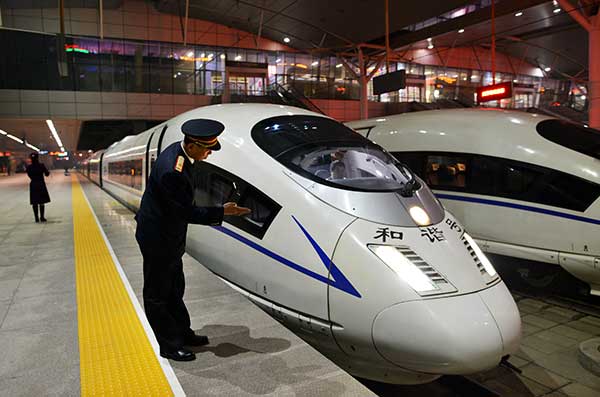
A driver checks a high-speed train before it heads from Tianjin to Beijing South Railway Station on Jan 25.[Photo/Xinhua]

Beijing and Tianjin are planning a monthly pass for high-speed intercity trains linking the cities, as well as canceling expressway toll fees between the two cities, the mayor of Tianjin said on Monday.

The move will facilitate the integrated development of Beijing, Tianjin and Hebei province, an outline given in 2015 to improve transportation links in the area, while also moving some of Beijing’s low-end industries to neighboring areas.

Wang Dongfeng, mayor of Tianjin, said the plan is to build a modern transportation system. He added that a unified smart prepaid traffic card, called Yikatong, already exists in 12 cities in the Beijing-Tianjin-Hebei region, and the government aims to expand its use to all cities in the area by the end of this year.

In addition to universal traffic cards and expressways, the proposal of a high-speed train network in the region was approved last year, with Beijing-Binhai New Area Intercity Railway expected to be completed by 2020.

The Beijing-Tianjin Intercity Railway was the first of its kind in China. Traveling at up to 350 kilometers per hour, passengers can commute between the cities in about 40 minutes on trains that depart every 10 to 15 minutes.

Officials from Tianjin’s transportation bureau said they are still deliberating the monthly pass mechanism and a timetable is not available.

Potential benefactors are eagerly awaiting the implementation of the planned policies.

“We are looking forward to having monthly train passes,” said Xiang Nan, the managing director of a Tianjin-based investment company that has offices in Beijing, downtown Tianjin and Binhai New Area of Tianjin. He has rented offices near the train stations to save time on commuting.

Xiang said that he and seven of his employees spend nearly 5,000 yuan ($730) every month on commuting. “We hope the monthly pass can help frequent passengers save money.”

In 2009, a prepaid express card was issued by railway authorities for Beijing-Tianjin intercity trains, offering exclusive entrance channels at stations so frequent travelers don’t have to buy tickets in advance or wait in line before boarding.

In 2012, the express card was upgraded into a debit card that also works on about 20 intercity rail transit lines nationwide.

However, in both cases, passengers still have to pay the full price for each trip-54.5 yuan from Beijing to downtown Tianjin.

“If expressway toll fees were lifted, it would save us a lot of money,” said Wang Rui, who drives between Tianjin, where she works, and Beijing, where she and her husband own a house.


More second-child assistance sought

A senior health official has called on governments at all levels to help relieve the burden on families wanting to have a second child.

Cui Li, vice-minister of the National Health and Family Planning Commission, said on Tuesday that an array of departments need to introduce measures to help resolve issues that have arisen with the introduction of the second-child policy in January 2016.

Health authorities have been rolling out policies nationwide since family planning rules were relaxed, including improvements to maternal care facilities.

However, Cui warned that families will need help from other government departments to handle some problems, including increased expenses, maternity leave and a shortage of kindergartens.

“We hope through the efforts of governments at all levels … some tangible policies can be made in areas such as taxation and social security to promote the implementation of the policy so that those who want to have a second child can realize their dream,” she said.

“We will focus on problems that emerge as a result of the policy and work to solve them with other departments,” she said, adding that the second-child policy has already yielded positive results.

Cui said 18.7 million babies were born in China last year, up by 11 percent on 2015, with 45 percent born to women who already had a child.

Over the same period, the maternal mortality rate fell from 201 per 1 million births to 199, according to data released by the commission last month, despite the fact half of the 90 million women who became eligible to have a second child are over 40-putting them at a higher risk of complications during pregnancy.

A report released in December by the All China Women’s Federation and Beijing Normal University also called for more investment in public services to make having two children easier and more affordable.

The report included a survey of 10,155 couples in 21 cities who already have a child that found 53 percent did not want a larger family. The biggest concerns were education resources, healthcare services, the environment and the financial burden.

Cui added that the commission has received a lot of advice from the National People’s Congress, the top legislature, and the Chinese People’s Political Consultative Conference, the top advisory body, on implementation of the second-child policy, including measures to improve pediatric services.

The commission received 1,512 suggestions on various healthcare issues from the two bodies last year, she said.

Xi Yanchun, a spokeswoman for the State Council Information Office, added that ministries and departments under the nation’s Cabinet responded to 7,873 suggestions from the NPC and 3,862 from the CPPCC last year.

They included economic development, poverty alleviation and environmental protection proposals, Xi said.


Progress on transplants puts nation in spotlight

A 10-year reform that has shaken off China’s dependence on executed inmates as the primary source for transplant organs has brought the country to the Vatican to share on the world stage its experience in combating organ commercialism.

Huang Jiefu, a former vice-minister of health and now director of the National Human Organ Donation and Transplant Committee, was invited by the Vatican’s Pontifical Academy of Science to speak about the “China model” of organ donation and transplant management at the two-day Summit on Organ Trafficking and Transplant Tourism that opened on Tuesday.

“This is the first time that China has been invited to a summit on organ transplanting held by an authoritative international organization,” Huang was quoted by the Global Times as saying on Monday. He could not be reached for comment on Tuesday.

Chen Jingyu, deputy director of Wuxi People’s Hospital in Jiangsu province and a leading lung transplant specialist, said such an invitation is “a New Year gift for us Chinese transplant surgeons who have been gradually recognized by international peers”.

In response to speculation on whether the invitation marks an improvement in China-Vatican relations, Foreign Ministry spokesman Lu Kang said on Tuesday at a regular media briefing that Huang’s participation “has nothing to do with the development of the bilateral relationship”.

China first performed a transplant in the 1970s, and Huang acknowledged in 2005 that a majority of the organs transplanted were harvested from executed prisoners.

To conform with international practice, China launched a public organ donation system and announced in 2015 that the use of organs from executed inmates had ceased.

By the end of last year, about 28,000 major organs such as livers, kidneys and lungs were harvested from nearly 10,000 donors who had died, according to data from the National Health and Family Planning Commission.

More than 140,000 people have registered under the organ donation system, according to the China Organ Transplantation Development Foundation, an organization under the commission.

“That demonstrates the great benevolence of the Chinese and an ever-increasing voluntarism,” Huang said earlier.

That helps China gain international acclaim and, more important, “sustain the development of organ transplantation here”, said Guo Zhiyong, a leading liver transplant surgeon at the First Affiliated Hospital of Sun Yat-sen University in Guangzhou, Guangdong province.

“I consider the invitation by the Vatican a recognition and huge encouragement for China’s organ transplantation field,” he said.

“An increasing Chinese involvement in global academic exchanges in transplants also benefits the world, since China ranks second in the world in the number of transplants, second only to the United States,” Guo added.

Chen, from Wuxi People’s Hospital, urged more Chinese surgeons to participate in international academic communications and “inform the world of China’s changes”.

However, there is still a long way to go before China’s organ donations fully satisfy the demand, said Huang, the former vice-minister of health.

Although China performs about 10,000 transplants a year, 300,000 patients are waiting for organs, previous reports said.


Injuries prevalent in China marathons

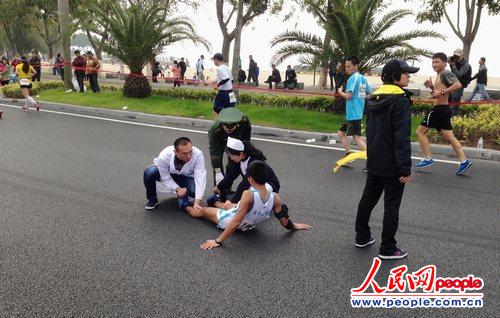
A runner has received medical treatment in Xiamen international marathon in 2014. [Photo: people.com.cn]

Marathon running is gaining rising popularity in China these days. Eight marathons were held in January in the country. However, runners’ awareness of injury prevention lags behind.

A recent survey conducted among around 10,000 runners by iranshao.com, a website focused on running, shows that over one third of runners have had knee injuries, about one fifth have had foot or waist injuries, about one seventh have had ankle injuries or suffered from plantar fasciitis, and only 15.7 percent haven’t had any injuries, which means six of seven runners have had injuries related to running.

In 2016, China held 328 marathons, attracting about 2.8 million participants, a massive 85 percent increase over 2015.


China to introduce review commission on cyber security

A commission will be established to deliberate important policies on cyber security and organize reviews, according to a document released by the Cyberspace Administration of China (CAC) on Tuesday.

The document, on the security of Internet products and services, has just been released for public opinion. The CAC will establish the commission with other authorities.

The document proposed that Internet products and services related to national security and the public interests should undergo a security review.

According to the CAC, reviews will focus on whether the products or services are secure and sufficiently managed, and on assessing risks of illegal control, disruption or interruption.

The reviews will also evaluate risks of providers using their products or services to illegally gather, store, process or make use of user information.

In addition, unfair competition, monopolization or any other functions that may damage users’ interests will be reviewed, according to the CAC.

Any service or product that fails the review will be blacklisted, making them off limits to all Communist Party of China (CPC) organs, government departments, and key industries.

HIGHLIGHTING PRODUCTS AND SERVICES

The review is neither a legal practice nor an administrative one, said an official with the CAC, but is merely supervision of important Internet products and services.

The review will not hinder foreign products from entering the Chinese market, but will only to boost confidence in such products and services, the official said. Authorities will treat Internet products and services from home and abroad equally.

Zuo Xiaodong, vice president of the China Information Security Research Institute, a government think tank, said the regulation means that while products and services that fail the review will be blacklisted, it does not mean that all Internet products and services purchased by CPC organs, government departments and key industries will be reviewed.

LAW-BASED INTERNET REGULATION

China has introduced a number of Internet laws and regulations and is home to about 700 million Internet users, the world’s largest online population.

In December, the CAC released a cyberspace security strategy, guaranteeing cyberspace sovereignty and national security, protecting information infrastructure and promising action against cyber terror and crime.

In November, a cyber security law stipulated that the government would take measures to “monitor, defend and handle cyber security risks and threats originating from within the country or overseas sources, protecting key information infrastructure from attack,intrusion, disturbance and damage.”

In July 2015, China’s top legislature adopted a new national security law highlighting cyber security and demanding the establishment of a coordinated, efficient crisis management system.

The law covers a wide spectrum of areas including defense, finance, science and technology, culture and religion.