Tank adapted into snow blower in N. China

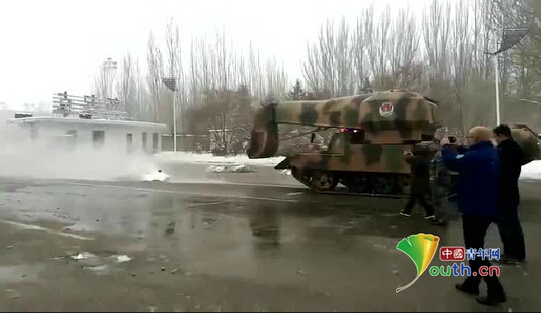
A tank-shaped snow blower on the streets of Baotou in northern China has really “blown” people away and quickly gone viral.

By adapting a jet plane engine to the tank, it can produce high heat to efficiently blow away snow at great distances. [Photo: youth.cn]

The armored fighting vehicle, which features an aircraft engine, came in handy when an unexpected spring snow hit the city today, and proven to be quite efficient in dealing with snow.

Called a turbojet snow blower, the machine was invented by the Inner Mongolia First Machinery Group, an affiliation of China North Industries Group Corporation (NORINCO GROUP).

By adapting a jet plane engine to the tank, it can produce high heat to efficiently blow away snow at great distances, according to an introduction of the machine.

The machine can achieve an average speed of 20 to 30 kilometers per hour, and a maximum speed at 50 kilometers per hour.

“It’s really awesome to see an armored vehicle being used to remove the snow,” said an internet user. “It’s a little bit noisy but proves to be very efficient.”


China commissions new naval training ship

The Chinese navy on Tuesday commissioned a new training ship at a military port in Lyushun, northeast China’s Liaoning Province, the PLA Daily reported Wednesday.

With hull number 83, the Qijiguang naval training ship is 163 meters long and 22 meters wide, with a full load displacement of 9,000 tonnes and maximum speed of 22 knots, making it the largest and most advanced training ship in the Chinese navy.

Designed and built by China, the training ship can accommodate over 400 navy cadets or officers for training in offshore waters and high seas. It can also be used in foreign exchanges, natural disaster rescue and other non-military operations.

Qi Jiguang was an ancient Chinese national hero in the Ming Dynasty (1368-1644) best known for leading Ming forces to defend China’s eastern coastal regions from raids by Japanese pirates in the 16th century.

The training ship is affiliated with Dalian Naval Academy.


Former HK chief executive Donald Tsang jailed 20 months for misconduct

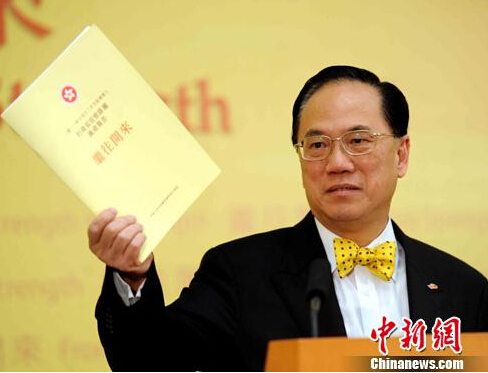
Former Hong Kong Chief Executive Donald Tsang Yam-kuen [File photo: Chinanews.com]

Hong Kong’s former Chief Executive Donald Tsang Yam-kuen was sentenced to 20 months in prison on Wednesday for misconduct while in office.

He will be sent to prison immediately.

Justice Andrew Chan of Hong Kong’s High Court said he had set a starting point of 30 months in prison, but gave a discount of ten months because of Tsang’s past good character and service to Hong Kong.

Tsang was found guilty last Friday of a charge of misconduct for failing to declare a conflict of interest when he approved applications for radio broadcasting license by a broadcasting company Wave Media.

He had faced two charges of misconduct and one charge of bribery. The nine jurors entered a majority verdict last Friday of one charge of misconduct. Tsang was cleared of another charge of misconduct.

The jury could not reach a decision on whether Tsang was guilty of accepting advantage. The judge has tentatively scheduled the proceeding to September, but a date has yet to be fixed.


Boost set for economic, social goals

China will “stabilize and improve its macroeconomic policies” and deepen reforms to achieve its economic and social development goals this year, according to a statement released after a key meeting on Tuesday.

The nation will continue to adopt proactive fiscal policy and prudent monetary policy, according to the meeting of the Political Bureau of the Communist Party of China Central Committee, which was presided over by Xi Jinping, general secretary of the CPC Central Committee.

Coordination of industrial, regional, investment, consumption, price, land and environmental protection policies will be strengthened, and reforms in key fields will be deepened to achieve better results, the meeting decided. Innovation will be promoted to help improve the efficiency of the economy and release domestic growth potential, participants agreed.

The meeting highlighted the significance of 2017, since the 19th CPC National Congress will convene later in the year.

Acknowledging that China has scored a strong start for the 13th Five Year Plan (2016-20) period, the meeting called for further efforts to balance multiple economic tasks this year, including stabilizing growth, advancing reforms, pushing restructuring, improving people’s livelihoods and preventing risks.

The meeting was held ahead of the two sessions-the annual meetings of the country’s top legislature and the top political advisory body that will be held in early March.

Supply-side structural reform will be further pushed and people’s livelihoods should be improved, the meeting statement said.

The meeting also decided that China will push the supply-side reform of agriculture to ensure healthy growth and increased income for farmers.

Tuesday’s meeting also decided that the government should improve governance to “better serve the people”.

According to the statement, 247 Party organizations have been inspected by teams sent from the CPC Central Commission for Discipline Inspection, the Party’s top anti-graft agency, since the inspection effort was launched in 2013.

The inspections, with a focus on sticking to the Party’s leadership, have functioned as a “political microscope” and a “political searchlight”, under which supervision of following the Party’s rules has been enhanced, said the statement.

On Tuesday, the CCDI disclosed information on its recent 11th round of inspections of Party and government agencies, institutes, associations and news media, such as the Supreme People’s Court, the Party School of the Central Committee of the CPC and China Central Television.

“The meeting highlighted the most important tasks for China this year,” said Liang Haiming, chief economist of the China Silk Road iValley Research Institute. “It highlights reform, innovation and people’s livelihoods.”

It is a must for China to further carry out reforms because the international situation has changed rapidly, Liang said.

Ancient gigantic Buddha statue with puzzling background

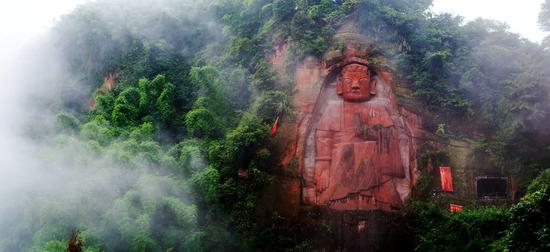
After Taliban blew up the world’s two largest Buddha statues in Bamyan, Afghanistan, 16 years ago, the 32-meter-high standing statue of Buddha in Sichuan became the largest on Earth.

The world’s tallest standing Buddha statue in Sichuan Province in Southwest China. [Photo:scol.com.cn]

However, despite its splendid view on Mt. Baxian, 891 meters high above the sea level, the origin of the statue remains elusive.

Its builders and dynasties have yet to be identified, and its hairstyle, earlobes and dressings are different from conventional Buddha statues. For example, Buddhas don’t usually wear bracelets. Moreover, this Buddha statue looks like it’s wearing an apron, which distinguishes its clothing from others.

Although the ambiguous elements of the statue perplexes historians, experts still believe the Buddha statue has distinctive historic value.