Green light for China’s first high security bio lab

China’s first high level biosafety laboratory has been accredited and will be fully operational soon, the Chinese Academy of Sciences (CAS) said Friday.

The certificate was issued by the China National Accreditation Service for Conformity Assessment, according to the CAS.

The lab in Wuhan, capital city of central China’s Hubei Province, will be used to study class four pathogens (P4) — the most virulent viruses that pose a high risk of aerosol transmission.

P4 is the highest biosafety level.

The lab in Wuhan will help China prevent and control outbreaks of infectious diseases and aid research and development of antiviral drugs and vaccines, said Zhang Yaping, vice president of the CAS.

All the air from the lab will go through two advanced filters before being discharged, while solid and liquid waste will also be properly processed, according to the CAS.

The Wuhan lab has undergone a trial operation since its construction was completed at the end of 2014. Some of the core research team have been trained in France and the United States.

Beijing to replace all taxis with new energy vehicles

Beijing is aiming to gradually replace its petrol-powered taxis with greener new energy vehicles to help reduce air pollution starting from this year.

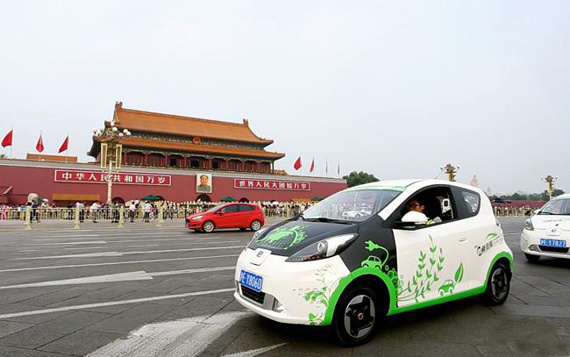
 A new engery car is on the road in Beijing. [File photo/ecns.cn]

The plan is contained in a discussion document on preventing and solving air pollution problems in the Beijing-Tianjin-Hebei Region and neighboring provinces, which was issued on February 14, according to National Business Daily.

All petrol-and diesel-powered taxis being taken out of service would need to be replaced by electric or liquid petroleum gas (LPG) powered cars. Any vehicles that taxi companies plan to buy should be electric or other types of new energy cars.

Statistics show that Beijing currently has about 71,000 taxis in total, out of which 67,000 are conventionally powered, the National Business Daily reports.

It is estimated the market size would reach 9 billion yuan (about 1,309 million USD) if all the taxis in Beijing were replaced by electric or natural-gas-powered vehicles, according to National Business Daily.

Experts say once the plans in the discussion document implemented, it will not only contribute to the environment, but stimulate China’s new-energy vehicle industry.

However, it is not easy for green powered taxis to compete with traditionally powered ones at present, due to concerns over longer time needed on charging and the limited mileage of electric vehicles, says Liu Tao from the Beijing Taxi Cum Automotive Leasing Association

Purchasing a traditionally powered vehicle would generally cost between 60,000 yuan (about 8,725 USD) to 70,000 yuan (about 10,179 USD), but an electric vehicle would cost about 140,000 yuan (about 20,359 USD), Liu said.

But if the number of new energy vehicles is increased, that cost will go down, say Li Liangjin, CEO of CAOCAO, a Chinese travel service platform.


China to build 6M homes for shantytown-dwellers in 2017

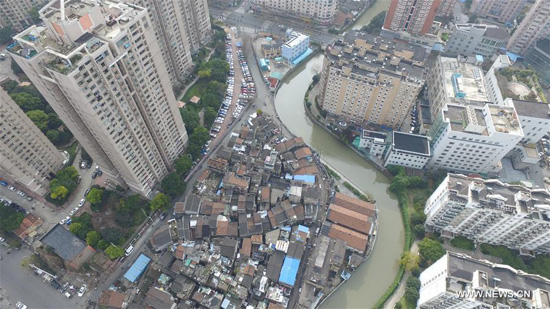
Aerial photo taken on Jan 9, 2017 shows view of Zhangqiao, one of the largest shantytowns, and surrounding estate in Hongkou district, East China’s Shanghai. [Photo/Xinhua]

China will build 6 million new homes for residents of shantytowns before the end of 2017, said Chen Zhenggao, Minister of Housing and Urban-Rural Development, at a news briefing in Beijing on Feb 23.

The Chinese central government started a three-year project to rebuild urban shantytowns in 2015, aiming to construct a total of 18 million new homes in all. In 2015, construction began on 6.01 million new dwellings, and another 6.06 were started in 2016.

According to Chen, the Ministry of Housing and Urban-Rural Development (MHURD) kicked off this year’s shantytown transformation work on Jan. 16. The central government has provided 224.3 billion RMB in subsidies for the work in 2017, an increase of 15 billion RMB compared with last year.

China is determined to reconstruct all of its existing shantytowns by 2020. MHURD is working with relevant departments to conduct a thorough investigation and make the planned transformation a reality.


227 applications to copyright ‘Ivanka’ in China

The U.S. department store franchise Nordstrom recently decided to stop selling Ivanka Trump’s clothing and accessory line. The retailer said that it won’t purchase products from the Ivanka Trump line based on the brand’s performance.

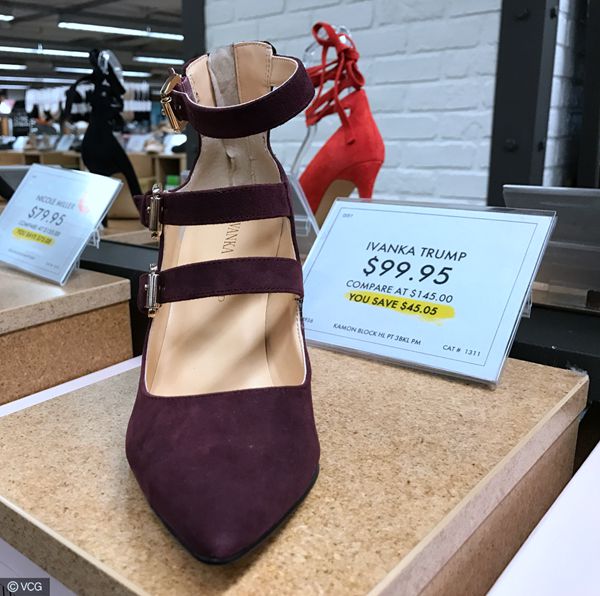
 Ivanka Trump’s line of shoes on sale at a U.S. store. [Photo/VCG]

This move irritated U.S President Donald Trump. “My daughter Ivanka has been treated so unfairly by @Nordstrom. She is a great person — always pushing me to do the right thing! Terrible!” Trump tweeted on his private Twitter account and the official @POTUS account. The Twitter criticism led to a brief fall in Nordstrom’s stock.

However, the trademark of Ivanka has become a hot commodity in China. Many Chinese firms have applied to use Ivanka Trump’s name as their trademark for their business. According to data from the Trademark Office of the State Administration for Industry and Commerce, there are 227 current applications to use “Ivanka” as a trademark on products ranging from diapers to cosmetics.

Among them, a Beijing-based company that provides weight loss services filed 55 applications to use the Chinese characters of Ivanka as its trademark for many products. Furthermore, the company also submitted 10 applications to use “IVANKA”, the English name of Ivanka Trump, for its products.

The rush to trademark Ivanka’s name is linked to her rising popularity in China, particularly after the presidential election. Most of the applications are still being processed, and it’s not clear whether any of them will be granted trademark rights.

According to Liu Kai, a lawyer from Hunan Province, foreign names or Chinese translations of such names are permitted as trademarks in business if they are not the names of public figures. However, it is easier to get the applications approved if a public figure is not popular in China.

“But now, the Chinese know Ivanka Trump because she is the first daughter in the U.S.,” said Liu Kai. According to a recent judicial interpretation by China’s Supreme People’s Court on Jan. 11, 2017, it is forbidden to use the names of public figures in trademarks, which the top courts say could “cause negative influence”.

“Therefore, I think it is impossible for these applications to get approved by the authority if the first daughter intervenes,” said Liu Kai.


Cooperation results in significantly improved air quality

Joint cooperation on environmental protection in the past three years between Beijing, Tianjin and Hebei province has resulted in significantly improved air quality in the region.

China has promoted the integrated development of the Beijing-Tianjin-Hebei region in recent years, relocating nonessential functions from Beijing and restructuring the economy in the region, with environmental protection, traffic management and industrial upgrading being prioritized.

In the past three years, the three local governments have expanded cooperation on information sharing, including holding joint emergency meetings, as well as standards drafting, policy-making and joint financing.

Yu Jianhua, chief engineer of the Beijing Environmental Protection Bureau, said the authorities of the three areas formed a mechanism in March 2015 to jointly cope with violations of environmental laws.

At the beginning of last year, Beijing, Tianjin and Hebei unified emergency response standards for severe air pollution.

In April, the three governments unified petroleum emission standards for vehicles.

“Beijing has invested in Hebei’s environmental protection, helping to cut coal use,” Yu said.

According to the bureau, Beijing has invested 962 million yuan ($139 million) in an air pollution control fund in Hebei in the past two years. Tianjin contributed 800 million yuan to the fund during the same period.

The results have been significant, with the industrial province of Hebei cutting coal use by 3.2 million metric tons in the past two years.

Beijing, Tianjin and Hebei have reduced coal consumption by 40.3 million tons in the past three years and cut iron production capacity by 40 million tons, which has contributed to the improved air quality.