30 years on, ID cards smooth life for Tibetans

Nyima Drolma has spent 15 years as a police officer, helping Tibetan people in remote areas to acquire ID cards. Compared to her work in the field, days spent at her desk in Lhasa are a walk in the park.

An ID card in China is an absolute essential. Chinese people use ID cards for everything: buying houses or train tickets, checking into hotels, visiting the doctor. The ID card system was born in 1984 and introduced to Tibet in 1987.

“Tibet is so vast and herdsmen live in far-flung areas where transportation is often problematic. It is the officers’ job to help them take photos, fill in forms and actually get the physical ID cards to the herdsmen,” said Drolma, 45.

“I have ridden horses, yaks, donkeys and tricycles to reach people in remote areas,” she said.

In 1998, she and her colleagues spent days collecting information and taking photos of herdsmen in a settlement about 200 kilometers from the nearest town in Qushui county on the Lhasa River. “We lived in the tents of the herders. It was so cold that the photos could not be developed. Despite the hardship, we think it is important to make the system accessible to all people no matter where they live,” she said.

Thirty years on, now almost all adults in Tibet have ID cards and frequently use them in modern social life.

“There was nothing like ID cards in the old Tibet,” said He Xiaodong, a historian at the regional museum. The museum keeps private stamps of serf owners and indentures which tell the gruesome social structure. Serfdom was abolished in 1951 in Tibet.

Identity cards are a modern social necessity to grant each individual equal rights to public service, said He.

Tsering Namgyel, a 71-year-old carpenter in Lhasa, was one of the first Tibetans with an ID card.

“Before, we used the hukou registration document, and when we needed to travel to other places, we went to local community commissions to ask for stamps and endorsement, which involved complex procedures,” he said.

In the first generation ID card, personal information was hand-written on small cards. China has been issuing its second-generation ID cards, featuring computer chips and digital encryption, nationwide since 2005. The cards have validity periods ranging from 10 years to 20 years.

The Tibetan regional police department said over three million 2nd-generation ID cards have been granted.

Generally, people over 16 years old are required to have an ID card, and those under 16 years old can get one if they wish.

Phurbu, a tourist guide in Lhasa, frequently uses his ID to book tickets for travelling. He cited a 2015 film “Tharlo,” which depicted a pony-tailed Tibetan sheep herder’s life, far from modernity, but upended after a journey he made to have an ID card made in the city.

“Life is not as dramatic as the story in the movie,” said Phurbu. “ID cards tell who we are and record how we interact with the world around us.”


Jiangxi Province reports 2 more H7N9 cases

Two more human infections of H7N9 bird flu were reported in east China’s Jiangxi Province, bringing total number of infections to 30 in the province this year.

The new cases were reported between Feb. 13 and 23, said a statement issued by the provincial health and family planning commission.

As of Thursday, 10 people had died of the infection in Jiangxi, said the statement.

People are advised to avoid exposure to live poultry and buy licensed poultry-related products.


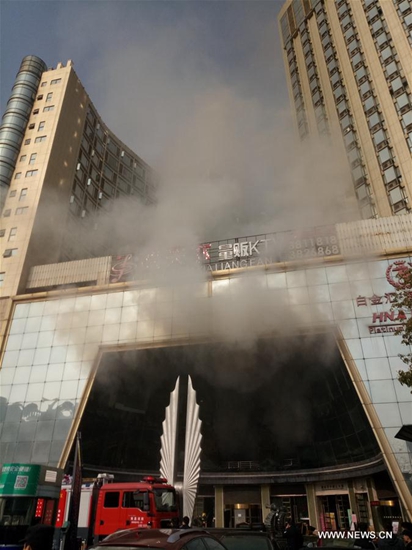
East China hotel fire traps people

Photo taken on Feb. 25, 2017 shows the fire site in a hotel in Nanchang, capital of east China’s Jiangxi Province. The fire broke out Saturday morning, trapping an unknown number of people. [Photo: Xinhua]

A fire broke out in a hotel Saturday morning in Nanchang, capital of east China’s Jiangxi Province, trapping an unknown number of people, authorities said.

The fire was spotted on the second floor of the HNA Platinum Mix Hotel in the Honggutan New District at about 8 a.m., firefighters said.

More than 10 construction workers were working on a decoration project on the second floor when the fire broke out, said a woman who escaped from the fire.

A man who broke the window to jump from the second floor was injured and rushed to hospital.

The four-story hotel is connected to a 24-story apartment building, where people are also found trapped, as Xinhua reporters saw on the site.

About 10 fire trucks are working to put out the fire.


Blueprint for a better Beijing set

Beijing should improve city planning and construction to build a “harmonious, world-class capital city” and better meet the demands of its residents, said President Xi Jinping, also general secretary of the Communist Party of China Central Committee, on Friday.

The city should take comprehensive measures to tackle problems that people care about most, such as air pollution, traffic jams, surging housing prices and too large a population, he said at a meeting after a two-day inspection.

Beijing should improve people’s livelihoods and provide better public services for the people, he said while presiding over a high-profile meeting in the Great Hall of the People to discuss how to improve Beijing’s city management and preparation work for the 2022 Winter Olympics.

“Whether its city planning and construction are good should be measured by how satisfied people are,” he was quoted by China Central Television as saying.

During the two-day inspection tour, Xi visited the construction site of Beijing’s new airport in the southern suburban district of Daxing and major stadiums that are to host Winter Olympics events.

He also visited Tongzhou district, the administrative sub-center of Beijing.

At the airport construction site, Xi urged workers and managers to adopt the strictest standards to ensure building quality.

Xi also stressed city planning and urged officials to study and devise effective policies to ensure Beijing’s sustainable development.

Beijing should stick to improving its core functions as the capital and move its non-capital functions out of the city to ease its population and environmental pressures, he said at the meeting.

On Thursday, Xi listened to a report by municipal departments on the traffic integration of Beijing, Tianjin and Hebei province.

The government put forward a national strategy in 2014 to promote coordinated development of the three regional economies so that the Beijing-Tianjin-Hebei region will grow into a major growth engine for the national economy.

Zhang Liqun, an economist of the State Council’s Development Research Center, said, “The government now emphasizes development of city clusters, and megacities must help neighboring regions develop.

“In the next stage, integration of traffic and water and power supply systems will pick up speed.”


Nurses detained for locking up public-use bikes

A public-use bike is seen locked at a residential building in Hefei, Anhui province, in January. [Photo provided to China Daily]

Two nurses in Beijing are under administrative detention for putting their own locks on two publicly shared bikes.

“The two nurses who put private locks on public-use bikes disturbed the public order,” said Liu Lin, a lawyer at Beijing Shuangli Law Firm, because it prevented other people from using the bikes.

Those who intentionally damage property may face a five- to 10-day administrative detention, according to the Law on Public Security Administration Punishments.

Tang Ke from the publicity office of OFO, the company that owns the bikes, confirmed the news and said further investigation was underway.

The market for public-use bikes – which are stored along sidewalks and can be accessed through an app – has boomed in China since the middle of last year. The new mode of transportation has brought a greener and more convenient mode of urban transportation, but the model has also caused many problems including illegal parking, theft and vandalism. Parking violations are also a common problem, followed by violation of traffic rules.

“Once users scan the app and click ‘accept’ when they rent the bike, they have signed an agreement with the service provider and should follow the rules,” Liu said.

OFO has introduced a blacklist banning users who break its rules.

Many cities such as Beijing, Shanghai and Shenzhen are proposing draft regulations to manage the market for public bikes. The Shenzhen traffic police department has also announced fines for the illegal parking of bikes.