China clears 1,845 cases of suspects in long custody without trial

China has cleared and settled 1,845 cases involving 4,459 suspects, who were placed in custody for more than three years without being charged, said sources with the Supreme People’s Procuratorate on Saturday.

The number represents all the cases unveiled in a nationwide rectification campaign on prolonged custody in 2013, said Yuan Qiguo, a senior SPP prosecutor during an online interview.

Among the suspects, 3,451 had been placed in custody for less than five years, 926 for five to eight years, and 82 for eight years or above.

“Prolonged custody without trial not only infringes upon the suspect and the defendant’s litigation rights, but also tarnishes the judicial organ’s image and credibility and impairs social harmony and stability,” Yuan said.

Amid enhanced supervision over the duration of criminal custody in recent years, the number of suspects, placed in custody for more than three years without being charged, had notably decreased, reducing from 4,459 in 2013 to six by 2015, the SPP figures show.

The prosecutor said China’s procuratorates will continue to make efforts to prevent and settle new cases involving prolonged detention of suspects in order to safeguard the rights of the suspects and the defendants.


Environmental court opens in NW China province

A special court for environmental cases has been established in northwest China’s Qinghai Province to provide legal service for environmental protection work in the Sanjiangyuan area.

The Sanjiangyuan environmental court, affiliated with the Yushu City People’s Court, was approved by the Higher People’s Court in Qinghai Province and was established on Tuesday, according to the government of the Tibetan prefecture of Yushu.

The court hired six people to handle environmental protection cases and civil suites related to pollution prevention and environmental damage in the area.

Sanjiangyuan literally means “the source of three rivers,” referring to the Yangtze, Yellow, and Lancang (Mekong) rivers. The ecology in the area has degraded due to human activities such as overgrazing.

The environmental court is the first such specialized judiciary organ in the province, said Man Zhifang, vice president of the Higher People’s Court in Qinghai Province.

Planning began on a national park in the area last year, aiming to protect the headwaters of the three rivers. It is expected to officially open in 2020. Endi


Foreign gov’ts should not interfere in internal affairs: HKSAR gov’t

A spokesman for the Hong Kong Special Administrative Region (SAR) government said on Saturday that foreign governments should not interfere in the internal affairs of the Hong Kong SAR.

In response to the U.S. Department of State’s human rights report relating to the Hong Kong SAR, the spokesman said, since the return to the motherland, Hong Kong has been exercising a high degree of autonomy and “Hong Kong people administering Hong Kong” in strict accordance with the Basic Law.

This demonstrates the full and successful implementation of the “one country, two systems” principle, which has been widely recognized by the international community.

“Under Article 158 of the Basic Law, the Standing Committee of the National People’s Congress (NPCSC) has the power to interpret the Basic Law. The NPCSC’s power of interpretation of the Basic Law is part of the constitutional order of the Hong Kong SAR, and is recognized by Hong Kong courts,” the spokesman said.

“There are ongoing judiciary proceedings regarding ‘confirmation form’ and ‘invalid nominations’ in relation to the 2016 Legislative Council election, as well as ‘oath-taking’ by certain Legislative Council Members. Foreign governments should respect the rule of law and the independent judicial system in Hong Kong. They should not interfere in the internal affairs of the HKSAR,” the spokesman added. Endit


China to raise 2017 defense budget by around 7 pct: spokesperson

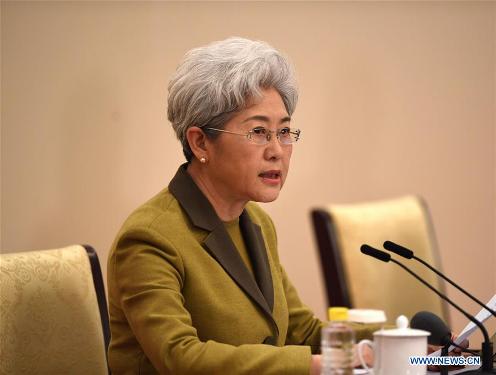
Fu Ying, spokesperson for the fifth session of China’s 12th National People’s Congress (NPC), speaks during a press conference on the session at the Great Hall of the People in Beijing, capital of China, March 4, 2017. The fifth session of the 12th NPC is scheduled to open in Beijing on March 5.

China’s 2017 defense budget will expand by around 7 percent, a spokesperson for the annual session of the country’s top legislature said Saturday.

Fu Ying, spokesperson for the 12th National People’s Congress (NPC) annual session, said the increase is in line with China’s economic development and defense needs.

The country’s defense budget rose by 7.6 percent in 2016.

The fresh raise could be the country’s slowest defense budget rise in more than a decade, and mark the second time that defense budget dip to single-digit increase since 2010. In 2009, the figure was about 15 percent.

U.S. President Donald Trump last month pledged to further strengthen his country’s armed forces.

In his first address to Congress after taking office, Trump proposed a huge 54-billion-U.S.-dollar surge in the country’s military spending, up 10 percent from the previous year.

Fu, meanwhile, noted that China’s defense spending accounts for about only 1.3 percent of the country’s gross domestic product, as compared with NATO members’ pledge to dedicate at least 2 percent of GDP to defense.

“You should ask them what their intentions are,” Fu told reporters.


China’s top legislature to open annual session Sunday

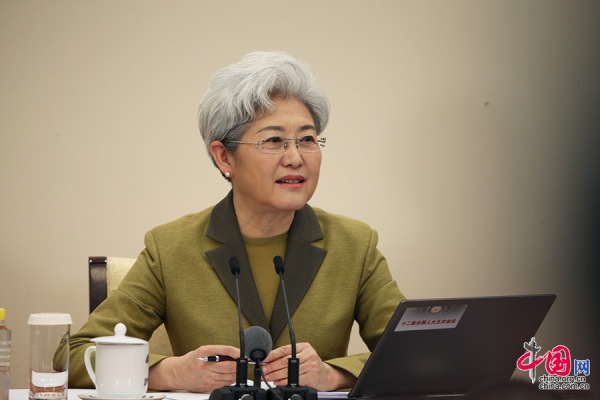
Fu Ying, spokesperson for the fifth session of China’s 12th National People’s Congress (NPC), speaks during a press conference on the session at the Great Hall of the People in Beijing, capital of China, March 4, 2017.

The annual session of China’s top legislature, the National People’s Congress (NPC), is scheduled to open Sunday morning in Beijing, a spokesperson told a press conference Saturday.

The fifth session of the 12th NPC will conclude on March 15, said Fu Ying, spokeswoman for the session.

A 169-member presidium for the session has been elected at a preparatory meeting. The presidium convened its first meeting Saturday morning and adopted the session’s agenda, she said.

National lawmakers will deliberate six reports including the government work report, draft general provisions of civil law, and three bills concerning the election of deputies to the 13th NPC, according to Fu.