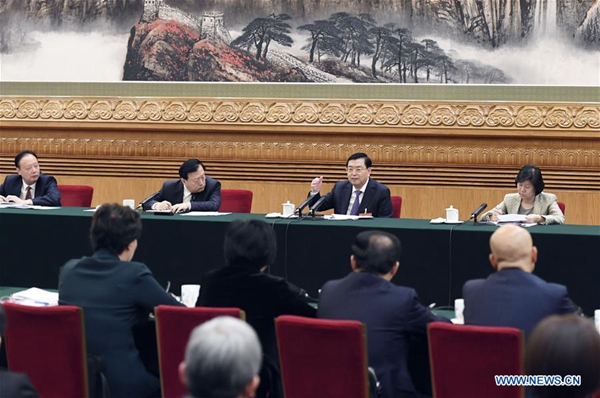
Chinese leaders review gov’t work report with lawmakers

Zhang Dejiang, chairman of the Standing Committee of China’s National People’s Congress (NPC), joins a panel discussion with deputies to the 12th NPC from Zhejiang Province at the annual session of the NPC in Beijing, capital of China, March 5, 2017. (Xinhua/Gao Jie)

Senior Chinese leaders on Sunday joined national legislators in deliberating the government work report, stressing the main theme of “seeking progress while maintaining stability.”

The report was delivered by Premier Li Keqiang at the opening of the annual session of China’s top legislature, the National People’s Congress (NPC).

Zhang Dejiang, Yu Zhengsheng, Liu Yunshan and Wang Qishan,all members of the Standing Committee of the Political Bureau of the Communist Party of China (CPC) Central Committee, joined national lawmakers in deliberating the report.

Zhang, also chairman of the NPC Standing Committee, joined lawmakers from east China’s Zhejiang Province.

Zhang stressed concrete actions to implement the decisions and policies of the CPC Central Committee, promote the steady and healthy development of the economy and the harmony of the society to create a favorable environment for the 19th National Congress of the Party, slated for later this year.

Yu Zhengsheng, also chairman of the Chinese People’s Political Consultative Conference National Committee, joined a delegation of lawmakers from central China’s Hubei Province during another panel discussion.

Yu urged Hubei Province to apply the new concepts of development and advance supply-side structural reform.

He called for further efforts to conserve energy and protect the environment to provide the people with clean water, fresh air, safe food and beautiful environment.

Liu Yunshan joined NPC deputies from Inner Mongolia Autonomous Region in their panel discussion.

Liu called for proper understanding of the relations between maintaining stability and seeking progress, stressing efforts to guide social expectations and dissolve risks, while making breakthroughs in reforms.P Major tasks in supply-side structural reform should be accomplished to improve growth quality and efficiency, he added.

Wang Qishan, also secretary of the CPC Central Commission for Discipline Inspection, joined NPC deputies from Beijing.

Wang stressed the need to explore effective CPC self-supervision for long-term governance, deepen reform of the national supervisory system and establish an anti-graft mechanism under the unified leadership of the Party.

The CPC should enhance supervision over itself and state organs to realize full-coverage oversight of all public servants, he added.


Beijing police detain suspect for verbally abusing women

Police have detained a suspect who appeared in an online video verbally abusing two women on a metro train in Beijing after the post went viral online on Saturday.

The video clip showed the suspect making abusive comments to the two women, grabbing a cell phone from one of them as the woman called a police hotline, and eventually pushing the woman out the train door at a station on Line 10.

Police said the 17-year-old suspect has been put under detention for interrogation.


CPPCC member: Carrie Lam is the best for HK chief

Tai Hay Lap, a member of the Chinese People’s Political Consultative Conference (CPPCC) from Hong Kong, speaking to a China.org.cn reporter in Beijing, March 4, 2017. [Photo/ China.org.cn]

Tai Hay Lap, a Hong Kong political advisor, said on Saturday in Beijing that he thought Carrie Lam was the best candidate for Hong Kong’s top job.

Tai, vice chairman of the Tin Ka Ping Foundation and a member of the Chinese People’s Political Consultative Conference (CPPCC), said he knew all three candidates seeking to become the Chief Executive of Hong Kong, “but, after comparing them, I would endorse Ms. Lam.”

On March 1, the election committee selected retired judge Woo Kwok-hing, former chief secretary Carrie Lam, and ex-financial secretary John Tsang to run for the Chief Executive’s post. The 59-year-old Lam secured 572 of the committee’s 1,200 votes – just 29 votes shy of the 601 needed to win the job. Meanwhile, Tsang and Woo got 160 and 179 votes, respectively.

Tai observed: “The Director of the Hong Kong and Macao Affairs Office, Wang Guangya, has proposed four qualities for the next Chief Executive: [That person] must love the country and love Hong Kong; must have ability to rule; must win the trust of the central government; and must win the support of the Hong Kong public. In regard to each of the four aspects, Ms. Lam is the best.”

Lee Tak-lun, another CPPCC member and vice-president and CEO of Grand Finance Group, said he believed Hong Kong people and members of election committee would show wisdom in selecting the right person as Chief Executive.

Both persons believed that, on the verge of the 20th anniversary of Hong Kong’s return to China, there were still many jobs yet to be completed by the region’s chief.

One is to do more to improve the recognition and identification of Chinese roots and culture among young Hong Kong people through education.

The two representatives are in Beijing to attend annual meeting of China’s top political advisory body, which will run through March 13.

“‘One country, two systems’ is an innovation,” Tai said of the constitutional principle formulated by the late Deng Xiaoping that Hong Kong and Macao could maintain for 50 years the capitalist economic and political systems, while the rest of China followed socialism; however it had not been “easy for us to make it thus far with the ‘One country, two systems’.

“Some young people never experienced what we went through before in Hong Kong, and never knew how the mainland helped us and always shows generosity towards us.”

He expressed cautious optimism for Hong Kong’s future, “Some young people in Hong Kong fear the challenges from the mainland and cannot see how the growth of the whole country is benefitting Hong Kong. The bad influence of some Western countries is here, too, so there are some negative voices. However, there’s only one China, and Hong Kong is the most diversified city in China in terms of development.

“Its development, whether [we talk] about the past or the future, is never about protectionism, but about breakthroughs and making the cake bigger.”

The Hong Kong Chief Executive election will be held on March 26, 2017 when the 1,200-members election committee will cast their votes.


China collects over 400 bln yuan in taxes from major FTZs

China collected 409 billion yuan (59.3 billion U.S. dollars) in taxes in four major free trade zones (FTZs) last year, data from the State Administration of Taxation (SAT) showed.

The tax revenue growth was driven by fast development, reasonable industrial structure and strong innovation in the Shanghai, Tianjin, Fujian and Guangdong FTZs.

Nearly 90 percent of the tax revenue came from the modern services sector, while high-end manufacturing witnessed strong growth in tax revenue, SAT data showed.

SAT data showed tax receipts from car manufacturing had annual growth of 44 percent last year, 34 percentage points higher than the national average.

Internet, software and information technology services posted stellar growth in tax revenues. The Guangdong FTZ, supported by tech-hub Shenzhen, saw tax revenues from the two sectors increase 470 percent and 390 percent respectively year on year.

FTZs are part of government efforts to test reform policies, including interest rate liberalization and fewer investment restrictions to better integrate the economy with international practice.

China launched its first FTZ in Shanghai in 2013. In late 2014, Tianjin, Fujian and Guangdong were allowed to set up a second group of FTZs. Another seven were approved in August 2016 in a bid to replicate the success of previous trials.


‘Hong Kong independence’ leads nowhere

The notion of “Hong Kong independence” will lead nowhere, a government work report to be delivered by Chinese Premier Li Keqiang on Sunday said.

The report, available just before the opening of the annual session of China’s top legislature, the National People’s Congress (NPC), also pledged to fully implement the “one country, two systems” principle in the special administrative region.

It said the central government will continue to implement, both to the letter and in spirit, the principle of “one country, two systems,” under which the people of Hong Kong govern Hong Kong, the people of Macao govern Macao, and both regions enjoy a high degree of autonomy.

“We will continue to act in strict compliance with China’s Constitution and the basic laws of the Hong Kong and Macao special administrative regions, and we will ensure that the principle of ‘one country, two systems’ is steadfastly applied in Hong Kong and Macao without being bent or distorted,” the report said.

This year marks the 20th anniversary of Hong Kong’ s return to China.

The report pledged full support for chief executives and governments of the two regions in exercising law-based governance, growing their economies, improving people’s well-being, advancing democracy, and promoting social harmony.

It added that efforts will be made to push forward cooperation between the mainland and Hong Kong and Macao.

In particular, the report said the central government will draw up a plan for the development of a city cluster in the Guangdong-Hong Kong-Macao Greater Bay Area, give full play to the distinctive strengths of Hong Kong and Macao, and elevate their positions and roles in China’ s economic development and opening up.

“We have always had full confidence about ensuring lasting prosperity and stability in Hong Kong and Macao,” it said.