Smoking banned in hotel for delegates

The ashtrays and matches in the guest rooms at Jingxi Hotel, one of the designated hotels for deputies to the National People’s Congress, have been removed this year.

The small move, for Shen Jinjin, an NPC deputy and a longtime anti-tobacco campaigner, is a big step forward in tobacco control.

As an NPC deputy for the past decade, he brought forward various suggestions to combat smoking, some of which have been accepted, such as the 100 percent smoking ban in public places introduced by Beijing, Shenzhen and Shanghai.

“We’ve seen strong restrictive measures over tobacco advertising in the new Advertising Law,” added Shen, head of the Disease Control and Prevention Center in Yancheng, Jiangsu province.

“At the two sessions over the years, positive changes can be seen,” he said.

Previously, participants in the two sessions even smoked during group discussions in the meeting rooms, and ashtrays and matches were widely placed.

In that scenario, “I would stop people politely and deliver anti-smoking messages, particularly the proven health-related hazards,” he said. “NPC deputies are usually influential and I don’t want to miss the opportunity to spread the message of tobacco control.”

As a veteran public health worker, Shen knows well the negative health impacts from smoking and the huge medical bills from treating smoking-related diseases.

The National Health and Family Planning Commission estimates that more than 1 million Chinese die from smoking-related diseases each year.

With more information becoming available to the public, a consensus about smoking control has been gradually reached in China, the world’s largest cigarette producer and consumer.

In 2015, Beijing passed the country’s strongest anti-smoking law, and delegates to the two sessions thereafter became able to enjoy a truly smoke-free environment in the city.

“Now they can only smoke outside the hotel, despite the chilly and windy weather here in early March,” he said.

Also, they began to accept a controlled way of smoking and “some smoking deputies even co-signed my motion urging the country to pass a State-level anti-smoking law,” he noted.

Beijing pioneered the introduction of strong smoking bans in public places, which should be expanded nationwide, he urged.

“We have the knowledge that smoking harms health and we have wide support from the public for smoking controls. Why is it so difficult to make a national law?” he said.

In November, Mao Qun’an, spokesman for the National Health and Family Planning Commission, the nation’s top health authority, said a national law would be enacted in 2016-and though the commission was charged to draft such a law, it didn’t.

Shen blamed that on interference from the tobacco industry, a major source of tax revenue for the government. “The fight is not over, and I will keep up the effort,” he said.



Audits help money get to the poor

Inspection and audit efforts to prevent the improper use of poverty relief funds have paid off, said the top poverty relief official.

Liu Yongfu, director of the State Council Leading Group Office of Poverty Alleviation and Development, made the comment on Tuesday during a news conference at the fifth session of the 12th National People’s Congress.

“In 2013, we audited poverty relief funds used in 17 counties, where 15 percent of the money was improperly used,” Liu said. “In 2016, we audited 30 counties and the ratio was down to only 3 percent.”

He said the country’s disciplinary watchdog unearthed about 16,000 cases related to improper use of poverty relief funds in 2016, leading to more than 19,000 people being punished. A hotline set up by the office has received more than 10,000 phone calls in the past two years.

“Previously, the majority of problems were related to corruption and waste. Now, the main problem is many of the funds are kept in the account unused,” Liu said.

“More problems are now found in townships and villages instead of cities and counties.”

He said the government will also help grassroots officials improve their ability to “spend the money well”. Each county is encouraged to set up a database so that the funds and projects are subject to public supervision.

China lifted 12.4 million rural residents out of poverty last year as part of the central government’s campaign to lift the remaining poverty-stricken people out of poverty by 2020. There are still 43.3 million people living below the poverty line of 2,300 yuan ($335) in annual income, according to National Bureau of Statistics.

Last year, China managed to increase the average per capita annual income of rural residents living in registered poor areas to 8,452 yuan, an increase of 8.4 percent compared with 2015, according to the bureau.


Chinese federation holds Women’s Day gathering

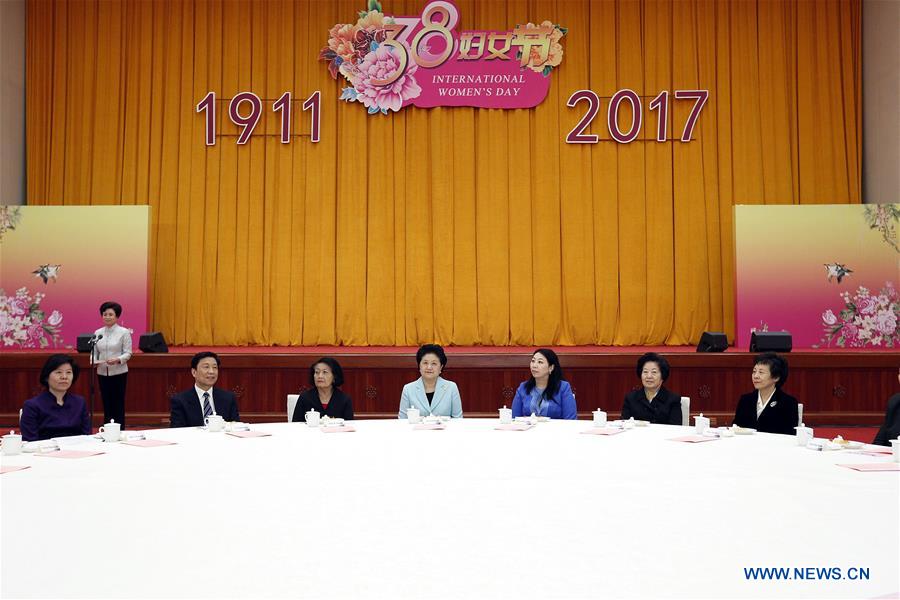
A gathering celebrating International Women’s Day is held in Beijing, capital of China, March 7, 2017. The All-China Women’s Federation held a gathering attended by Chinese women from various circles and foreign diplomats here on Tuesday ahead of International Women’s Day. (Xinhua/Zhang Yuwei) 


The All-China Women’s Federation held a gathering attended by Chinese women from various circles and foreign diplomats here on Tuesday ahead of International Women’s Day.

The federation has carried out the decisions made by the Central Committee of the Communist Party of China (CPC) and pushed forward reform to better serve women over the past year, said the federation’s president Shen Yueyue in a speech.

Shen, who is also vice chair of the Standing Committee of the National People’s Congress, China’s top legislature, said the federation will unify and lead the country’s women to follow the Party and make new contributions to welcome the 19th CPC National Congress, slated for later this year.

China is willing to work together with women worldwide in building a community of shared future, she added.

More than 1,000 people were present at the event to observe International Women’s Day on March 8.


80% of Chinese women feel gender discrimination at work

More than 80 percent of women in China experience gender discrimination at work, according to a survey carried out by one of China’s largest job sites.

In the survey released just ahead of International Women’s Day by Zhaopin.com, 81 percent of the female respondents say that they feel gender discrimination at work. About 22 percent of them say the discrimination is “serious,” 59 percent say the discrimination is “moderate,” and only 2 percent of female respondents say they experience no discrimination at all.

Thesurvey is based on answers from 128,576 respondents, 43 percent of whom are female.

About 74 percent of the male respondents say that they feel gender discrimination at work, slightly less than their female counterparts.

Working females who hold higher qualifications experience more discrimination, the survey found. About 43 percentofthe female respondents who havea master’s degree or higher report”serious gender discrimination,” compared to 12 percent of women who graduate from high school, 18 percent of women who graduate from junior college, and 28 percent of women who have only attended college.

Working women have also reported gender discrimination in promotion. More than 80 percent of the femalerespondents say they haveexperienced discrimination in promotion, 25 percent report “serious discrimination,” while only 3 percent say they feel no discrimination at all.

Among all therespondents, 59 percent of men say they had their first promotion after workingfor two years, compared to 49 percent of women — 10 percent less than men. And 72 percentof all the respondentssay their immediate superiorsare male while only 28 percent are female.


NPC deputy: Second child families should enjoy subsidies

Ye Tingfang 

Families with a second child should enjoy subsidies, tax free or rebated individual income tax, Sun Xiaomei, professor from China Women’s University and a deputy of the National People’s Congress (NPC) recently proposed.

Sun submitted the proposition during the ongoing two sessions, namely, the NPC and the Chinese People’s Political Consultative Conference (CPPCC) which opened at the beginning of March.

Families with a second child need subsidies and preferential policies to alleviate the economic costs, Sun explained.

She advised the country to prioritize the rights of second-child families by securing their privileged access to low-rent houses or low-costs housing, extra medical reimbursements and insurance, the exemption of children’s tuition in universities and preferential maternity leave to relieve the mothers from extra working hours.

Initiated 10 years ago by Ye Tingfang, a translator as well as a former CPPCC member, out of concern for China’s diminishing demographic dividends, the right to have a second child won an overwhelming mandate in 2016, putting an end to the decades-long one-child family-planning policy.

The average birth rate in China per couple was 1.2 from 2010 to 2015, indicating a sharp decline of 36 percent in birth of every generation. The demographic aging draws considerable concern among the deputies and members in the two sessions.

Huang Xihua, a NPC deputy, advised the country to lower the minimum legal marriage age from 21 for females and 22 for males, to 18.

“It is not an advocacy for early marriage, but a move to protect the rights of young people,” Huang said.