
Chinese leaders attend funeral of former senior political advisor

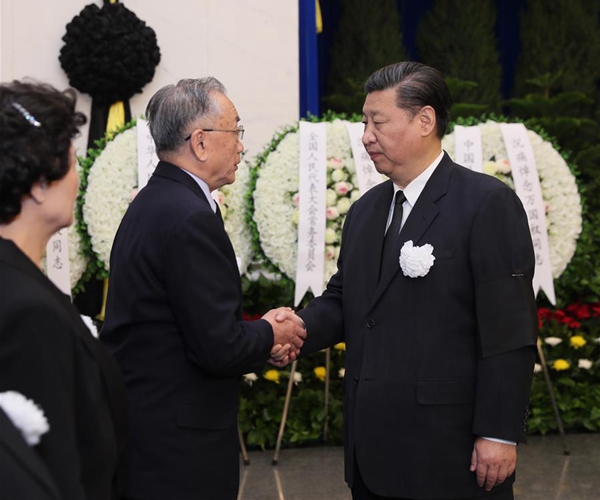
Chinese President Xi Jinping (R) shakes hands with a family member of Wan Guoquan, former vice-chairman of the National Committee of the Chinese People’s Political Consultative Conference, during Wan’s funeral at the Babaoshan Revolutionary Cemetery in Beijing, capital of China, March 28, 2017. [Photo/Xinhua]

The cremation of Wan Guoquan, former vice-chairman of the National Committee of the Chinese People’s Political Consultative Conference, was held Tuesday, with Chinese leaders paying their respects at the funeral in Beijing.

Xi Jinping, Li Keqiang, Zhang Dejiang, Yu Zhengsheng, Liu Yunshan, Wang Qishan, Zhang Gaoli, as well as Jiang Zemin and Hu Jintao either visited Wan when he was in hospital or extended their condolences after his death.

Xi Jinping, Zhang Dejiang, Yu Zhengsheng, Liu Yunshan, Wang Qishan, Zhang Gaoli, as well as Hu Jintao attended the funeral at Babaoshan Revolutionary Cemetery.

They stood in silent tribute and bowed three times in front of Wan’s body. They also offered Wan’s family their condolences.

Wan was also executive vice-chairman and honorary vice-chairman of the Central Committee of the China National Democratic Construction Association, one of China’s eight non-communist parties.

Wan died on March 23 at the age of 99.


CPC calls to institutionalize education campaign

The Communist Party of China (CPC) Central Committee has said the ongoing education campaign on Party management should be institutionalized.

According to a circular issued by the general office of the CPC Central Committee made public on Tuesday, the campaign was launched in 2016 and focuses on the study of the Party Constitution and code of conduct, as well as the speeches made by Xi Jinping, general secretary of the CPC Central Committee.

A series of remarks made by Xi are the latest achievements in the theoretical system of socialism with Chinese characteristics, and they mark the latest development of contemporary Marxism in China, it said.

The remarks are considered important thought for Party building and advancing the great cause of socialism with Chinese characteristics, it said, adding that they will also serve as guiding principles for all Party organizations and members.

Party organizations at various levels should fully realize the importance of institutionalizing the campaign and put ideological education high on their agendas, it said.

Efforts should be made to standardize actions of Party organizations and members in accordance with the Party Constitution and code of conduct.Efforts should also be made to ensure Party organizations fully play their roles and leading officials are clean, honest and bold in assuming responsibilities.

Party organizations should evaluate results of the campaign annually, it said.

The circular asked Party committees at all levels to lead grassroots Party organizations and members to unite more closely around the CPC Central Committee with Xi as the core.

Party committees at all levels should make annual study schedules while leading officials should have their own individual study plans, it noted.

Party organizations should guide members to strengthen their ideals and beliefs, implement the Party’s decisions and observe Party discipline and rules, according to the statement.

Those who fail to act accordingly will be criticized seriously or held accountable, the document added.


Top tourism province Yunnan goes harsh on kickbacks

Southwest China’s Yunnan, the top province for tourists, rolled out harsh regulations to tackle tourist scams.

Yunnan is the top tourist province in China, receiving over 431 million domestic and overseas tourists in 2016, about 10 percent of the national total. It boasts rich tourism resources, including unparalleled natural scenery, ethnic culture and world heritage sites such as Lijiang.

However, it has faced increasing public criticism after incidents such as forced shopping excursions, scams, and the humiliation and beating of tourists.

Statistics from the National Tourism Administration and web resources show Yunnan frequently ranks top in the number of complaints filed by tourists.

In February, complaints against Yunnan tour operators accounted for about 34.8 percent of the national total. Most of the complaints were related to cheap tours and forced shopping.

“The new regulation was made to separate tours from shopping, and we aim to restore tourism market order within a year,” said Yu Fan, director of the provincial tourism development commission at a press conference on Monday.

Shops at tourist destinations often sell overpriced goods of shoddy quality. According to the new regulation, which comes into effect on April 15, these shops will turn into supermarket-style shops with proper pricing and fall under day-to-day supervision by tourism and commerce authorities.

The regulation bans kickbacks or commissions, which had come under the guise of “parking fees” or “tea fees” for bus or taxi drivers, and “head-count fees” for guides.

“The new regulation removes the source of profit for tour operators,” said Mou Xuemei, director of the tourist guide association in Lijiang, Yunnan.

“It means guides can no longer receive commissions, and their earnings will solely depend on whether their clients are happy,” Mou said.

In Lijiang, there are about 2,000 tourist guides.

“The new policy will greatly impact them, and I have heard them talking about the policy since word of it came out,” she said.

“Kickbacks are a national problem. Everyone will look and see how tourism reform in Yunnan goes,” she said.

According to a tourism industry report, some shops sell jade, medicine and Pu’er tea at ten times the price of purchase. Fifty to 90 percent of the money goes back to travel companies, which then give kickbacks to their guides accordingly.

“Commissions based on shopping tours are dysfunctional and distort the proper enjoyment of the travel experience,” said Garry Crockett, global executive chairman of China Ready & Accredited, a tourism consulting firm.

“The new regulation brings China’s domestic tourism policy into harmony with international best practice. Most Western travellers expect transparency in tour arrangement and like to be provided with freedom to choose which shop they patronize during their travels,” he said.

Yunnan will establish a rating system for tourist guides and increase supervision of guides. It will also establish a blacklist for discredited tour operators.


Avian flu under spotlight

Avian flu under spotlight

The central government has urged local authorities to tackle the outbreak of H7N9 avian influenza. [Photo/China Daily]

The central government has urged local authorities to tackle the outbreak of H7N9 avian influenza by taking more effective measures to prevent the virus from spreading.

The move was decided at an executive meeting of the State Council, China’s Cabinet, which was presided over by Premier Li Keqiang on Feb 22.

Li was briefed on prevention and control measures against the lethal virus. He called for local governments to monitor the epidemic and punctually disclose relevant information to the public.

Since the first case of a human infected with the virus in China in 2013, it has killed thousands of people across the globe.

The number of patients infected with the H7N9 strain in China has increased rapidly since December and more than 16 provinces have reported an outbreak of the epidemic since the beginning of this year.

The virus claimed 79 lives in January, more than triple the death toll for December, and far surpassing the number of deaths in the same month over recent years, the National Heath and Family Planning Commission reported on Feb 15.

After the meeting, regions such as Beijing, Anhui and Guizhou provinces took swift action to control the disease and ensure public health. The number of those infected dropped to 160, with 61 fatalities in February, according to the commission.

According to a statement released after the meeting, live poultry markets where infected birds are detected will be immediately closed, as exposure to infected poultry is one of the main causes of human infection.

The meeting decided to upgrade the sector in areas where markets have been hit by the virus by ordering that poultry be raised in large factories, before being slaughtered in designated sites and transported via cold-chain logistics to supermarkets. By doing this, consumer safety will be further ensured as they will not be exposed to live infected poultry.

The statement said sufficient medical supplies and funds will be provided for all emergency and necessary treatment. Patients will get their medical bills reimbursed through the medical insurance system.

Shu Yuelong, director of the National Center for Influenza, said there was no evidence to show the virus can be easily transmitted among humans. He added that people should avoid touching infected poultry, or exposure to any live poultry markets, which are two of the most common reasons for human infection.

Prevention measures start with source-stringent control over live poultry so the meeting decided to impose stricter surveillance over the breeding and transporting of live poultry. Disinfection and quarantine measures will also be strengthened. Local markets that detect an outbreak must be closed as soon as possible and the animals destroyed, the statement said.

China has invested huge funds in surveillance and management of the virus since 2013, said a communiqué released by the World Organization for Animal Health and the Food and Agriculture Organization of the United Nations on March 17. However, obvious symptoms take time to become apparent after infection, making prevention and control measures more complicated, the document said.

The Chinese Center for Disease Control and Prevention said on March 17 that the outbreak will not be large-scale as it is difficult for humans to pass it on.

The past four years have seen a new outbreak of the virus and each year saw fatalities, said Du Zhengyu, a disease-control doctor in Anqing, Anhui province.

“The government is taking market-management measures by shutting down live poultry markets that impose potential threats to people living nearby. More importantly, the public should be cautious themselves,” he said.

Du suggested that individuals should be alert to any direct contact with live poultry and hesitant to buy live animals such as chickens. In addition, anyone who has cold-like symptoms should go to hospital for a checkup and treatment, he added.


Official seeks connection with tech giant on social media

A Chinese official has used an unlikely networking method to get in contact with Lei Jun, CEO of China’s tech giant Xiaomi, posting a notice on social media seeking business cooperation with the company.

Ji Xiang, vice mayor of Ma’anshan in Anhui Province, has come under the spotlight after his handwritten notice seeking contact with a tech mogul posted on his WeChat friends’ circle went viral.

“If anyone in my ‘omnipotent’ friends’ circle can reach Lei Jun, please introduce us as the city wants to work with him on a project,” wrote the 47-year-old official.

Within 10 minutes, said Ji, 10 friends offered to help, out of his circle of over 5,000 friends, ranging from senior government leaders to blue-collar workers, on the social media platform.

“We are now communicating with senior executives in Xiaomi Inc. via a WeChat group to discuss potential cooperation,” he said. Ji claimed social media had greatly boosted work efficiency and helped consolidate resources within a large circle of “friends.”

The vice mayor publishes an average of up to 70 posts a day, including his updates as well as shared news and articles.

Chinese President Xi Jinping has told officials to heed public opinion using the internet and has encouraged them to make greater use of the internet to learn about the concerns and wishes of the people.