Girls apologize over assault on young students

Four female students who appeared in a viral video of an assault on two young girls in Sichuan Province have been forced to apologize and their families ordered to pay compensation, police said on Wednesday.

The group-identified as Li, Liu and Zhao, all 14, and Zhang, 13-were taken into custody after an investigation into footage filmed on Friday that showed the victims being repeatedly slapped and kicked.

According to the local authorities, the video was recorded outside a high school attended by the victims in Longfeng town, which forms part of Pengzhou. The suspects attend other schools in the area.

The city’s public security bureau said on Wednesday that the suspects’ families had been fined an undisclosed sum and ordered to cover any medical expenses. All of the suspects were placed in administrative detention, except for Zhang, as children under the age of 14 cannot be detained.

The victims had accepted the girls’ apologies, the bureau added.

Lasting just over two minutes, the video shows a girl dressed in black who first slaps a young student in a green school uniform 14 times within 35 seconds, and then kicks and hits a short-haired girl. Neither victim is seen fighting back.

Police did not reveal which of the suspects was the girl in black or the motivation behind the assault.

The incident is the latest in a string of bullying cases that have gained media attention in the past year.

On April 22, a video showed a female student in Hunan Province being slapped 32 times by a group of female students in less than 100 minutes.

On May 16, a male high school student in Shandong Province was beaten by another boy in a school toilet.

Officials approved the arrest of 1,180 people involved in school bullying and violence nationwide last year, according to the Supreme People’s Procuratorate, the top prosecuting authority.

A total of 688 first-time juvenile offenders or those who committed minor offenses were exempt from prosecution in the hope they would return to society a better person.

School violence has aroused widespread concern. The National People’s Congress, the top legislature, announced in March that it will conduct an inspection of school safety this year and study how to reduce violence on campuses.


Subway to compensate man over injury

A man left paralyzed after being crushed by fellow passengers on a Beijing subway train has been awarded 260,000 yuan ($37,700) in compensation, a court said on Wednesday.

The Changping District People’s Court ruled that Beijing Subway, which operates the line, was 20 percent responsible for the accident that left the plaintiff, identified only as Liu, in need of 24-hour care.

Liu attempted to board a subway train on Line 5 at Tiantongyuan North Station at about 7 p.m. on Jan. 15, 2014, when he was crushed in a surge of passengers.

The then-56-year-old fell unconscious on the train, “but the rush hour crowd did not pay any attention to him, let alone help him”, according to his lawyer, Liu Yongfei.

“My client was not sent to hospital until the train arrived at Lishuiqiao, three stations later, which is when subway workers spotted him on surveillance cameras,” he said. Although similar cases caused by overcrowding at Chinese subway stations are not rare, the attorney said, “the injury suffered by my client can be said to be the most serious and tragic.”

The victim, who worked at an advertising company and had previously complained of neck problems, was hospitalized for 765 days after the accident, “and even now he cannot stand up and have a meal by himself”, Liu said. “He cannot live by himself.”

Considering the seriousness of the injury, the man’s family appealed to the court in early 2015, requesting the metro company pay 1.9 million yuan in compensation, including medical fees and loss of income for the man’s absence from work, according to Liu.

In February 2015, the court accepted the case. It made the judgment at the end of last year and disclosed the verdict online to receive public supervision on March 30.

In the judgment, the court said the subway company, as the regulator of the system, should take more security measures to protect passengers during rush hour.

“Although the litigant’s injuries were not directly caused by the metro operator, the case highlighted a lack of protection and security measures for passengers, and the company did not provide enough evidence to prove it had fulfilled its responsibility at the time,” said Huang Ying, the judge in charge of the case.

Therefore, the court decided to ask the company to claim 20 percent of the responsibility in the case and pay compensation to the victim, Huang said.

The court said the 260,000 yuan was to cover three years of medical fees and that the plaintiff can ask for further compensation in line with the law if he needs to in the future, the attorney added.

The litigant and his family were satisfied with the result and said they would not appeal to a higher court, Liu said.


Inspections expose mass environmental violations

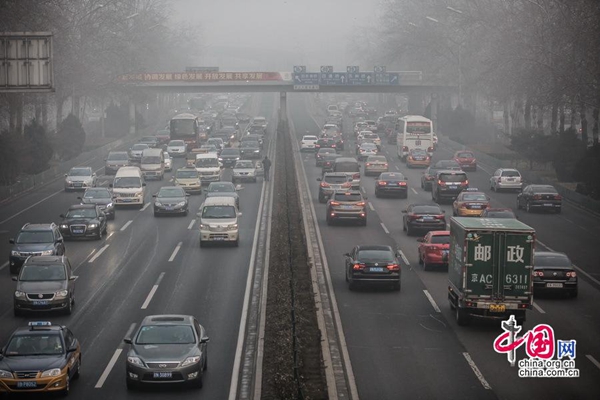
Heavy smog hits Beijing. [Photo/China.org.cn]

Inspections have exposed violations by companies illegally discharging pollutants and falsifying monitoring data, despite emergency responses to the ongoing air pollution in northern regions, according to the Ministry of Environmental Protection.

Severe violations were exposed by the nation’s top environmental officials during random inspections in the Beijing-Tianjin-Hebei region and the neighboring provinces of Henan, Shanxi and Shandong, it said.

The ministry announced the launch of a yearlong intensified inspection program in the area’s 28 major cities, starting on Wednesday. Up to 5,600 government workers will be transferred from across the nation to support the mission, making the campaign the largest-ever national operation in the field of environmental protection.

On Tuesday, Chen Jining, the minister of environmental protection, visited Sinopec Beijing Yanshan Co, a major petrochemical enterprise in Fangshan district, to inspect levels of discharged pollutants. Chen said that after waiting for 20 minutes, he was unable to obtain records on the repairing of equipment related to emissions monitoring.

It showed the company failed to operate as required in controlling and reducing emissions of air pollutants, and it has been required to correct its problems, Chen said.

In addition to poor management, Zhao Yingmin, the vice-minister of environmental protection, exposed severe violations by a new material production company in Anyang, Henan province, which was found to have falsified monitoring data to make sulfur dioxide emission levels show a negative reading.

As of Monday, inspectors in seven cities in northern regions had exposed 200 pollution problems, including excessive emissions, falsified monitoring data and weak implementation of laws by local governments, according to the ministry.

The ministry said on Wednesday that blue-sky days in the 28 major cities in the Beijing-Tianjin-Hebei region and neighboring provinces of Henan, Shanxi and Shandong accounted for 60.9 percent of the month, an increase of 20.6 percent year-on-year.

But in the first quarter of this year, only 42.8 percent of days had good air, a decrease of 0.7 percent compared with last year.

The air pollution that blanketed many cities on Monday started to ease on Wednesday, with pollution levels falling from severe to lightly polluted or good, according to data from the China National Environmental Monitoring Center.

Beijing started to see the air quality improve by 5 pm on Wednesday, but it is forecast to worsen again on Thursday, becoming severe, the second-highest level in the six-tier quality system, according to the monitoring center.

At least 13 cities, including Beijing, had issued orange alerts, the second-highest emergency response level, as of Wednesday, requiring limited use of vehicles and the suspension of production at some industrial sites.

“It’s essential to implement the restriction efforts fully, and tighten the controls on construction sites and dust caused by vehicles,” Chen said.


2022 Olympic Winter Games facility construction launched

Cai Qi, Mayor of Beijing, attended a meeting on the construction of the ancillary facilities and venues for the Beijing 2022 Olympic Winter Games on March 31, marking the first meeting of its kind and officially launching the construction work of the Beijing 2022 Olympic Winter Games venues and related infrastructure.

Beijing is responsible for the construction of 31 venues and the related infrastructure. The major venues and facilities will be completed by the end of 2019.

Beijing Mayor Cai Qi said the city needs to ensure a “wonderful, extraordinary and outstanding” Olympic Winter Games as it is a major event in China and has brought development opportunities to Beijing.

Cai said the construction needs to create a “Winter Olympics speed” while ensuring safety and quality.

The plan for the National Speed Skating Stadium needs to be improved, and the National Stadium (Bird’s Nest) and the National Swimming Center (Water Cube) needs to be upgraded.

Cai also said that the venue in Yanqing District should follow the rules of the games and the requirements of the International Olympic Committee. He said the construction of the venues should follow the principles of cost-saving and environmental friendliness.


Premier Li: Unleash productivity through thorough reforms

China is prioritizing reforms to bring better economic vitality and higher living standards for its people.

The State Council’s executive meeting on Wednesday came with an outline for specific plans for this year’s economic reform, short-listing areas that require focused reform. The meeting was presided over by Premier Li Keqiang.

“Chinese economy is fundamentally motivated by the country’s reform efforts,” Li said. “To deliver results we have projected for the year, it is still down to how well we carry on with reforms.”

He pointed out that reforms will inevitably touch the cheese of vested interest, and joint efforts are called from all government departments.

Efforts in deepening economic reform will be carried out in several aspects in 2017.

Improvements were urged in areas such as cutting overcapacity, destocking, deleveraging, reducing corporate costs and shoring up weak links through using force of the market and law-based measures, aiming for a more effective economic growth with high quality.

Efforts in transforming government functions and streamlining administration will continue with stricter and more comprehensive regulation, creating a more inviting business environment for the real economy.

Innovation and entrepreneurship will be further encouraged with an incentive mechanism. The government will also come out with wider and more effective regulation on private property protection.

Fiscal and tax reform as well as reform in state owned enterprises (SOEs) were also urged. The country will also enhance reform measures on furthering opening up, environmental protection as well as the agricultural supply-side structural reform.

The new guideline also suggested inviting private capital participation in social welfare, including medical care, education reform, and social organizations.

“The government needs to focus on key reform steps that catches greater traction. This is similar to clenching our fist firmly when holding something vital,” Li pointed out.

“The key to reform is to unleash the hitherto pent-up productivity,” Li added. “Our job is to make big businesses stronger, small businesses more vibrant, through means firmly adhered to market principles and the rule of law. Given greater latitude for their own initiatives, all businesses, big or small, will work together to invigorate the Chinese economy.”