Yangtze to be hit by worse droughts, floods this year

The areas along the Yangtze River are likely to see more severe droughts and floods than usual this year, flood control authorities announced Monday.

During flood season this year, the river’s middle and lower reaches will see more rainfall while the upper area — except the Jinsha, Jialing, Min and Tuo rivers — will see up to 30 percent less precipitation than normal years, said Cui Jiangxue, deputy secretary-general of the Yangtze River Flood Control and Drought Relief Headquarters.

According to meteorological and hydrological forecasts, drought and floods in the river basin will occur at the same time, he said at a meeting in Wuhan, capital of central China’s Hubei Province.

The headquarters urged provinces and cities along the river to track weather conditions closely and improve flood control measures.

Heavy rain along the river since January has resulted in landslides and floods in some areas.

Due to rainfall in the middle and upper reaches, the volume of water entering the Three Gorges Reservoir almost doubled to 13,000 cubic meters per second in the 24 hours starting 2 p.m. Saturday.

The water inflow began to decrease Sunday afternoon and hit 10,200 cubic meters per second at 2 p.m. Monday — a record high since 1993. The inflow of the reservoir will continue to drop Tuesday.

More than 500 ships are waiting to pass through the dam’s ship locks.


Over 500 crocodile products seized in south China

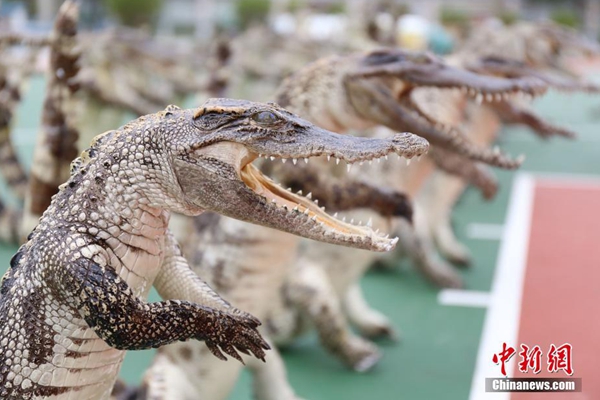
Over 500 crocodile products seized in south China. [Photos: Chinanews.com] 

Border police in southern China’s Guangxi Zhuang Autonomous Region said Monday they had seized 537 products made from Siamese crocodiles, a protected species.

The products, including 370 pieces of crocodile skin, 90 tails and 77 specimens, were detected on a logistics vehicle attempting to cross the China-Vietnam border in early March.

The police thoroughly examined the vehicle after noticing that its goods were unusually placed. The driver also failed to provide official document for transporting the products.

The skins were around 43 centimeters wide and at least 1.2 meters long apiece. The longest specimen was nearly two meters long.

Siamese crocodiles are a critically endangered species native to Southeast Asia. Their skin is used as a raw material for luxury leather products on the international market. In China, it is illegal to raise them without a license or to trade and traffic them.


Peking University to start enrollment for Oxford campus

The site where the Peking University is to set as their British campus. [Photo: cnr.cn]

Peking University is set to start staff recruitment and student enrollment for its British campus in the city of Oxford in June.

The elite university in Beijing signed with the Open University in February to purchase a 15-acre campus in Oxford for 8.8 million pounds, or 10 million U.S. dollars. The location will serve as an overseas campus for the university’s HSBC Business School.

The school will enroll 100 international students when it opens in August 2018, coinciding with the 120th anniversary of Peking University.

This is the first time that a Chinese university has used its own finances to set up and manage a school in a foreign country.

Yu Changjiang, a scholar in education, described the move as a remarkable step for China’s higher education to go global.

“Previously HSBC Business School has been recruiting teaching staff and introducing resources from abroad, but now it has begun its process of going global, thus forming bilateral exchanges between its foreign counterparts,” said Yu, “this will actually become a major tendency for China’s higher education industry, which will gradually develop its own characteristics and advantages to be shared internationally.”

HSBC Business School’s finance, management and economic courses will feature Chinese business cases to help students become better acquainted with the Chinese economy and reforms.

Students will take the first year course in the Oxford campus and the second year at the schools’ campus in Shenzhen.

Those on the campus in the southern Chinese city will also be allowed to select elective courses on the campus in Oxford.


Beijing to reward informants on spying

Beijing citizens who provide useful information on spying are eligible for a cash reward of up to 500,000 yuan (US$72,460), according to a policy that went into effect Monday.

Informants can pass information to authorities through calling a hotline, sending letters or visiting the city’s state security bureau.

After collating the information, the bureau can offer rewards ranging from 10,000 yuan (US$1,448) to 500,000 yuan (US$72,460) based on the reports’ usefulness.

Personal information of informants will not be disclosed without their consent, and informants can also seek protection from security authorities if they or their close relatives are in danger due to informing.

However, informants will be punished if they deliberately slander others, or invent and spread false information.


Insurance official under investigation

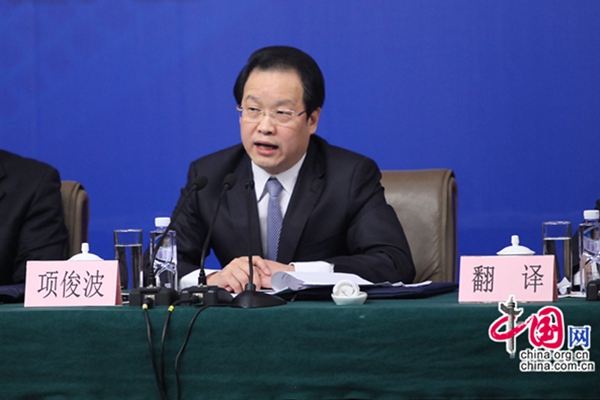
Chairman of the China Insurance Regulatory Commission Xiang Junbo [Photo/China.org.cn]

Xiang Junbo, chairman of the China Insurance Regulatory Commission, is under investigation by China’s top anti-graft authority, according to an online statement published on Sunday.

The Central Commission for Discipline Inspection of the Communist Party of China said in its online statement that Xiang was being investigated for suspected serious violation of the Party’s code of conduct.

The investigation began after China’s top leadership vowed to contain systemic financial risks.

Xiang, 60, has headed the insurance commission and served as a member of the monetary policy committee of the Chinese central bank since 2011.

The insurance regulator under Xiang had stepped up the crackdown on the radical acquisition of listed companies by the insurers and their risky and highly leveraged investments using short-term proceeds from sales of high-yield policies.

Xiang told a news conference in February the insurance sector should not be the “club of the rich” or a “hideout for financial titans”.

He also warned that the regulator will “severely punish” short-term speculation by insurers and their hostile takeovers of listed companies’ stakes.

His agency also banned Chinese business tycoon Yao Zhenhua, chairman of the private conglomerate Baoneng Group, from the insurance industry for 10 years for illegal investments.

Xiang oversaw the rapid growth of China’s insurance sector, with total assets reaching 15.1 trillion yuan ($2.19 trillion) at the end of 2016, tripling since its assets reached 5 trillion yuan in 2010.

Xiang, one of the most prominent financial regulators in China, served as deputy governor of the People’s Bank of China between 2004 and 2007. Later he served as the chairman of the Agricultural Bank of China, one of the big five State-owned commercial banks. He oversaw the shareholding restructure of the bank, listed in Shanghai and Hong Kong in 2010.

Xiang also had extensive experience in auditing and served as the deputy auditor-general of the National Audit Office.

Separately on Sunday, the top anti-graft authority also announced the investigation of Li Changjun, former Party chief and president of the Beijing Branch of the Export-Import Bank of China, for suspected serious violation of the Party’s code of conduct.