Contrite Metro diners write apology letter

Photo from Metro police’s Weibo account shows four foreigners who dined on a Metro train yesterday attend an “education” meeting with police and the Metro operator. [Shanghai Daily]

Four foreigners who set up a table and dined on a Metro Line 11 train last Friday in Shanghai wrote an apology letter yesterday.

The incident sparked an online uproar, with the foreigners accused of displaying bad manners.

The Metro operator and police officers have summoned and talked to the foreigners, whose nationalities and names were not released, about their behavior and they apologized in the office of Shanghai Shentong Metro Group.

Metro police said a total of six foreigners were involved, all of them working for the same company. As two of them were on a business trip, the remaining four attended the meeting, which was held yesterday.

Eating and drinking on the Metro is not illegal but is discouraged in Shanghai. However, setting up a table in the middle of a train carriage could be dangerous as it might block movement of commuters or injure others, which could mean a 50 yuan (US$7.25) fine, according to the Metro operator.

Police said they did not punish the foreigners because after checking surveillance footage, “the table was small, not as big as it looked in the photo (initially published on the Internet), and there were not many people in the carriage.”

Whether to ban eating or drinking on the Metro has long been a controversial subject in many Chinese cities, including Shanghai and Beijing.

In Hong Kong, it is illegal. People there can be fined HK$2,000 (US$257) if found eating or drinking on Metro trains or platforms.

Eating and drinking are also banned on Singapore’s subway. But there is no such rule in New York.


Guidelines to help fix national healthcare

China will press to strengthen medical partnerships and arrange closer ties between top-tier hospitals and grassroots medical services to provide better health management and care for urban and rural residents.

A set of measures was approved during the State Council’s executive meeting on Wednesday, presided over by Premier Li Keqiang.

“The goal for the medical partnerships is to make quality medical care more accessible to the wider public, especially in less-developed areas,” Li said. “We’ve managed to set up nationwide medical insurance coverage and increased medical competence in grassroots medical institutions. The coverage is among the highest in the world. What we mostly need now are medical professionals.”

People are demanding more and better healthcare, and the allocation of medical resources is a tough balancing act.

The idea of building partnerships across medical institutions providing different levels of care would help bridge the gap of resources. According to the National Health and Family Planning Commission, by 2016 medical partnerships had been set up in 205 cities across China.

“Currently, high quality medical resources are mostly in big cities. These should further trickle down to lower tiers so that wider demand will be met,” Li said. “We must encourage joint partnerships of city level hospitals and grassroots institutions, while imposing expense reimbursements.”

Wednesday’s meeting yielded new measures.

Administrative fragmentation between regions, fiscal expenses, insurance payouts and human resources will be resolved. More diversified forms of medical partnerships will be encouraged, with top-tier hospitals taking on leading roles. The guidelines encourage an internet-based medical information platform to help better diagnose and prescribe treatments for rural patients.

More will be done to allocate high quality medical resources to wider regions. To do this, teams of medical professionals will be sent to less developed areas with enhanced sharing of health and medical services.

China will accelerate building a cascaded medical system and will introduce demand-oriented and contract-based family doctors. The government plans to cover all impoverished regions with such services this year while inviting private healthcare institutions to participate.

The guidelines stress better coordination systems and policies in new medical partnerships, allowing a more balanced allocation of resources across different levels of medical centers. The government will encourage diverse forms of payments and performance at grassroots levels will be included in evaluations of medical practitioners, who often can work at any organization within the partnership.

“The government needs to have well-designed, concrete guidelines to build medical consortia, taking local conditions in different regions into consideration,” Li stressed. “Local governments are encouraged to have their own ideas in exploring systematic innovation.”

Wang Chen, president of the China-Japan Friendship Hospital, said strengthening medical partnerships is the best approach available to improve the nation’s health system.

He said medical resources remain limited, fragmented and unevenly distributed. Also medical doctors’ abilities vary.

“As it’s hard and time-consuming to train quality physicians, medical partnerships is the most feasible way to systemize and optimize resources available now,” he said.


1st high-throughput communications satellite launched

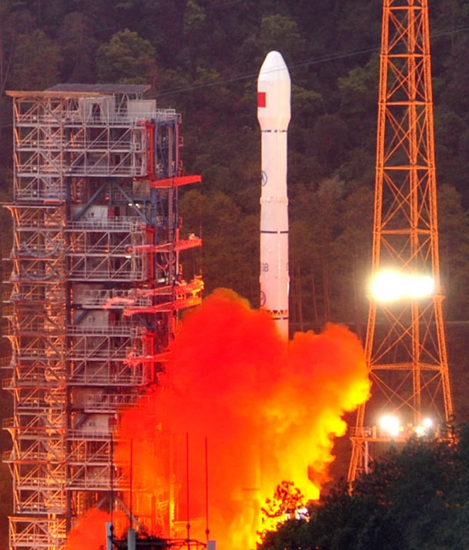
Shijian 13, China’s most advanced communications satellite, is launched at the Xichang Satellite Launch Center in Sichuan Province on Wednesday. [Photo/Xinhua]

A Chinese satellite will not only enable passengers of high-speed trains to watch high-definition videos more smoothly but also help those at the scene of natural disasters report emergencies.

Shijian-13, China’s first high-throughput communications satellite, was launched from Xichang Satellite Launch Center in southwest China’s Sichuan Province at 7:04 p.m. Wednesday.

The satellite, with a transfer capacity of 20 Gbps and a designed orbital life of 15 years, was sent into orbit on a Long March-3B carrier rocket.

The satellite, which has a higher message capacity than the combined capacity of all of China’s previous communications satellites, is capable of providing better Internet access on planes and high-speed trains, as well as in less-developed regions.

While in orbit, the satellite will undergo tests on its broadband multimedia satellite communications system and the high speed laser communication technology between the ground and the satellite.

“The launch is a milestone for China’s communications satellite technology,” said Tian Yulong, chief engineer of the State Administration of Science, Technology and Industry for National Defence.

Different from previous satellites fueled by chemicals, Shijian-13 is the first Chinese satellite to be powered by electricity.

Using electricity as propellant could potentially improve efficiency by as much as 10 times compared with those that use chemicals as a propellant, said Zhou Zhicheng, commander in chief of Shijian-13 satellite system, adding that it can also help extend satellite life and reduce launch weight significantly.

For the first time, a large number of domestic components have been used on the communications satellite. It is also the first time a laser communications system has been installed on a Chinese high orbit satellite with a long lifespan.

The satellite and the rocket were designed by academies affiliated with the China Aerospace Science and Technology Corp., and the China Academy of Launch Vehicle Technology respectively.

It was the 246th flight mission by a Long March carrier rocket.


China customs in mammoth ivory tusk bust

Customs authorities in northeast China’s Heilongjiang Province said Wednesday that they had seized more than 1 tonne of mammoth ivory smuggled from Russia.

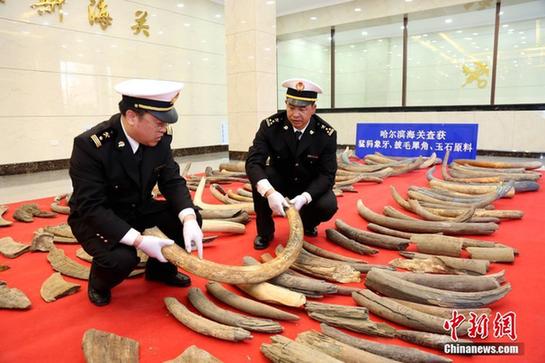
The seized mammoth ivory is fossils of extinct species. [Photo/Chinanews.com]

Luobei customs found 107 mammoth tusks, along with 37 woolly rhino horn parts and 1.11 tonnes of jade in secret compartments in a truck attempting to enter China through Luobei port in mid-February.

The driver of the truck fled after being informed that the truck, which claimed to carry soybeans, needed further examination. He and the owner of the goods were caught in a hotel later that month.

The owner, surnamed Han, had bought the truck and built secret compartments for smuggling. He was accused of smuggling goods under the country’s criminal law.

Russia’s Siberia region is a major source of mammoth tusks, a raw material for ivory-carving, which are usually uncovered by hunters when the tundra snow melts.


China mulls security control on exporting key data

Chinese citizens’ personal information and the country’s important data collected by Internet service providers may need evaluation and permission before being shared with non-domestic entities.

Such information should stay within China and be subject to security assessment before being provided to anyone outside China, according to a draft guideline released Tuesday for public opinion by the Cyberspace Administration of China.

To export personal information the collector must get consent from the individual, the draft says.

For data related to national security, the economy or public interest, such as information on nuclear facilities, armed forces or public health, the collector should coordinate a security evaluation with the authorities.

The evaluation will ensure online data is managed legally, the guideline said.

To make suggestions on the draft, the public can email security@cac.gov.cn before May 11.