China’s workplace safety improves in Q1

China’s workplace accidents and related deaths dropped in the first quarter of 2017 as the government stepped up work safety inspections, official data showed Wednesday.

The number of workplace accidents around China plunged 26.3 percent year on year to 10,131 in the first three months, while the death toll in those accidents dropped 16.6 percent to 7,196, according to a report unveiled at a press conference of the State Administration of Work Safety.

Spokesperson Su Jie said at the press conference that the country has stepped up special work safety inspections around major holidays and in important industries since the beginning of this year.

In the first quarter, authorities ordered 1,092 companies to suspend production or business for rectification, up 22.1 percent from a year ago. A total of 246 companies were shut down, up 138.8 percent year on year.

Of those accidents, 7 were categorized as major accidents, compared with 6 major accidents in the same period last year.

A major accident in China refers to one in which either more than 10 people are killed, more than 50 are injured, or the direct economic loss exceeds 50 million yuan (7.3 million U.S. dollars).

In the second quarter, the country will continue to screen for safety hazards to control the occurrence of major accidents, Su said.

Campaigns will be launched to ensure work safety in major industries, including the mining, chemical, construction and transportation fields, she said.

Efforts should also be made to improve emergency response to floods by coordinating efforts of different departments and timely release forecasts and warnings, according to Su.


China to launch first cargo spacecraft Tianzhou-1

China’s first cargo spacecraft Tianzhou-1 is scheduled for launch at 7:41 p.m. Thursday from the Wenchang Space Launch Center in southern China’s Hainan Province, the office of China’s manned space program said Wednesday.

The cargo spacecraft will be carried into orbit by a Long March-7 Y2 carrier rocket, the office said.

Fuelled by liquid oxygen and kerosene, the medium-sized rocket is able to carry cargo spacecraft and man-made satellites. It made its maiden flight June 2016.

Tianzhou-1 is the first cargo ship independently developed by the country. It is expected to operate in orbit at an altitude of 380 kilometers before docking with the orbiting Tiangong-2 space lab, it said.

The cargo spacecraft will also carry out space experiments, including one on non-Newtonian gravitation, before falling back to earth.

The launch of Tianzhou-1 will mark a crucial step for China in building a space station by 2020.


China to monitor water pollution spending

China unveiled new measures Wednesday to prevent misuse of water pollution funds.

A performance rating framework will be set up to assess whether the money is spent wisely and whether the anti-pollution project is well managed, according to a statement jointly released by the Ministry of Environmental Protection and the Ministry of Finance.

After a comprehensive review on their performance, fund users will be graded on a four-tier rating system, and local authorities will reward the good, and punish the bad, the statement said.

The detailed guideline came as authorities try to rein in the misuse of environmental funds. China’s top auditor has found that 17.6 billion yuan (about 2.56 billion U.S. dollars) of fiscal funds for pollution control and resource management in 2016 were not used effectively.

A total of 397 water protection projects had failed to achieve the desired effect, and some environment funds were not distributed in accordance with special protection plans, according to the National Audit Office.


Beijing under siege by catkins

Beijing under siege by catkins

Willow catkins shroud parked vehicles and a fruit vendor on Huixin Dongjie in Beijing’s Chaoyang district on Monday. [Photo/China Daily] 

The Beijing municipal government is looking at ways to deal with the masses of willow and poplar catkins-pollenating flowers-blowing throughout the city.

Though a small number of the fluffy pods may elicit a romantic mood, too many can cause problems with traffic, street cleaning and allergic people.

To solve the problem, the Beijing Municipal Landscape and Forestry Bureau said it will trim and thin trees, and treat 400,000 willow and poplar trees with chemicals this year to limit their catkin production. It will also replace willow and poplar trees with other kinds of trees to gradually reduce the problem.

In addition, it will use high-pressure water jets to reduce floating catkins and has asked the urban cleaning department to clear away the debris in a timely manner.

According to the bureau, Beijing has 2 million poplar and willow trees, which produce a large number of catkins for about a month every spring.

Shen Guofang, a forestry expert and an academician at the Chinese Academy of Engineering, said catkins cannot be dealt with simply by cutting the trees.

“The ecological benefits from full-grown trees far out-weigh the annoyance caused by catkins,” he said. “If we cut them, the city’s natural environment will be damaged.”

Willows and poplars account for 5.4 percent of the city’s green trees, according to the bureau.

Liu Xiuchen, a consultant for the State Council who has worked in the gardening and landscape industry for decades, said that in the 1950s the government didn’t have enough money to spend on greening in the capital, so the low-cost and fast-growing poplars and willows became the best choice at that time and were widely planted.

Poplars and willows produce catkins as part of their reproduction process. The city government will stop using female poplar and willow trees to limit the number, the bureau said.


Key forum to rally support for Belt and Road Initiative

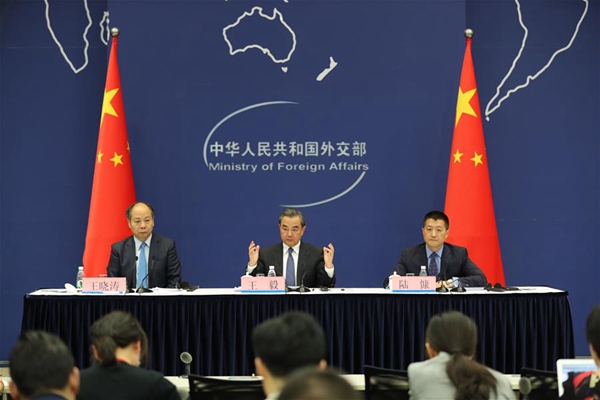
Chinese Foreign Minister Wang Yi (C) and Wang Xiaotao (L), deputy head of the National Development and Reform Commission, attend a press conference on the Belt and Road Forum for International Cooperation in Beijing, capital of China, April 18, 2017. [Photo/Xinhua]


China is counting on an upcoming forum to build support for its Belt and Road Initiative, a Chinese solution to global economic blues.

Next month, the Belt and Road Forum for International Cooperation will convene in Beijing.

The gathering meets an increasingly urgent need for a new cooperation platform that brings countries together to pull the world out of the economic mire and inject fresh energy into interconnected development.

The world experienced the worst economic hardships last year since the global financial crisis, with a 13-percent drop in foreign direct investment and weak trade growth.

“We do not lack the resources or ability to address our problems, but the current fragmented and exclusive international cooperation model makes it difficult to integrate resources,” Chinese Foreign Minister Wang Yi said on Tuesday at a press briefing.

A new platform is needed to explore ways of cementing economic recoveries, creating new growth and improving infrastructure, Wang said.

The two-day forum starting May 14 may go some way to showing that the initiative proposed by China in 2013 can do that job.

The Belt and Road Initiative aims to become a transnational network connecting Asia with Europe and Africa, promoting common development among all countries involved. The meeting is expected to translate the ambitious blueprint into solid progress and turn a new page on the initiative.

Thus far, 28 heads of state and government leaders have confirmed their attendance at the forum. Other delegates include officials, entrepreneurs, financiers and reporters from 110 countries, and representatives of 61 international organizations.

Wang expects the results of the forum to range from consensus building to specific measures on implementation. China expects to sign agreements with around 20 counties and 20 organizations at the event.

Cooperation and win-win development will lie at the core of the forum.

“The Belt and Road has become the most important public good China has provided to the world. It was first proposed by China but now is for all countries to enjoy,” Wang said.

Since 2013, China has invested more than 50 billion U.S. dollars in Belt and Road countries. A total of 56 economic and trade cooperation zones have already been built by Chinese businesses there, generating nearly 1.1 billion dollars in tax revenue and creating 180,000 local jobs.

“China is upbeat about the initiative in boosting mutual development and is willing to channel more energy into it,” Wang said, adding that China’s transformation and opening up will provide more opportunities.

Meanwhile, he called for concerted efforts from counties involved, saying that beneficiaries will in return inject vitality into the regional development in the future.

“We do not need ‘lone heroes’ but partners who pull together in times of trouble,” Wang said. The initiative is not a solo performance.

Wang compared the Belt and Road to “a circle of friends” open to all countries that share the same goals, rather than an exclusive club, saying that China has no intention of drawing geographical boundaries to areas covered by the initiative.

“As long as the spirit of the Belt and Road is recognized… everyone can enjoy its opportunities,” he said.