5,000-yr-old ruins found at SW China construction site

Archaeologists announced Wednesday neolithic ruins dating back 4,500 to 5,000 years had been found in southwest China’s Sichuan Province.

The ruins was found on Ling Mountain in the ancient city of Langzhong last July, when villagers were building a reservoir, said Sun Zhibin, from the Sichuan Provincial Cultural Relics and Archaeology Research Institute.

A team led by Sun excavated the ruins from September 2016 to January 2017.

A total of 108 items were found at the ruins, including porcelain pots and plates, and stone tools, such as axes and spears.

“The discovery has provided new material for the research on cultural blending in the Sichuan Basin and its surrounding culture,” he said.

The discovery, the first ruins dating back to the late neolithic period near the middle reaches of Jialing River, has put back human activity at Langzhong from 3,000 years ago to 4,500 to 5,000 years ago, said Sun.


China seeks breakthroughs in combatting smog

China will increase research on smog in its battle against air pollution in Beijing and surrounding areas.

Government agencies, including environmental protection authority, academies and institutions will work together to integrate resources, according to reports of a State Council executive meeting presided over by Premier Li Keqiang on Wednesday.

Scientists working on anti-smog research may be given extra funding from the central budget.

The work will focus on causes of the heavy seasonal air pollution, emission control and health.

The government hopes to improve air quality and explore transferable pollution control systems for all parts if the country which suffer from smog.

China is addressing air pollution with stricter measures on emissions and an emphasis on clean energy. Minister of Environmental Protection Chen Jining said earlier this week that Chinese cities reported more “good air” days in 2016.


3 investigated for damaging valuable tourist site

Three tourists are being investigated for causing damage to a valuable tourist spot in eastern China’s Jiangxi Province, local authorities said.

The suspects from neighboring Zhejiang Province drill holes in a 128-meter-tall rock on Sanqingshan Mountain, a world natural heritage site, and used ropes to climb to the top of the rock on April 15, according to the site’s administration committee. They also refused to listen to staff guidance at the site.

The rock, known as the “Giant Python of the Mountain,” is of scientific and aesthetic significance after more than 300 million years of geological evolution, but has poor stability and is only 7 meters in diameter at the thinnest part.

Geological experts found that the rock had sustained damage from the tourists’ drilling.

Further investigation is underway.


China’s first home-built aircraft carrier hits the water

Launch ceremony of China’s first home-built aircraft carrier 001A in Dalian, Liaoning Province, on Apr. 26, 2017. [Photo/WeChat]

China launched its second aircraft carrier Wednesday morning in northeast China’s Dalian shipyard in Liaoning Province.

The new carrier, the first domestically-built one, was transferred from dry dock into the water at a launch ceremony that started at about 9 a.m. in Dalian shipyard of the China Shipbuilding Industry Corp.

It is China’s second aircraft carrier, which comes after the Liaoning, a refitted former Soviet Union-made carrier that was put into commission in the Chinese People’s Liberation Army Navy in 2012.


25 Beijing underpasses undergo renovations

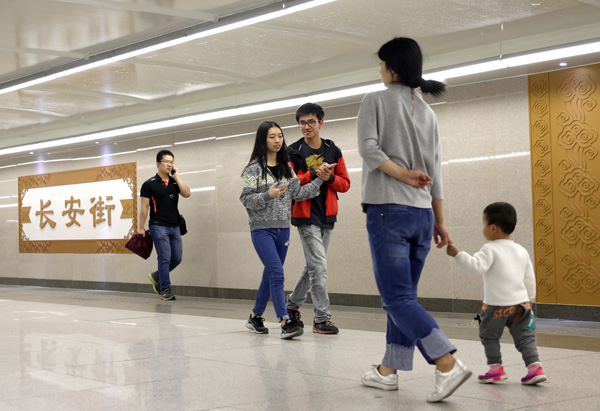
Pedestrians walk through a renovated underground passage under the Xidan section of Chang’an Avenue in Beijing downtown on Saturday. [Photo/China Daily]

Beijing will finish restoring 25 pedestrian underpasses this year along Chang’an Avenue, the capital’s central thoroughfare, to upgrade their function and appearance.

The underpasses, built between the mid-1980s and early ’90s, stretch from Jianguomen on the East Second Ring Road to Fuxingmen on the West Second Ring Road.

The city’s transport authority started the revamp at the end of last year after it was deemed that the outdated pathways failed to fit in with the modern streetscape of Chang’an Avenue.

Work on two underpasses, Xidan West and Tian’anmen West, has been completed, and the other 23 are expected to be restored by the end of this year, the authority said. It did not reveal how much was being spent on the project.

A white marble plaque at the entrance of Xidan West underpass bears its name. In the underpass, a gold-mounted jade plaque with the name Chang’an Avenue is on one side of the marble wall and a golden statue with the design of Xidan Memorial Arch is on the other.

“The goal of our design for those underpasses is to be solemn and dignified,” said Liu Yong, deputy chief engineer at the Beijing Municipal Engineering Professional Design Institute.

He said this project should match the style of the streetscape upgrading work along Chang’an Avenue this year.

Duan Wenzhi, head of engineering at Beijing’s road maintenance and management office, said the 25 underpasses will feature similar decorations, but each will have its own characteristic design that takes in the surrounding landmarks.

In addition, Duan said they also fixed issues such as leaks and upgraded the drainage system.

Some will find the underpasses brighter than before, he added, since they adopted LED lights that are stronger, have a longer service life and save energy.

Tu Gang, a commuter who uses the Xidan West underpass to get to work, said he was happy to see the new look.

“I know the restoration was paid for by the municipal government, which means money from every citizen in the capital, but I think it is worthwhile as long as it can last for at least 100 years,” he said. “Most important, the design of the art should have more cultural and historical meaning and artistic elements.”

Chang’an Avenue runs between Tian’anmen Gate, the entrance to the Palace Museum, and Tian’anmen Square.