Chinese scientists make quantum leap in computing

Chinese scientists have built world’s first quantum computing machine that goes beyond the early classical — or conventional — computers, paving the way to the ultimate realization of quantum computing beating classical computers.

Chinese scientists have built world’s first quantum computing machine that goes beyond the early classical computers. [Photo / chinagate.cn]

Scientists announced their achievement at a press conference in the Shanghai Institute for Advanced Studies of University of Science and Technology of China on Wednesday.

Many scientists believe quantum computing could in some ways dwarf the processing power of today’s supercomputers. The manipulation of multi-particle entanglement is the core of quantum computing technology and has been the focus of international competition in quantum computing research.

Recently, Chinese leading quantum physicist Pan Jianwei, an academician of the Chinese Academy of Sciences and his colleagues — Lu Chaoyang and Zhu Xiaobo, of the University of Science and Technology of China, and Wang Haohua, of Zhejiang University — set two international records in quantum control of the maximal numbers of entangled photonic quantum bits and entangled superconducting quantum bits.

Pan said quantum computers could, in principle, solve certain problems faster than classical computers. Despite substantial progress in the past two decades, building quantum machines that can actually outperform classical computers in some specific tasks — an important milestone termed “quantum supremacy” — remains challenging.

In the quest for quantum supremacy, Boson sampling, an intermediate (that is, non-universal) quantum computer model has received considerable attention, as it requires fewer physical resources than building universal optical quantum computers, Pan said.

Last year, Pan and Lu Chaoyang developed the world’s best single photon source based on semiconductor quantum dots. Now, they are using the high-performance single photon source and electronically programmable photonic circuit to build a multi-photon quantum computing prototype to run the Boson sampling task.

The test results show the sampling rate of this prototype is at least 24,000 times faster than international counterparts, according to Pan’s team.

At the same time, the prototype quantum computing machine is 10 to 100 times faster than the first electronic computer, ENIAC, and the first transistor computer, TRADIC, in running the classical algorithm, Pan said.

It is the first quantum computing machine based on single photons that goes beyond the early classical computer, and ultimately paves the way to a quantum computer that can beat classical computers. This achievement was published online in the latest issue of Nature Photonics this week.


Mini nuclear reactor now ready to be built

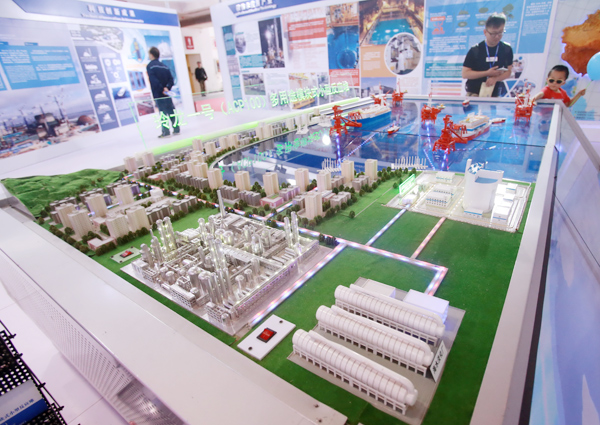
The first pilot project to use China National Nuclear Corporation’s (CNNC) cutting-edge third-generation ACP100 nuclear reactor has completed its preliminary design stage and is qualified for construction in Hainan Province.

Visitors watch the models of ACP 100 nuclear reactor at an expo in Beijing, April 29, 2017. [Photo/China Daily] 

The company said that the ACP100, China’s first small reactor developed by CNNC for practical use, which the company calls the Linglong One, is expected to be built at the end of this year in the Changjiang Li Autonomous County of Hainan.

All research, development and design procedures have been completed, and work will proceed on the feasibility study, soil and water conservation research, environmental impact assessment, construction land geological disaster risk assessment and seismic safety assessment following the issuing of the relevant permits by the end of next month.

Qian Tianlin, general manager of China Nuclear New Energy Investment, said earlier that small-scale nuclear reactor technology has reached a stage at which it can be used on a pilot basis.

It can be used to generate heat for a residential district replacing coal-fired boilers, he said.

According to Qian, small modular reactors are defined by the International Atomic Energy Agency as advanced reactors producing up to 300 megawatts of power that can largely be built in factories and shipped to utilities and end users.

They were widely promoted in the 1990s, thanks to their enhanced level of security and flexible use, including providing heat and sea desalination, he said.

China is highly supportive of small modular reactors, and the company’s Linglong One is the first reactor of its kind in the world to have passed the safety review by the IAEA, a remarkable breakthrough in global small multipurpose modular reactor development.

Qian said he expects mass production of the small modular reactors after the pilot project in Hainan is up and running, and for the technology to be exported globally.

Many countries, including Pakistan, Iran, the United Kingdom, Saudi Arabia, Indonesia, Mongolia, Brazil, Egypt and Canada, have shown a keen interest in potential use of the technology, it said.

Wan Gang, head of the China Institute of Atomic Energy, said small modular reactors are safe amid growing public concern over nuclear safety following the 2011 Fukushima nuclear disaster in Japan.

According to CNNC, compared with million-kilowatt reactor nuclear power plants, the Linglong One features low and controllable core temperatures and is economically superior to other power supply modes and is more environmentally friendly.


Key component of world’s longest cross-sea bridge installed

Key component of world's longest cross-sea bridge installed

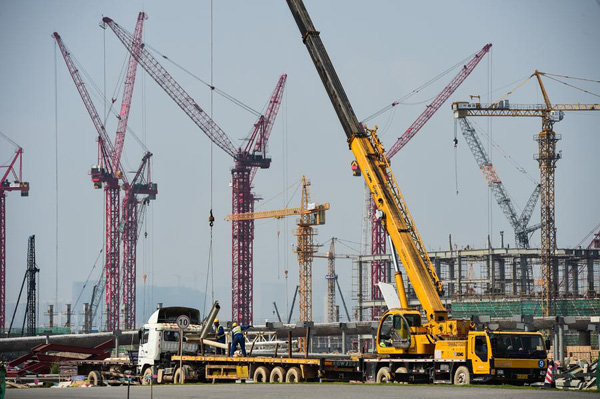
The 55-kilometer bridge connecting Zhuhai in Guangdong province with Hong Kong and Macao is under construction on April 29, 2017. [Photo/Xinhua]

Chinese engineers installed a 6,000-ton key structure of the world’s longest cross-sea bridge linking Hong Kong, Zhuhai and Macao.

The wedge, 12-meter-long and weighing more than 25 Airbus A380 jets, was lowered to connect the immersed tubes of the underground tunnel of the bridge, said Lin Ming, chief engineer of the island and tunnel section of the bridge.

The 55-kilometer bridge connects Zhuhai in Guangdong Province with Hong Kong and Macao. It includes a 22.9-km bridge and 6.7-km underground tunnel.

Before the wedge was installed on Tuesday, 33 immersed tubes, each 180 meters long and weighing 80,000 tons, had been installed.

“There is only one wedge for a tunnel, and we cannot afford to fail in its installation. It took two years to prepare for today,” said Chen Yue, director of the engineers’ office of the bridge’s island and tunnel section. The installation procedure took about six hours.

“The margin of error for the wedge is 1.5 centimeters. We have to measure precisely the influence of wind, current and buoyancy force,” said Lin.

“It is like putting a needle through a hole — a truly unprecedented event in the history of transportation,” Lin said.

A gigantic crane, which was transformed from a tanker, was used to hoist the wedge, lowering it to the desired destination between the underwater tubes.

The wedge will be welded and finished by June, Lin said.

By the end of the year, the bridge will be open to traffic, said Zhu Yongling, director of the bridge management bureau.

Construction began in December of 2009 at Zhuhai. The Y-shaped bridge starts from Lantau Island in Hong Kong with branches to Zhuhai and Macao.

The bridge will cut travel time from Hong Kong to both Zhuhai and Macao from three hours on the road to a 30-minute drive.


New rules will keep patients’ info secret

A nurse at the China-Japan Friendship Hospital cares for an inpatient. [Photo/China Daily]

As more hospitals mine big data to improve services and tackle illnesses, the central government has vowed to safeguard patients’ personal information with a new regulation on h


Central China reports one H7N9 death

A woman died of H7N9 bird flu infection in central China’s Hubei Province, local authorities said Tuesday.

The woman, 68, tested positive for the H7N9 strain of virus on April 27 after days of high fever with no apparent cause, the emergency response office of Wuhan City Government said in a statement.

She died on April 30.

H7N9 is a bird flu strain first reported to have infected humans in China in March 2013. Infections are most likely occur in winter and spring.