China’s coal-rich province to close 18 collieries in 2017

North China’s Shanxi Province will close down 18 collieries and cut 17 million tonnes of coal production capacity this year, local authorities said.

The mines across 11 counties, include nine that produce at least 900,000 tonnes annually, according to the province’s leading group for cutting steel and coal overcapacity.

Last year, Shanxi reduced 23 million tonnes of coal capacity and shut down 25 coal mines.

With a quarter of China’s proven coal reserves, Shanxi aims to limit the number of its mines to 900 by 2020, with an average production capacity of 1.8 million tonnes annually.

Shanxi set its economic growth target at 5.5 percent this year.


China to enhance CPC leadership in cultural organizations

Central authorities have called for enhancement of cultural organizations by the Communist Party of China (CPC) leadership, according to a guideline released Thursday.

The guideline, issued by the general offices of the CPC Central Committee and the State Council, pointed out that overall development of cultural organizations lacks vitality, with some organizations weak in CPC leadership or internal management, and some unclear about their responsibilities.

CPC leadership in cultural organizations should be strengthened and improved, and innovations should be made in management and operation systems to raise efficiency, the guideline stated.

The management system should be under the leadership of the CPC and supervised by the government. Different levels of the system should take different responsibilities and coordinate with each other, the guideline stated.

The system should have a clear structure, efficient services and proper management in order to better serve cultural institutions and workers.

“CPC leadership should be enhanced in political, ideological and organization aspects,” the guideline reads.

As a bridge that connects the Party and the government with the market and society, cultural organizations are responsible for delivering messages from the Party and the government and implementing their decisions.

According to the guideline, cultural organizations are welcome to participate in making regulations, industrial standards and criteria, in talent evaluation, and in providing consulting services.

Cultural organizations should promote entrepreneurship among the people and the transformation of the cultural industry. They should hold more activities such as training, seminars and expositions.

The guideline also said that self-discipline and credibility should be promoted among cultural organizations. Institutions of press, publication and media can set up morality committees, while Internet cultural organizations are encouraged to do their part in cyberspace control and management.

The CPC leadership should cover and be fully displayed in all cultural organizations.

Improvement should be made in fiscal, auditing and asset management systems as well as websites sponsored by cultural organizations and other online media channels, according to the guideline.

Cultural organizations are banned from cooperation with overseas organizations or individuals that endanger national security and interests. Activities held by overseas organizations in China must be managed according to law.

Leaders and cadres of the Party are not allowed to hold posts in cultural organizations before retirement or establish cultural organizations without approval, the guideline stated.


China to enhance CPC leadership in cultural organizations

Central authorities have called for enhancement of cultural organizations by the Communist Party of China (CPC) leadership, according to a guideline released Thursday.

The guideline, issued by the general offices of the CPC Central Committee and the State Council, pointed out that overall development of cultural organizations lacks vitality, with some organizations weak in CPC leadership or internal management, and some unclear about their responsibilities.

CPC leadership in cultural organizations should be strengthened and improved, and innovations should be made in management and operation systems to raise efficiency, the guideline stated.

The management system should be under the leadership of the CPC and supervised by the government. Different levels of the system should take different responsibilities and coordinate with each other, the guideline stated.

The system should have a clear structure, efficient services and proper management in order to better serve cultural institutions and workers.

“CPC leadership should be enhanced in political, ideological and organization aspects,” the guideline reads.

As a bridge that connects the Party and the government with the market and society, cultural organizations are responsible for delivering messages from the Party and the government and implementing their decisions.

According to the guideline, cultural organizations are welcome to participate in making regulations, industrial standards and criteria, in talent evaluation, and in providing consulting services.

Cultural organizations should promote entrepreneurship among the people and the transformation of the cultural industry. They should hold more activities such as training, seminars and expositions.

The guideline also said that self-discipline and credibility should be promoted among cultural organizations. Institutions of press, publication and media can set up morality committees, while Internet cultural organizations are encouraged to do their part in cyberspace control and management.

The CPC leadership should cover and be fully displayed in all cultural organizations.

Improvement should be made in fiscal, auditing and asset management systems as well as websites sponsored by cultural organizations and other online media channels, according to the guideline.

Cultural organizations are banned from cooperation with overseas organizations or individuals that endanger national security and interests. Activities held by overseas organizations in China must be managed according to law.

Leaders and cadres of the Party are not allowed to hold posts in cultural organizations before retirement or establish cultural organizations without approval, the guideline stated.


Chinese nurse’s first aid to Japanese student goes viral

Chinese nurse's response to sick Japanese student goes viral

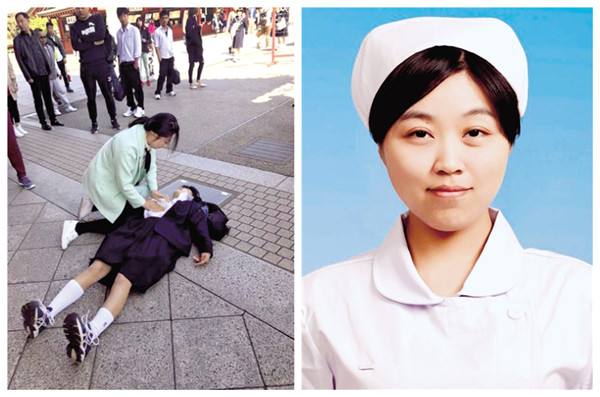
Chinese nurse Ren Shuangshuang. [Photo/Zhengzhou Evening News]

A post about a Chinese nurse who helped a Japanese student has gone viral on Weibo, a Twitter-like social media platform.

During a vacation in Japan, the 28-year-old nurse rushed to aid a Japanese middle-school student who was having an epileptic seizure on April 18, according to media reports.

Ren Shuangshuang works at Henan Cancer Hospital as a surgical nurse. She encountered the Japanese girl when visiting the famous tourist attraction Senso-ji.

“It was very crowded and a girl fainted,” Ren recalled. She immediately approached the girl after the translator for her tour group cried out for help. The girl was twitching and foam was coming out of her mouth. Ren immediately guessed that the girl was having an epileptic seizure.

Ren lay the girl down, unbuttoned her coat and cleaned the foam from around her mouth. She stuffed a wet tissue into the girl’s mouth to prevent her from accidentally biting her tongue. The girl eventually regained awareness and tried to sit up to thank Ren, but the nurse told her to lie back down and rest. An ambulance later arrived to transport the girl to a hospital.

Ren’s actions were recorded by other tourists and uploaded to social media. Her good deed has been widely lauded.

So far, the post has got more than 12,000 comments and nearly 200,000 thumbs-up. “Good girl! That’s what a doctor with good virtues would do. Love has no nationalities,” said one of the comments, which received more than 16,000 thumbs-up.


Star UAV to monitor forest fire

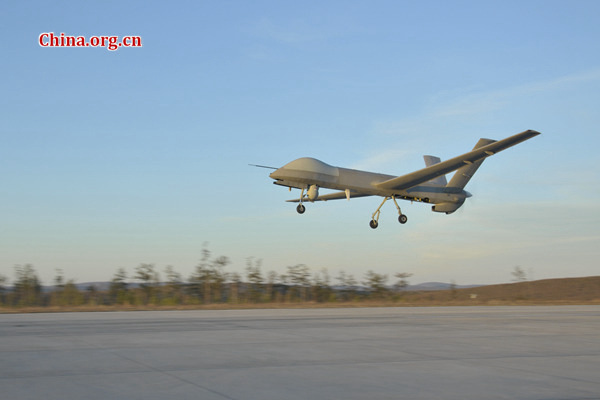
A CH-4 UAV takes off from a regional airport in the Greater Khingan Mountains for forest monitoring on May 10. [Photo provided to China.org.cn]

A CH-4 unmanned aerial vehicle (UAV), also known as a “rainbow drone,” was deployed recently in northeast China’s Greater Khingan Mountains to provide an “eye in the sky” for possible forest fires.

Its deployment followed pressing demands from local forestry authorities for an advanced form of forest monitoring and to provide an early warning in case of fire. It coincided with the 30th anniversary of a major fire in the Greater Khingan Mountains, on May 6, 1987.

Monitoring and surveillance to spot forest fires in the region were traditionally conducted by forest keepers’ visual observation from fixed look-out posts and, occasionally, from a manned aircraft.

Although quite effective, such methods were far from efficient enough and involved too much manpower, said Wu Pengchao, chief of the Tahe Aviation Station in the mountains.

By contrast, a fixed-wing UAV like the CH-4 is a far better solution. Its service ceiling is 7,200 meters. In normal operation, it can hover at an altitude of 4,000 – 5,000 meters and stay airborne for up to 40 hours, meaning one sortie can provide constant surveillance for almost two days during which time ground staff can take a rest in shifts.

The CH-4 is equipped with both visual and infrared sensors to allow it to see day and night.

In particular, its near-infrared sensors allow CH-4 to see through dense smoke and pinpoint the source of any fire, according to Zhou Nai’en, deputy general manager of CH UAV Company, which is affiliated to the China Academy of Aerospace Aerodynamics (CAAA).

“This is something human eyes can never achieve, no matter how many manned planes are mounted,” said Zhou, noting that traditional aerial observation for forest fire was conducted by people looking out through the plane’s portholes with binoculars.

The Tahe aviation station chief said the introduction of the UAV also followed the call from State Forestry Administration to enhance and innovate forest monitoring; the station chose CH-4 out of other homebuilt UAVs because of its superb performance over affordable price.

Forest surveillance is the latest mission to add to the list of civil tasks of rainbow drones whose good performance in overseas anti-terrorism operations has earned them fame as “star UAVs.”

Zhou, a designer for rainbow series drones, maintained that a UAV was a basic platform with the payload deciding whether its mission is military or civil.

Domestically, different types of rainbow drones have shown their strengths in geological exploration and exploitation, disaster area observation and regional communications enhancement. Their roles will soon be expanded to maritime surveillance, according to Zhou.