Chinese president inaugurates Belt and Road forum

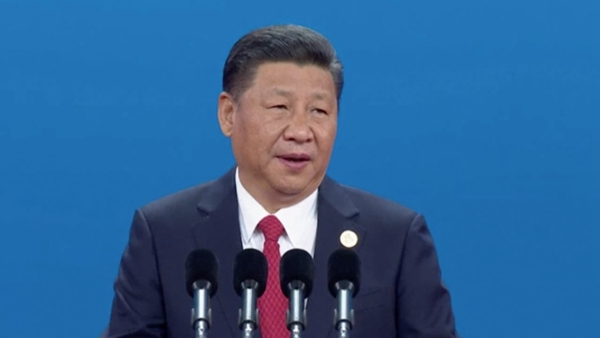
Chinese President Xi Jinping is delivering a keynote speech at the opening ceremony of the Belt and Road Forum for International Cooperation on Sunday morning. [Photo/CGTN]

Chinese President Xi Jinping on Sunday said the Belt and Road Initiative is “a project of the century” that will benefit people across the world.

Xi made the remarks when delivering a keynote speech at the opening ceremony of the two-day Belt and Road Forum for International Cooperation.

Named after the historic Silk Road, the Belt and Road Initiative was proposed by Xi in 2013 to chart out new territories for international cooperation.

“Spanning thousands of miles and years, the ancient silk routes embody the spirit of peace and cooperation, openness and inclusiveness, mutual learning and mutual benefit,” Xi told an audience of more than 1,500 from across the globe.

“The Silk Road spirit has become a great heritage of human civilization,” he said.

A total of 29 foreign heads of state and government leaders attended the forum, including Russian President Vladimir Putin.

Other delegates include officials, entrepreneurs, financiers and journalists from over 130 countries, and representatives of key international organizations, such as UN Secretary-General Antonio Guterres, World Bank President Jim Yong Kim, and Managing Director of the International Monetary Fund Christine Lagarde.

The United States sent a delegation led by Matt Pottinger, special assistant to the president and senior director for Asia at the National Security Council.

By all means, the forum, which also features a round-table summit of global leaders on Monday, is one of the premium gatherings in today’s world, and the most prestigious international assembly China has ever inaugurated.

At the center of its focus is Xi’s grand plan to better combine the rapidly expanding Chinese economy with the development of Asia, Europe and Africa.

Now a catchphrase both domestically and abroad, the Belt and Road Initiative is essentially a new inclusive platform on which countries in Eurasia and beyond can strengthen economic and cultural cooperation to achieve common prosperity.

By linking countries and regions that account for about 60 percent of the world’s population and 30 percent of global GDP, the initiative is a perfect example of China offering its own wisdom and solutions to global governance, said Wang Yiwei, a professor at the School of International Relations at Renmin University of China.

“It features inclusive and sustainable growth and takes into account development needs of different countries and regions for common prosperity,” he said.


Beijing enters Belt and Road time

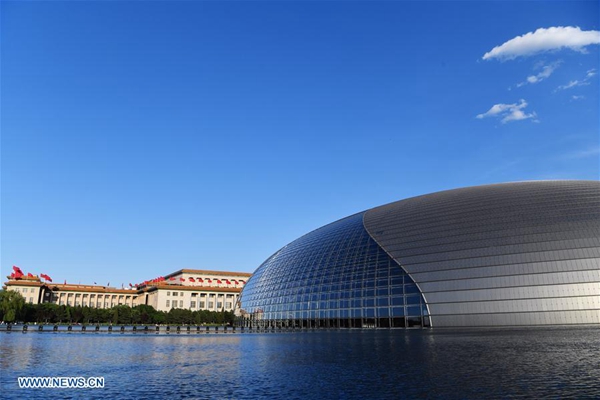
Photo taken on May 13, 2017 shows the National Centre for the Performing Arts and the Great Hall of the People in Beijing, capital of China. The Belt and Road Forum (BRF) for International Cooperation will be held in Beijing from May 14 to 15. (Xinhua/Jin Liangkuai)

The Chinese capital is in Belt and Road time with high hopes that the Belt and Road Forum for International Cooperation means a new dawn for globalization.

A total of 29 heads of state and government leaders are scheduled to be in Beijing for the forum which opens on Sunday. Chinese President Xi Jinping will attend the opening ceremony and deliver a keynote speech. On Monday, he will host a leaders’ round table summit.

The forum is by far the most important meeting on the Belt and Road Initiative since Xi first raised the concept in 2013. It is also the largest-scale and highest-level international meeting initiated by China.

Participants will also include more than 1,500 delegates from over 130 nations; more than 70 international organizations including the United Nations, the International Monetary Fund and the World Bank; representatives of the European Union, France, Germany, Britain, Japan, the Republic of Korea and the United States.

The forum comes at a time when the world is waiting to see a new chapter of globalization which features more inclusive and inter-connected development.

Jose Vinals, chairman of Standard Chartered PLC, praised the “very good timing” of the forum, saying it will do much for communication between governments, business communities and other stakeholders as they develop new strategic cooperation mechanisms.

In an email to Xinhua, Vinals writes of a globalization “under attack and suffering setbacks.” The Belt and Road Initiative, he believes, is the strong support which globalization needs today.

Roads, railways, pipelines and ports will give developing nations and landlocked regions easier access to capital, goods and talent, creating growth opportunities for those who benefited little from the last round of globalization.

The initiative is essentially about balancing the global economy, said Zhang Yansheng of the China Center for International Economic Exchanges.

“While globally we see an overall excess of industrial capacity, liquidity and welfare, many Belt and Road countries face a shortage of those very things,” Zhang told Xinhua in an interview. “Left unsolved, this problem will lead to a widening gap between developed and developing economies.”

The Belt and Road puts priority on infrastructure and connectivity. It means better linking countries to the global trade network and enabling them to bring their comparative advantages to the market.

Improved infrastructure will particularly benefit those economically least developed regions, including Central and South Asia with large infrastructure gaps and difficulties in financing new projects, according to Tianjie He and Louis Kuijs, economists at the Britain-based advisory firm Oxford Economics.

They estimate that Belt and Road countries will contribute 80 percent of global GDP growth by 2050, up from 68 percent last year, with China’s share remaining broadly stable at around 40 percent and that of the rest of Asia doubling to over 30 percent.

Differing from previous models, the globalization actuated by the Belt and Road will be more inclusive. Cooperation will not be subject to restrictive rules nor high thresholds, said Wang Yiwei of the Renmin University of China.

“The Belt and Road Initiative does not force other countries to accept China’s plans and rules, but calls for alignment of development strategies,” he told Xinhua.

Many countries and regions along the Belt and Road have dovetailed the initiative with their own programs, including Mongolia’s Prairie Road, Kazakhstan’s Nurly Zhol (Bright Path), the Russia-led Eurasian Economic Union and the EU’s Junker Investment Plan.

Without predefined rules, the Belt and Road is about learning from doing, about seeking consensus project by project, said Zha Daojiong of Peking University.

Expectations are high: no one will be left behind in the new era of globalization. However, there might be lingering risks of protectionism, financial constraints and regional insecurity.

Zha believes a vibrant economy, blossoming trade, investment, jobs and profits can keep the lid on security risks.

“The Belt and Road Initiative helps people get busy with business, rather than busy with terrorism,” he said.


Flights disrupted by drone at SW China airport

More than 200 flights were disrupted due to an unauthorized drone flying around an airport in southwest China’s Chongqing Municipality Friday evening.

Flights to and from Chongqing Jiangbei International Airport were affected from 7:20 p.m. Order was restored at 9:37 p.m., but 34 minutes later the drone appeared again.

More than 40 flights were forced to land at alternative airports, while over 60 were canceled and another 140 were delayed, affecting over 10,000 passengers.

This was the second time an unauthorized drone has caused disruptions at the airport this week. On Tuesday, 12 flights were forced to land elsewhere.

As privately-owned drones have become increasingly popular in China, several airports have experienced flight disruptions due to illegal drone activity, which poses a threat to aviation safety.

In late April, four drones were illegally flown over Chengdu Shuangliu International Airport in southwest China’s Sichuan Province, which forced 58 flights to land at alternative airports, four flights to return to their departure airport, and more than 10 to be canceled.

Since February, Kunming Changshui International Airport in Yunnan Province has reported at least seven drone disruptions. Local police have launched investigations.


Attentive train station worker saves distressed woman

Weng Jianzhong, a worker at the Xianyou railway station in Putian, Fujian province, was awarded 6,000 yuan for saving a woman trying to kill herself by jumping onto the train tracks as a high-speed train was approaching.

Weng was on duty Wednesday afternoon and noticed the woman was visibly distressed at around 2:50 pm, according to a notice from railway authorities.

When the woman entered the platform after checking her ticket at around 4:50 pm, Weng asked for her carriage number, but she did not answer. As train D6529 approached, the woman ran towards it.

Fortunately, Weng was keeping an eye on her, and rushed to her in time, dragging her back before she could reach the track.

The woman was not hurt, but Weng’s head was injured after falling to the ground while struggling to pull the woman back.

The woman was later taken home by her family members.


City acts after ministry requires tougher measures

Langfang city in Hebei province will redouble its efforts to control air pollution by the end of October, as required by the Ministry of Environmental Protection, local authorities said on Thursday.

The ministry announced last week that it would be supervising the city’s efforts going forward. “We will take stricter measures to shut down or oversee polluting companies that have been identified by the ministry,” said Li Chunyuan, deputy head of the Langfang Environmental Protection Bureau.

The ministry said in a notice on its website on Friday that it will oversee Langfang’s work on air pollution control because the city, which has been haunted by environmental issues in recent years, still has many prominent problems to deal with.

“Some local government officials of Langfang don’t realize the seriousness of the environmental issues and are slow to implement related plans, leading to continuous illegal pollution-discharging activities by clusters of companies,” the notice said.

According to the notice, two counties in Langfang, including Wenan and Dacheng, are facing serious pollution caused by a number of companies making plywood and thermal insulation materials, and processing plastics and nonferrous metals, all of which are polluting.

According to Langfang Daily, 2,290 companies in 20 clusters were identified by the ministry.

Most of the companies emit volatile organic waste without proper processing, it said. They have poor environmental protection facilities, directly discharge waste or disperse it in the open air.

According to Li, all of the companies processing nonferrous metals in Dacheng county have been closed permanently, while some others were temporarily shut down pending improvements.

This is the first time the ministry has stepped in directly to oversee a city’s work on preventing air pollution since earlier last month when it began intensified environmental scrutiny in the Beijing-Tianjin-Hebei region, chinanews.com reported.

Beyond Langfang, the ministry also found clusters of polluting companies – the major environmental issue for the region – in Binzhou and Jining, Shandong province; Cangzhou and Hengshui, Hebei province; Yangquan and Changzhi, Shanxi province; and Zhengzhou, Henan province.

All will be urged by inspection teams designated by the ministry to deal with pollution in a more timely manner.