Beijing promotes culture under B&R Initiative

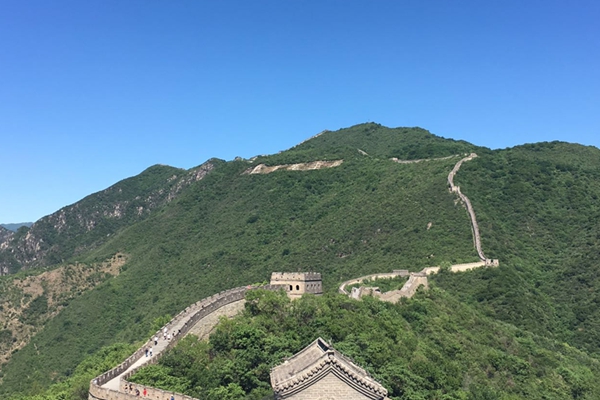
The Mutianyu section of the Great Wall in Huairou, a mountainous district in the north of Beijing, capital of China. [Photo by Cui Can/China.org.cn]

Reporters from home and abroad were invited to visit the International Culture Village of the Great Wall at Mutianyu ahead of the Belt and Road Forum for International Cooperation on May 13, as part of Beijing’s efforts to better demonstrate the capital’s achievements on protecting cultural relics and building beautiful villages.

Attracted by the charm of the Mutianyu Great Wall, lots of foreigners have settled in nearby villages. Located at the foot of the Great Wall, the International Culture Village covers an area of 17.8 square kilometers and consists of four villages—Mutianyu, Beigou, Tianxianyu and Xinying.

The culture village has attracted 30 foreign entrepreneurs to settle down and establish businesses since 2005.

Jim Spear and his Chinese wife Tang Liang run a hotel named “The Brickyard” at the village. Mr. Spear gave an introduction to their design ideas — “enjoy the luxury of simple comfort,” which means getting close to nature and using existing buildings to realize sustainable development.

He also stressed the importance of respecting ancient culture in building new villages. With Spear’s help, local villagers have re-decorated their own houses reflecting a mixture of old and the new, and also East and West. They then rent the houses to foreigners. A unique town with international characteristics has gradually taken shape here.

The Mutianyu Great Wall was built on the ruins of a previous structure from the Northern Qi Dynasty (550-577), becoming a quintessence of the Great Wall developing during the Ming Dynasty (1368-1644). As one of the best-preserved parts of the Great Wall, the Mutianyu section draws masses of tourists attracted by its beautiful scenery and traditional culture. Over 70 percent of visitors come from overseas.

Wang Zhigang, deputy manager of Financial Street Holdings Co.Ltd., delivered a welcome address to visiting reporters, pointing out the importance of the Mutianyu Great Wall in promoting international cultural exchanges, as well as describing efforts to protect ancient cultural relics.

“Under the background of the Belt and Road Initiative, we are going to deepen the historical relic’s development, and to provide a better travel experience for visitors,” he said.

Cyberspace authority warns of ransomware attack

China’s cyberspace authority Monday warned computer users to install and upgrade security software to avoid being hit by the global ransomware attack.

A statement issued by the cybersecurity coordination bureau of the Cyberspace Administration of China said the “WannaCry” ransomware attack, which began to spread worldwide Friday, has affected some enterprises and government offices in China.

Police, authorities in the industry, information technology, education, banking and cyberspace sectors as well as some computer security companies have taken response measures, the statement said.

Media reports have also helped increase public awareness of the virus and contain the spread of the attack, it added.

The authority said this global cyberattack has once again shown the unprecedented internet security challenges, calling on all sectors to address to cybersecurity issues.


China sets up national lab developing brain-like AI technology

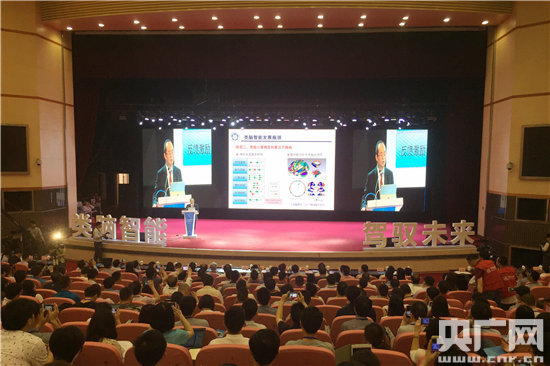
China’s first national laboratory for brain-like artificial intelligence (AI) technology is inaugurated Saturday in Hefei. [Photo/cnr.cn]

China’s first national laboratory for brain-like artificial intelligence (AI) technology was inaugurated Saturday in Hefei, capital of East China’s Anhui Province, to pool the country’s top research talent and boost the technology.

Approved by the National Development and Reform Commission in January, the lab, based in China University of Science and Technology (USTC), aims to develop a brain-like computing paradigm and applications.

The university, known for its leading role in developing quantum communication technology, hosts the national lab in collaboration with a number of the country’s top research bodies such as Fudan University, Shenyang Institute of Automation of the Chinese Academy of Sciences as well as Baidu, operator of China’s biggest online search engine.

Wan Lijun, president of USTC and chairman of the national lab, said the ability to mimic the human brain’s ability in sorting out information will help build a complete AI technology development paradigm.

The lab will carry out research to guide machine learning such as recognizing messages and using visual neural networks to solve problems. It will also focus on developing new applications with technological achievements.


Xi highlights peace, prosperity, opening up of Belt and Road

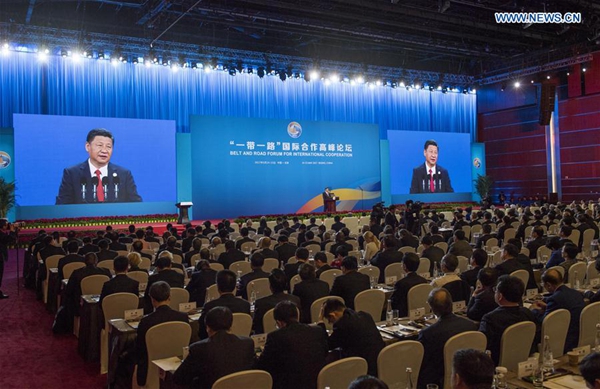
Chinese President Xi Jinping delivers a keynote speech at the opening ceremony of the Belt and Road Forum for International Cooperation in Beijing, capital of China, May 14, 2017. (Xinhua/Li Xueren)

Chinese President Xi Jinping said Sunday the Belt and Road should be built into a road of peace, prosperity, opening up, innovation and connecting different civilizations.

He proposed the five guiding principles for the pursuit of the Belt and Road initiative while delivering a keynote speech at the opening of the two-day Belt and Road Forum for International Cooperation in Beijing.

“The ancient silk routes thrived in times of peace, but lost vigor in times of war. The pursuit of the Belt and Road Initiative requires a peaceful and stable environment,” said Xi.

“We should foster a new type of international relations featuring win-win cooperation; and we should forge partnerships of dialogue with no confrontation and of friendship rather than alliance,” he said.

He called for fostering the vision of common, comprehensive, cooperative and sustainable security, and creating a security environment built and shared by all.

The president urged the Belt and Road to be built into a road of prosperity.

“In pursuing the Belt and Road Initiative, we should focus on the fundamental issue of development, release the growth potential of various countries and achieve economic integration and interconnected development and deliver benefits to all,” he said.

Stressing infrastructure connectivity, Xi called for promoting land, maritime, air and cyberspace connectivity, focusing on key passageways, cities and projects, and connecting networks of highways, railways and sea ports.

He called for joint efforts to improve trans-regional logistics network and promote connectivity of policies, rules and standards so as to provide institutional safeguards for enhancing connectivity.

“We should build an open platform of cooperation and uphold and grow an open world economy,” Xi said.

“We should jointly create an environment that will facilitate opening up and development, establish a fair, equitable and transparent system of international trade and investment rules and boost the orderly flow of production factors, efficient resources allocation and full market integration,” he continued.

China welcomes the efforts made by other countries to grow open economies, participate in global governance and provide public goods, he said.

“Together we can build a broad community of shared interests,” he said.

Xi also underlined the role of innovation in pursuing the initiative.

“We should pursue innovation-driven development and intensify cooperation in frontier areas such as digital economy, artificial intelligence, nanotechnology and quantum computing, and advance the development of big data, clout computing and smart cities so as to turn them into a digital silk road of the 21st century.”

Xi urged efforts to strengthen cooperation in ecological and environmental protection and build a sound ecosystem so as to realize the goals set by the 2030 Agenda for Sustainable Development.

“We should ensure that when it comes to different civilizations, exchange will replace estrangement, mutual learning will replace clashes, and coexistence will replace a sense of superiority,” he said.

Xi called for establishing a multi-tiered mechanism for cultural and people-to-people exchanges, building more cooperation platforms and opening more cooperation channels.

The forum, the highest-level international meeting since Xi proposed the Belt and Road Initiative in 2013, gathers 29 foreign heads of state and government leaders as well as delegates from some 130 countries.


China scales up financing support for B&R Initiative

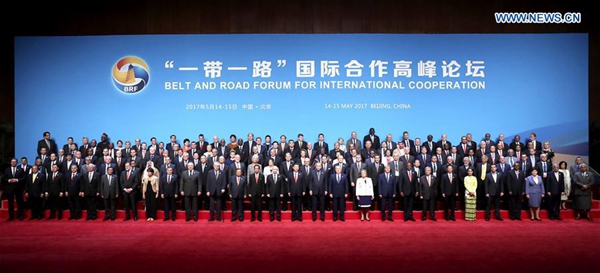
Chinese President Xi Jinping and other delegates attending the Belt and Road Forum (BRF) for International Cooperation pose for a group photo in Beijing, capital of China, May 14, 2017. Xi attended the opening ceremony of the forum and delivered a keynote speech. (Xinhua/Pang Xinglei)

President Xi Jinping said Sunday that China will contribute an additional 100 billion yuan (about US$14.5 billion) to the Silk Road Fund to scale up financing support for the Belt and Road Initiative.

Xi made the announcement when delivering a keynote speech at the opening ceremony of the two-day Belt and Road Forum for International Cooperation.

Designed to finance the Belt and Road Initiative, the Silk Road Fund was officially founded in December 2014 and jointly backed by China’s foreign exchange reserves, the China Investment Corp., the Export-Import Bank of China (China EximBank) and China Development Bank (CDB).

To provide more funding for Belt and Road cooperation, China will also encourage financial institutions to conduct overseas RMB fund business with an estimated amount of about 300 billion yuan, Xi said.

In addition, the CDB and the China EximBank will set up special lending schemes respectively worth 250 billion yuan equivalent and 130 billion yuan equivalent to support Belt and Road cooperation on infrastructure, industrial capacity and financing, he said.

China will also work with the Asian Infrastructure Investment Bank (AIIB), the BRICS New Development Bank, the World Bank and other multilateral development institutions to support Belt and Road related projects, Xi said.

Financing bottleneck is a key challenge to realizing connectivity. China has engaged in multiple forms of financial cooperation with countries and organizations involved in the Belt and Road Initiative.

The AIIB has provided 1.7 billion U.S. dollars of loans for nine projects in Belt and Road participating countries.

The Silk Road Fund has made four billion U.S. dollars of investment, and the 16+1 financial holding company between China and Central and Eastern European countries has been inaugurated.

A multi-tiered Belt and Road financial cooperation network has taken an initial shape, Xi said in the speech.

China will also work with other parties concerned to jointly formulate guidelines for financing the Belt and Road related development projects, he said.

Proposed by Xi in 2013, the Belt and Road Initiative is a grand plan to connect Asia with Europe and Africa along, and beyond, ancient trade routes by putting in place an unparalleled trade and infrastructure network.

So far, the initiative has won support from more than 100 countries and international organizations, of which over 40 have signed cooperation agreements with China.

A total of 29 foreign heads of state and government leaders attended the forum. Other delegates include officials, entrepreneurs, financiers and journalists from over 130 countries, and representatives of key international organizations.