Police detain 203 for online lottery fraud in China

Over 200 people have been caught for their alleged involvement in an online lottery fraud worth 100 million yuan (14.5 million U.S. dollars), police in northwest China’s Shaanxi Province said Tuesday.

Among the 203 arrested, more than 100 will face criminal charges as they were allegedly trained to lure victims in their fake lottery scheme online, said a police officer in the provincial capital Xi’an.

Gang members were asked to develop “clients” via social networking software such as QQ and WeChat as “honey traps,” and lure them to buy lottery tickets by sending them fake winning screenshots and promising them high rate of winning.

Police started investigating the case in January, when a victim surnamed Hong said to have paid a total of 45,000 yuan via Alipay or WeChat for the “lottery investment” via a young woman net friend surnamed Li.

After three months’ investigation, more than 200 policemen made the arrests in three locations on May 5. More than 200 computers and other equipment were also seized.

Since 2015, the gang had made 50 million yuan from transactions worth of more than 100 million yuan, with victims spread across the country.

Further investigation is under way.


Investment in early childhood produces big returns

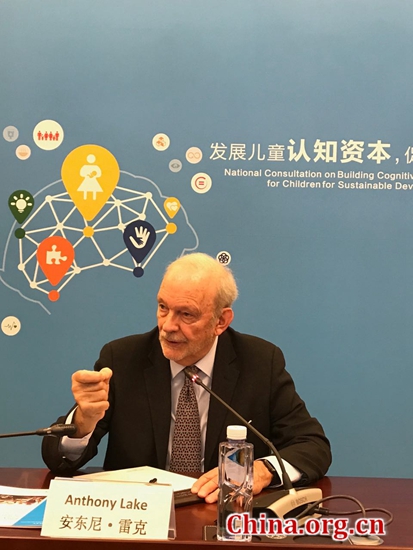
Mr. Anthony Lake, executive director of UNICEF, talks about cognitive capital in Beijing on May 16, 2017. [Photo by Li Xiaohua/China.org.cn]

Investing in high-quality interventions that promote optimal brain development during a child’s formative years not only benefits the individual, but can bring enormous dividends to the future growth and prosperity of a country like China, Mr. Anthony Lake, executive director of UNICEF, declared in Beijing on May 16.

He made these remarks at a media interaction session on the sidelines of a consultation meeting discussing how social and financial investments raising cognitive capital – the capacity of people to think and learn and work together –will help sustain and grow the economies of the future.

Interventions in childhood are proven to have high rates of social, economic, and environmental returns. Statistics from the Copenhagen Consensus Center (2017) show that for every U.S. dollar invested in reducing malnutrition and promoting immunization, the returns are approximately US$45 and US$60, respectively.

Investing in breastfeeding may increase world gross national income by at least 0.49 percent or US$302 billion per year, leading to improvements in IQ, and leave no environmental footprint unlike formula feeding.

Dr. Martin Burt, founder and CEO of Fundación Paraguaya, emphasized raising awareness of the importance of the breastfeeding among mothers. “Mothers face conflicting pressures because of tiredness, nervousness and stress; only if she understands the importance of breastfeeding, will she not give formula bottles to babies,” he noted.

Mr. Lake also stressed the word needed to be spread in the community and among parents to “feed your child well, to play with your child and to protect the child from violence. None of these things cost very much, but all will add greatly to the future ability of the child, for the child to be healthy, to think clearly and to earn more, and that in turn benefits the whole society.

“This is especially important for poor children, because if they don’t get the same care and attention as well off ones, when they grow up, society will be divided by the different cognitive capacities between the poor and the well off,” he added.


73.5 pct of employees receive paid annual leave

About 73.5 percent of surveyed people said that they received paid annual leave, while 21.9 percent people said they did not have paid days off.

The survey, conducted among 1,997 employers, was published in Tuesday’s edition of the China Youth Daily.

According to a regulation on paid annual leave, which was made effective in 2008, employers who work consecutively more than one year should receive paid days off.

In the survey, 64.9 percent of correspondents said that their employers asked them to use their paid annual leave within a year, and if they did not, their paid vacation would expire.

Wen Chenjing, a member of the labor relations research committee of the Shanghai Bar Association, said that there is no legal basis for employers to reset paid annual leave after a year.

National legal annual leave can be spent after a year, while extra vacation allowed by employers could expire in accordance with company regulations, said Wen.

In response to a question about how to implement the regulation on paid annual leave, 42.2 percent of surveyed people hoped to increase supervision and punish violators, and 20.7 percent of people hoped to improve laws and regulations.


Death toll from truck-bus crash rises to 12

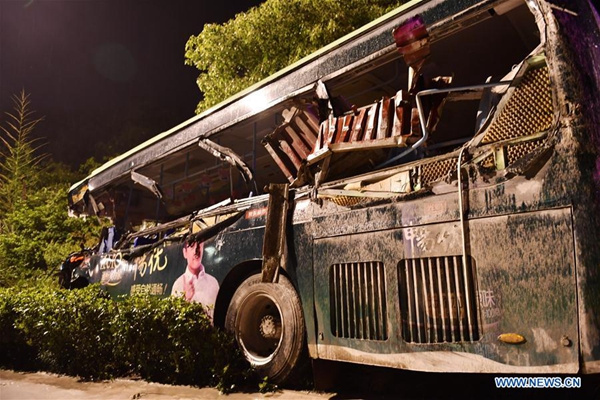
Photo taken on May 15, 2017 shows the wreck of a bus damaged in traffic accident on a national highway in Yingtan City, east China’s Jiangxi Province. [Photo/Xinhua]

The death toll from a truck-bus crash in east China’s Jiangxi Province Monday has risen to 12, local authorities said Tuesday.

Two people, including the bus driver, died at hospital after medical treatment failed. Another six were still being treated.

The accident happened at around 5:25 p.m. Monday on a national highway in Yingtan City when a truck collided head-on with a bus, according to the city’s publicity department. A total of 30 people sustained minor injuries.

The bus was severely damaged.

A video recorded at the site showed passengers standing in rain and a woman screaming to her phone, shouting that “people on the bus are covered in blood” and she “can’t wake them up.”

More than 300 medical workers were involved in the emergency treatment. In addition, more than 120 locals have donated 40,000 ml of blood.

The truck driver has been detained, and an investigation is under way.


Environmental protection projects in border areas

China and other countries are working on cross-border environmental protection along the Belt and Road region.

In the Gaoligong Mountains on the China-Myanmar border, a variety of rare species thrive. China has built national and provincial nature reserves there, while Myanmar has two of its own.

The area is prone to forest fires, logging and poaching, particularly in the Nujiang, Baoshan and Dehong areas in Yunnan Province. Such incidents pose threats to both countries, making cross-border environmental protection vital.

In 2015, China and Myanmar established a research lab on biodiversity, to conduct a variety of projects such as field surveys and training. Both sides work together against illegal activities in the region.

“We often meet colleagues from Myanmar,” said Li Zhengbo, deputy head of the Baoshan management bureau of the Gaoligong Mountains National Nature Reserve. Foresters on both sides have reached agreements on putting out forest fires, investigating criminal cases, and building environmental protection awareness.

From 2010 to 2015, Yunnan apprehended 130,000 suspects in regard to forest and wildlife crime in the region, many with the assistance of Myanmar.

As the Belt and Road increases pace, more joint eco-efforts are underway. Research projects on environmental protection have begun between China and Pakistan on the riverflow, landscape and geological disasters.

“We will try to find mechanisms to decrease risks and improve regional cooperation,” said an expert with the Chinese Academy of Sciences.

“The China-Pakistan Economic Corridor is an important part of the Belt and Road Initiative, and research on environmental protection will definitely play an important part in the construction of the Silk Road Economic Belt and the corridor,” said Lei Jiaqiang, director of the Xinjiang Institute of Ecology and Geography under the Chinese Academy of Sciences.