AlphaGo beats top Go player in first of three games
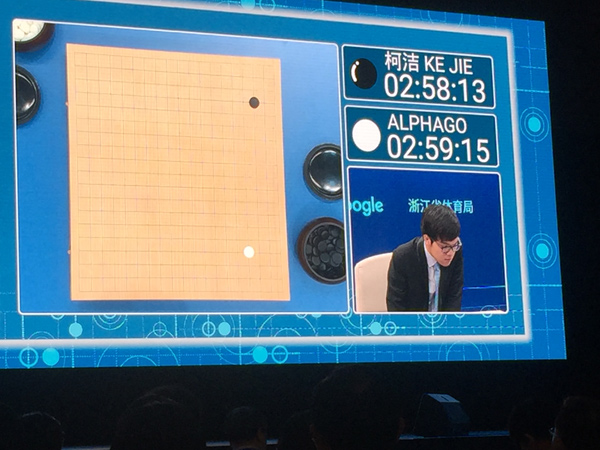
Battle between China's Go champion and computer begins

Ke Jie is playing Go with AlphaGo. [Photo/Chinadaily.com.cn]

Google’s AlphaGo prevailed in the first game out of three against Ke Jie, the world’s No 1 Go player on Tuesday.

The victory seems to further underline that AlphaGo is virtually unbeatable in the ancient board game. Go was previously thought as being beyond the reach of algorithms due to its notorious complexity, but artificial intelligence has made major progress in self-learning.

Ke, who holds multiple world titles, played black in the first game, with AlphaGo taking the white stones. During the competition, Ke looked as if he was feeling a mounting pressure, with strong expressions and fidgeting, when pondering his next moves against AlphaGo.

The competitors will play two more games, one on Thursday and Saturday. The winner of the match will win $1.5 million.

This is the latest showdown between elite human Go players and AlphaGo, which defeated South Korean Go master Lee Se-dol 4-1 at a match in March 2016.


Battle between China’s Go champion and computer begins

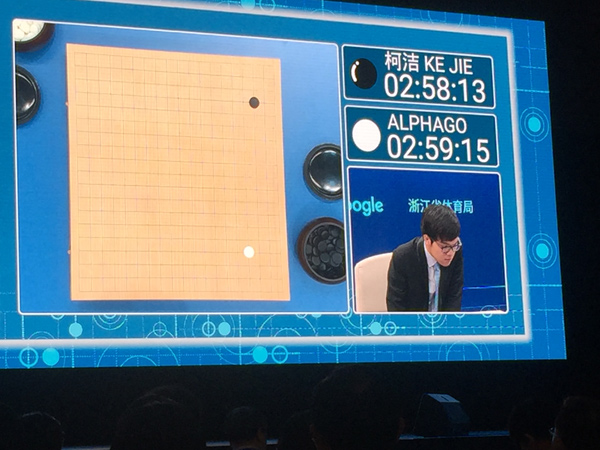
Battle between China's Go champion and computer begins

Ke Jie is playing Go with AlphaGo. [Photo by Ma Si/chinadaily.com.cn]

The final battle between man and machine has begun with the world’s top Go player taking on Google’s AlphaGo.

China’s Ke Jie, 19, has started the first game in a best of three contest against Google’s AlphaGo Tuesday in China, the birth place of the 3,000-year-old board game.

The showdown, in Wuzhen, Zhejiang province is the latest contest between elite human Go players and AlphaGo developed by Google’s DeepMind.

The program defeated South Korean Go master Lee Se-dol 4-1 in March 2016.

On the eve of the much-anticipated game, world-title holder Ke posted on his Weibo account: “No matter win or lose, this will be my final contest with AI”.

“I believe the future belongs to AI for it is leaping forward at a pace far beyond our imagination,” he said.

“But it is still a machine. I can’t feel its love and passion for Go. I will fight against it with all of my enthusiasm. I will never give up,” Ke said.

At the opening ceremony of the contest, Demis Hassabis, chief executive of Google DeepMind, said he hoped the match will help man and machine jointly explore the mysteries of Go together.

“Many Go players come up with new moves they have never thought of before after competing against AlphaGo. Whether man loses or wins, it is a victory for human beings,” he said.


China to form global satellite navigation system by 2020

China will launch some 18 Beidou navigation satellites by 2018, a leading navigation satellite expert said Tuesday.

Six to eight Beidou satellites will be sent into orbit in the second half of this year, said Wang Li, director of the China Satellite Navigation System management office, addressing the eighth China satellite navigation academic annual meeting.

The Beidou satellite navigation system will be able to provide services for countries participating in the Belt and Road Initiative by 2018, Wang said.

By 2020, the Beidou satellites will form a complete global satellite navigation system, Wang added.

The output value of China’s satellite navigation and locating services reached 210 billion yuan (30.5 billion yuan) in 2016, with the Beidou system contributing more than 30 percent of the total value.

The sector is forecast to have about 400 billion yuan in annual output value by 2020.

China started building its own satellite navigation system in 2000 when it sent two orbiters into space as a double-satellite experimental positioning system to end its dependence upon the U.S. GPS system.

Since 2012, Beidou has provided navigation, time and text messaging services in the Asia and Pacific region.


China applies for 23,000 integrated circuit patents since 2008

China has applied for over 23,000 domestic patents on integrated circuits since 2008, an official told a press briefing Tuesday.

Over the last nine years, the country also applied for more than 2,000 international patents on integrated circuits, often known as chips, according to Ye Tianchun, head of the Institute of Microelectronics of Chinese Academy of Sciences (CAS).

In 2008, the State Council, China’s cabinet, approved a major project on integrated circuits.

Since then, more than 30 Chinese-developed devices and products have entered the market, raising some of the country’s tech enterprises to world-leading levels, said Ye.

The project set the country’s business innovation on the right track, as China previously relied heavily on imported integrated circuit products, said Chen Chuanhong, an official at the CAS.

“When our chips thrive, our economy will also prosper,” he added.


Infectious diseases kill 1,306 in China in April

A total of 1,306 people died from infectious diseases on the Chinese mainland in April, according to official data released Tuesday.

Up to 531,302 cases of infectious diseases were reported on the mainland last month, statistics from the National Health and Family Planning Commission showed.

Over 299,000 cases resulting in 1,294 deaths were classified as Class B diseases under China’s Law on the Prevention and Treatment of Infectious Diseases.

Viral hepatitis, tuberculosis, syphilis, gonorrhoea and bacterial and amoebic dysentery accounted for 94 percent of cases in this category.

Category C diseases were responsible for nearly 232,000 cases and 12 deaths. Foot and mouth disease, infectious diarrhea and influenza were the most prevalent in this category, accounting for 94 percent of the cases.